
The Last Underwater Arsenal of America: Why USS Georgia Is Heading into Retirement

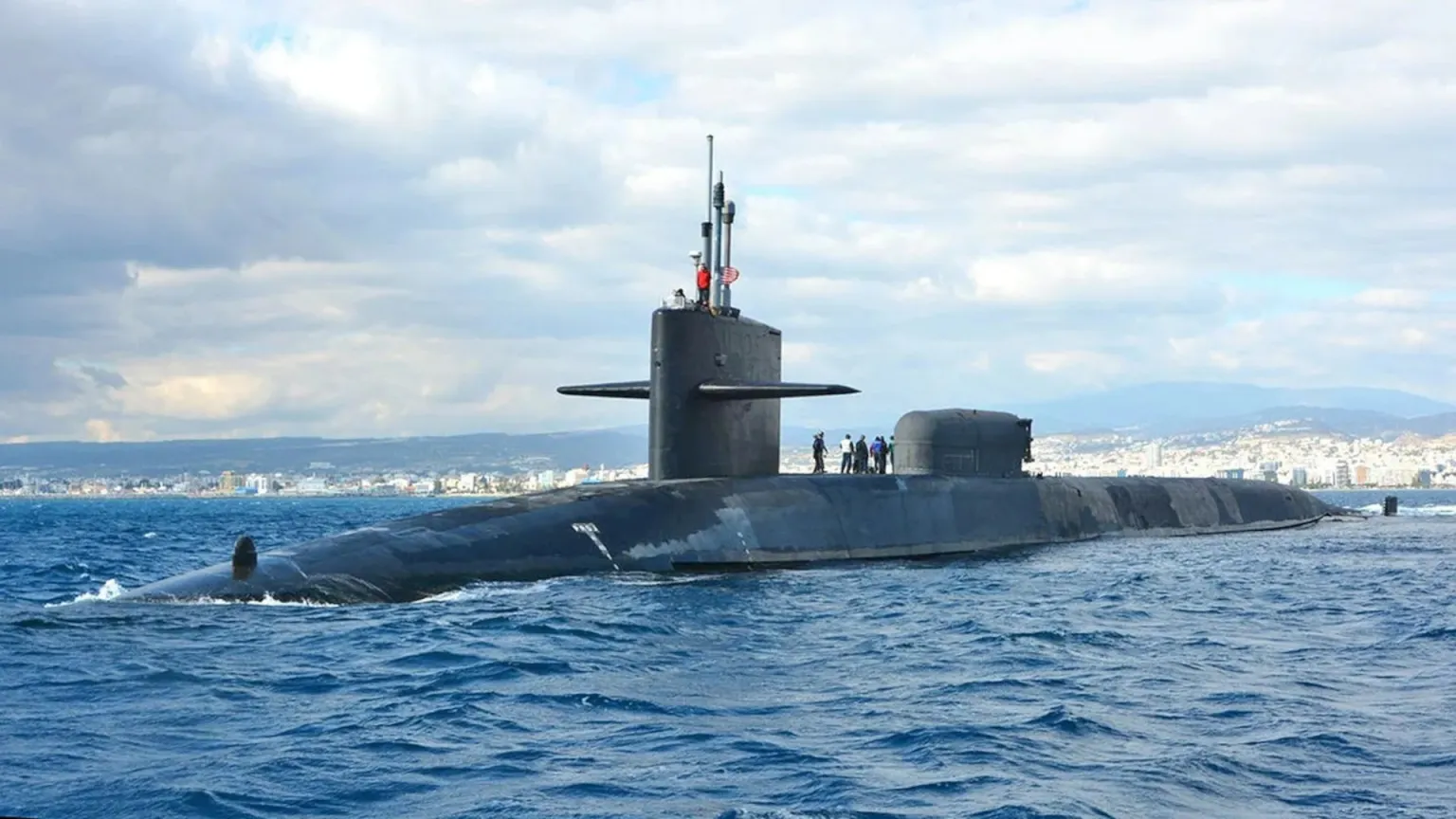
Throughout the history of the U.S. Navy, many submarines have earned legendary status. Some became symbols of nuclear deterrence, others gained fame through intelligence missions or Cold War cat-and-mouse games beneath the oceans.
Yet only a handful combined the firepower of a missile cruiser, the stealth of a special operations platform, and the endurance of a nuclear submarine.
Among them was the USS Georgia (SSGN-729)—one of the four unique Ohio-class guided missile submarines (SSGN). Now, after decades of service, the vessel is preparing to leave the fleet, marking the beginning of the end for what remains the most heavily armed cruise missile submarines ever built.
From Nuclear Deterrent to Tomahawk Arsenal
USS Georgia was never originally intended to be a cruise missile carrier.
Construction began in 1979, and the submarine entered service in February 1984 as a ballistic missile submarine (SSBN) armed with Trident nuclear missiles. Its mission was straightforward: provide a survivable second-strike capability during the Cold War.
Following the collapse of the Soviet Union, however, the United States reassessed its strategic nuclear posture.
With eighteen Ohio-class ballistic missile submarines in service, the Navy no longer required such a large strategic force. Instead of scrapping the oldest boats, the Navy chose a far more ambitious solution—convert four of them into guided missile submarines.
Thus, the USS Ohio, USS Michigan, USS Florida, and USS Georgia became the world’s first purpose-built strategic cruise missile submarines.
The Largest Underwater Missile Arsenal Ever Built
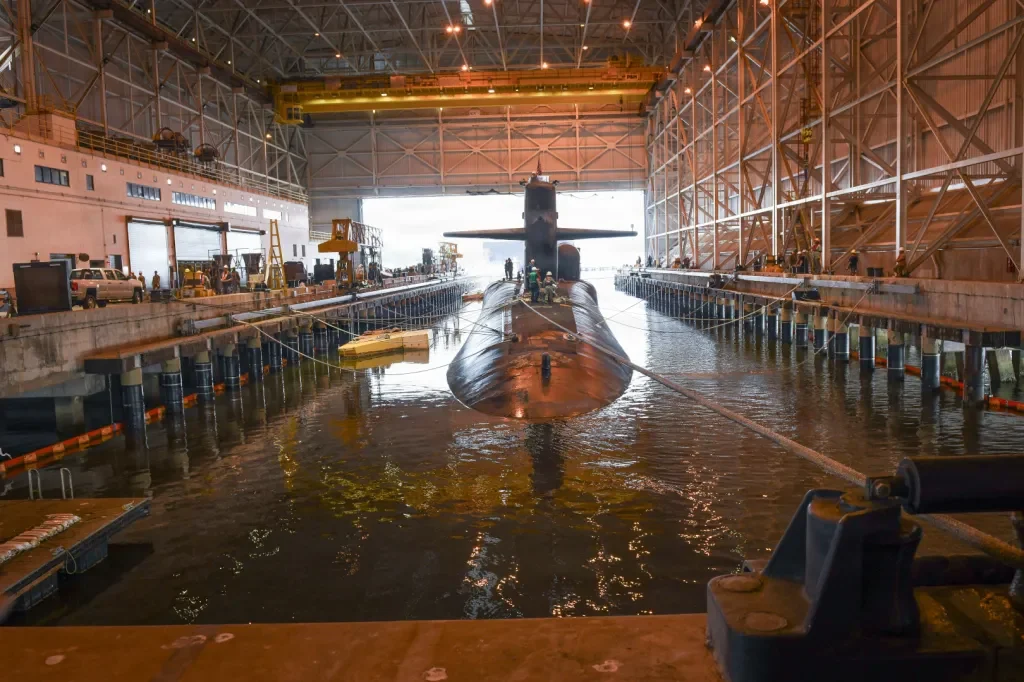
The conversion completely transformed Georgia’s capabilities.
Instead of carrying 24 Trident ballistic missiles, twenty-two launch tubes were redesigned to house Tomahawk cruise missiles.
Each tube could accommodate seven missiles, giving the submarine an astonishing maximum load of 154 BGM-109 Tomahawk cruise missiles.
That single submarine carried more long-range precision strike weapons than the entire surface fleets of many countries.
The remaining two missile tubes were converted into lockout chambers for U.S. Navy SEALs, combat divers, and special operations equipment.
The result was a submarine capable of launching massive precision strikes while simultaneously deploying special forces deep behind enemy lines.
More Than Just a Missile Carrier
The Ohio-class SSGNs became some of the most versatile submarines ever operated by the U.S. Navy.
Their missions included:
- launching large-scale Tomahawk missile strikes;
- covert deployment of Navy SEAL teams;
- supporting underwater drones and special mission equipment;
- serving as command-and-control platforms;
- conducting intelligence and reconnaissance operations.
Few naval platforms have ever combined such a wide range of capabilities within a single hull.
This versatility explains why the SSGNs remained among the Navy’s most valuable assets long after their conversion.
Why USS Georgia Is Being Retired
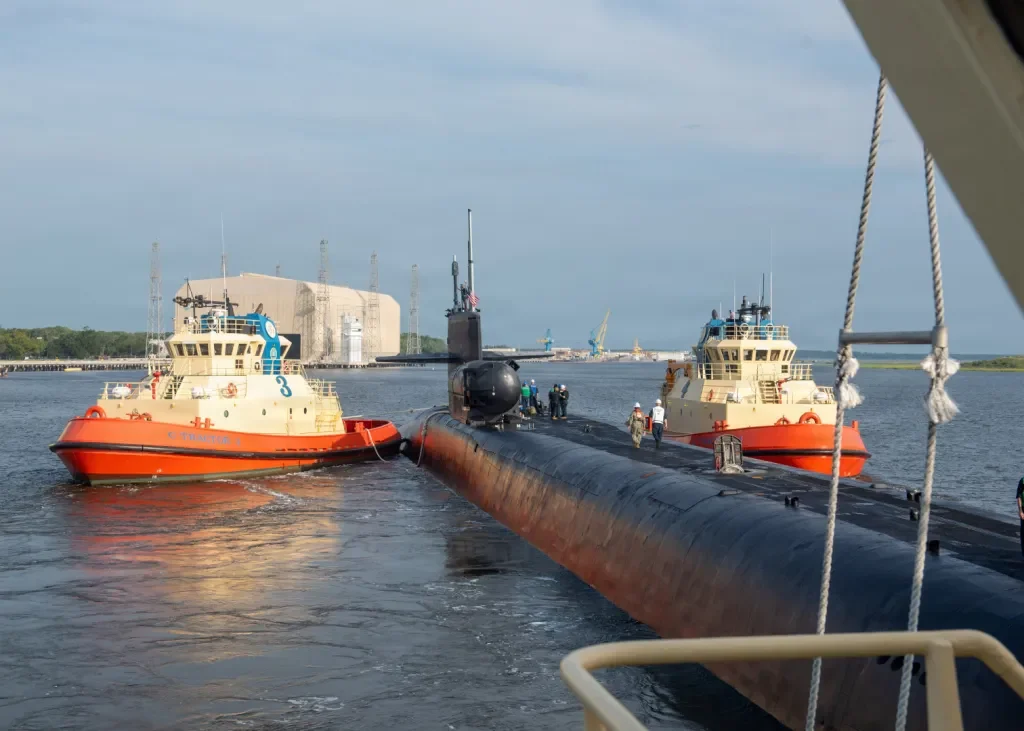
The decision has little to do with combat effectiveness.
Instead, it is a matter of age.
USS Georgia entered service in 1984, making it more than four decades old. Despite extensive refueling and modernization work, both the submarine’s hull and nuclear propulsion system are approaching the limits of their operational lifespan.
The U.S. Navy has therefore begun the gradual retirement of all four Ohio-class SSGNs.
USS Georgia is among the first to leave active service, with the remaining submarines scheduled to follow over the coming years.
Why Replacing the Ohio SSGNs Is So Difficult
The Navy’s replacement plan centers on the Virginia-class Block V attack submarines equipped with the Virginia Payload Module (VPM).
While these submarines represent the latest generation of American undersea warfare, they cannot match the raw missile capacity of the Ohio-class SSGNs.
A single Ohio-class guided missile submarine carries:
- 154 Tomahawk cruise missiles.
A Virginia Block V submarine carries approximately:
- 40 Tomahawk cruise missiles.
In practical terms, one retiring Ohio SSGN delivers roughly the same missile firepower as almost four Virginia-class Block V submarines.
For this reason, many American naval analysts view the retirement of the Ohio SSGNs as one of the most significant reductions in U.S. conventional strike capability in decades.
Compounding the issue, construction of new Virginia-class submarines continues to lag behind planned production rates.
USS Georgia (SSGN-729) Specifications
| Class | Ohio-class SSGN |
| Type | Nuclear-powered guided missile submarine |
| Commissioned | 1984 |
| Converted to SSGN | 2004–2008 |
| Length | 170.7 m (560 ft) |
| Beam | 12.8 m (42 ft) |
| Submerged displacement | Approximately 18,750 tons |
| Reactor | 1 × S8G nuclear reactor |
| Maximum submerged speed | Over 25 knots |
| Operating depth | Over 240 m (official figures remain classified) |
| Crew | Approximately 155 (Blue and Gold crews) |
| Main armament | Up to 154 BGM-109 Tomahawk cruise missiles |
| Torpedo tubes | 4 × 533 mm |
| Special operations capacity | Up to 66 special operations personnel |
The End of an Era
USS Georgia is far more than another aging submarine leaving active service.
It represents an entire philosophy of naval warfare that emerged after the Cold War.
Instead of carrying strategic nuclear weapons, these submarines became stealthy platforms capable of delivering devastating conventional precision strikes anywhere in the world while remaining virtually undetectable beneath the ocean’s surface.
For nearly two decades, the four Ohio-class SSGNs stood as the most heavily armed cruise missile submarines ever built.
Their retirement marks the close of a remarkable chapter in naval history—and leaves the U.S. Navy without a true one-for-one replacement for one of its most unique and formidable underwater weapons systems.






