286 Days Without a Proper Port Call: USS Abraham Lincoln Returned Covered in Rust — and That Is a Bad Sign for the U.S. Navy

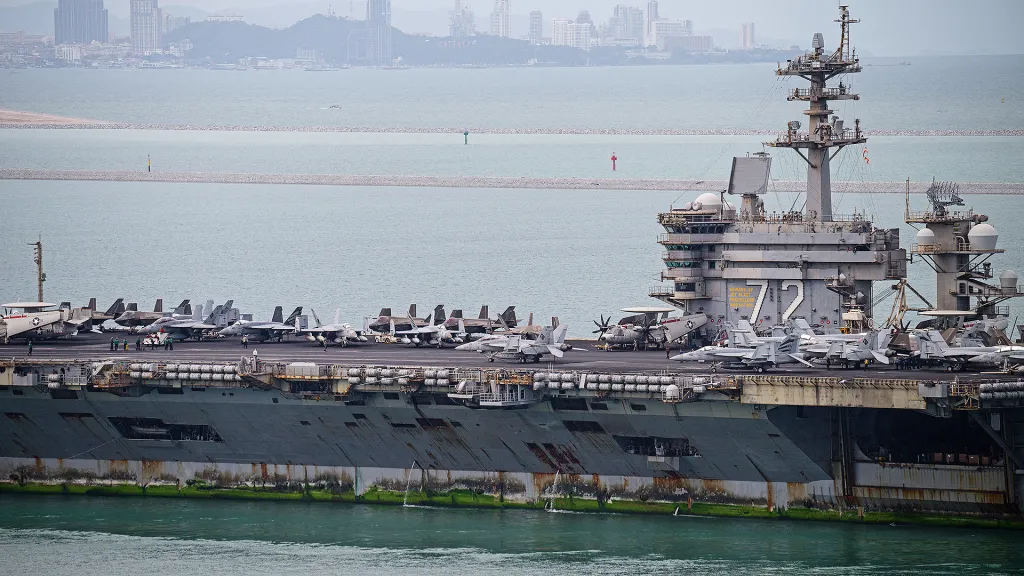
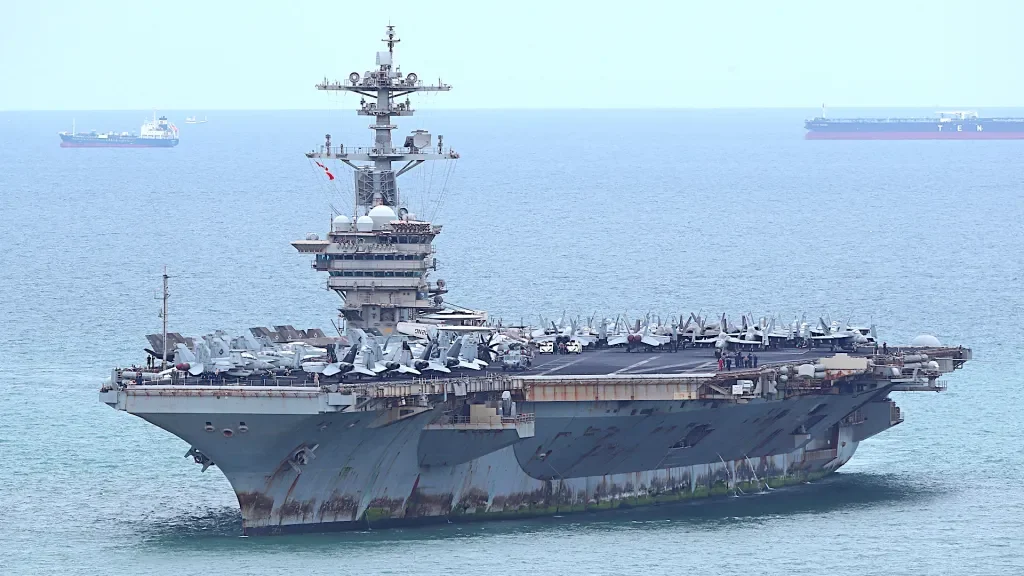
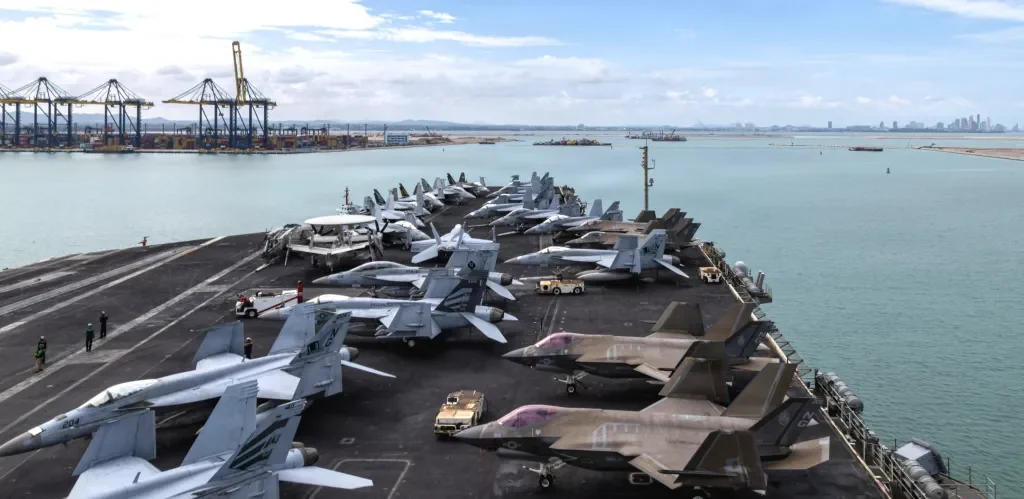
When the nuclear-powered aircraft carrier USS Abraham Lincoln entered Thailand’s Laem Chabang port on September 2, one of the most powerful warships on the planet looked as though it were returning not from a routine deployment, but from a prolonged war of attrition. Its enormous gray hull was streaked with long brown trails. Rust was visible around the sponsons, beneath the edges of the flight deck, and across external structures, while a conspicuous green band of marine growth ran along the waterline. For a roughly 100,000-ton nuclear supercarrier — one of the most recognizable symbols of American military power — the sight was almost embarrassing.
But the photographs of Abraham Lincoln are interesting for a reason that has little to do with claims that the American carrier is somehow “rotting away.” That explanation would be simple, dramatic, and largely wrong. By this point, the ship had been deployed for roughly nine and a half months and had gone 286 days without a proper port visit that allowed its crew normal liberty ashore. There had been brief logistical stops — including Guam in December 2025 and, according to available reporting, another during the summer in the Middle East — but thousands of people had effectively continued living inside the same enormous war machine. What began as a relatively conventional Pacific deployment turned into months of intensive operations in the Middle East. The rust streaking down the carrier’s hull was merely the most visible part of the accumulated wear.
And that is considerably more troubling.
Because Abraham Lincoln did not break down.
Worse: it kept working.
It Is Not Rotting. And That May Be Even Worse
First, it is worth dealing with the most visually dramatic element in the photographs. Those enormous brown streaks do not mean that the carrier’s hull has rusted through or that the ship is about to fall apart. So-called running rust is a familiar sight on warships that spend extended periods at sea. Saltwater is extremely aggressive, protective coatings become damaged, exposed steel begins to corrode, and water carries the corrosion products down the hull, turning relatively localized areas into huge and ugly-looking streaks.
So using Lincoln’s appearance as proof of some catastrophic technical collapse of the U.S. Navy would be misleading. Much of what is visible can be cleaned, treated, and repainted. A carrier’s enormous crew is normally capable of maintaining the ship’s appearance even during lengthy deployments. But there are limits to what can be done at sea, particularly during an exceptionally long deployment in which manpower and resources are focused on sustaining intensive combat operations.
That is why the rust matters not as a technical problem in itself.
It matters as a symptom.
If the only problem facing Abraham Lincoln were the brown stains on its hull, the issue could be solved relatively quickly. The real bill for nine and a half months of operation lies deeper inside the ship and is almost invisible in photographs: machinery operating hours, cycles accumulated by aviation equipment, wear on pumps, generators, cooling systems, electronics, piping, valves, and thousands of other components inside the enormous vessel.
Every one of them has a service life.
And every time maintenance is postponed to gain another month of operational presence, that maintenance requirement does not disappear.
It is simply pushed into the future.
An Aircraft Carrier Is a Factory That Barely Shut Down for Nine Months
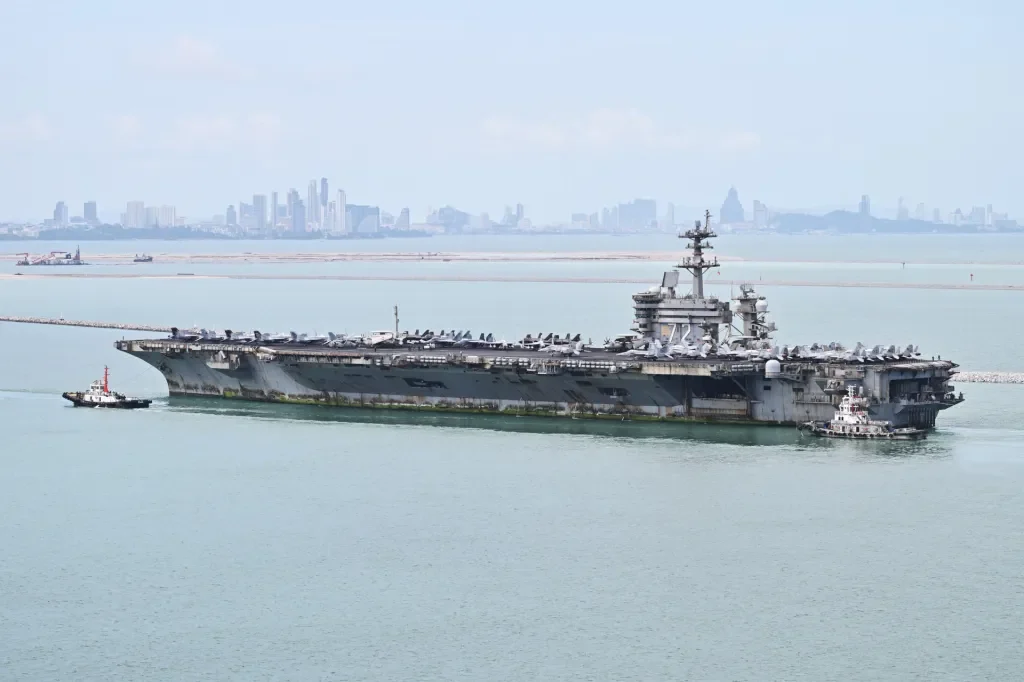
USS Abraham Lincoln left San Diego in November 2025. Its carrier strike group was initially expected to conduct a relatively conventional Pacific deployment, but those plans changed. The ship was redirected to the Middle East, arriving there in January 2026, and from February 28 its strike group participated in the opening strikes against Iran as part of the U.S. Operation Epic Fury, continuing to support subsequent combat operations in the region for months. Only in August was the decision finally made to withdraw the carrier from the region.
It is important to understand what “operating an aircraft carrier” actually means. The enormous ship is not simply moving across the ocean. It is simultaneously a floating airfield, aircraft maintenance base, ammunition depot, fuel complex, power plant, radar node, hospital, and small city. Every combat sortie means preparing an aircraft, inspecting it, fueling it, loading weapons, moving it across the flight deck, launching it, recovering it, inspecting it again, repairing whatever needs attention, and preparing it for another mission. At the same time, the crew must maintain the flight deck, catapults and arresting gear, aircraft and weapons elevators, reactors, electrical systems, cooling equipment, and thousands of compartments.
Then the entire process repeats.
Day after day.
Week after week.
Month after month.
An aircraft carrier therefore does not wear out simply because it is at sea. It wears out because it is an enormous industrial complex operating around the clock in one of the most hostile environments for machinery on Earth.
What is remarkable is how long the U.S. Navy can keep such a factory running.
But that ability creates a trap of its own.
America Learned How to Supply a Carrier Almost Indefinitely. It Did Not Learn How to Make the Carrier Indestructible
Nuclear propulsion has created a persistent myth surrounding modern American aircraft carriers: that they possess almost unlimited endurance. There is some truth to this. Their reactors allow the ships to operate for years without refueling the propulsion plant, while the enormous amount of energy available allows them to maintain high speeds, power complex equipment, and support aviation operations without the traditional fuel limitations of conventionally powered warships.
But only the carrier itself is nuclear-powered.
Its aircraft are not.
Its crew is not.
Its ammunition is not.
Spare parts do not emerge from the reactors either.
This is why an enormous logistics machine exists behind every American carrier strike group, largely invisible from shore. Replenishment ships bring aviation fuel, food, ammunition, spare parts, and countless consumables. This system allowed Abraham Lincoln to continue intensive operations for months without returning to a proper port.
And here we arrive at the paradox.
The U.S. Navy has become so good at sustaining a ship at sea that it has acquired the ability to postpone bringing it home for a very long time.
Which creates the temptation to keep it there a little longer.
Another week.
Another month.
Another operation.
Logistics can keep pushing the limits of endurance farther away.
It cannot abolish those limits.
Eventually, the ship begins borrowing service life from its own future.
Every Extra Month at Sea Eventually Has to Be Repaid at the Pier
Extending a deployment looks extremely attractive on an operational map. The combatant commander keeps an aircraft carrier for another month. The air wing remains available. Political leaders retain the ability to rapidly project force. There is no need to wait for the next carrier strike group to arrive.
But that extra month does not come free.
The longer the ship remains under intensive use, the more work accumulates for its eventual return. Some maintenance can be performed at sea, but a huge range of tasks requires a port, specialized infrastructure, or a shipyard. Aircraft accumulate flight hours. Equipment accumulates operating cycles. The crew accumulates fatigue.
The accounting becomes uncomfortable.
Every additional day of combat availability the Navy gains today may eventually have to be paid for with days that the same ship spends alongside a pier tomorrow.
And the problem is that Abraham Lincoln is becoming increasingly difficult to dismiss as a one-off exception.
USS Gerald R. Ford completed a historic 326-day deployment in May. USS Theodore Roosevelt, preparing for another deployment, could reportedly spend at least eight months away from home. Chief of Naval Operations Adm. Daryl Caudle has publicly spoken about the need to bring deployments back toward a sustainable duration of roughly seven months while still providing combatant commanders with the forces they require.
The most worrying thing about the photographs of Abraham Lincoln is therefore not the rust.
It is that Abraham Lincoln is beginning to look less like an exception.
Keeping One Carrier at Sea Actually Requires Several Carriers
The United States operates the world’s largest fleet of nuclear-powered aircraft carriers, but the headline number creates another illusion. Having roughly a dozen carriers on the naval register does not mean all of them can sail into combat tomorrow.
Aircraft carriers exist within cycles.
One is deployed.
Another is preparing to replace it.
A third has just returned and is rebuilding readiness.
A fourth is undergoing scheduled maintenance.
A fifth may be deep into a years-long refueling and complex overhaul.
A sixth is training its crew and air wing.
Only because these cycles overlap can the United States continuously maintain several carrier strike groups in different parts of the world.
But the system works properly only when the schedule remains reasonably predictable.
If a carrier spends nine, ten, or nearly eleven months deployed instead of seven, the problem does not end with that ship. Its replacement may have to alter its own readiness cycle. Once the first carrier returns, it may require additional maintenance. Preparation for its next deployment can shift. The crew needs recovery time. And somewhere else in the world, another crisis may suddenly generate demand for another carrier strike group.
A vicious cycle can emerge.
To compensate for a shortage of available carriers today, the Navy keeps those already at sea deployed longer. But the longer it uses them today, the harder it becomes to maintain enough available carriers tomorrow.
The strain of exceptionally long deployments can therefore produce cascading effects across routine maintenance, major overhauls, modernization programs, and personnel management.
At that point, the rust-covered side of Abraham Lincoln stops being a photograph of a poorly painted ship.
It becomes a photograph of a much larger systemic problem.
The Carrier’s Most Frightening Limitation Cannot Be Repaired at Sea
There is another limitation that neither nuclear reactors nor replenishment ships can eliminate.
People.
Thousands of sailors and Marines serve aboard the carrier and throughout its strike group. They operate the reactors, maintain aircraft, move weapons, repair electronics, stand watches, prepare food, work on the flight deck, and keep the enormous vessel functioning.
And unlike machinery, human endurance is much more difficult to measure on a maintenance schedule.
By the time Lincoln reached Thailand, its crew had gone 286 days without normal liberty ashore. Brief logistical stops had not given sailors the opportunity for a conventional port visit. In the final weeks before the carrier left the region, the condition of the crew had already become a subject of public discussion, with relatives of sailors raising concerns about morale and psychological strain. Reports also emerged of serious man-overboard incidents. U.S. military leaders disputed some of the most severe characterizations of conditions aboard the ship, so individual incidents should not be treated as proof of the condition of an entire crew numbering in the thousands.
But the fundamental limitation remains.
Aviation fuel can be pumped aboard from a tanker.
Ammunition can be transferred.
Food can be delivered.
A spare component can be replaced.
A damaged aircraft can be moved into the hangar and returned to service.
But no replenishment ship can pull alongside an aircraft carrier and transfer another three months of human endurance aboard.
A nuclear reactor can operate for years without refueling. A crew cannot.
Human beings therefore become one of the ultimate limits on the endurance of a nuclear-powered aircraft carrier.
The Most Uncomfortable Part Begins After the Carrier Comes Home
Eventually, Abraham Lincoln will return home. Its hull will be cleaned. Damaged coatings will be repaired. Rust will be treated and covered again in familiar haze-gray paint. Marine growth will disappear from the waterline. After some time, the nuclear giant will once again look the way one of the principal symbols of American sea power is supposed to look.
But restoring its appearance is considerably easier than restoring the service life already consumed.
After an exceptionally long deployment, equipment has to be serviced, accumulated work completed, aircraft maintained, and the crew allowed to recover. The more often the U.S. Navy is forced to extend deployments, the more this burden begins to spread throughout the wider force.
And this is where the most uncomfortable feature of a carrier-readiness problem emerges.
It can reinforce itself.
A shortage of ready ships encourages longer deployments.
Longer deployments increase subsequent maintenance requirements.
More maintenance reduces the number of ready ships.
Fewer ready ships create pressure to keep the remaining deployed ships at sea longer.
And the cycle repeats.
The American carrier force is still far from a point where it can no longer perform its missions. In fact, Abraham Lincoln’s deployment demonstrates precisely the opposite: the United States possesses the logistics, infrastructure, and technical expertise required to sustain an enormous nuclear carrier and its air wing through nearly ten months of extraordinarily intensive operations.
But that very capability can make the underlying problem easier to ignore.
The system does not suddenly collapse.
It keeps working.
Each successive cycle simply becomes a little more expensive.
The Aircraft Carrier Begins to Consume Its Own Future
That may be the most accurate way to describe what is happening.
Military machines rarely fail in one spectacular moment. More often, they accumulate technical debt. Maintenance is deferred. A scheduled cycle is stretched. A component operates longer than originally intended. A crew remains deployed for another month. The next ship sails sooner. The next maintenance period becomes more difficult.
Individually, none of these decisions necessarily looks catastrophic.
In fact, each one can be perfectly rational.
If a combatant commander needs an aircraft carrier today, it is difficult to explain why that carrier should leave because of a problem that may only become visible six months later.
But when those decisions are repeated, the fleet gradually begins spending tomorrow’s readiness to maintain today’s presence.
That is why Abraham Lincoln’s 286 days are more interesting than a simple record of an unusually long deployment.
Shortly before it, Gerald R. Ford spent 326 days deployed.
The next Theodore Roosevelt is preparing for a deployment expected to last at least eight months.
And the head of the U.S. Navy is publicly discussing the need to restore a more sustainable deployment cycle of roughly seven months.
In other words, the Navy itself understands the problem.
The question is whether the operational environment will allow it to solve it.
The Rust May Be the Cheapest Part of the Bill
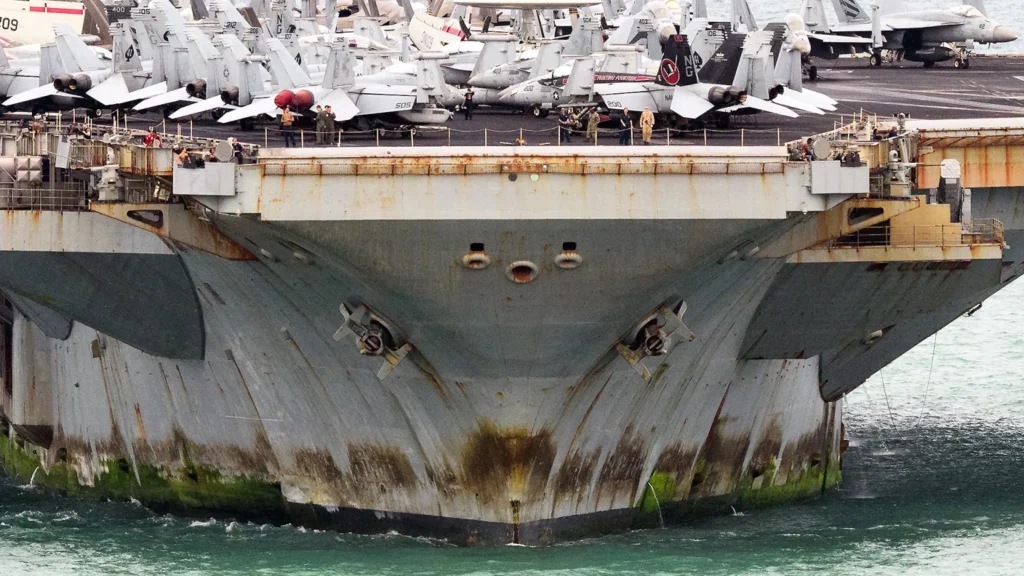
When Abraham Lincoln finally entered Laem Chabang, the most visible consequence of its marathon deployment was the enormous rust streaks covering its hull. Those streaks made the photographs dramatic. They made the story visually irresistible.
And they will probably be the easiest problem to fix.
The ship will be cleaned. Corrosion will be treated. Damaged coatings will be restored. The green band along the waterline will disappear. Before long, the nuclear giant will once again look the way American aircraft carriers usually appear in official photographs.
But a camera cannot photograph the machinery life that has already been consumed.
It cannot show the maintenance work that has accumulated.
It cannot show disrupted schedules.
It cannot show the fatigue of thousands of people.
And it cannot show the next aircraft carrier that may have to deploy earlier or remain at sea longer because the previous one finally has to spend time alongside a pier.
That is why the condition of USS Abraham Lincoln is troubling not because an American aircraft carrier has become covered in rust.
The rust may simply be the cheapest part of the bill the U.S. Navy received for those 286 days.
Nuclear propulsion really does allow an aircraft carrier to operate for years without worrying about fuel for the ship itself. American naval logistics can keep bringing aviation fuel, ammunition, food, and spare parts for months. An enormous crew can continue launching aircraft day after day. On an operational map, the carrier can begin to look almost like an unlimited resource.
The photographs from Thailand are a reminder that it is not.
There is no such thing as an unlimited aircraft carrier.
And if they are used for too long as though there were, eventually the problem will no longer be how much rust has appeared on the hull.
The problem will be how many carriers are still available to send to sea.