
Not Every Drone Can Survive Africa: Why Climate Is Becoming the Chief Designer of Modern Unmanned Aviation

In recent years, Ukraine has widely been regarded as the world’s leading proving ground for the evolution of unmanned aerial systems. It is here that FPV drones, long-range strike UAVs, and coordinated drone swarms have transformed the battlefield and reshaped military thinking.
Yet more and more defense experts are reaching an important conclusion: Ukraine’s experience cannot simply be copied and applied everywhere else.
The reason is surprisingly simple.
War is shaped not only by the enemy.
It is also shaped by the environment.
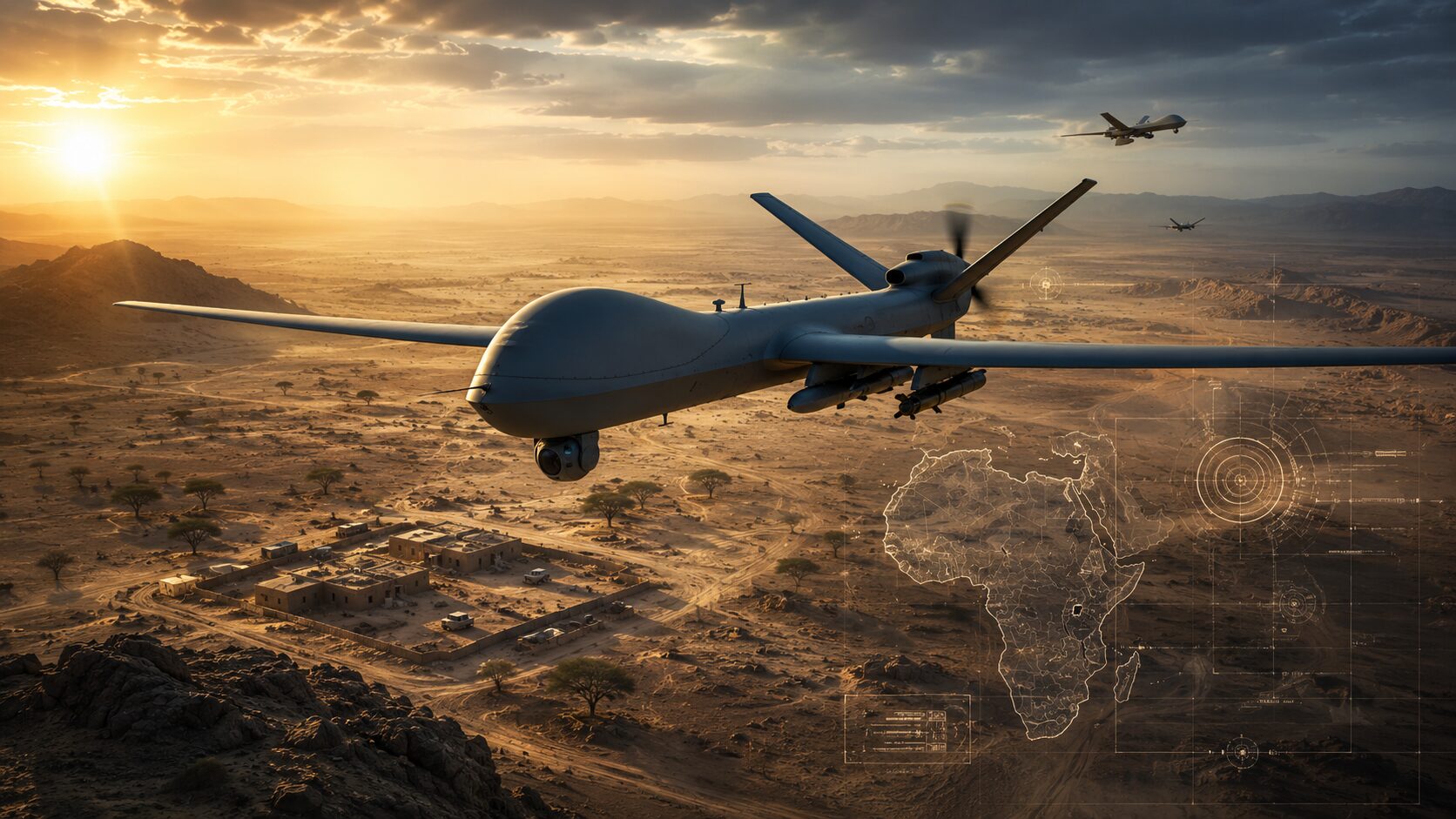
That is precisely the lesson emerging from the growing use of drones across Africa. Analysts argue that the continent’s geography and climate demand completely different technical solutions, and many systems that perform exceptionally well in Eastern Europe would prove far less effective under African conditions.
Why Ukraine and Africa Need Different Drones
At first glance, a drone is just a drone, regardless of where it flies.
In reality, the differences are enormous.
Eastern Europe presents operators with rain, snow, mud, dense vegetation, and a highly developed transportation network for much of the year.
Africa presents an entirely different battlefield.
Extreme heat.
Constant dust.
Fine sand.
Strong crosswinds.
Vast distances between settlements.
Minimal infrastructure.
Every one of these factors changes what engineers expect from an unmanned aircraft.
Increasing range alone is no longer enough.
The aircraft must be capable of operating for weeks in remote regions without access to major airfields or sophisticated maintenance facilities.
Dust Can Be More Dangerous Than Missiles
One of the greatest threats to aviation equipment in Africa is not enemy fire.
It is dust.
Tiny particles penetrate engines, bearings, control mechanisms, cameras, and electronic systems.
Under continuous desert operations, the service life of many components can be reduced dramatically.
As a result, manufacturers are forced to rethink their designs.
More efficient air filtration systems.
Better protection for electronic equipment.
Materials capable of withstanding prolonged exposure to extreme temperatures.
Simplified maintenance procedures.
Consequently, a drone intended for African operations may differ significantly from an outwardly similar aircraft designed for European conditions.
Why Fixed-Wing Aircraft Are Making a Comeback
Another important conclusion concerns the type of drone itself.
While the war in Ukraine has made FPV drones and quadcopters the symbols of modern combat, many specialists believe that Africa increasingly favors fixed-wing unmanned aircraft.
The reason is geography.
Large areas of the continent have limited road infrastructure, while operational distances are often measured in hundreds of kilometers.
Under such conditions, a quadcopter simply lacks the necessary endurance and speed.
A fixed-wing UAV can remain airborne for many hours, monitoring enormous areas and carrying out missions that once required manned aircraft.
When a Drone Replaces a Fighter Jet
For many African nations, there is another important consideration.
Operating a modern fighter force is extraordinarily expensive.
Acquiring advanced combat aircraft requires investments worth billions of dollars, while long-term maintenance often costs just as much.
As a result, long-range drones are increasingly assuming missions traditionally performed by manned aircraft.
Reconnaissance.
Border surveillance.
Persistent patrol.
Detection of armed groups.
Precision strikes against identified targets.
In many situations, this approach provides capabilities that are considerably more affordable than maintaining a fleet of modern fighter aircraft.
The Ability to Repair Matters as Much as Performance
Logistics creates another unique challenge.
Even the most sophisticated drone loses much of its value if replacement parts must travel thousands of kilometers before repairs can begin.
That is why defense planners increasingly emphasize local maintenance capability.
The aircraft must be simple enough that most repairs can be performed in field conditions with limited equipment.
In modern warfare, maintainability is gradually becoming just as important as speed, payload, or range.
The Era of the Universal Drone Is Ending
The evolution of unmanned aviation reveals an important trend.
Only a few years ago, engineers sought to build a single drone capable of performing almost every mission under almost any conditions.
That philosophy is changing.
Today’s unmanned aircraft are increasingly optimized for specific operational environments.
Some are designed for dense urban combat.
Others for forests.
Others for maritime operations.
And still others for deserts and vast open landscapes.
This is why the lessons learned in Ukraine remain enormously valuable—but cannot always be transferred directly to other regions of the world.
The Future Belongs to Specialized Drones
Modern warfare is becoming less universal with every passing year.
Climate.
Terrain.
Logistics.
Industrial capacity.
Economic resources.
All of these factors are beginning to shape drone design just as much as military doctrine itself.
Instead of a single “perfect” drone, the coming decades are likely to produce dozens of specialized aircraft, each optimized for a particular theater of operations.
If the twentieth century taught aerospace engineers how to adapt aircraft to different climates, the twenty-first century is teaching them to do exactly the same thing with unmanned aviation.






