A Wingspan Almost as Large as the B-2, but Only About 14 Meters Long: Why China Built the Giant WZ-X Stealth Drone

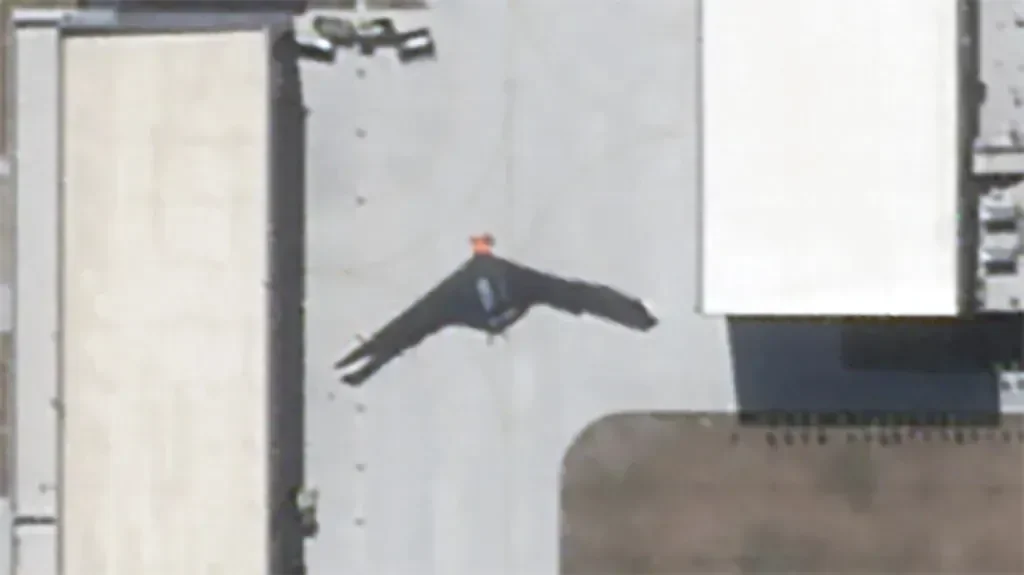
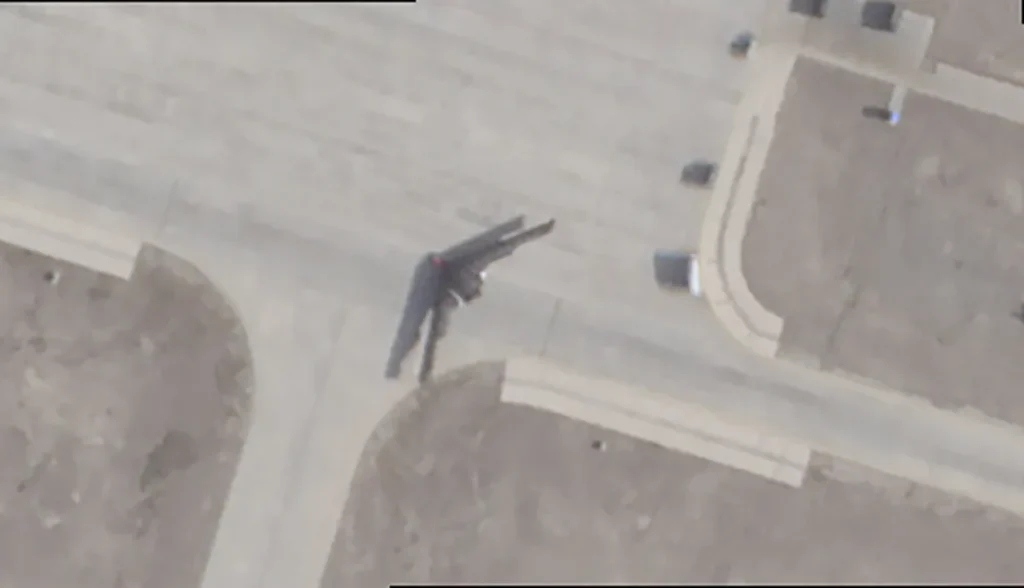
For a long time, China’s WZ-X looked almost like an error in a satellite image. In May 2025, an unusual unmanned aircraft was spotted at the People’s Liberation Army’s secretive test facility near Malan in Xinjiang. Its central section resembled a familiar stealth flying-wing design, but beyond it things became much stranger: enormous, slender wing panels stretched so far outward that the aircraft’s total wingspan was estimated at roughly 170 feet, or 52 meters. For comparison, the American B-2 Spirit has a wingspan of about 52.4 meters. Yet the estimated length of the Chinese aircraft is only around 14 meters. Even in the world of experimental unmanned aviation, those proportions looked extraordinary.
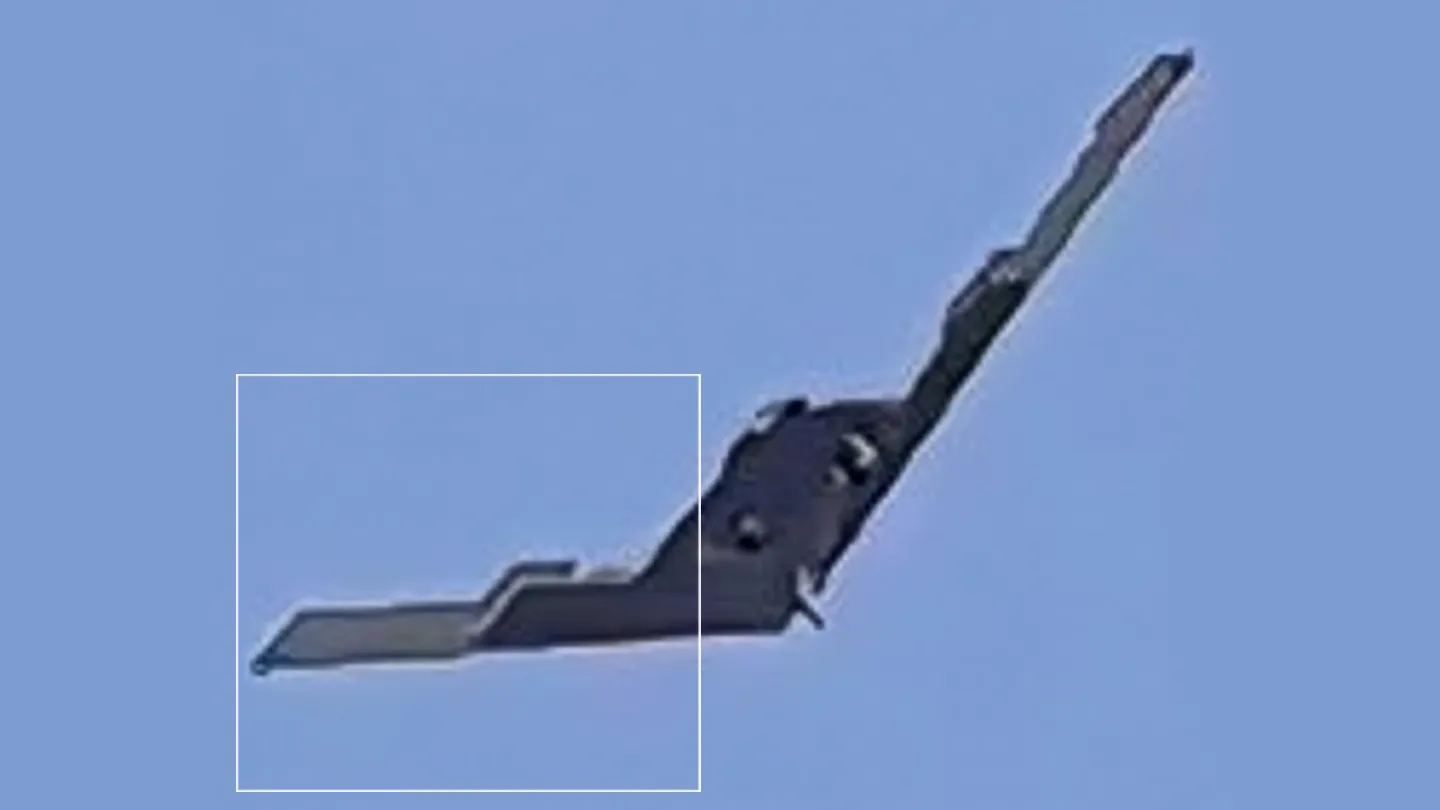
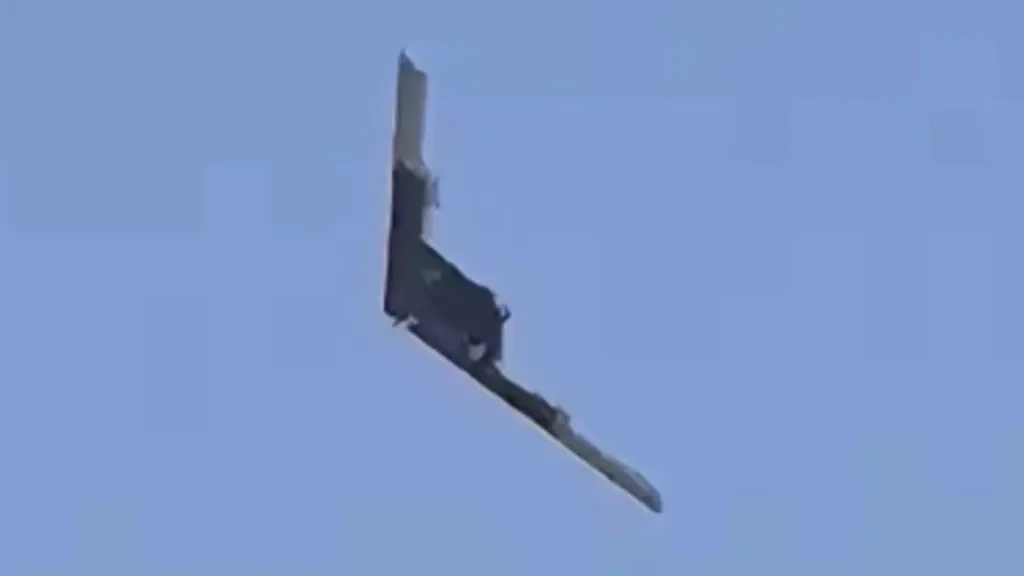
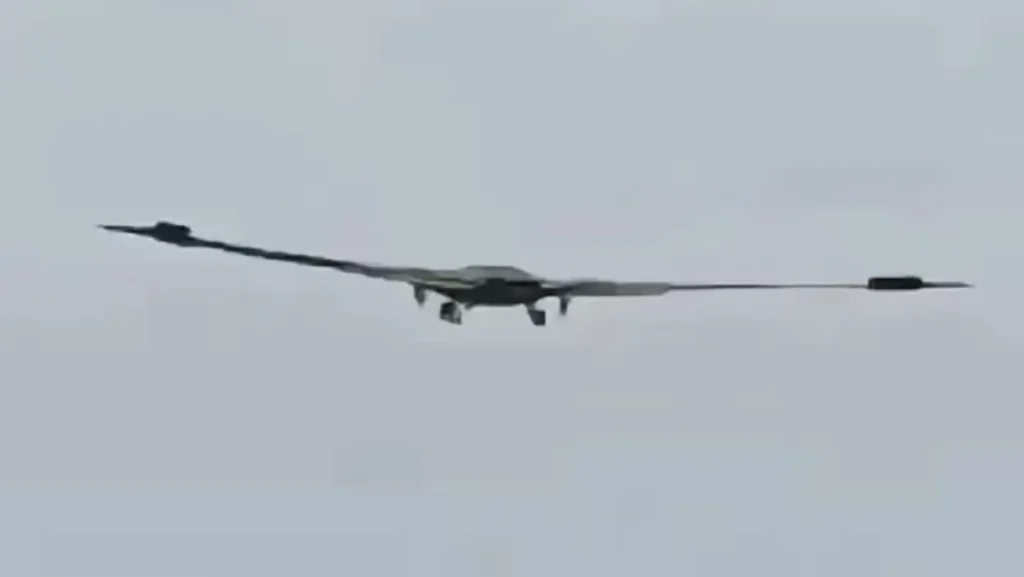
At first, there was a perfectly reasonable question: was the wing really shaped like that? Satellite imagery can create optical artifacts, while some apparent details might have been shadows, ground equipment, or even camouflage. Now, much clearer photographs of the WZ-X in flight, together with new satellite imagery of Malan, have confirmed the most interesting feature. The enormous wing really does have an unusual configuration: the broad inner section transitions rather abruptly into a much narrower outer section, after which a long, slender wing panel extends almost all the way to the tip. This creates a shallow stepped or sawtooth shape along the trailing edge. Split drag-rudder surfaces can also be seen on the outer sections, conceptually reminiscent of those used on the B-2.
But the unusual wing shape itself is less interesting than the question it raises.
Because if Chinese engineers really built an aircraft with these proportions, then we are probably looking at more than just another large stealth drone.
Its design practically announces that it wants to fly very high, very far, and for a very long time.
China Has Built Something Less Like an “Unmanned B-2” and More Like a Giant Stealth Glider
Comparisons between the WZ-X and the B-2 are inevitable because their wingspans are almost identical, but they are also somewhat misleading. The B-2 is a heavy strategic bomber. Its enormous internal volume is required not only for fuel but also for a substantial weapons payload. The aircraft has to combine range, stealth, and the ability to carry heavy ordnance.
The proportions of the WZ-X look different.
Its central section is relatively compact, while its wing is extraordinarily long. Such proportions normally appear when aerodynamic efficiency is a particularly high priority. In general, increasing a wing’s aspect ratio can reduce induced drag and allow it to generate lift more efficiently. That is why long, narrow wings are common on gliders and high-altitude, long-endurance aircraft. The actual aerodynamics of the WZ-X are obviously much more complicated than a simple “longer wing equals longer range” equation, especially when stealth requirements are involved, but the aircraft’s geometry is nevertheless revealing.
This is why Chinese military aviation analyst Andreas Rupprecht has suggested that the WZ-X could be a twin-engine high-altitude aircraft conceptually similar to what the secretive American RQ-180 is generally believed to be. His estimates suggest a normal patrol altitude of roughly 59,000–66,000 feet, or about 18–20 kilometers, and a potential range exceeding 12,000 miles. These figures are not officially confirmed, just as the aircraft’s real designation, manufacturer, engines, and exact mission remain unknown, so they should not be treated as established specifications.
Even without those numbers, however, the architecture supports a more cautious conclusion.
The WZ-X does not appear to have been optimized for high maneuverability.
Nor does it look like an aircraft designed primarily for fighter-like speed.
Its most valuable commodity may instead be time in the air.
And This Is Where a Problem Appears That Global Hawk Solved Long Ago — Except for One Detail
High-altitude, long-endurance unmanned aircraft are nothing new. Their operating logic is well understood: climb into the thin air at high altitude, fly economically for many hours, and use powerful sensors to monitor an enormous area.
Such an aircraft can perform reconnaissance, signals intelligence, communications relay, targeting support, and effectively become a persistent information node in the sky.
The problem with a conventional HALE drone is that aerodynamic efficiency alone does not make it survivable.
A large aircraft with long wings can remain airborne for hours over territory where the enemy cannot threaten it. Against modern integrated air defenses, however, the situation changes completely. An altitude of 18–20 kilometers has long ceased to provide guaranteed protection. A large, radar-visible aircraft can potentially be detected at very long ranges and then engaged by long-range surface-to-air missiles or fighters.
This is where the WZ-X becomes much more interesting than an ordinary high-altitude reconnaissance drone.
Judging by its external configuration, China appears to be trying to obtain the aerodynamic qualities of a HALE aircraft together with at least some of the advantages of a stealth aircraft.
That is a much harder problem than simply building a large flying wing.
Because Stealth and an Extremely Long Wing Do Not Necessarily Like Each Other
A stealth aircraft is an enormous collection of compromises. Its surfaces must be designed to reduce radar reflections in the most threatening directions. Air intakes need to be concealed. Engine compressor faces should ideally be shielded. Exhausts have to be carefully integrated into the airframe. Antennas and sensors cannot simply protrude wherever convenient. Weapons, if carried, usually need to be housed internally.
Even conventional vertical stabilizers become problematic, which is why the most radical stealth designs often become tailless aircraft or flying wings.
And then the designer of the WZ-X adds a wing roughly 52 meters across.
The larger the structure, the more difficult it becomes to control weight, elasticity, and deformation. Long, slender wings flex in flight. Their control surfaces must remain effective, while the structure itself has to withstand aerodynamic loads. At the same time, the geometry still has to remain compatible with low-observable requirements.
This is why the new photograph of the WZ-X is so interesting. It confirms that the strange transition between the inner and outer wing sections is a genuine design feature. It is still impossible to say with confidence why Chinese engineers selected this architecture. Even exotic possibilities such as detachable or folding outer wing sections have been discussed, although the simplest explanation is that this is simply an unusual aerodynamic configuration.
But the result looks as if the engineers deliberately sacrificed the conventional visual purity of a flying wing in order to obtain exceptionally long outer panels.
If so, range and endurance may have been given extremely high priority.
Why Would a Stealth Reconnaissance Aircraft Be Needed if It Is Not Going to Fly Directly Over the Enemy?
This is one of the most important characteristics of modern reconnaissance aviation.
Stealth does not necessarily exist so an aircraft can fly unnoticed directly over a surface-to-air missile battery.
It may simply allow the aircraft to get closer.
Imagine a conventional high-altitude drone that an opponent can reliably detect from a great distance. It has to remain well outside the most dangerous areas. Yet the effectiveness of many sensors is constrained by physics: the farther away the target is, the more difficult it becomes to collect high-quality information.
Reduce the reconnaissance aircraft’s radar signature, and the area in which it can operate with acceptable risk may potentially move closer to the enemy.
Even a few hundred kilometers can matter enormously.
A radar sensor gains a different viewing geometry. Electronic intelligence equipment can receive weaker signals more effectively. Communications links become easier to maintain. The aircraft can look farther beyond the radar horizons of other systems. And if it is operating at an altitude of around 20 kilometers, its own line of sight is enormous.
The formula becomes interesting:
A conventional HALE drone attempts to survive through distance.
A stealth reconnaissance aircraft can attempt to survive through distance plus low observability.
This is one reason the presumed American RQ-180 has attracted so much interest for so many years. If assessments of its mission are broadly correct, such an aircraft would occupy the space between relatively vulnerable high-altitude reconnaissance drones and much more expensive strategic stealth aircraft.
China now appears to be exploring the same niche.
But the WZ-X Could Be Much More Important Than Just Another Reconnaissance Drone
If the aircraft can remain at high altitude for many hours while operating relatively close to potentially hostile airspace, an entire range of missions becomes possible.
The most obvious is electro-optical and radar reconnaissance. A large central airframe provides space for sensors and fuel. A second possibility is signals intelligence: searching for and classifying radars, communications links, and other emitters. A third is acting as a communications relay between aircraft, ships, satellites, and ground forces.
That final role may prove particularly important.
Modern warfare increasingly depends not on a single aircraft or missile, but on the ability to connect many platforms into one system. One aircraft detects a target. Another refines its coordinates. A third transmits the information. A fourth delivers the weapon.
That requires airborne communications nodes.
A protrusion visible on top of the WZ-X in the new photographs may correspond to a satellite communications antenna, although its purpose cannot yet be confirmed. If the aircraft really is intended for prolonged high-altitude missions, SATCOM equipment would be entirely logical.
In that case, the WZ-X should no longer be viewed simply as an airborne “eye.”
It could potentially become a router in the sky.
And This Is Where Its Enormous Size Starts to Make Sense
A large aircraft means a large fuel capacity.
But not only that.
Modern reconnaissance systems require electrical power and cooling. Active electronically scanned array radars, electronic intelligence equipment, powerful computers, and communications systems can place substantial demands on an aircraft’s electrical architecture.
The larger the platform, the greater the opportunity to accommodate fuel, generators, cooling equipment, antennas, and multiple sensor systems.
An unmanned aircraft has another important advantage: there is no need to keep a crew alive. There is no cockpit, no ejection seats, no conventional flight controls for pilots, no crew life-support system, and no limitation imposed by how many hours a human being can physically remain inside the aircraft.
If the aircraft can stay aloft for a day or longer, the limiting factor is no longer the pilot.
It becomes fuel, lubricants, equipment reliability, and mechanical endurance.
This makes an unmanned aircraft particularly well suited to the role of a persistent high-altitude reconnaissance platform.
It may not be a weapon that arrives when the war begins.
It could be part of the infrastructure that remains permanently above the war.
And China Is Not Building Just One Aircraft Like This
This may be more important than the WZ-X itself.
Over the past year and a half, an entire group of unusual unmanned aircraft has been observed at the test facility near Malan. In March 2026, satellite imagery simultaneously captured two enormous low-observable aircraft. Alongside the WZ-X, with its roughly 52-meter wingspan, was another large drone commonly referred to by observers as the GJ-X. It uses a cranked-kite configuration and has an estimated wingspan of around 42 meters. Available evidence indicates that both aircraft have progressed into flight testing.
And they are noticeably different.
The GJ-X has a bulkier central fuselage and shorter span, potentially making it better suited to carrying a substantial internal payload and perhaps to strike missions. The WZ-X, by contrast, appears much more strongly optimized for aerodynamic efficiency and prolonged high-altitude flight.
They are joined by much smaller designs such as the GJ-11 and CH-7, various unmanned combat aircraft concepts, and experimental tailless crewed aircraft including the J-36 and J-XDS. In 2025, the GJ-11 was officially shown flying together with a J-20 fighter and a J-16D electronic warfare aircraft, itself an indication of China’s growing interest in integrating crewed and uncrewed platforms into a common air-combat system.
What is happening at Malan therefore looks increasingly less like the testing of one unusual prototype.
China appears to be exploring an entire family of different flying-wing designs optimized for different missions.
And That May Be the Most Important Conclusion From the New Photographs
For now, very little about the real WZ-X is known with certainty.
Even “WZ-X” is not a confirmed Chinese designation, but a name adopted by outside observers. Its manufacturer is unknown. Its engines are unknown. Its weight is unknown. There are no confirmed figures for range or operational ceiling. We do not know which sensors are installed internally. Nor can we confidently state that the aircraft is specifically intended for strategic reconnaissance; a strike role cannot yet be completely excluded.
But we now know considerably more about its geometry.
And an aircraft’s geometry can sometimes reveal its mission before an official press release ever does.
The WZ-X has the central body of a flying wing, allowing engines, fuel, and equipment to be enclosed within a potentially low-observable shape. It has a wingspan comparable to that of the B-2. It has extraordinarily long and slender outer wing sections, suggesting that aerodynamic efficiency was given unusually high priority. And judging by the available photographs, it is already flying.
Calling it simply a “Chinese unmanned B-2” would therefore be far too easy.
The B-2 was designed primarily to bring weapons to a target without being detected.
The WZ-X may have been designed for a very different purpose:
to bring sensors close to the target without being detected — and then remain there for a very long time.
If that interpretation proves correct, China is not simply developing another reconnaissance drone. It is attempting to combine qualities that traditionally belonged to two largely separate categories of aircraft: the aerodynamic efficiency and persistence of a giant high-altitude reconnaissance platform with the ability of a stealth aircraft to operate closer to modern air defenses.
In that case, the strangest feature of the WZ-X — its enormous, slender wing — is not an exercise in exotic aircraft design.
It may be the key to understanding the entire project.
Because in modern air warfare, sometimes the most important thing is not to be the first aircraft to reach the target, but to be the last one still flying above it.