From Crimea to Afghanistan: The Revolver That Followed the British Empire for Three Decades

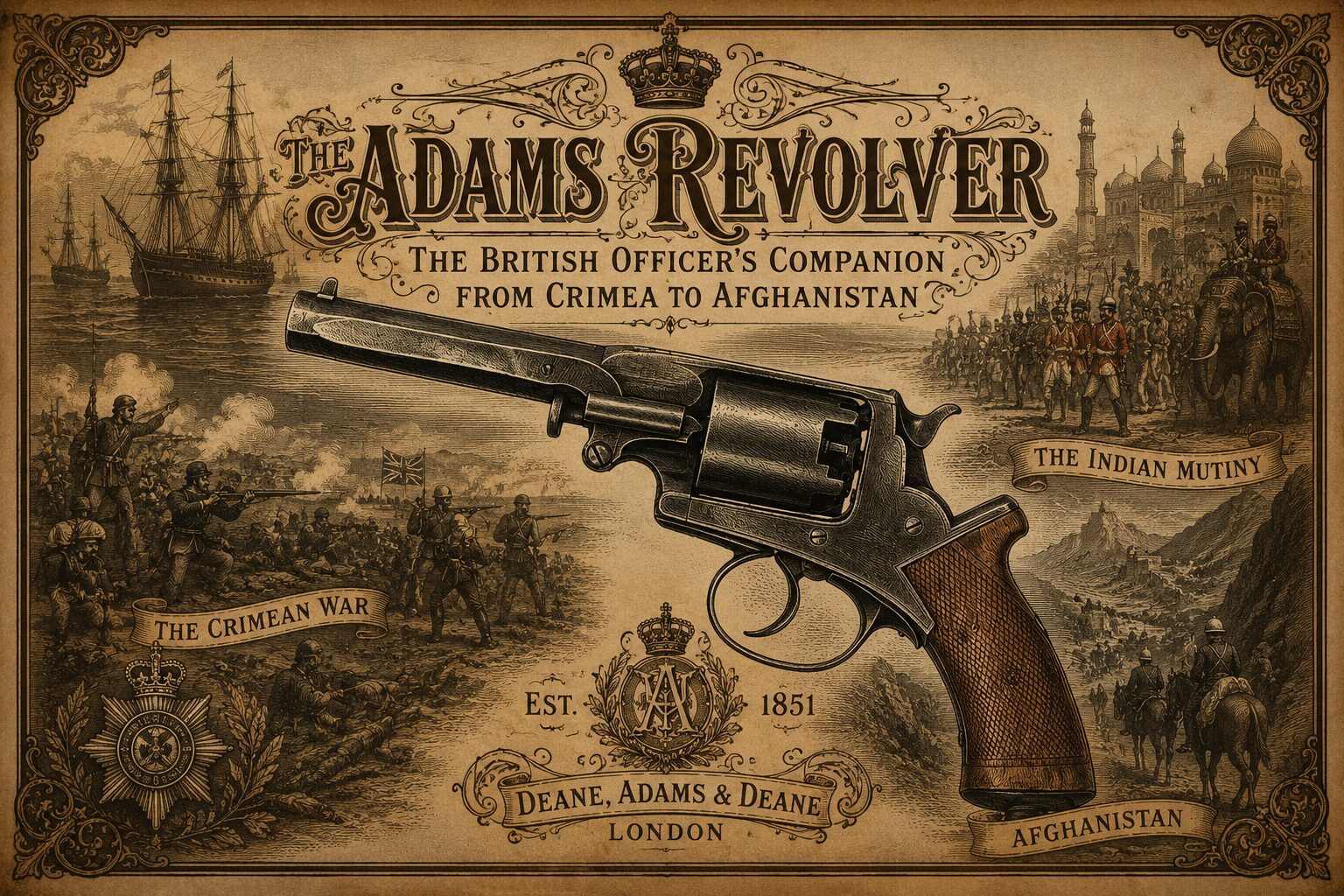
In the nineteenth century, every great power had a weapon that became a symbol of its era. For the United States, it was Colt’s revolver. For the Russian Empire, it was the Berdan rifle. For Victorian Britain, that distinction belonged to the Adams revolver.
It first appeared in the age of percussion firearms, saw its baptism of fire during the Crimean War, survived the Indian Rebellion of 1857, accompanied British expeditions across Africa, and remained in service through the Second Anglo-Afghan War. Over the course of its military career, the revolver evolved from a percussion weapon firing loose powder and lead balls into a cartridge-firing sidearm chambered for metallic ammunition. Yet British officers continued to carry weapons bearing the Adams name long after the man who created the original design had passed away.
The story of the Adams revolver is not only one of technological innovation but also of fierce competition with Colt and the expansion of the British Empire itself.
Britain’s Answer to Colt

By the early 1850s, the name of American inventor Samuel Colt was already famous on both sides of the Atlantic. His revolvers were selling around the world, and Colt was determined to establish himself in Britain by securing lucrative government contracts.
At precisely that moment, however, another designer proposed a radically different vision of what a military revolver should be.
That man was Robert Adams.
Interestingly, Adams was not originally a professional gunsmith. While working for the London firearms company George & John Deane, he handled business operations while quietly developing his own firearm designs.
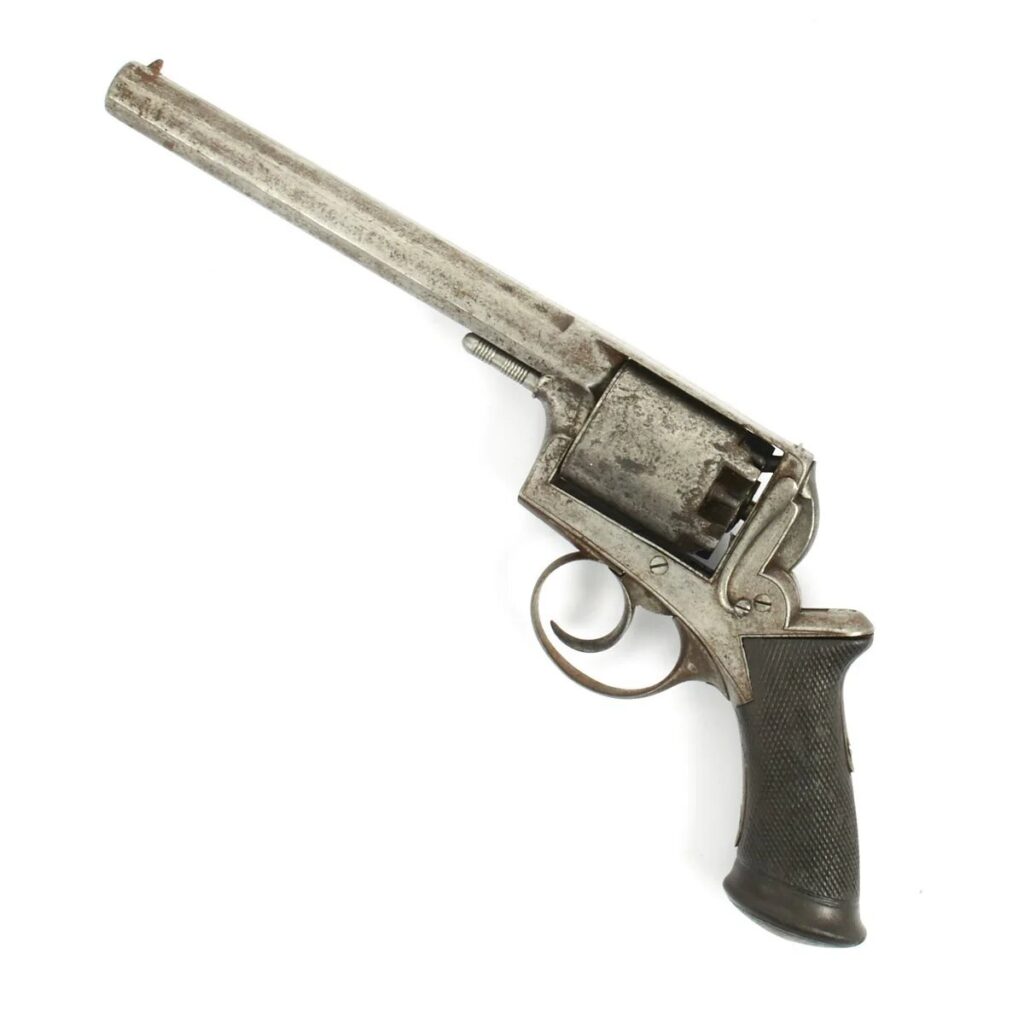
In 1851, he patented a revolver that departed dramatically from Colt’s philosophy.
Where Colt’s revolvers featured an open-top frame and a single-action mechanism that required the hammer to be manually cocked before every shot, Adams introduced a solid-frame revolver with a double-action-only trigger mechanism.
For an officer suddenly thrown into close combat, the advantage was obvious: instead of cocking the hammer before every shot, he simply had to keep pulling the trigger.
In battle, that difference could mean the difference between life and death.
The Great Exhibition Where Britain Defeated America
That same year, London hosted the Great Exhibition of 1851.
Samuel Colt arrived with an enormous display, hoping to impress both the British public and military officials.
Instead, the unexpected star of the exhibition became Robert Adams.
His revolver received one of the exhibition’s awards and attracted considerable attention from British Army officers.
Colt refused to concede defeat. The following year, he opened a factory in London and secured substantial contracts to supply revolvers to both the British Army and Royal Navy.
Yet military trials conducted at the Woolwich Arsenal gradually shifted official opinion.
The Adams revolver proved quicker to operate, more reliable, and demonstrated superior practical rate of fire.
Even its lack of a built-in loading lever was not considered a serious disadvantage, as the early conical bullets could simply be pressed into the chambers by hand.
Ultimately, the British market made its choice.
By 1856, Colt’s London factory had closed its doors.
The Crimean War Settled the Argument
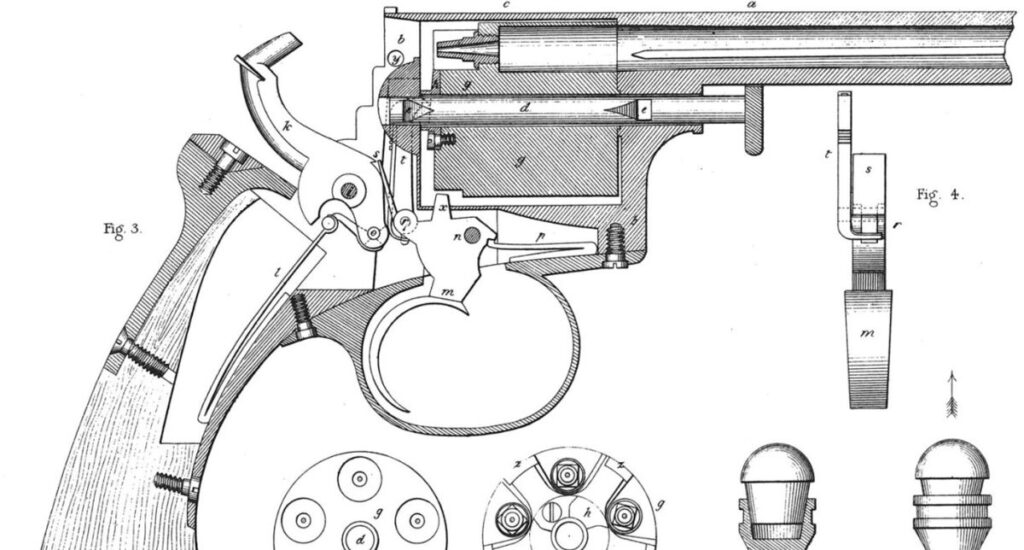
The true test of the Adams design came during the Crimean War.
It was there that Adams revolvers first saw large-scale combat in the hands of British officers.
One of the most famous accounts comes from Captain Joshua Cross, who fought during the Battle of Inkerman.
During an intense hand-to-hand engagement, he was attacked by several Russian soldiers simultaneously.
Later, Cross wrote directly to Robert Adams, explaining that he had survived only because of the revolver’s self-cocking mechanism. Had he been forced to cock the hammer before every shot—as with a Colt revolver—he believed he would have been killed. Instead, he managed to shoot four attackers before receiving a bayonet wound to the thigh.
Accounts like this rapidly established the Adams revolver’s reputation among British officers.
Experience had demonstrated that rapid fire in close combat was often more valuable than a light trigger pull.
Why the British Preferred Big-Bore Revolvers
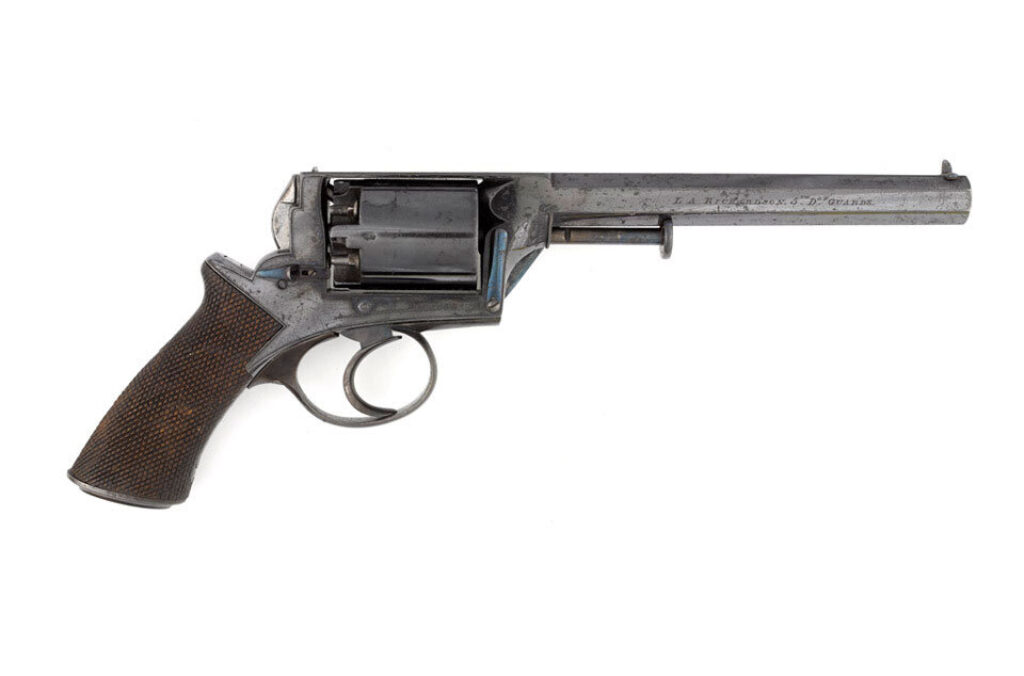
As the design evolved, Adams increased the caliber to .50.
By modern standards, such a large caliber may appear excessive, but British military thinking followed a different logic.
Throughout Britain’s colonial campaigns, opponents frequently continued fighting despite multiple hits from smaller-caliber weapons.
This became especially apparent during the Indian Rebellion of 1857.
Future General George Fosbery later recounted the story of a British officer armed with a Colt Navy revolver. The officer fired repeatedly at an advancing rebel, striking him several times in the chest. Yet the lightweight, high-velocity bullets passed completely through the man’s body with little immediate stopping effect. The attacker still managed to kill the officer with his sword before collapsing himself moments later.
Incidents like this convinced British military authorities that heavy, large-caliber bullets offered superior stopping power.
This philosophy eventually led to Britain’s famous tradition of large-bore revolvers and even the enormous-caliber “elephant guns” of the late nineteenth century.
Beaumont Turned a Good Revolver into a Great One
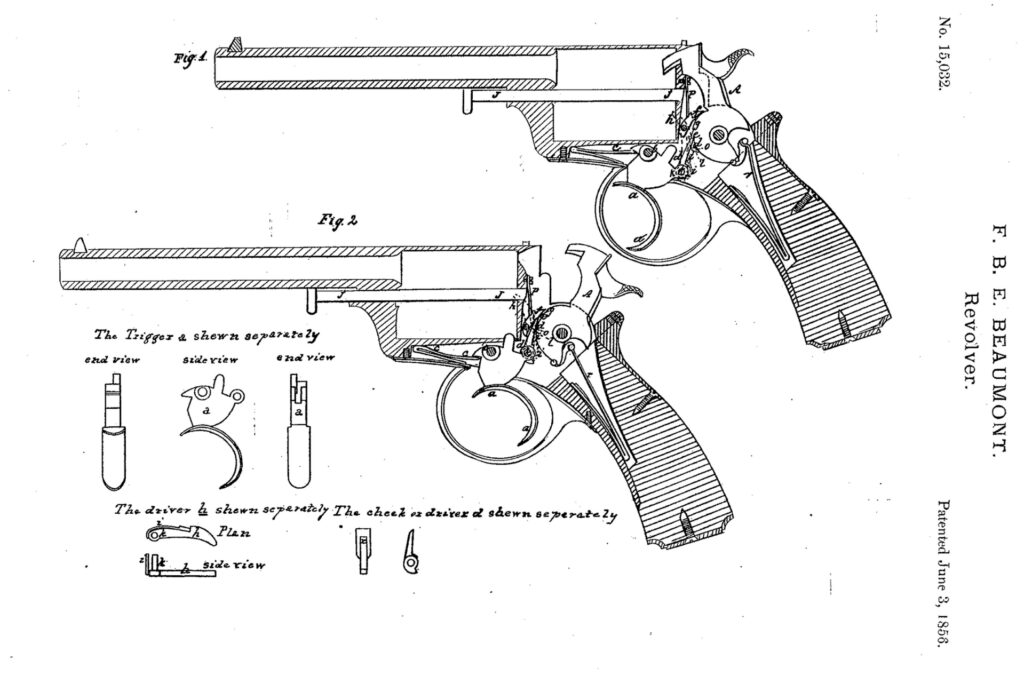
The original Adams revolver had one significant drawback.
It operated exclusively in double-action mode.
Every trigger pull both rotated the cylinder and cocked the hammer, resulting in a long and relatively heavy trigger pull.
Lieutenant Frederick Beaumont solved the problem.
In 1855, he patented an improved lockwork that allowed both double-action and single-action operation.
The shooter could either fire rapidly using the self-cocking mechanism or manually cock the hammer beforehand to obtain a lighter trigger pull and improved accuracy.
Robert Adams immediately purchased Beaumont’s patent.
The result became known as the Beaumont-Adams revolver, widely regarded as the finest percussion revolver ever produced in Britain.
The Second Adams and the Age of Metallic Cartridges
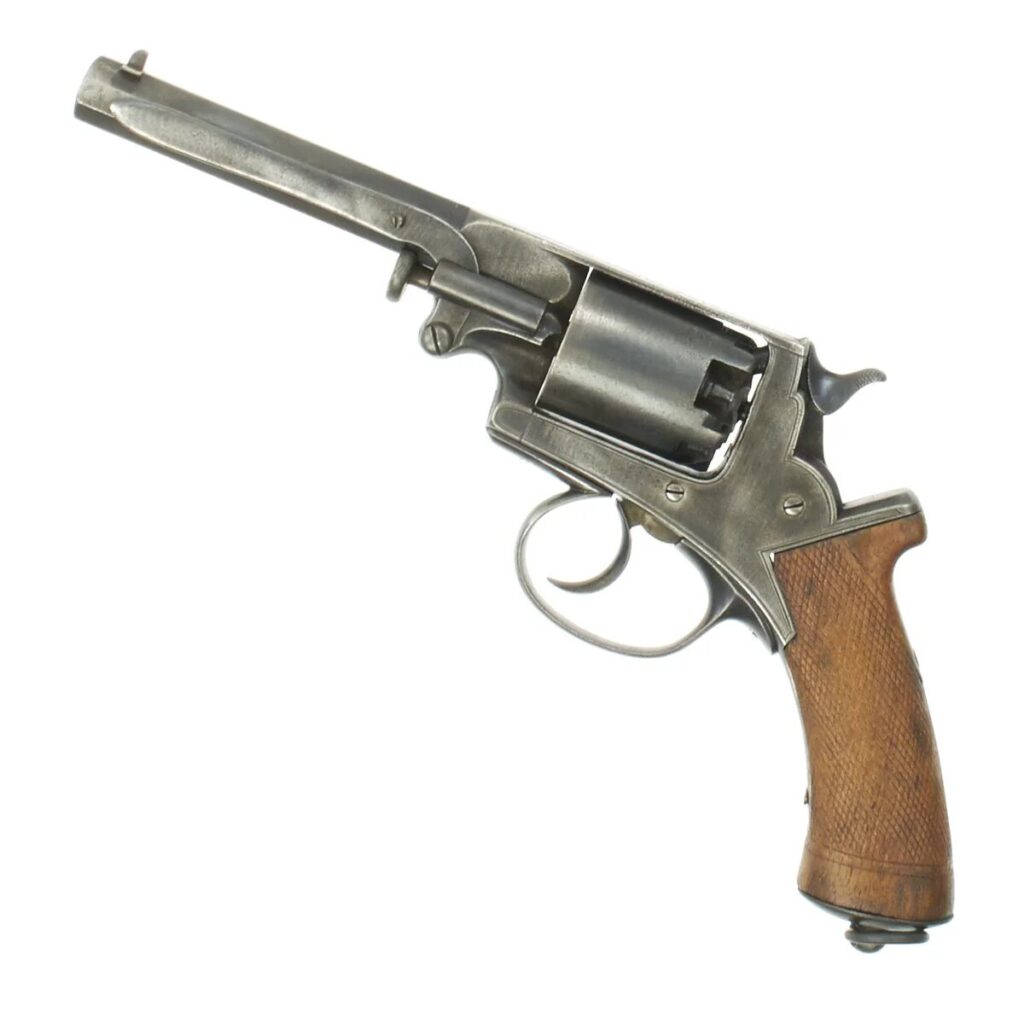
Soon afterward, the story took an unexpected turn.
Following disagreements with his business partners, Robert Adams left the company.
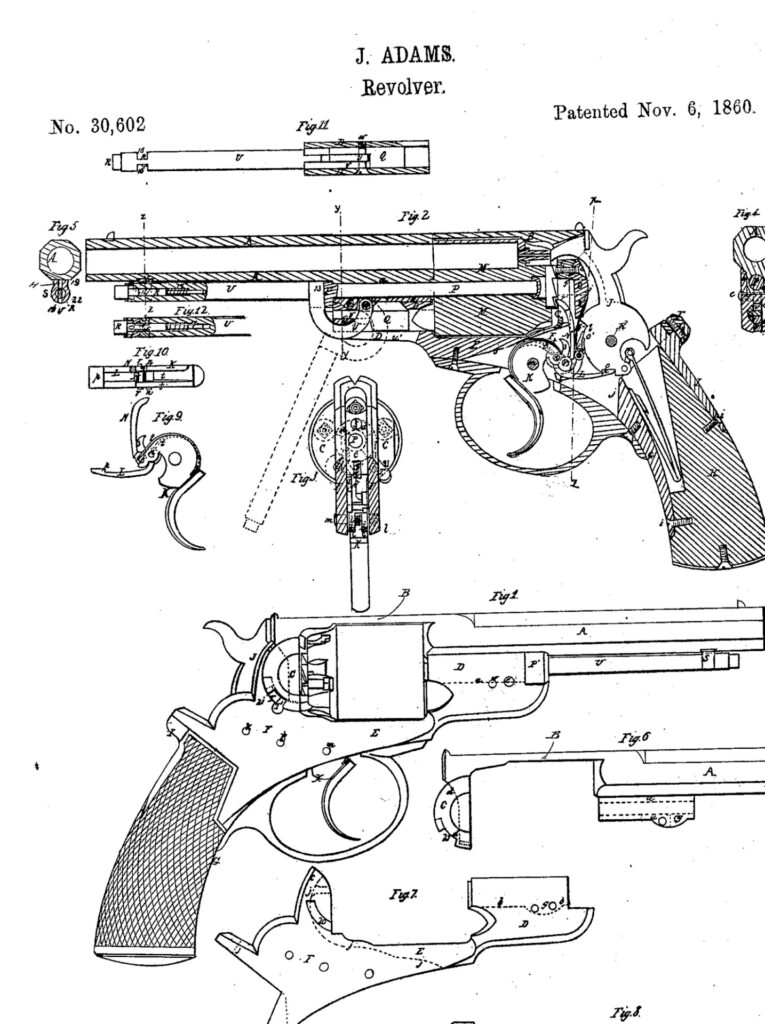
Further development of the revolver fell to his brother, John Adams.
It was John who successfully adapted the design for the age of metallic cartridges.
As self-contained ammunition replaced percussion systems throughout the world, he redesigned the revolver for the new .450 Adams cartridge. At the same time, the original five-shot cylinder was replaced with a six-shot version, while manufacturing of the frame became simpler and less expensive.
The resulting Adams Mk.I was officially adopted by the British Army in 1867.
Later improvements produced the Mk.II and Mk.III models.
Although the weapon had evolved dramatically, the Adams name remained proudly engraved on the frame.
The Final Campaign
By the late 1870s, however, the design was beginning to show its age.
Its greatest weakness was slow reloading.
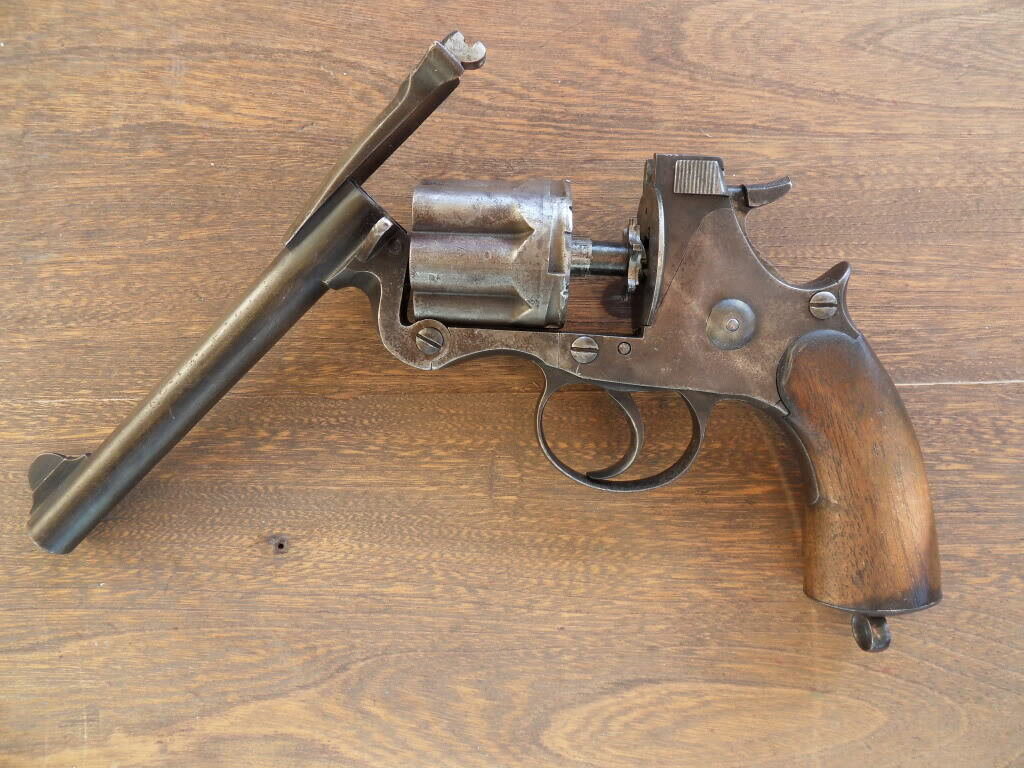
Spent cases had to be extracted individually, while newer top-break revolvers could eject all empty cartridges simultaneously with a single movement.
Even so, the Adams Mk.III remained in British military service.
Many officers carried it during the Second Anglo-Afghan War.
Only in 1880 was it finally replaced by the Enfield No.1 revolver, whose top-break frame and automatic extractor represented the next generation of military sidearms.
Thus ended the nearly thirty-year military career of one of Britain’s most important revolvers.
Legacy
The Adams revolver is often overshadowed by the global fame of Colt and, later, Smith & Wesson.
Yet it was the sidearm that accompanied the British Empire throughout one of the most dramatic periods of its expansion. From the trenches before Sevastopol to the mountains of Afghanistan, from India to Britain’s African colonies, Adams revolvers remained trusted companions of British officers for almost three decades.
It was neither the world’s first revolver nor its last.
But it proved an enduring truth of military history: victory does not always belong to the inventor who introduces an idea first. More often, it belongs to the one who adapts that idea most successfully to the realities of war.
Adams Mk III Specifications
- Type: Double-action revolver
- Country of Origin: United Kingdom
- Designers: Robert Adams, John Adams, Frederick Beaumont
- Adopted: 1867 (Mk.I)
- Cartridge: .450 Adams
- Cylinder Capacity: 6 rounds
- Weight: Approximately 1.1 kg (2.4 lb)
- Barrel Length: 114–152 mm (4.5–6 inches), depending on the variant
- Effective Range: Approximately 50 meters
- Service History: Crimean War (percussion versions), Indian Rebellion of 1857, British colonial campaigns, Second Anglo-Afghan War.