QBZ-191: Why China Abandoned Its Futuristic Bullpup and Returned to a Conventional Rifle


In 1997, China unveiled a weapon that was supposed to symbolize the new People’s Liberation Army. The QBZ-95 looked exactly like what people in the 1990s imagined a 21st-century assault rifle should look like: a bullpup layout, the magazine behind the pistol grip, an unusual silhouette, and China’s proprietary 5.8×42mm cartridge. Compared with the AK-74, M16, and even relatively new Western designs, the Chinese rifle genuinely looked like a weapon from the future.
A little more than two decades later, China did something unexpected.
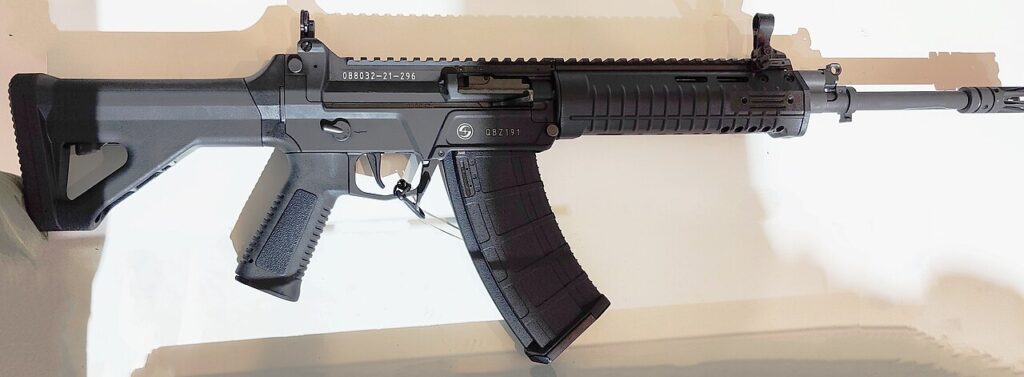
The PLA’s new standard assault rifle put the magazine back in front of the pistol grip, adopted a conventional adjustable stock, a long upper rail for optics, and an overall configuration that, from a distance, could easily be mistaken for yet another member of the broad AR-style family. The QBZ-191 was officially unveiled during the October 1, 2019 military parade in Beijing and is now gradually replacing the QBZ-95 family.
At first glance, this seems strange. China spent decades developing its own small-arms school, created a unique intermediate cartridge and an unconventional bullpup rifle — only to apparently return to the same basic layout everyone else had been using.
In reality, the QBZ-191 tells almost the opposite story. China did not abandon its own small-arms system. It retained arguably its most distinctive element — the 5.8×42mm cartridge — while concluding that an unconventional rifle layout offered diminishing advantages in the modern battlefield environment.
The QBZ-191 looks more conservative precisely because the requirements placed on a modern infantry rifle have changed.
Why China Built the Unusual QBZ-95 in the First Place
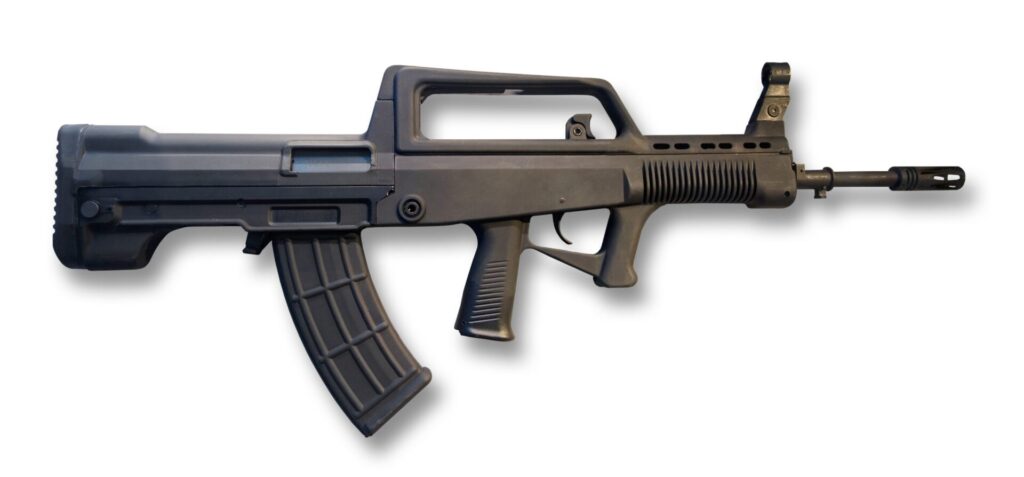
To understand the QBZ-191, we first need to look at its predecessor.
For much of the 20th century, Chinese small arms developed under enormous Soviet influence. China manufactured its own versions of the SKS and Kalashnikov rifle, while the Type 56 became one of the most widely produced AK derivatives in the world.
Eventually, however, Beijing decided to pursue its own path. One result was the development of the Chinese 5.8×42mm intermediate cartridge, intended to occupy broadly the same role as the Soviet 5.45×39mm and NATO 5.56×45mm rounds. Alongside it came an entirely new family of infantry weapons, the best known of which was the QBZ-95.
At the time, choosing a bullpup configuration made considerable sense.
Placing the magazine and action behind the trigger allows a relatively long barrel to fit into a much shorter overall weapon. For a mechanized army, that is a significant advantage. Soldiers can enter and leave infantry fighting vehicles, operate inside buildings, and move through confined spaces more easily without sacrificing the ballistic performance provided by a full-length barrel.
China was hardly alone in reaching this conclusion.
Britain adopted the L85, France used the FAMAS, and Austria had the Steyr AUG. Around the turn of the century, it was perfectly reasonable to imagine that the bullpup might become the standard configuration of the infantry rifle of the future.
That never happened.
Why China Put the Magazine Back in Front
Development of the new Chinese rifle family began around 2014–2015, and one of the fundamental decisions was to return to a conventional configuration. The QBZ-191 is intended to gradually replace both the QBZ-95 and QBZ-03, although the enormous size of China’s armed forces means that process will inevitably take years.
The reason is not that bullpup rifles suddenly stopped working.
Rather, the price paid for their compact dimensions became increasingly apparent.
With the magazine located close to the shooter’s shoulder, reloads can be less natural. Weight distribution is strongly biased toward the rear. The trigger has to be connected to the firing mechanism through a linkage. Truly ambidextrous controls can be more difficult to implement. And most importantly, the modern infantry rifle has gradually evolved from being simply a firearm into a platform for accessories and electronics.
Optical sights, red dots, night-vision devices, thermal imagers, laser aiming modules, flashlights, foregrips, bipods, suppressors — all of this equipment needs somewhere to go.
And here, the conventional layout, with its long receiver and handguard, has proved remarkably adaptable.
The QBZ-191 therefore looks much more familiar than its predecessor. It features an adjustable telescoping stock, improved ergonomics, more accessible controls, mounting interfaces for accessories, and new polymer magazines with transparent ammunition-checking windows.
In other words, China sacrificed some of the bullpup’s compactness in exchange for significantly greater versatility.
It May Look Like an AR-15, but It Is Not One Inside
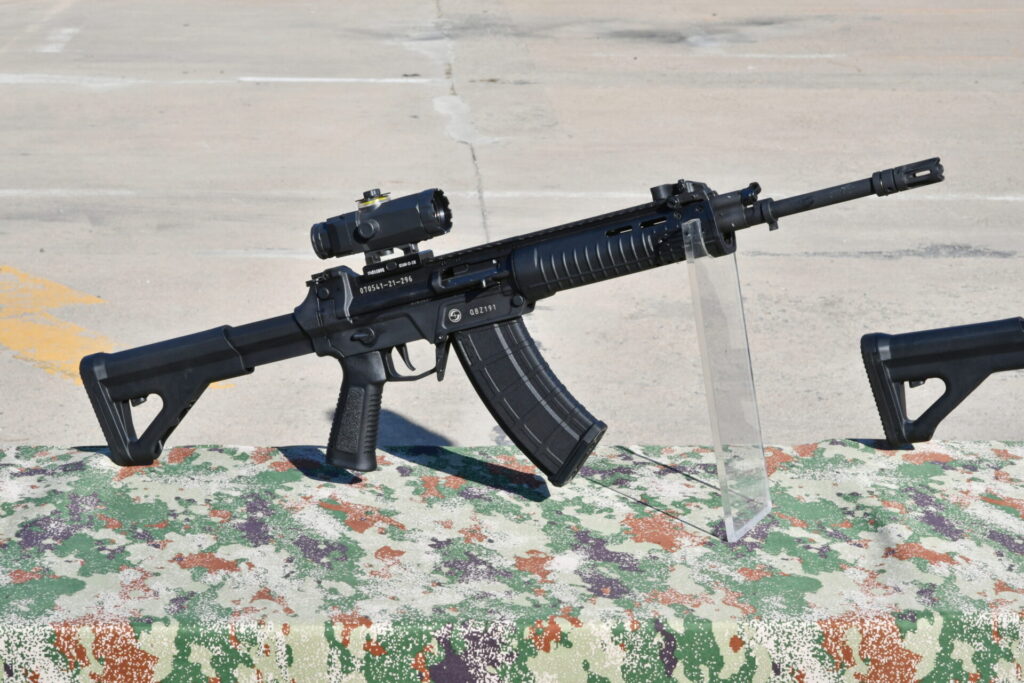
The superficial resemblance to modern Western rifles can be misleading. The QBZ-191 is not simply a Chinese copy of the M4.
Its operating system uses a short-stroke gas piston and rotating bolt, a conservative and well-established solution widely used in modern military rifles.
Available figures put the standard rifle’s unloaded weight at approximately 3.1 kg, with a barrel around 368 mm long and a cyclic rate of roughly 750 rounds per minute.
Yet China retained the defining feature of its modern infantry weapons system: the 5.8×42mm cartridge.
And that matters.
If Beijing had simply decided to copy the Western approach wholesale, adopting the NATO-standard 5.56×45mm cartridge would have been an obvious option. Instead, the PLA changed the rifle while retaining its indigenous ammunition and simultaneously developing a new generation of that ammunition.
The QBZ-191 is therefore not an abandonment of China’s independent small-arms philosophy.
Rather, China appears to have separated the elements it still considers genuinely useful from those that no longer provide enough practical advantage.
The bullpup layout could go.
The 5.8×42mm cartridge could stay.
The Most Interesting Part of the QBZ-191 May Actually Be Its Ammunition
The new rifle uses further developments of China’s 5.8×42mm ammunition. The Type 191 weapon family has been associated with a new generation of cartridges generally referred to as DBP-191, with Chinese sources claiming improved performance at medium and longer ranges compared with previous ammunition.
The choice of caliber is historically interesting in itself.
China is the only major military power to have developed and fielded its own modern intermediate cartridge in this particular class on such a large scale. The Soviet Union chose 5.45×39mm, NATO standardized around 5.56×45mm, while China developed its own 5.8mm solution.
Of course, comparing cartridges purely by bullet diameter is largely meaningless. Actual performance depends on projectile weight and construction, chamber pressure, barrel length, and the specific ammunition type. Reliable open-source information about modern Chinese military ammunition is also considerably more limited than equivalent data for American or European cartridges.
Nevertheless, the continued use of 5.8×42mm shows that the PLA remains satisfied with the basic ballistic concept.
China abandoned the QBZ-95.
It did not abandon the cartridge around which the QBZ-95 had been built.
QBZ-191 Specifications
There is a familiar problem when discussing modern Chinese weapons: figures in open sources vary, while complete official technical documentation is rarely available. It is therefore better to rely on the most consistently reported specifications rather than present estimates as established facts.
| Type | Assault rifle |
| Country | China |
| In service | Since 2019 |
| Cartridge | 5.8×42mm |
| Operating system | Gas-operated, short-stroke piston |
| Locking system | Rotating bolt |
| Weight | Approx. 3.1 kg unloaded |
| Barrel length | Approx. 368 mm |
| Feed system | 30-round detachable magazine |
| Rate of fire | Approx. 750 rounds/min |
| Muzzle velocity | Approx. 910 m/s |
| Effective range | Approx. 400 m by conservative estimates |
| Fire modes | Semi-automatic / automatic |
| Stock | Adjustable telescoping |
The Australian Army’s equipment reference gives the standard QBZ-191 an effective range of around 400 meters, while more recent Chinese claims reported by state media suggest that the broader Type 191 family can be effective at considerably longer ranges.
Such figures should be treated cautiously. “Effective range” can mean very different things depending on target type, ammunition, optics, and testing methodology.
What matters more is that the QBZ-191 was never designed as a standalone weapon.
It Is Actually an Entire Family of Weapons
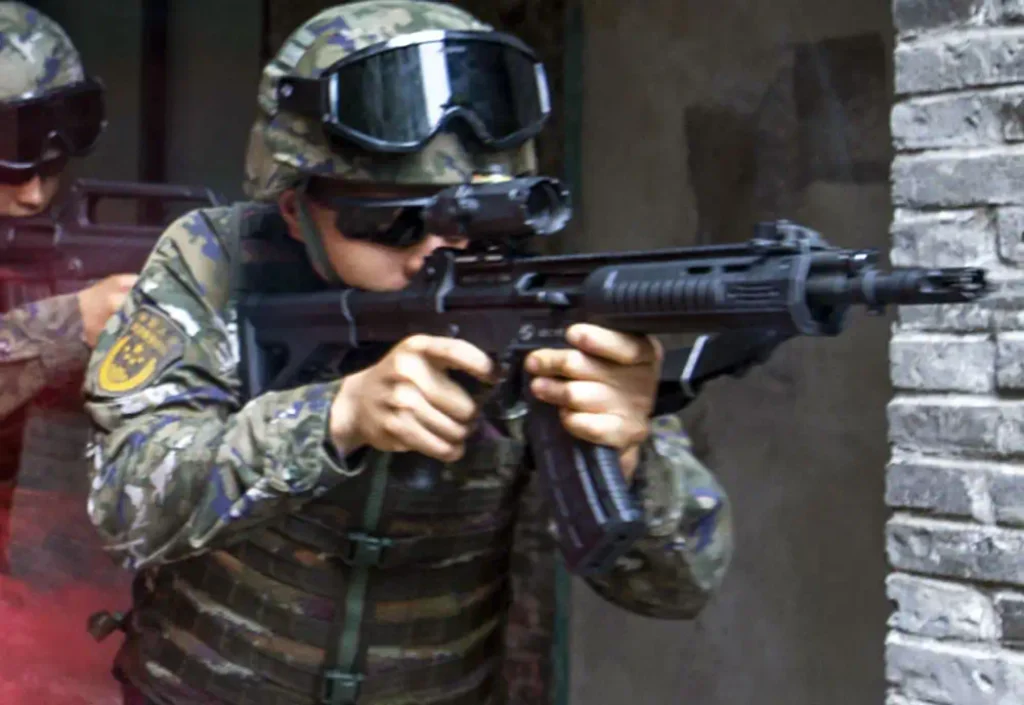
China has followed the same general path seen in many modern small-arms programs. Instead of fielding multiple largely unrelated weapons, it has developed a common architecture that can be adapted to different battlefield roles.
The standard QBZ-191 uses a barrel approximately 368 mm long.
For vehicle crews and other personnel who need a more compact weapon, China developed the shortened QBZ-192, with a barrel of roughly 266 mm.
At the opposite end of the family is the QBU-191, a designated marksman rifle featuring a heavier free-floating barrel approximately 550 mm long and more capable optics.
The QBU-191 is particularly useful for understanding the new Chinese concept.
Previously, a designated marksman might use a separate specialized weapon such as the QBU-88. Now the role can be filled by a rifle that shares its basic architecture with the standard infantry weapon but uses a longer barrel and magnified optic.
An effective range of up to approximately 800 meters is commonly cited for the QBU-191.
The result is a thoroughly modern family structure: a short carbine for personnel who prioritize compactness, a standard rifle for ordinary infantry, and a long-barreled version for precision fire.
Different missions — one basic weapon system.
That may ultimately be more important than the QBZ-191’s appearance.
The Chinese Infantryman Is Becoming an Electronics Carrier Too
There is another reason the new rifle returned to a conventional layout: the Chinese infantryman is changing as well.
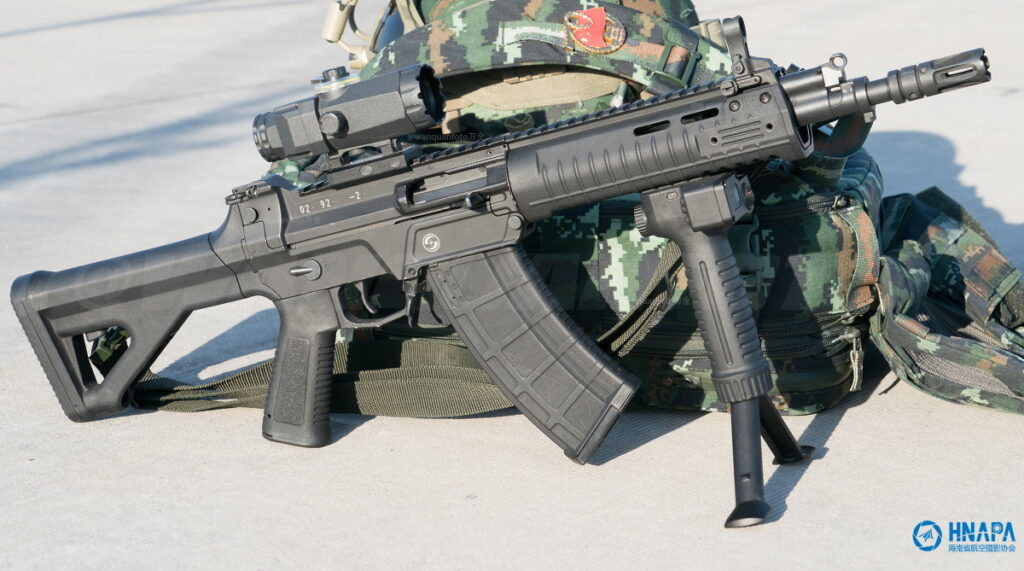
The QBZ-191 forms part of a much broader modernization of PLA individual equipment. The rifle was designed from the beginning to accept optical sights and additional accessories. The family can be equipped with prism optics, variable-power sights, thermal devices, laser aiming modules, suppressors, and other equipment.
And the development is continuing.
In 2026, Chinese state media showed an updated QBZ-191 featuring an extended upper mounting rail, allowing different electro-optical devices to be combined more conveniently. Further testing was reported ahead of potential deliveries of the improved configuration to the PLA and People’s Armed Police.
That is a revealing detail.
When the QBZ-95 was developed, the central component of the system was still largely the rifle itself.
Today, the rifle increasingly serves as the foundation for an entire sighting and sensor system.
Two decades after the QBZ-95 appeared, an infantryman no longer needs only iron sights and perhaps the ability to attach an optic. He may require space for a daytime sight, night-vision equipment, a thermal attachment, a laser aiming module, and potentially future digital devices.
The conventional rifle architecture turned out to be better suited to this evolution.
Why the QBZ-191 Looks So Suspiciously Familiar
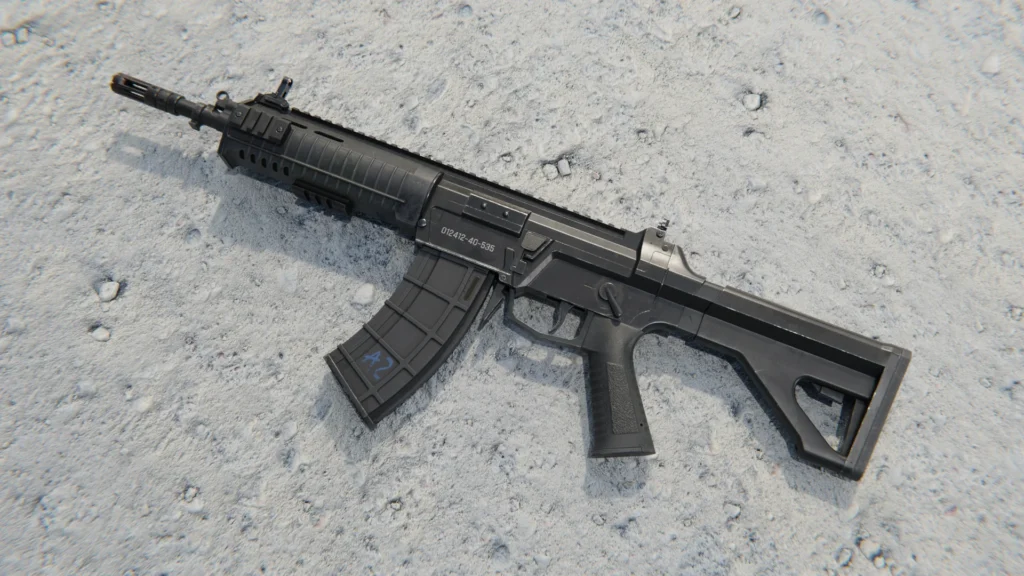
Remove the national markings and many modern rifles from different countries are becoming surprisingly similar.
Adjustable stock.
Pistol grip.
Long upper rail.
Polymer magazine.
Modular handguard.
Optics.
Laser module.
Suppressor.
American M4 derivatives, Germany’s HK416, modern Russian rifles, and China’s QBZ-191 are all addressing many of the same ergonomic and operational requirements. As a result, their designs are gradually converging.
That does not necessarily mean copying.
More often, it means design convergence.
If soldiers wear body armor, an adjustable stock makes more sense than a fixed one. If night-vision devices are used, mounting interfaces are needed. If the same rifle must fit soldiers of different sizes, adjustable components are useful. If more electronics are being attached to the weapon, free space on the receiver and handguard becomes increasingly valuable.
Physics and human anatomy work the same way in Beijing, Moscow, and Washington.
After decades of experimentation, designers are therefore beginning to arrive at broadly similar solutions.
China’s Most Modern Rifle Looks More Conventional — and That Is the Point
The QBZ-191 is interesting precisely because of its apparent lack of visual originality.
When the QBZ-95 appeared, China seemed to be making a statement:
We can create our own rifle system that looks neither Soviet nor American.
And it certainly succeeded.
The QBZ-191 reflects a different level of confidence. China no longer needs to make its infantry rifle unconventional simply to demonstrate an independent design philosophy. It can use a conventional layout because it works. It can use extensive accessory mounting interfaces because they are practical. It can adopt a telescoping stock because it better suits the modern infantryman.
At the same time, China has retained what it genuinely considers worth keeping: its proprietary 5.8×42mm ammunition, its own weapon architecture, domestic optics, and an entire family ranging from the compact QBZ-192 to the marksman-oriented QBU-191.
The transition from the QBZ-95 to the QBZ-191 is therefore difficult to describe as a step backward.
China has instead completed an interesting circle.
In the 1990s, it seemed that a 21st-century rifle had to look futuristic. The bullpup promised shorter overall dimensions, greater compactness, and a more modern configuration.
Then the requirements changed.
The 21st-century infantryman increasingly needs something else: good ergonomics, fast reloads, an adjustable stock, capable optics, room for electronic equipment, and a common platform that can be adapted to multiple roles.
The result is a curious paradox:
China’s newest standard assault rifle looks considerably more traditional than the weapon it introduced more than two decades earlier.
And that may be one of the clearest signs of just how much the definition of a modern infantry rifle has changed.