

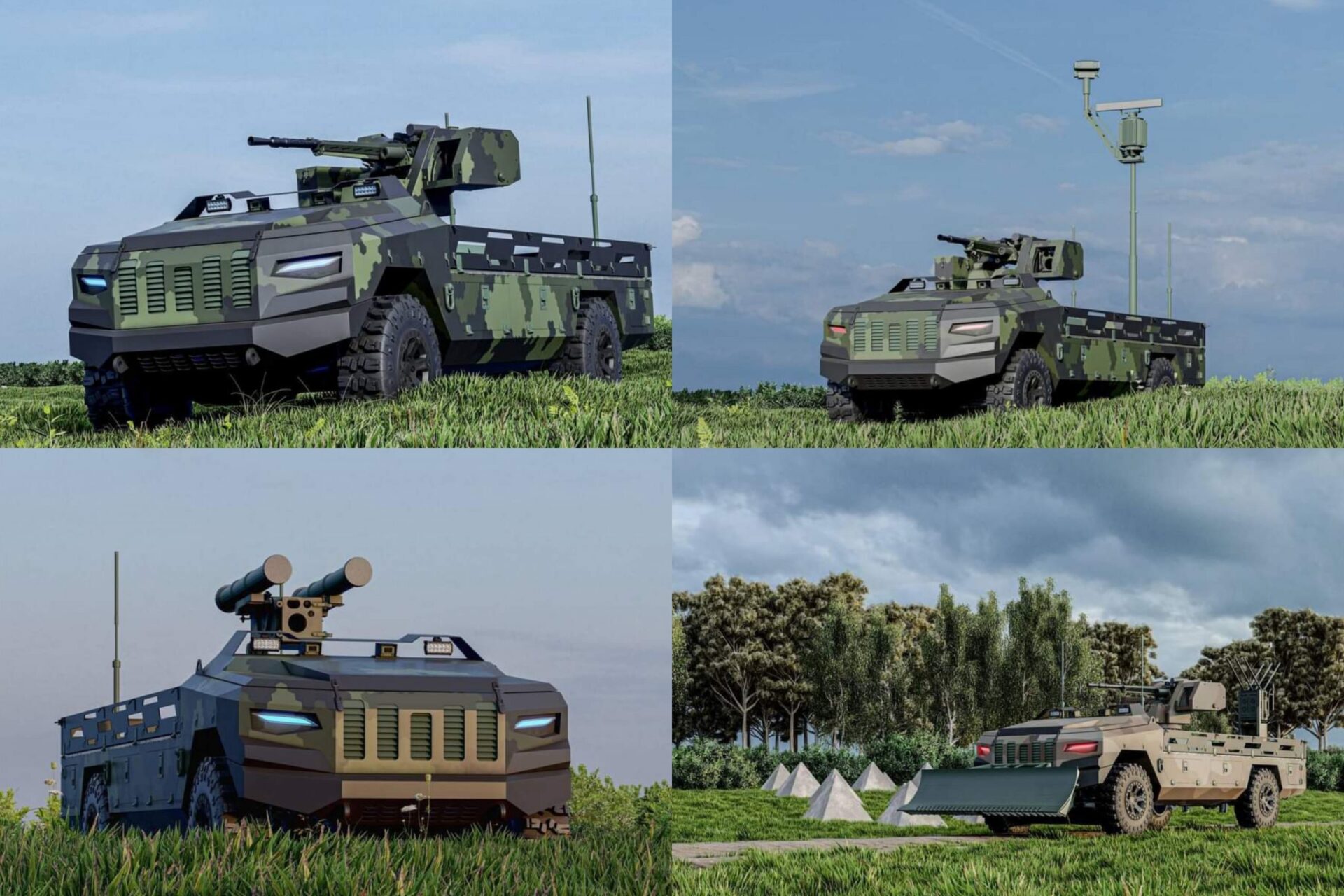
Most military ground robots developed in recent years resemble small tracked carts. They are relatively inexpensive and can carry several boxes of ammunition, evacuate one wounded soldier, or mount a light machine gun. However, in terms of payload, speed, and operational range, they remain auxiliary systems rather than true vehicles. Ukraine’s Protector unmanned ground vehicle was created according to a very different concept. It is not a robotic cart, but a full-size driverless vehicle built with extensive use of conventional automotive components.
In size and weight, the Protector is closer to a military pickup truck or a light armored vehicle. It has a diesel engine, a four-wheel-drive chassis, a protected engine compartment, and a large open platform for cargo or mission equipment. This allows it to operate not only as a transport vehicle, but also as a carrier for a machine-gun turret, anti-tank missiles, reconnaissance systems, electronic-warfare equipment, or engineering tools.
This approach makes the Protector one of the most interesting Ukrainian unmanned ground systems. Unlike many experimental projects, it was not created primarily as a technology demonstrator. It was designed as a relatively simple, repairable frontline machine capable of performing the work of an ordinary military truck without placing a driver or crew in danger.
Where the Protector Chassis Came From
The Protector is based on an automotive design. According to several defense publications, the project uses components associated with the Isuzu Trooper body-on-frame SUV. This appears to involve more than simply converting a complete production vehicle. The developers used its general architecture, transmission solutions, and widely available automotive components when creating the new unmanned chassis.
The Isuzu Trooper was a logical starting point. It was a conventional body-on-frame four-wheel-drive vehicle designed for off-road use and capable of carrying substantial loads. Using a commercial automotive base meant that there was no need to develop a new engine, gearbox, transfer case, axles, steering system, and much of the suspension from scratch. For a military vehicle, this reduces cost, simplifies servicing, and improves the availability of spare parts.
This principle has long been used in the development of light armored vehicles. Many armored cars are essentially protected bodies installed on reinforced commercial chassis. The Protector follows the same logic, but instead of an armored cabin with a driver, it has remote controls and a low-profile hull without a crew compartment.
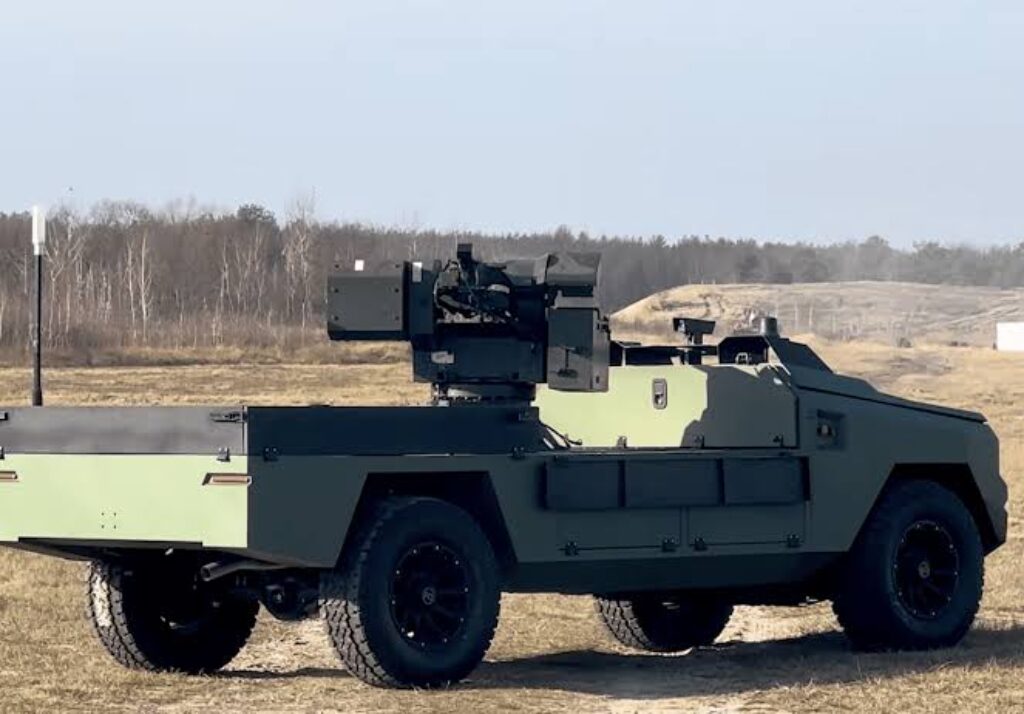
Removing the cabin made it possible to change the internal layout. The engine and major mechanical components are located at the front, while most of the vehicle’s length is given over to the cargo platform. In effect, the designers removed the passenger body, seats, and conventional driving controls, retained the automotive running gear, and converted the available space into payload capacity.
Manufacturer and Origins of the Project
The Protector was developed by the private Ukrainian company Ukrainian Armor. The company is known for the Varta and Novator armored vehicles, mortars, remote weapon stations, and other land-warfare systems. The Protector represented the company’s move into the field of heavy unmanned ground vehicles.
The system was first publicly presented in 2024. From the beginning, the manufacturer emphasized modularity. The same vehicle could be used for logistics, casualty evacuation, reconnaissance, or as a carrier for weapons. The Protector later received official approval for operation by the Ukrainian armed forces, allowing military units to procure it for operational use.
Its design has continued to evolve in response to field experience. The initially stated payload was approximately 700 kg, but in 2026 the manufacturer reported that this had been increased to 1.5 tonnes. Communications equipment was also improved, including the addition of control through LTE networks.
Differences between published specifications are largely the result of several development stages. Early figures for weight, payload, and equipment do not always correspond to the latest upgraded version.
Dimensions, Weight, and Powerplant
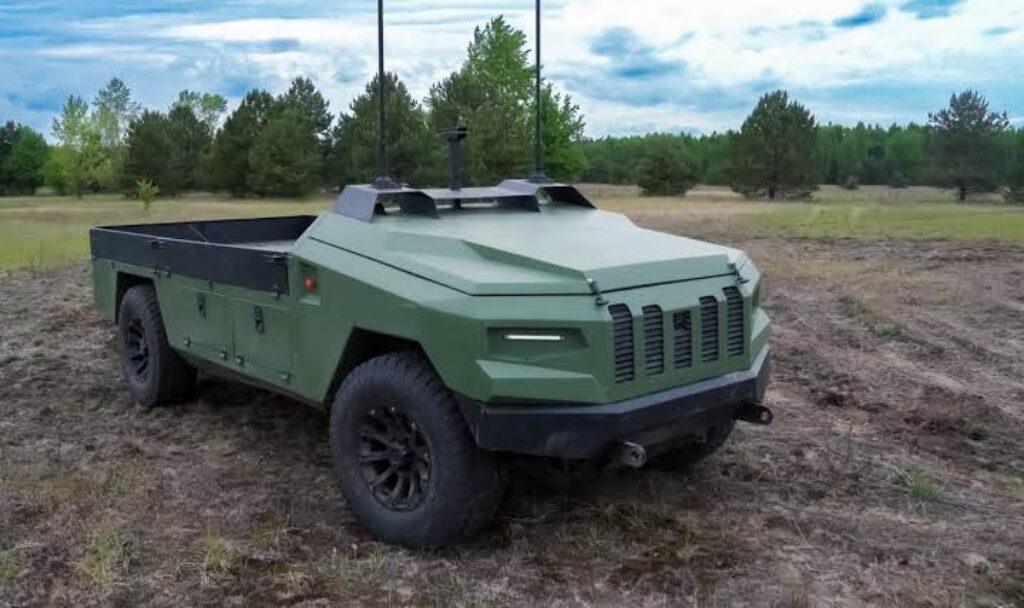
The Protector is not a compact machine. The early version was approximately 5.2 m long, about 1.9 m wide, and roughly 1.4–1.5 m high. Depending on configuration, installed equipment, and payload, its combat weight is generally reported as being between 3 and 4 tonnes.
The vehicle is powered by a diesel engine producing approximately 190 hp. At a weight of several tonnes, this gives it a power-to-weight ratio comparable to that of a conventional four-wheel-drive SUV or light armored vehicle. The early version reportedly had a maximum speed of around 60 km/h, although its practical speed over broken terrain is likely to be significantly lower.
The early model carried approximately 76 liters of fuel, while claimed consumption was about 12 liters per 100 km. In theory, this would provide a substantial road range, although fuel consumption inevitably rises during off-road driving, prolonged low-speed operation, and use with additional equipment. Some reports have cited a practical remotely controlled range of up to 400 km.
Unlike most small unmanned ground vehicles, the Protector does not depend on battery capacity. Its diesel powerplant allows it to operate for long periods away from charging infrastructure, refuel rapidly from ordinary military fuel supplies, and retain mobility in cold weather. The disadvantages are noise, thermal signature, and greater mechanical complexity.
Running Gear and Cross-Country Mobility
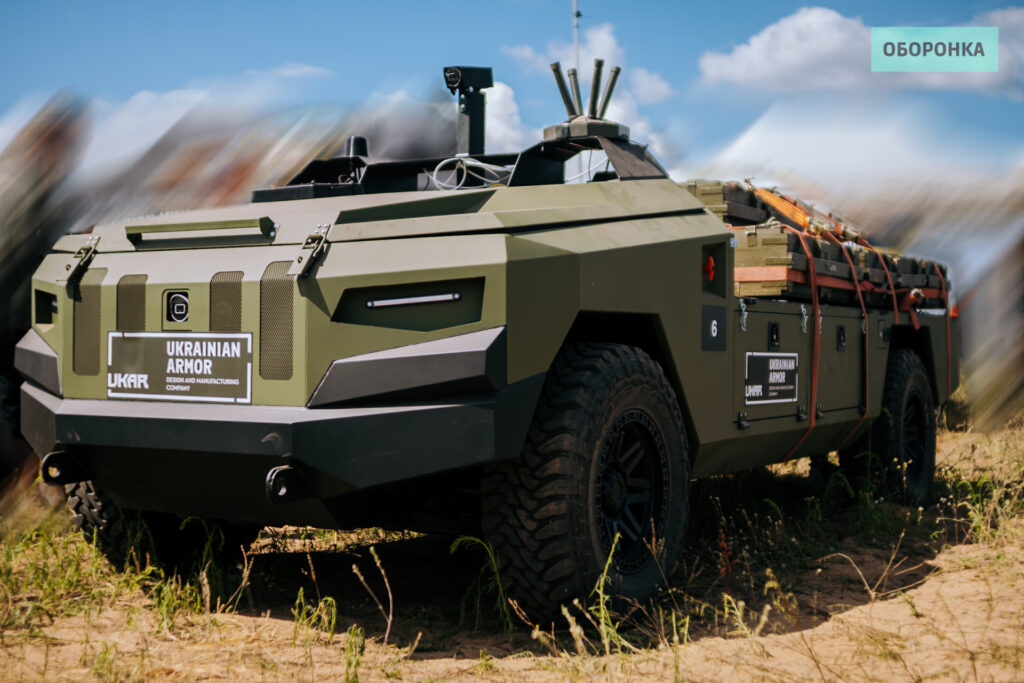
The Protector uses a 4×4 wheeled configuration. For a heavy unmanned platform, this represents a compromise between cross-country mobility, road speed, and ease of maintenance. A tracked robot performs better in deep mud or loose soil, but is slower, wears its running gear more rapidly, and is more difficult to transport over long distances. A wheeled vehicle can travel dozens or even hundreds of kilometers under its own power without requiring a separate transporter.
The body-on-frame design allows the platform to carry heavy loads and absorb the recoil of mounted weapons. Its wheelbase and relatively low center of gravity should provide acceptable stability. The vehicle can move along dirt roads, across fields, and over broken terrain, although it will still be less capable in extreme conditions than a purpose-built tracked system.
Its large dimensions are both an advantage and a weakness. The Protector can carry a substantial payload, but it is more difficult to conceal in a tree line, trench, or ruined position. From the air, it resembles a small vehicle and can be detected by reconnaissance drones. Its primary role is therefore not a direct assault on fortified positions, but logistics and support along hazardous routes where sending a manned vehicle would create even greater risk.
Protection Without a Crew
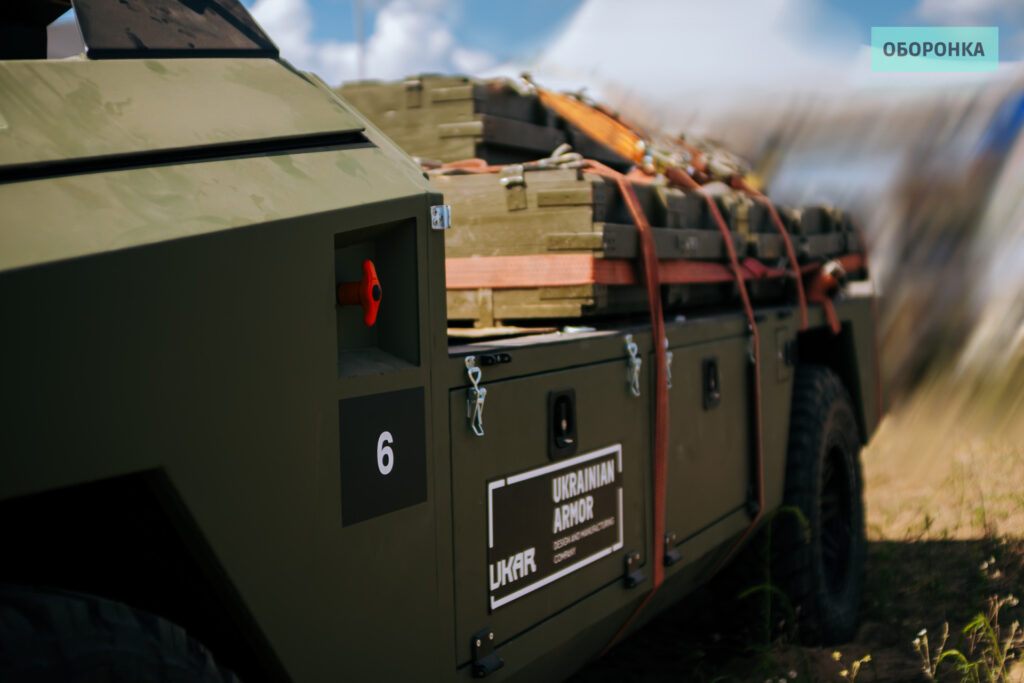
The Protector has ballistic and fragmentation protection broadly corresponding to STANAG 4569 Level 1. This level is intended to stop ordinary small-arms fire and shell fragments, but it does not protect against heavy machine guns, anti-tank guided missiles, artillery shells, or direct strikes from FPV drones carrying shaped-charge warheads.
However, comparing the Protector with a conventional armored personnel carrier is misleading. Its main protection is not the thickness of its armor, but the absence of people inside. When a standard truck is hit by a drone, the army loses not only the vehicle and its cargo, but often the driver as well. The loss of an unmanned platform is primarily a material loss.
The armor is intended to protect the engine, fuel system, actuators, electronics, and communications equipment from fragments and stray bullets. It increases the chance that the vehicle can continue moving after a nearby explosion or light small-arms fire. Increasing protection to the level of an armored personnel carrier would be impractical. Additional armor would reduce payload, mobility, and range, while still failing to make the platform invulnerable to modern anti-tank weapons.
How the Driverless Truck Is Controlled
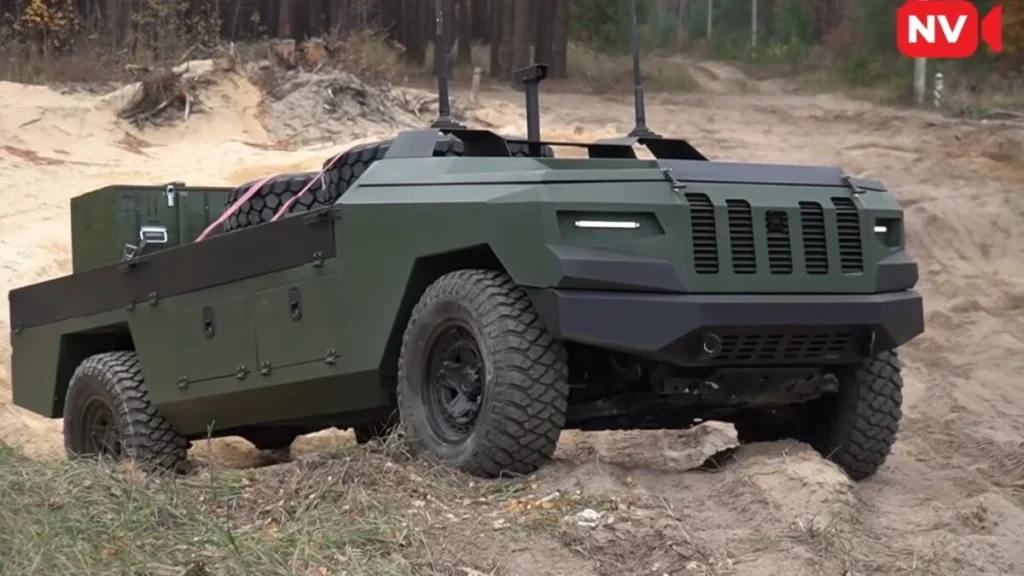
The Protector is primarily a remotely controlled vehicle rather than a fully autonomous one. The operator receives video from onboard cameras and controls the vehicle from a remote station. This arrangement is simpler and more reliable than full autonomous navigation, especially on a battlefield where roads may be blocked by craters, destroyed vehicles, wire obstacles, or minefields.
The system uses radio links, while the upgraded version can also operate through LTE networks. A cellular connection can potentially increase control range and make use of existing communications infrastructure, but it depends on network coverage and the survival of base stations. At the front, mobile communications may be jammed or entirely unavailable, so LTE should be viewed as an additional channel rather than the sole means of control.
Electronic warfare remains one of the main challenges. If the link is lost, the robot must either stop, return along a pre-programmed route, or continue a simple assigned task. Details of the Protector’s fallback algorithms have not been disclosed. Future development is likely to focus on automatic route following, obstacle avoidance, and return-to-base functions after loss of communications.
Full autonomy is not necessarily essential for a frontline logistics vehicle. Reliable communications, good cameras, a robust transmission, and the ability to recover a damaged platform may be more important than advanced decision-making software.
Its Main Role Is Frontline Logistics
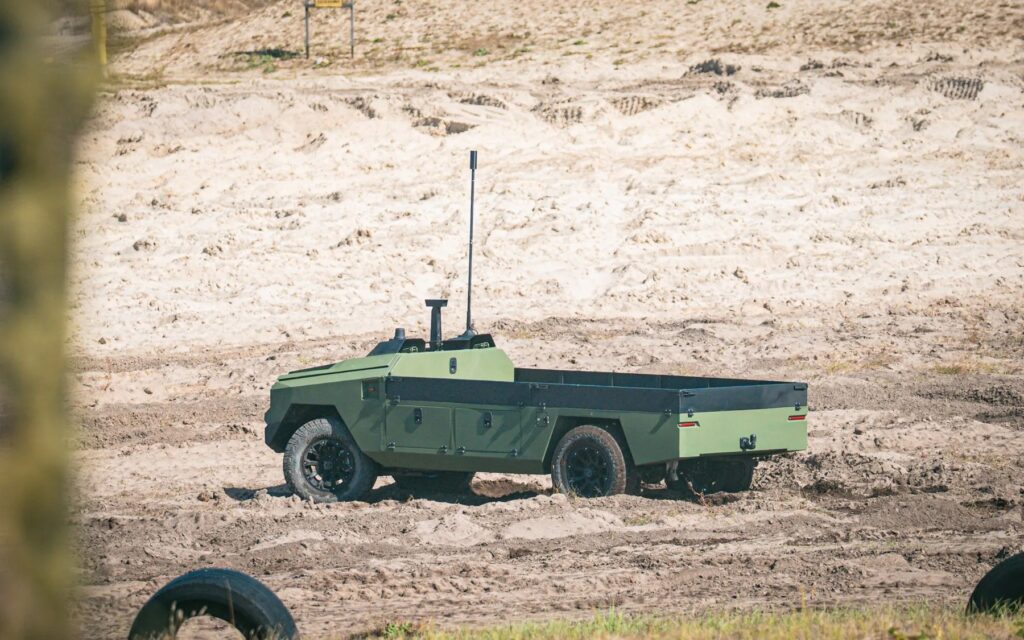
The Protector was originally developed as an unmanned transport vehicle. It can deliver ammunition, water, food, batteries, fuel, engineering tools, and other supplies to forward positions. With a payload of up to 1.5 tonnes, a single trip can replace several missions by smaller robotic platforms.
According to the manufacturer, one vehicle transported approximately 15 tonnes of cargo during a month of operation. It has also been claimed that a fully loaded Protector can deliver roughly a week’s worth of supplies to a small unit. Such figures depend on the type of cargo and the intensity of combat, but they demonstrate the scale of the platform. The Protector is not a mechanical porter carrying a few boxes; it is a true unmanned truck.
The vehicle can also be used for casualty evacuation. Stretchers or seats can be placed on the open cargo platform, while the absence of a crew allows the machine to enter areas that an ordinary ambulance cannot safely reach because of continuous aerial surveillance and the threat from FPV drones. The obvious disadvantages are the lack of medical personnel onboard and the limited protection provided to casualties during transport.
Another possible role is the recovery of smaller damaged robots. The Protector’s payload allows it to carry several light unmanned ground vehicles, transport them closer to the operational area, and retrieve them after a mission. In this configuration, it becomes a kind of robotic carrier for other robots.
The Protector with a Heavy Machine Gun
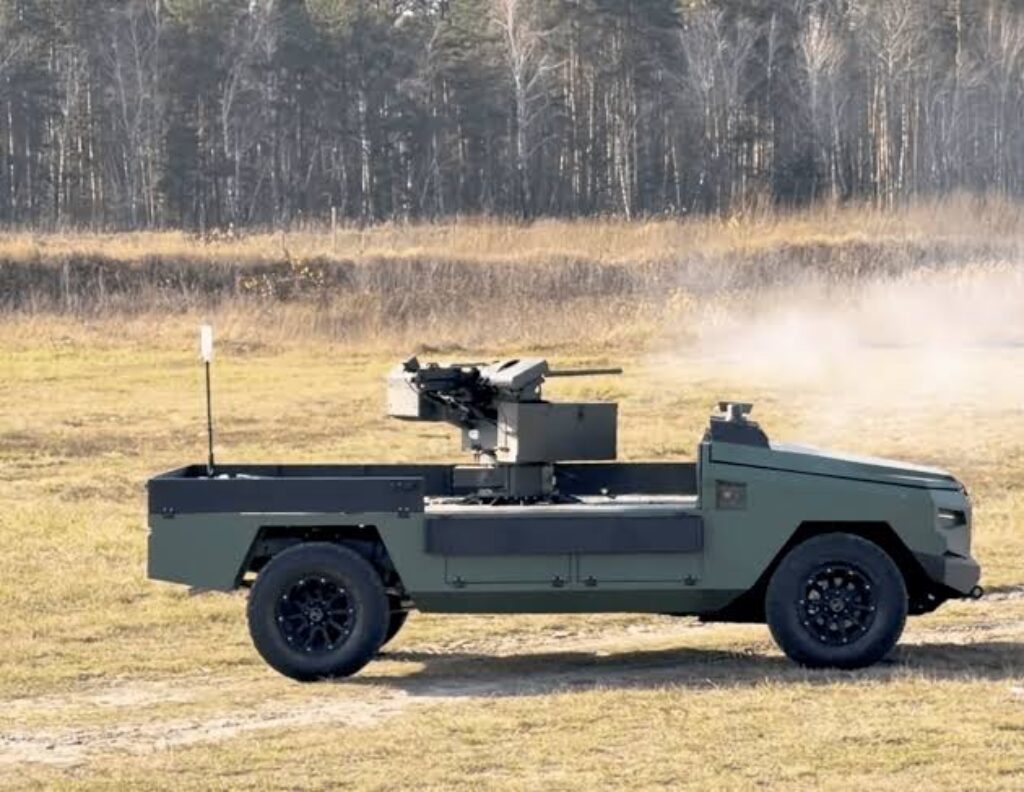
The best-known combat version is equipped with the Tavria-12.7 remote weapon station. This module carries a 12.7 mm Browning M2 heavy machine gun and an electro-optical sighting system for day and night operation. The combination has undergone firing trials both from a stationary position and while moving.
Installing a heavy machine gun turns the transport robot into a fire-support vehicle. The Browning M2 can engage personnel, light fortifications, unarmored vehicles, and some types of lightly armored equipment. The Protector’s mass provides a more stable firing base than that of small ground robots, although accuracy while moving depends on the stabilization system and the quality of the turret drives.
Even so, an armed Protector should not be regarded as an unmanned tank. Its armor remains light, while its size makes it relatively easy to detect. The most realistic roles would include firing from cover, guarding positions, escorting columns, supporting troops along previously reconnoitered routes, or operating in areas where the use of crewed vehicles would be too dangerous.
The weapon station remains under remote human control. The operator observes the target through cameras and authorizes fire. Technically and legally, this is therefore a remotely operated combat vehicle rather than an autonomous weapon capable of selecting targets independently.
Anti-Tank Version and Other Mission Modules
Promotional materials and demonstration images have also shown the Protector carrying the Amulet anti-tank missile system. This module can use missiles from the Stugna family and would turn the platform into a mobile anti-tank firing position. The vehicle has also been displayed with engineering attachments, including blades and other equipment.
The anti-tank version offers a clear advantage: the platform can be sent to a firing position without a crew onboard. The operator may remain at a considerable distance, observe through the optical channel, and launch a missile without being directly exposed to return fire. After firing, the vehicle can change position or remain concealed in ambush.
However, such a configuration requires reliable communications and careful concealment. The Protector is much larger than a man-portable missile system, while its diesel engine produces a visible thermal signature. It is unlikely to replace infantry anti-tank teams, but it could supplement them in particularly dangerous sectors.
The modular platform could also theoretically carry electronic-warfare systems, communications relays, radar equipment, surveillance systems, generators, or engineering devices. With a payload of 1.5 tonnes, the range of possible mission equipment is considerable. In effect, the Protector could become the base vehicle for an entire family of specialized unmanned systems.
Is a Mortar Version Possible?
The vehicle’s payload and size make the installation of a mortar technically possible, but no confirmed production Protector mortar variant has yet been publicly demonstrated. Images of mortar-carrying ground robots often show other Ukrainian or foreign platforms.
Installing a 60 mm or 82 mm mortar would be feasible, but several engineering problems would have to be solved. Recoil must not damage the suspension or destabilize the vehicle, so the mortar would probably need to transfer recoil directly to the ground through a baseplate or deployable supports. Automated aiming and a safe loading mechanism would also be required.
A simpler use would be to employ the Protector as a carrier for mortar ammunition and crew equipment, or to transport a mortar to a firing position. A fully robotic mortar vehicle would be a much more complex system than a cargo carrier or a vehicle fitted with an existing remote weapon station.
Protector Technical Specifications
The vehicle’s characteristics have changed during development, so the following figures refer to known early and upgraded versions:
Manufacturer: Ukrainian Armor
Type: Heavy wheeled unmanned ground vehicle
Drive configuration: 4×4
Base architecture: Components associated with the Isuzu Trooper body-on-frame SUV
Length: Approximately 5.2 m
Width: Approximately 1.87–1.9 m
Height: Approximately 1.4–1.5 m
Gross weight: Approximately 3–4 tonnes, depending on configuration
Engine: Diesel
Power: Approximately 190 hp
Maximum speed: Up to 60 km/h
Range: Up to 400 km, according to some statements
Fuel capacity: Approximately 76 liters on the early version
Payload: Initially around 700 kg, increased to as much as 1.5 tonnes
Ballistic protection: STANAG 4569 Level 1
Control: Remote radio control, with LTE support on the upgraded version
Armament: Optional Tavria-12.7 remote weapon station with a Browning M2 heavy machine gun; the Amulet anti-tank configuration has also been demonstrated.
Not a Tank, but a Universal Unmanned Chassis
The Protector is most interesting not as a single combat vehicle, but as an attempt to create a universal automotive platform without a crew. Its design contains no revolutionary mechanical features. Body-on-frame construction, a diesel engine, four-wheel drive, and an open cargo bed have been used in conventional SUVs and military trucks for decades. The innovation lies in combining these familiar elements with remote control and modular mission equipment.
Using an automotive base is especially practical in wartime. Such a vehicle can be produced more quickly and cheaply than a specialized robot with a unique suspension and transmission. Commercial components simplify repairs, while relatively high road speed and long range allow the machine to operate far from its control point.
At the same time, the Protector remains vulnerable. It is large, visible, lightly armored, and dependent on communications links. A direct hit from an anti-tank weapon or a heavy FPV drone would probably disable it. But the purpose of such a platform is not to survive every possible strike. Its purpose is to accept risk in place of human beings.
That is why frontline logistics remains the Protector’s most logical role. Machine-gun and anti-tank versions expand its capabilities, but its main value lies in the ability to travel along a dangerous route, deliver a tonne of ammunition, or evacuate wounded soldiers without exposing a driver to enemy fire.
A century ago, ordinary military trucks followed a similar path. They began as simple transport vehicles, were later armored, armed with machine guns, and eventually developed into specialized fighting vehicles. Today, the same process is repeating itself without crews. The Protector began as an unmanned truck, but it is gradually becoming the foundation for an entire family of robotic vehicles, from cargo carrier and ambulance to heavy weapons platform.






