
The U.S. Spent Billions to Abandon Steam Catapults. Now It Wants to Bring Them Back

For more than half a century, the U.S. Navy launched carrier aircraft using steam. The technology was heavy, cumbersome, and far from perfect, but it had been refined through decades of operational experience. Then the United States decided to make a technological leap: the new Gerald R. Ford-class aircraft carriers received the Electromagnetic Aircraft Launch System, or EMALS, a technology that required the Navy to rethink a significant part of the carrier’s architecture.
The transition was painful. The new system proved more complex, more expensive, and more troublesome than expected. It took years of development to improve reliability, while the first Ford became one of the most expensive warships ever built.
At first glance, the obvious conclusion seems simple: if the old system works and the new one causes so many problems, why not just go back to steam?
That is exactly what is now being proposed.
On August 13, 2026, President Donald Trump directed the Pentagon and the U.S. Navy to prepare, within 60 days, a plan to abandon electromagnetic catapults and weapons elevators on the future USS Doris Miller (CVN-81). EMALS would be replaced by steam catapults, while the Advanced Weapons Elevators would give way to hydraulic systems. Under the proposal, the first three Ford-class carriers would retain the new technology, while later ships could potentially return to older systems.
At first glance, this looks conservative but entirely rational.
The problem is that USS Doris Miller is not a Nimitz. And putting steam back onto a carrier specifically designed without it could prove far more difficult than replacing steam with electricity in the first place.
Steam Works — And That Is a Powerful Argument
Supporters of returning to the old system have one almost unassailable argument: steam catapults really do work.
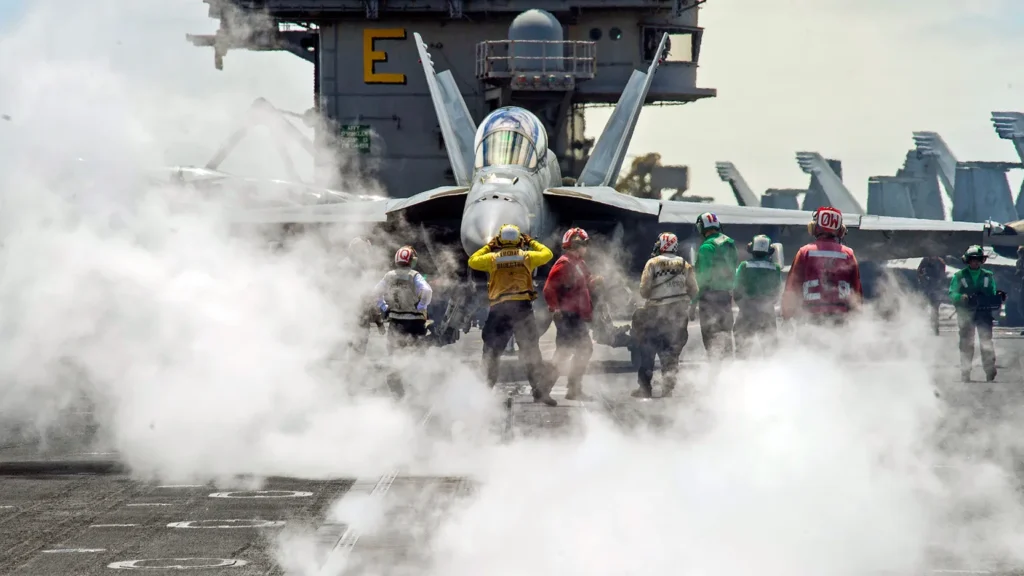
All ten remaining Nimitz-class aircraft carriers use them. Over decades of service, the U.S. Navy has learned how to launch heavy fighters, airborne early-warning aircraft, transports, and numerous other types of carrier-based aircraft using steam.
The operating principle is relatively straightforward.
High-pressure steam generated by the ship’s propulsion plant is fed into cylinders located beneath the flight deck. Pistons inside those cylinders are connected to the catapult shuttle. The aircraft is attached to the shuttle, and the system accelerates the multi-ton machine to flying speed over a distance roughly comparable to the length of a football field.
The process is extraordinarily violent, mechanically complex, and requires substantial infrastructure.
But it is proven.
And that is precisely why criticism of EMALS became so damaging.
The new system was supposed to be better in almost every respect.
Why Was EMALS Needed in the First Place?
The electromagnetic catapult was not developed simply because the Navy wanted to replace an old technology with something newer and more impressive.
Steam catapults have genuine limitations.
They require extensive piping and auxiliary equipment, are maintenance-intensive, occupy considerable internal volume, and cannot control aircraft acceleration as precisely as an electromagnetic system.
EMALS operates on an entirely different principle.
Instead of steam pressure, it uses a linear electric motor. Energy is stored, conditioned through power electronics, and then used to generate an electromagnetic field that accelerates the shuttle and the aircraft.
And electricity itself is not even the most important part.
The key advantage is control.
According to NAVAIR, EMALS offers more precise control of end speed, smoother acceleration, potentially higher sortie-generation rates, reduced stress on aircraft structures, and the ability to launch a much wider range of aircraft — from lightweight unmanned systems to heavy strike aircraft.
This is an important detail.
Because the U.S. carrier of the mid-21st century may operate an air wing very different from the one for which the Nimitz class was originally designed.
The Carrier of the Future Will Have to Launch More Than Fighters
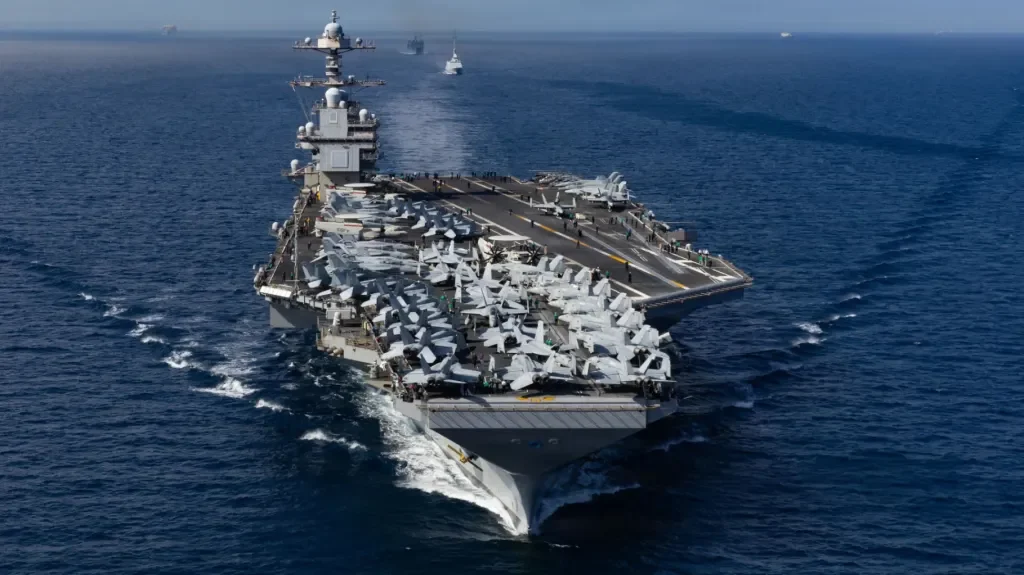
Modern carrier air wings still consist predominantly of relatively heavy crewed aircraft.
The F/A-18E/F Super Hornet, EA-18G Growler, F-35C, and E-2D Hawkeye fit comfortably within the traditional carrier aviation model.
But that could change.
The MQ-25 is already opening the door to much wider use of unmanned aircraft in U.S. carrier aviation. It could eventually be followed by reconnaissance, strike, and combat drones of various sizes.
That means a future catapult may have to handle an extremely wide range of launch weights.
Launching a 30-ton combat aircraft is one problem.
Launching a much lighter unmanned aircraft is another.
The ability to precisely control launch energy is one of EMALS’ fundamental advantages. NAVAIR specifically emphasizes the system’s ability to launch aircraft ranging from lightweight unmanned vehicles to heavy strike platforms.
This creates an interesting paradox.
The steam catapult is extremely well suited to the carrier air wing the U.S. Navy operates today.
EMALS was designed partly for an air wing that does not yet fully exist.
But the New Technology Was Far More Difficult Than Expected
On paper, everything looked excellent.
In practice, USS Gerald R. Ford became a textbook example of what can happen when too many new technologies are introduced simultaneously aboard a single warship.
New reactors.
A new electrical architecture.
New radars.
EMALS.
Advanced Arresting Gear.
Electromagnetic weapons elevators.
Problems emerged in several areas at once.
The reliability of the aviation systems proved particularly troublesome.
Even Pentagon reporting for FY2025 noted that the reliability and maintainability of EMALS and the Advanced Arresting Gear continued to negatively affect flight operations and sortie generation. Improvements were being recorded following hardware and software upgrades, but dependence on external technical support remained a concern.
So criticism of EMALS did not emerge from nowhere.
The system genuinely failed to meet its original reliability expectations.
But this is where timing becomes important.
Because the system being considered for abandonment today is no longer an experimental catapult.
EMALS Is Finally Starting to Work
USS Gerald R. Ford is operational, performs real-world missions, and its electromagnetic catapults have already conducted tens of thousands of launches.
More importantly, in February 2026 the U.S. Navy reported preliminary results from sustained flight-operation testing. According to the Navy, the combination of the Ford-class flight deck, EMALS, and Advanced Arresting Gear demonstrated improved sortie-generation performance compared with the Nimitz class.
The Navy emphasized that final analysis was still underway, but the systems were reportedly performing according to design.
That creates a rather unusual situation.
The United States spent decades developing a new technology.
It built a new aircraft carrier around it.
It encountered enormous technical problems.
It spent years fixing them.
And now, just as the system is beginning to demonstrate the capabilities for which it was originally developed, there is a proposal to turn back.
But even that is not the biggest problem.
You Cannot Simply Replace Electromagnets With Steam
Imagine that the U.S. Navy decides tomorrow that EMALS is no longer needed.
At first glance, the solution sounds simple.
Remove the electromagnetic catapult.
Install a steam catapult.
Continue building the ship.
But aircraft carriers do not work that way.
The Ford class was designed specifically around the elimination of steam catapults. Its power plant, internal spaces, electrical systems, and numerous auxiliary components were designed with EMALS in mind.
Returning to steam would require installing equipment that the ship was never intended to carry.
Steam piping would be required.
Catapult cylinders.
Valves.
Auxiliary systems.
Changes to internal compartments.
Potential structural reinforcement.
In addition, the Ford-class propulsion plant was designed with a lower requirement for steam services than the Nimitz class, precisely because the new ship was no longer expected to feed enormous steam catapults.
And this is where an old, proven technology suddenly stops being simple.
Because a simple technology installed on the wrong platform can become an extremely complicated engineering project.
USS Doris Miller Is Already Under Construction
The situation is further complicated by the status of CVN-81.
USS Doris Miller is no longer just a set of drawings. The carrier is already under construction, and significant amounts of equipment have either been ordered or are already being manufactured.
That means the design changes would not take place during the initial concept phase. They would have to be introduced after an enormous industrial program is already underway.
Those are two very different situations.
If the United States decided to build an entirely new class of aircraft carriers with steam catapults, engineers could design the power plant, internal spaces, piping, and overall architecture around them from the beginning.
Instead, the proposal is to take an existing Ford-class design and partially restore systems from the previous generation.
And aboard a ship this complicated, every modification tends to spread.
Move a pipe, and an adjacent compartment may have to change.
Add equipment, and weight increases.
Change weight, and stability and structural loads have to be reassessed.
Alter energy requirements, and other systems may need reconsideration.
And so on.
This is why returning to a familiar technology does not automatically mean lower costs.
Old Does Not Necessarily Mean Cheap
There is another problem that is easy to overlook.
American industry certainly knows how to maintain steam catapults.
But maintaining existing equipment and manufacturing entirely new systems are not the same thing.
For decades, U.S. aircraft carrier construction has been moving toward EMALS. Supply chains, personnel, contractors, and engineering expertise have gradually adapted to the new system.
Some of that process would now have to be reversed.
At the same time, support for EMALS cannot simply disappear.
USS Gerald R. Ford is already in service.
The future USS John F. Kennedy is also receiving EMALS.
USS Enterprise is being built with the same system.
The Navy will therefore have to maintain EMALS infrastructure for decades regardless of what happens to CVN-81.
If USS Doris Miller and subsequent ships return to steam, a second infrastructure will have to exist alongside it.
And that creates perhaps the most uncomfortable scenario of all.
One Carrier Class, Two Different Technologies
Under the proposal, the first three Ford-class carriers — CVN-78, CVN-79, and CVN-80 — would retain EMALS, while the change could begin with CVN-81.
That could leave ships of the same class operating two fundamentally different aircraft-launch systems.
Different spare parts.
Different specialists.
Different training programs.
Different repair procedures.
Different supply chains.
Different maintenance requirements.
Meanwhile, several Nimitz-class carriers with their own steam systems will remain in service for decades.
Instead of standardization, the U.S. Navy could end up adding yet another technological layer to its carrier fleet.
Any savings achieved through a supposedly simpler catapult could easily be absorbed by the cost of supporting multiple systems simultaneously.
Meanwhile, China Has Chosen Electromagnetic Catapults
There is also a rather ironic international dimension to the story.
When the United States began developing EMALS, electromagnetic launch technology represented one of the most advanced features of the future U.S. carrier fleet.
China has now followed a similar path.
The new Chinese aircraft carrier Fujian uses electromagnetic catapults. Moreover, a related system has also appeared on China’s new Type 076 amphibious assault ship Sichuan.
Other countries have shown interest in electromagnetic launch technology as well.
This creates a curious picture.
The United States developed the electromagnetic catapult.
Other countries began developing or acquiring similar technologies.
And the United States itself is now considering a partial return to steam.
But it would be far too simplistic to conclude that China has somehow technologically “overtaken” the United States.
The real lesson is different.
Advanced technology makes sense only when its advantages justify the complexity of operating it.
That is the real argument now surrounding EMALS.
Which Is Better: Steam or Electromagnetic Launch?
There is no universal answer.
If technological maturity and accumulated operational experience are the primary criteria, the steam catapult makes an extremely strong case.
If the future development of carrier aviation is the priority, EMALS offers significant advantages.
Steam:
— has been proven over decades;
— is well understood by Navy personnel;
— can reliably launch existing carrier aircraft;
— benefits from an enormous body of operational experience.
EMALS:
— provides more precise control of acceleration;
— offers smoother launches;
— can handle a wider range of aircraft weights;
— potentially reduces stress on aircraft structures;
— is better suited to future carrier air wings incorporating unmanned aircraft;
— is already integrated into the Ford-class electrical architecture.
This is why the central question is slightly different.
Not “Which catapult is better?”
But rather:
“Which catapult makes more sense for an aircraft carrier that has already been designed and is already being built?”
And from that perspective, the situation looks very different.
The Most Dangerous Time to Abandon a Technology
If the U.S. Navy had abandoned EMALS twenty years ago, the decision could have been interpreted as an admission that the program had failed.
If the decision had been made before construction of the Ford class began, the ships could have been designed around steam from the outset.
But the United States is now in a completely different position.
EMALS already exists.
The industrial infrastructure already exists.
Personnel are being trained.
USS Gerald R. Ford is operating the system at sea.
Additional carriers are being built around it.
Tens of thousands of launches have already been accumulated.
And 2026 testing is beginning to suggest that the new carrier architecture may finally be delivering the sortie-generation improvements it was designed to provide.
In other words, the United States risks abandoning the technology not while it is failing, but after the most painful stage of making it work may already have passed.
That fundamentally changes the economics of the decision.
Paying Twice for the Same Problem
The steam catapult is not an obsolete or useless mechanism.
Quite the opposite.
It is one of the most proven technologies in the history of carrier aviation. It has performed its mission for decades and continues to do so today.
But USS Doris Miller is not USS Nimitz.
The Ford class was designed as a new-generation aircraft carrier with a different energy architecture, different internal systems, and a much greater emphasis on electrical power. EMALS is part of that concept, not simply a device bolted onto the flight deck.
Returning to steam would therefore mean much more than changing the method used to launch aircraft.
It could mean redesigning parts of a carrier already under construction, rebuilding industrial supply chains, creating additional training and maintenance infrastructure, and introducing two different catapult architectures within the same generation of U.S. aircraft carriers.
And the most paradoxical part is the timing.
EMALS really was problematic.
It really was expensive.
Its reliability really did fall short of expectations for years.
The U.S. Navy had to invest enormous resources into making the system work.
But now it is finally beginning to perform as originally intended.
That is why the greatest risk of returning to steam is not that the steam catapult is bad technology.
The risk is that the United States has already paid an enormous price to move from steam to electromagnetic launch — and may now pay again to move back.






