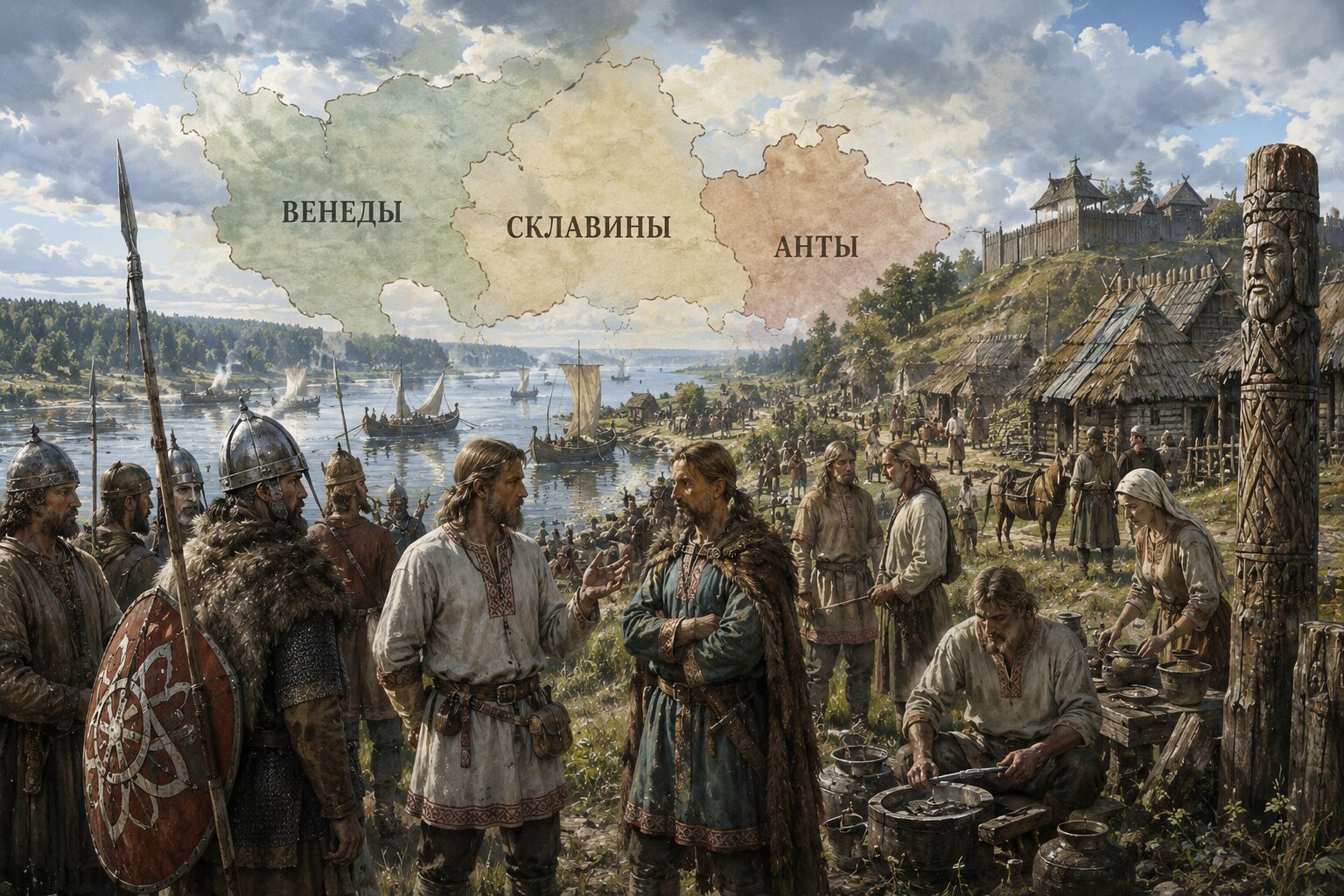
The history of the ancient Slavs is one of the strangest mysteries of Europe. A vast people who would later settle territories stretching from the Baltic to the Balkans and from the Elbe to the Volga seem to appear in written history almost suddenly. In the first centuries AD, classical authors knew very little about the Slavs. Then, within only a few generations, they begin appearing everywhere — in Byzantine chronicles, Gothic wars, raids across the Balkans, and conflicts with nomadic empires.
What makes the story even more fascinating is that these early Slavs appear in sources under several different names at once: the Venedi, the Sclaveni, and the Antes.
For centuries historians debated whether these were separate peoples or simply different names for the same Slavic world. Were they tribal unions? Regional branches? Or merely labels used by outsiders who did not fully understand the peoples living beyond the frontiers of the Roman world?
And most importantly — what ultimately happened to them?
Because today nobody calls themselves an Ant or a Sclavene anymore.
Yet from these peoples the medieval Slavic world would gradually emerge.
The Venedi — The First Shadows of the Slavs
The oldest name that many historians associate with the early Slavs is the Venedi.
Roman authors of the first and second centuries AD already mention a vast people living somewhere east of the Germanic tribes and north of the Carpathians. Tacitus described them rather vaguely, as though he himself did not fully understand whether they were Sarmatians, Germans, or an entirely separate people.
The problem was that classical geographers possessed only a very poor understanding of Eastern Europe.
To the Romans, the lands beyond the Vistula appeared almost like the edge of civilization itself — endless forests, swamps, and territories inhabited by mysterious “barbarians.” That is why the Venedi in Roman writings resemble little more than the shadow of a people only beginning to enter history.
Later, Ptolemy even referred to an entire “Venedic Sea,” likely meaning the Baltic. This suggests that the name itself had become widespread across the region.
But who exactly the Venedi were remains heavily debated.
Some historians view them as direct ancestors of the Slavs. Others argue they represented a broader collection of Eastern European tribes among whom Slavic identity was only beginning to form.
The Sclaveni — The People Who Flooded the Balkans
The true explosion of Slavic history begins in the sixth century.
It is then that Byzantine chroniclers suddenly start writing constantly about the Sclaveni.
For the Eastern Roman Empire, this became a major problem. The Balkans were overwhelmed by raids from these northern tribes. They crossed the Danube, attacked cities, looted provinces, and vanished once again into forests and marshlands.
What especially shocked the Byzantines was the Sclaveni’s style of warfare.
Procopius wrote that they did not fight like conventional armies. The Sclaveni avoided open battle whenever possible, preferring ambushes, sudden attacks, night raids, and combat in difficult terrain. They navigated forests and rivers with remarkable skill, could hide in marshes for long periods, and often disappeared immediately after striking.
For the traditional Byzantine military system, they were an extraordinarily frustrating enemy.
Even more interestingly, Byzantine authors noted the relative “democratic” nature of Sclaveni society. According to the chroniclers, they did not obey a single king but lived in tribal unions where major decisions were made collectively.
To the empire, accustomed to strict imperial hierarchy, this appeared almost chaotic.
The Antes — Eastern Slavs of the Steppe Frontier
While the Sclaveni are usually associated with the western branch of the Slavic world and the Balkans, the Antes were connected primarily with the eastern territories between the Dniester and Dnieper rivers.
In Byzantine sources, the Antes appear more organized and politically powerful than many neighboring tribes.
Their fate became deeply tied to the Great Steppe.
The Antes constantly encountered nomadic peoples — Huns, Avars, Bulgars. At times they fought them, at times allied with them, and sometimes fell under their influence. Eastern Europe in the sixth and seventh centuries was essentially a massive cauldron of peoples, languages, and cultures continuously mixing together.
This is precisely why the origins of the Slavs remain such a complicated subject.
The Slavs did not emerge “from nowhere.” The Slavic world formed within a vast region where Balts, Germans, Sarmatians, Thracians, and steppe peoples had interacted for centuries.
The Avar Blow and the Disappearance of the Antes
The most mysterious aspect of the Antes is their sudden disappearance.
By the early seventh century, they almost completely vanish from historical records.
And here another power enters the story: the Avar Khaganate.
The Avar Khaganate became one of the most terrifying forces of the early Middle Ages. Its nomadic military elite dominated enormous territories across Central and Eastern Europe. It was the Avars who dealt the Antes a devastating defeat, after which the very name of the people gradually disappeared from written sources.
But did the Antes themselves truly vanish?
Most likely — no.
Most historians believe the Antes confederation simply collapsed, while its population gradually merged into the emerging East Slavic tribal world.
In other words, the Antes did not disappear.
They became part of the future Slavic civilization.
Why the Slavs Spread Across Eastern Europe So Quickly
One of the greatest questions of early medieval history is this: why did the Slavs spread so rapidly?
By the seventh and eighth centuries, Slavic tribes occupied enormous territories.
There were several reasons for this.
First, Eastern Europe after the Migration Period had become partially depopulated. Many Germanic tribes moved into the territories of the collapsing Roman Empire, leaving large areas of forest and forest-steppe relatively open.
Second, the Slavs proved remarkably adaptable. They easily settled new lands, quickly mixed with local populations, and generally did not create rigid centralized states, which made their expansion highly flexible.
Finally, the geography of Eastern Europe itself worked in their favor. Forests, rivers, marshes, and immense open territories perfectly suited peoples accustomed to mobile lifestyles and loose tribal structures.
The People Who Changed the Map of Europe
Perhaps the most remarkable thing about the Venedi, Sclaveni, and Antes is that they left behind almost no great stone cities, monumental empires, or massive architectural wonders.
Compared to Rome, Byzantium, or Persia, the early Slavs appeared relatively poor and historically “invisible.”
And yet they would ultimately transform the map of Eastern Europe.
From these tribal unions would later emerge Poles, Russians, Belarusians, Ukrainians, Czechs, Slovaks, Serbs, Croats, Bulgarians, and many other Slavic peoples.
And that is why the Venedi, Sclaveni, and Antes are not merely forgotten names from ancient chronicles.
They are the first shadows of a civilization that would later become one of the largest cultural worlds in Europe.