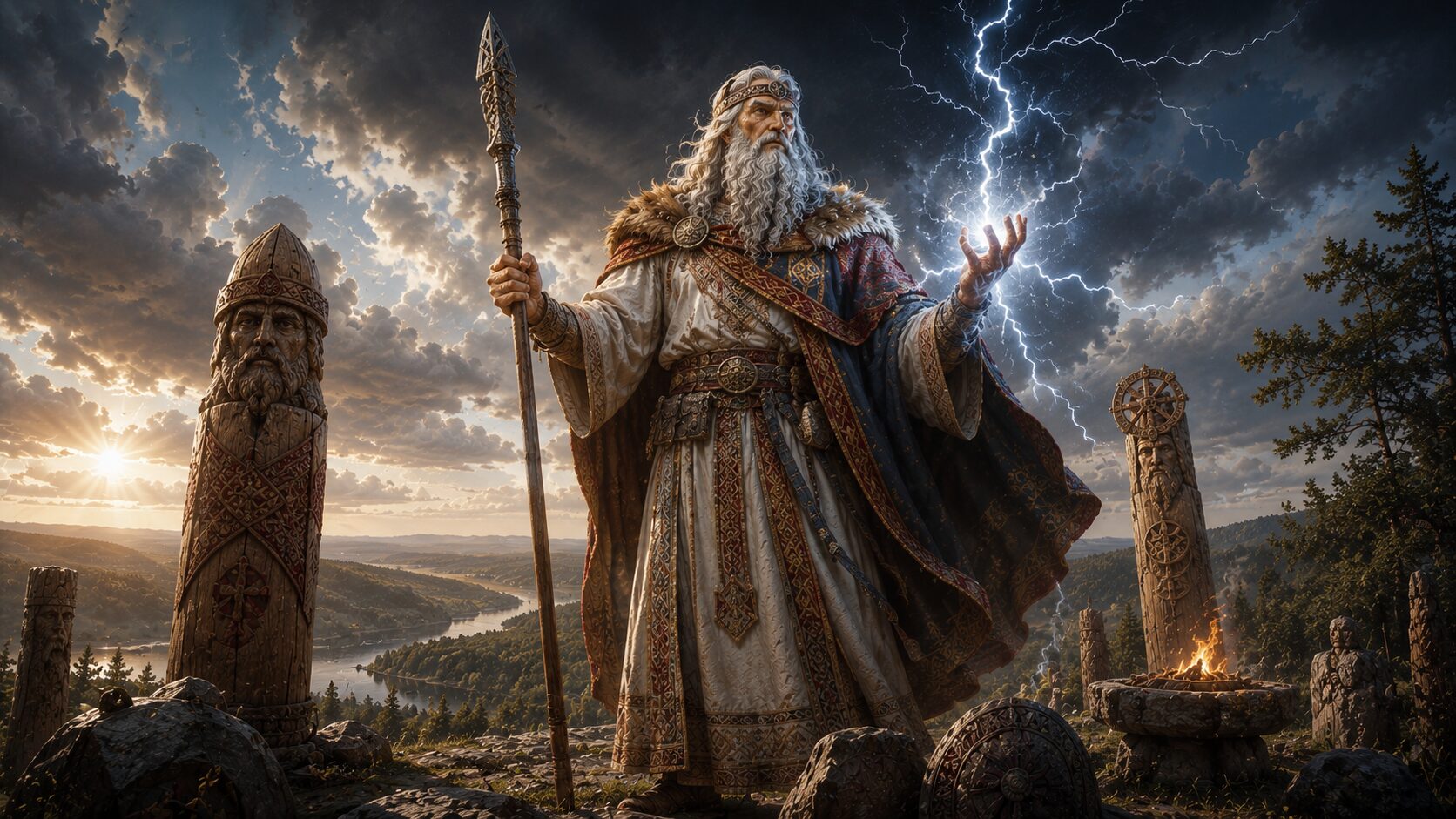
When people think of Slavic paganism, names such as Perun, Veles, or the mysterious Mokosh usually come to mind. The internet is filled with colorful diagrams featuring dozens of gods, world trees, and elaborate “Slavic runes.” Yet once we turn to historical sources, a different picture emerges—one that is both simpler and far more fascinating.
The ancient Slavs left behind no equivalent of the Bible, the Poetic Edda, or the Iliad. They wrote no sacred texts describing the creation of the world or the deeds of their gods. Everything historians know today has been painstakingly reconstructed from chronicles, Byzantine and Arab accounts, archaeological discoveries, linguistic evidence, folklore, and comparisons with other Indo-European cultures.
As a result, our modern understanding of Slavic paganism reveals a worldview far richer than the familiar list of gods found in popular culture.
Surprisingly Few Sources
The first myth worth dispelling is a simple one.
We do not know the complete Slavic pantheon.
In fact, there is good reason to believe that no single, unified pantheon ever existed.
The Slavs were not a centralized civilization with a single organized religion. They inhabited a vast territory stretching from the Elbe River to the upper Volga, and from the Baltic Sea to the Balkans. They were divided into numerous tribal confederations, including the Polans, Drevlians, Krivichs, Ilmen Slavs, Vyatichs, Radimichs, and many others. While they likely worshipped many of the same gods, local traditions varied considerably, and some deities may have been revered only within specific regions.
For this reason, historians prefer to speak not of a unified Slavic pantheon, but of the deities whose existence is firmly supported by historical evidence.
The single most important source is the pagan reform of Prince Vladimir of Kiev in 980 AD.
Before converting to Christianity, Vladimir attempted to establish a unified state cult by erecting statues of several major gods in Kiev.
This list remains our most reliable snapshot of East Slavic paganism.
Vladimir’s Pantheon
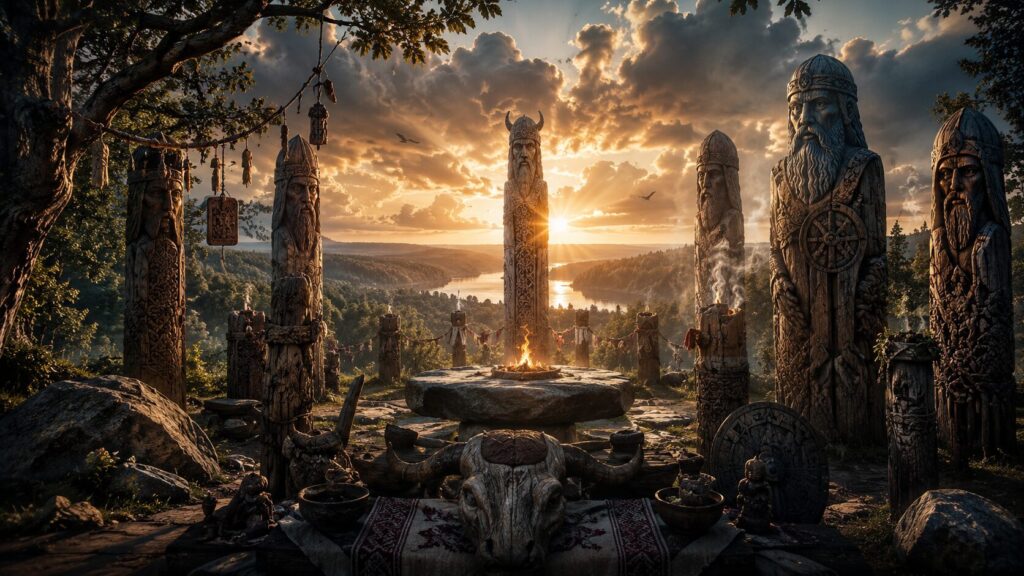
The chronicle mentions only six principal deities.
At its head stood Perun, the god of thunder, lightning, warfare, and princely authority. By the 10th century, members of the Kievan Rus’ military elite swore oaths in his name when signing treaties with the Byzantine Empire. To the warrior aristocracy, Perun was the supreme divine protector.
Beside him stood:
- Khors, probably a solar deity, possibly of Iranian origin;
- Dazhbog, the giver of light and prosperity, later remembered as the mythical ancestor of the Rus’ people;
- Stribog, lord of the winds;
- Simargl, perhaps the most enigmatic figure in the entire pantheon;
- Mokosh, the only female deity among Vladimir’s idols, associated with fertility, women’s work, and perhaps fate itself.
Yet one famous name is missing from this list.
Why Isn’t Veles Among the Idols?
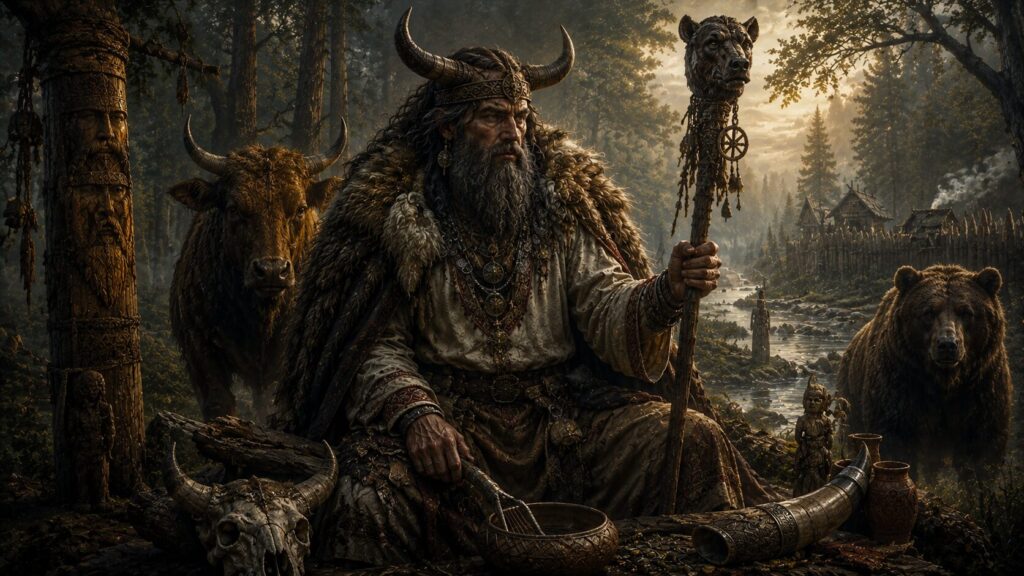
At first glance, it seems strange that Veles, one of the best-known Slavic gods, was absent from Vladimir’s official pantheon.
But this does not mean his cult was unimportant.
Quite the opposite.
Long before Vladimir’s reform, Rus’ princes swore treaties with Byzantium in the names of both Perun and Veles.
Their functions appear to complement one another.
Perun represented princely power, warfare, thunder, and celestial order.
Veles, meanwhile, governed wealth, cattle, commerce, magic, poetry, and most likely the realm of the dead.
Many modern scholars believe that the relationship between Perun and Veles formed the central mythological axis of Slavic religion.
One crucial point, however, must be emphasized.
This was not a struggle between good and evil.
A World Without the Devil
Modern religions often divide the universe into forces of absolute good and absolute evil.
Ancient Slavic belief seems to have taken a very different approach.
Perun was not the embodiment of perfect goodness.
Veles was not a Satan-like adversary.
A forest spirit could guide a lost traveler back to safety.
The same spirit might also lead another person into a deadly swamp.
A household spirit protected the family home.
But if neglected or offended, it could become dangerous.
Rusalki, water spirits, bathhouse spirits, and countless other supernatural beings found in Slavic folklore were rarely portrayed as purely benevolent or entirely malicious.
Their behavior depended largely on how humans treated them.
The universe was understood as a network of relationships rather than a battlefield between light and darkness.
Nature Was Alive
To an ancient Slav, nature was never merely a collection of resources.
It was alive.
Every river possessed its own power.
Every forest had its guardian.
Ancient oak trees were sacred.
Springs could serve as places where humans encountered the divine.
Many ordinary activities were therefore accompanied by rituals.
Offerings were made before the harvest began.
Ceremonies marked the construction of new homes.
Even cutting down an ancient tree might require a symbolic gift.
To us, these customs may appear superstitious.
To a person living in the 10th century, they represented normal and respectful relations with the living world.
The Clan Came Before the Individual
Modern society revolves around the individual.
Ancient Slavic society revolved around the clan.
The clan determined a person’s:
- ancestry;
- land;
- protection;
- memory;
- future.
An individual did not exist in isolation.
Each person formed part of an unbroken chain of generations.
Death did not sever this connection.
It merely transformed it.
The Ancestors Never Truly Left
Ancestor worship formed one of the foundations of Slavic spirituality.
The dead were not believed to disappear into some distant realm.
Instead, they remained close to their families.
Food was offered to them.
They were symbolically invited to family feasts.
Their guidance was sought during difficult times.
At the same time, they were treated with caution and respect, since angering one’s ancestors could bring misfortune.
Many modern Eastern European memorial traditions still preserve echoes of these ancient beliefs.
The Universe Was Sustained by Order
If there is one principle that unites the reconstructed Slavic worldview, it is the importance of cosmic order.
Spring follows winter.
Sowing follows plowing.
Harvest follows growth.
Thunder renews the sky.
Ancestors protect their descendants.
Descendants honor their ancestors.
As long as this natural order is maintained, the world remains stable.
Disrupting it threatens both society and nature itself.
Interestingly, similar ideas appear throughout the Indo-European world. Ancient India had the concept of ṛta, while ancient Iran spoke of asha. Although the Slavic term has not survived, the underlying worldview appears remarkably similar.
A Three-Layered Universe
One of the most convincing scholarly reconstructions suggests that the Slavs imagined the cosmos as consisting of three interconnected realms.
The Upper World belonged to the heavens.
There dwelled the sun, thunder, birds, and Perun.
The Middle World was the realm of humanity.
Fields.
Forests.
Villages.
Livestock.
Daily life.
The Lower World was associated with the earth, the roots of the cosmic tree, underground waters, the ancestors, and Veles.
From this perspective, the relationship between Perun and Veles was not one of enemies locked in eternal conflict.
Rather, it represented the interaction of two essential forces.
Without rain, crops cannot grow.
Without the earth, there is no harvest.
Without death, there can be no renewal of life.
A Hero Was Not a Saint
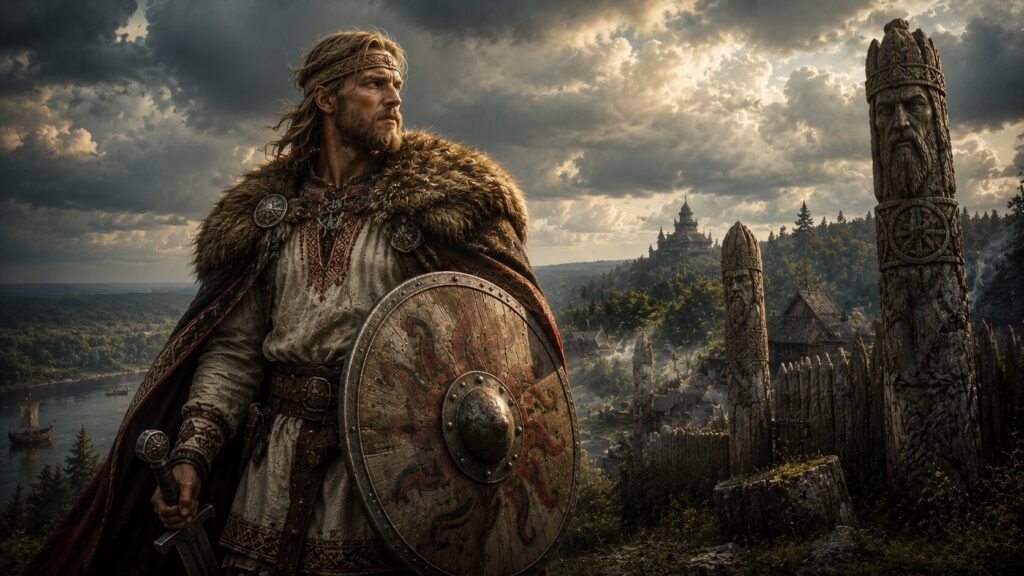
Slavic concepts of virtue also differed from later religious ideals.
A true warrior was expected to be:
- courageous;
- loyal to his word;
- generous;
- devoted to protecting his own people.
He was not expected to show universal compassion toward his enemies.
This value system closely resembled those of many early medieval Indo-European societies, from the Norse to the Celts.
Above all else stood honor.
Especially the sanctity of an oath.
Breaking one’s sworn word ranked among the gravest offenses imaginable.
Temples Were Rare
Another common misconception is that the Slavs built numerous monumental temples.
In reality, the Eastern Slavs rarely constructed large religious buildings.
Instead, sacred places were usually found in nature:
- oak groves;
- hilltops;
- springs;
- islands;
- unusual stones.
Archaeologists have discovered dozens of such sanctuaries.
Interestingly, many remained sacred even after the Christianization of Rus’.
Churches and chapels were often built on the very same sites.
Rather than erasing the old sacred landscape, Christianity frequently absorbed and reinterpreted it.
What Do We Actually Know?
This is where history ends and modern imagination often begins.
We can confidently confirm the existence of Perun, Veles, Mokosh, Dazhbog, Stribog, Khors, and several other deities.
Swarog, Rod, and the Rozhanitsy are much less securely attested.
Figures such as Lada, Lel, Yarilo, and Kupala remain subjects of scholarly debate. Some historians regard them as genuine pre-Christian deities, while others argue that they originated as later folk traditions or personifications of seasonal festivals that gradually acquired divine status.
For this reason, the elaborate “Slavic Olympuses” often found online should be viewed as modern reconstructions rather than established historical fact.
A World Far More Sophisticated Than It Appears
The deeper historians explore Slavic paganism, the clearer one conclusion becomes.
This was never a primitive religion centered merely on thunder and lightning.
Instead, it was a sophisticated worldview shaped by centuries of experience among farmers, hunters, and warriors. Nature was not something to conquer but something to live alongside. The ancestors remained active members of the community. An oath carried greater weight than written law. The highest responsibility of every individual was not to dominate the world but to preserve its balance.
Perhaps this is what makes the ancient Slavic worldview so compelling today.
It left behind no sacred scriptures or philosophical treatises. Yet even the scattered fragments that have survived reveal a remarkably coherent vision of the universe—one in which humanity, nature, the ancestors, and the gods were bound together by a web of mutual obligations.
More than a thousand years after the Christianization of Rus’, interest in Slavic paganism continues to grow—not simply because of its mysterious gods, but because it offers a glimpse into how our ancestors understood the world, and what place they believed humanity held within it.