The Sword of Ares: Why the Scythians Drove Their Akinakai into the Ground and Worshipped Weapons

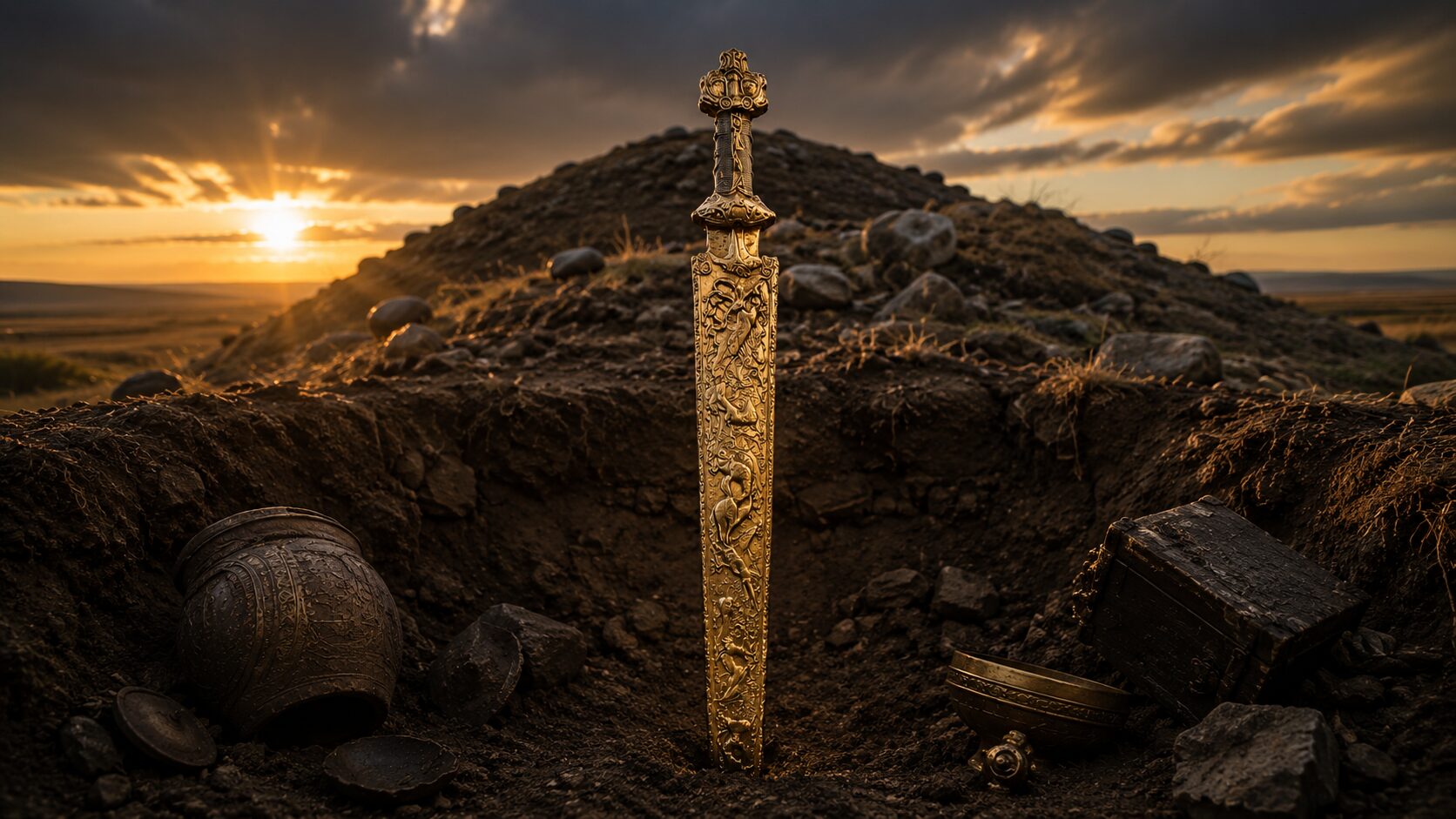
The vast steppes of the Northern Black Sea region continue to yield discoveries capable of reshaping our understanding of the ancient world. One of the most remarkable is a golden akinakes unearthed in 1968 near the village of Velyka Bilozerka in what is now the Zaporizhzhia region. Archaeologists had already recovered many luxurious Scythian weapons over the decades, yet this sword immediately stood apart.
It was not lying beside other treasures.
It was not placed in its scabbard next to the remains of its owner.
It was not arranged among the usual funerary objects.
Instead, the akinakes stood vertically, its point driven into the earth as though someone had planted it only moments before leaving the site. That extraordinary detail transformed the discovery into one of the most intriguing finds in all of Scythian archaeology. To understand the meaning of this unusual ritual, we must look not only at the weapon itself, but also at the people for whom a sword was far more than an instrument of war—it was the earthly embodiment of a god.
The Akinakes: A Sword Designed for Horsemen
The word akinakes is familiar to many students of ancient history, yet relatively few understand what kind of weapon it actually was.
Although commonly described as a sword, the akinakes occupied a position somewhere between a short sword and a long dagger by modern standards. It generally measured between 40 and 70 centimeters in length and featured a double-edged blade with a diamond-shaped cross-section. This design produced a weapon that was exceptionally strong while remaining compact.
The earliest examples appeared during the early first millennium BC and are generally associated with Iranian-speaking peoples. From there, the weapon spread widely among the Scythians, Sarmatians, Medes, Persians, and many other cultures of the Eurasian Steppe.
For a mounted warrior, it was nearly the ideal sidearm.
The Scythian composite bow remained the principal weapon of war, allowing horse archers to strike enemies from great distances while riding at full speed. But when the distance closed and combat became hand-to-hand, the akinakes took over.
Its short blade could be drawn quickly even from horseback. It did not interfere with riding equipment, allowed both thrusting and slashing attacks in close combat, and proved equally effective whether used by a mounted warrior or on foot.
It is hardly surprising that the weapon appears so frequently in the finest surviving examples of Scythian art.
The Golden Akinakes of Velyka Bilozerka
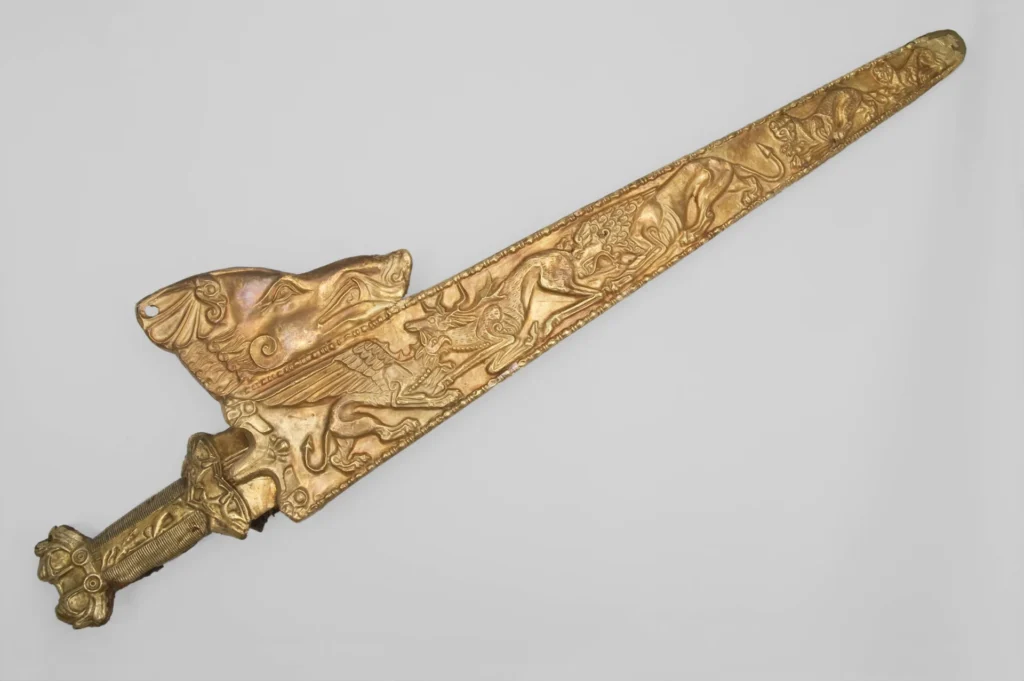
The sword discovered at Velyka Bilozerka dates to the fourth century BC—the golden age of Great Scythia.
This was the era of the famous King Ateas, who united vast territories of the Pontic Steppe under his rule. It was also the period during which Scythian goldsmiths produced masterpieces that now occupy places of honor in the world’s leading museums.
The Bilozerka akinakes perfectly reflects this flourishing civilization.
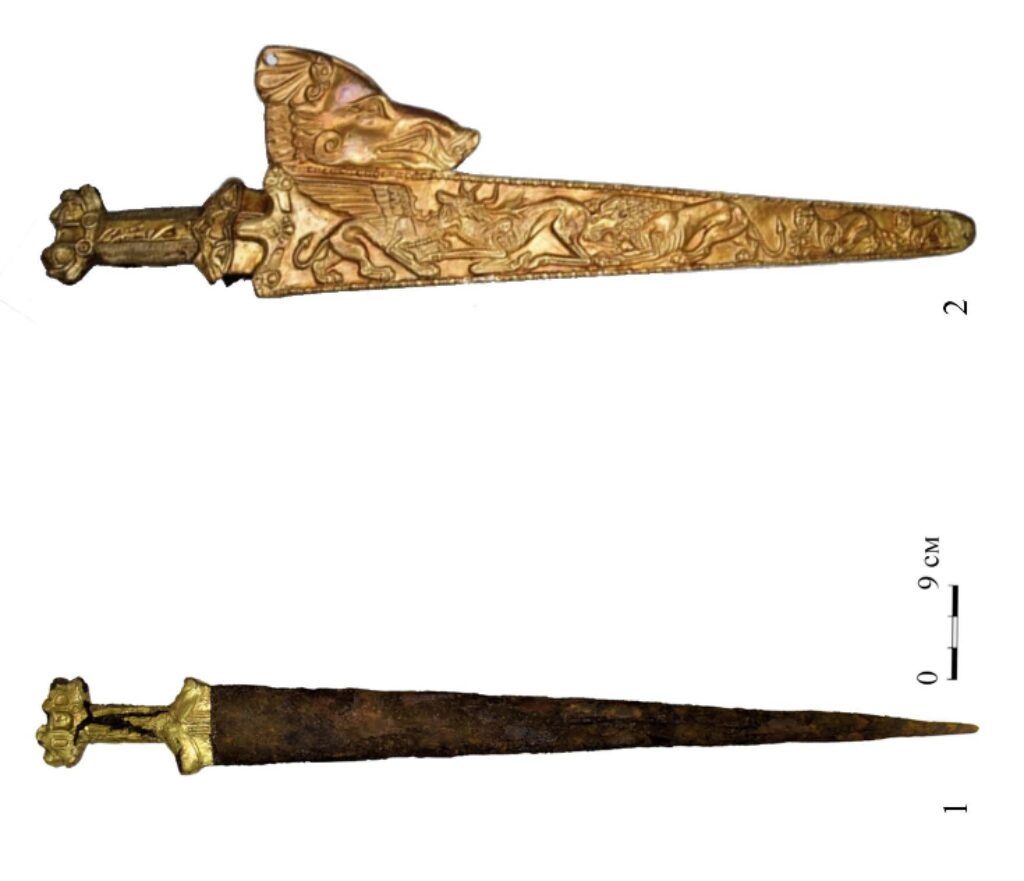
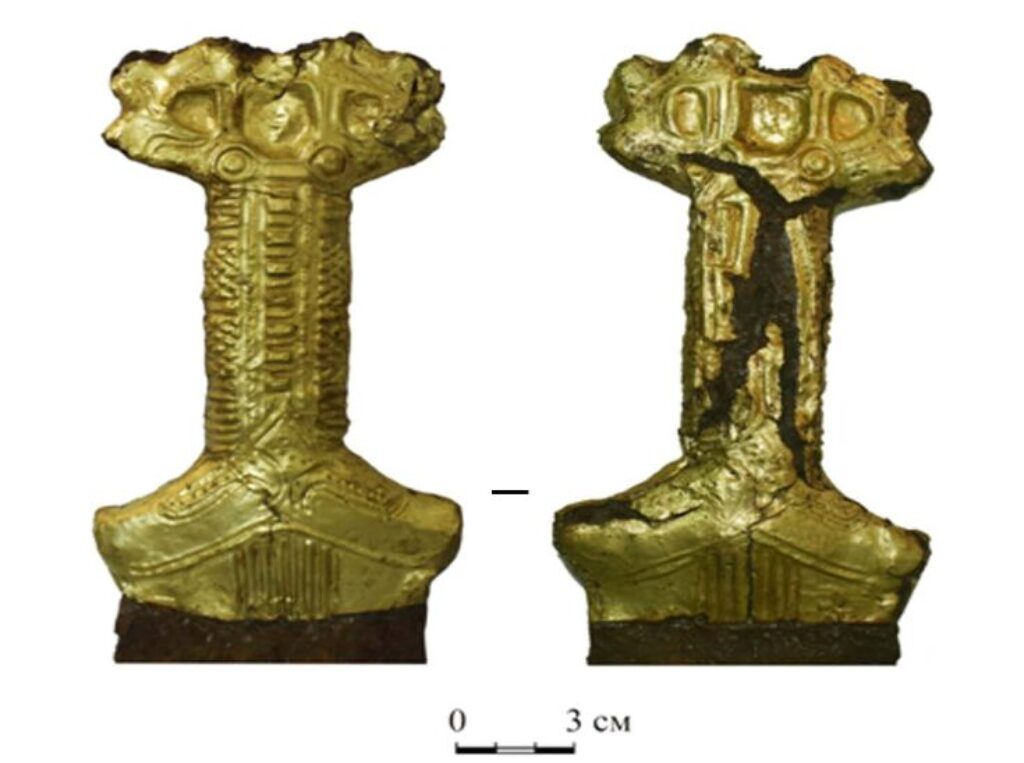
The weapon measures approximately 65 centimeters in total length, with a blade roughly 53 centimeters long. Its iron hilt ends in the characteristic antenna-shaped pommel typical of Scythian swords, while nearly the entire grip was covered with delicate sheets of gold foil.
The scabbard was no less impressive.
Its wooden core was clad in heavy gold plates decorated in the famous Scythian Animal Style. The central composition depicts a classic “predator scene,” where a lion and a griffin attack a deer.
To modern eyes, the image may appear to be nothing more than elaborate decoration. For the Scythians, however, it carried profound symbolic meaning.
The lion and griffin represented celestial power, royal authority, and divine strength, while the deer symbolized the earthly world, life, sacrifice, and renewal. Similar compositions appear throughout Scythian art, reflecting a worldview built upon the eternal struggle between opposing forces.
Nearly every researcher agrees that this was never intended to be an ordinary battlefield weapon.
Its delicate gold covering would have been far too fragile for regular combat. It most likely belonged to a member of the highest military aristocracy—a royal nobleman or perhaps an individual who combined both military and priestly authority.
A People Who Worshipped a Sword
Perhaps the most remarkable feature of Scythian culture was not its extraordinary wealth, but its religion.
For the Scythians, the supreme symbol of the god of war was not a statue.
It was an actual iron sword.
The Greek historian Herodotus described this unusual practice during the fifth century BC. According to his account, the Scythians built very few temples and rarely created statues of their gods. The sole exception was the deity whom Greek writers identified with Ares.
His sanctuary was unlike anything found elsewhere in the ancient world.
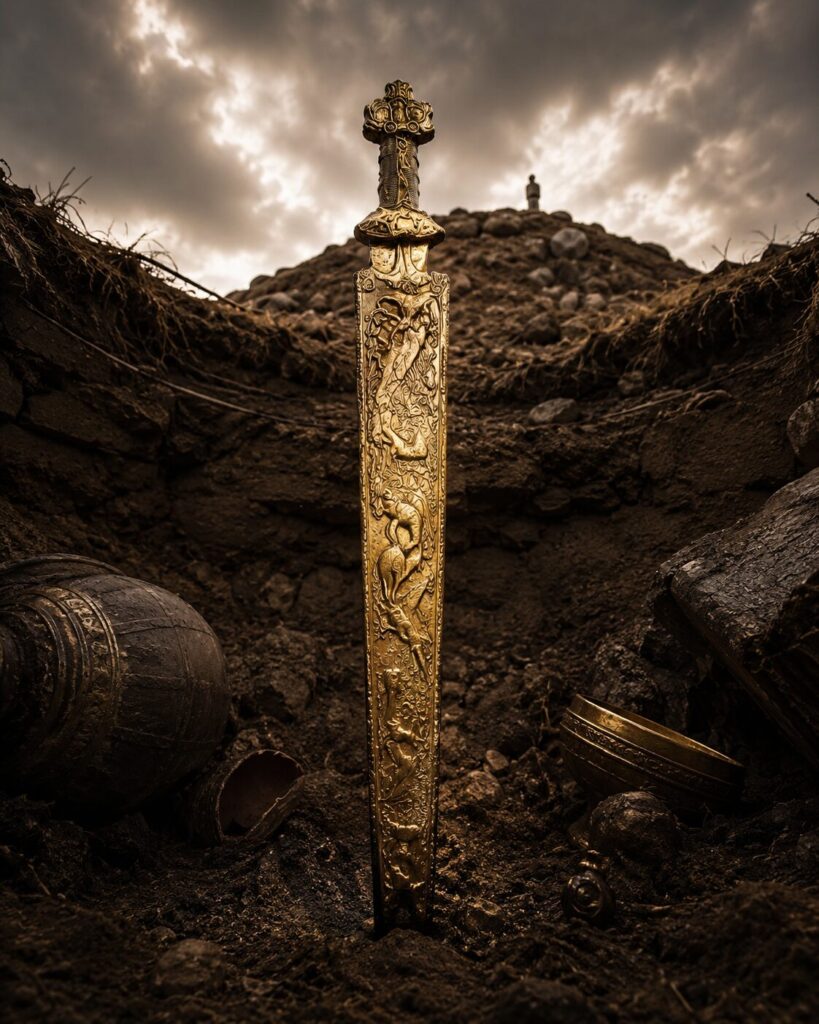
On top of a great mound constructed from brushwood and earth, the Scythians planted an ancient iron sword. That sword itself became the object of worship. Sacrifices were offered before it, religious ceremonies were performed around it, and the weapon was regarded as the physical manifestation of the god.
Few religious traditions of antiquity were quite like it.
The Egyptians worshipped statues.
The Greeks filled magnificent temples with marble sculptures.
The Persians tended sacred fires.
The Scythians worshipped a weapon.
Within this remarkable tradition lies a perfect reflection of a society whose entire way of life revolved around warfare, horses, and the endless steppe.
Why Was the Sword Standing Upright?
It is at this point that the discovery at Velyka Bilozerka takes on an entirely new significance.
The vertical position of the sword can hardly be explained as accidental.
Several interpretations have been proposed.
The first draws directly from Herodotus. The sword may have been deliberately planted in the ground in exactly the same manner as the sacred swords described at Scythian sanctuaries. If so, archaeologists may have uncovered not simply an expensive weapon, but the remains of an ancient religious ritual.
A second interpretation reaches even deeper into Indo-European mythology.
Across many ancient cultures, an upright object symbolized the Axis Mundi—the cosmic pillar connecting heaven, earth, and the underworld. In this interpretation, the sword’s point penetrated the earth while its hilt reached toward the sky, transforming the weapon into a symbolic bridge between the different layers of the universe.
A third possibility is equally compelling.
Its owner may have deliberately offered his sword to the god of war, surrendering it forever as a sacred object rather than retaining it as personal property.
Whatever the correct explanation may ultimately prove to be, one conclusion is clear.
The position of the sword was intentional. It reflects a sophisticated religious tradition that archaeology is only beginning to understand.
Great Scythia: Far More Than a Land of Nomads
Modern popular culture often portrays the Scythians as little more than wandering horsemen endlessly crossing the Eurasian steppe.
The reality of the fourth century BC was far more complex.
During the reign of King Ateas, Great Scythia controlled enormous territories stretching from the Danube to the Don River. Major trade routes crossed its lands, linking the Greek colonies of the Black Sea with the heart of the Eurasian interior.
The Scythian elite accumulated immense wealth.
As a result, archaeologists continue to discover magnificent gold ornaments, weapons, horse harnesses, and jewelry produced by craftsmen of extraordinary skill. Many of these masterpieces were created by Greek artisans working for Scythian patrons, producing a unique fusion of Hellenic craftsmanship and steppe symbolism.
The Bilozerka akinakes stands among the finest examples of this artistic tradition.
Within a single object, it unites the military culture, religious beliefs, royal ideology, and artistic brilliance of one of antiquity’s greatest nomadic civilizations.
Why This Discovery Still Matters
Archaeologists have uncovered dozens of magnificent Scythian swords over the past two centuries.
Yet the Bilozerka akinakes is valuable for reasons that extend far beyond its gold.
Its greatest importance lies in the preservation of its original ritual context.
Because the weapon remained standing exactly as it had been placed, researchers were given a rare opportunity to glimpse an ancient religious ceremony frozen in time for nearly 2,400 years.
Discoveries like this continue to transform our understanding of the Scythians.
Rather than the stereotypical “barbarian nomads” described in many ancient accounts, they emerge as the creators of a sophisticated civilization with a highly developed military tradition, complex religious beliefs, extraordinary artistic achievements, and a distinctive philosophy of war.
The golden akinakes of Velyka Bilozerka remains one of the clearest symbols of that forgotten world—a world in which a sword was not merely a weapon, but the earthly embodiment of the god of war himself.