“A Dead Language” That Conquered Half the World: How Latin Actually Died

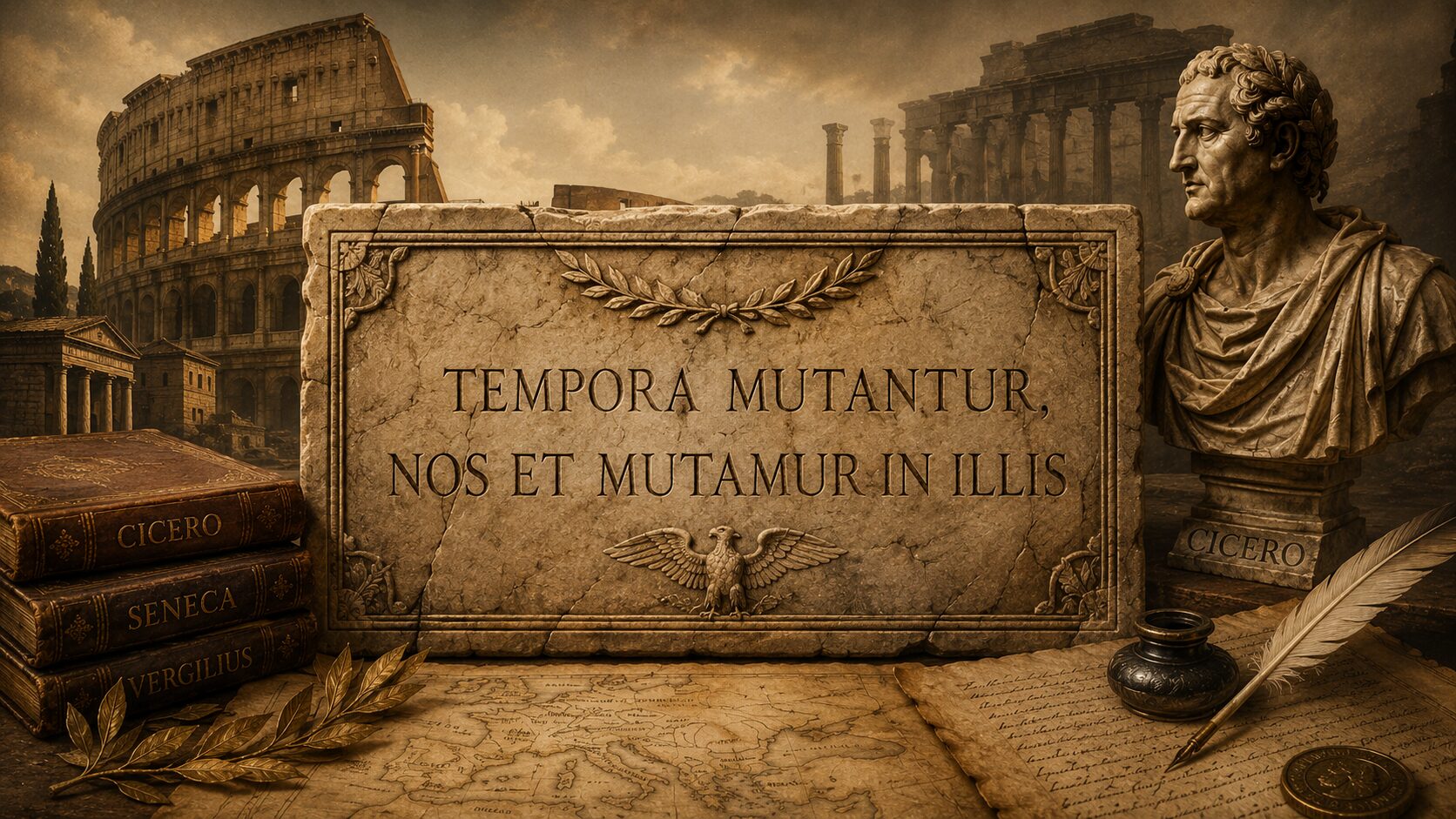
Today, Latin is called a “dead language.” You no longer hear it in city streets, in noisy marketplaces, or in everyday arguments between neighbors. No new dialects grow from it, no folk songs emerge in it, and no children learn it naturally from their parents. For modern people, Latin is mostly the language of ancient books, medical terminology, Catholic liturgy, and mysterious inscriptions carved above university gates.
And yet there is a strange paradox at the center of its story.
This “dead” language is still alive almost everywhere.
Every day, hundreds of millions of people use words born in the Latin world. Spanish, French, Italian, Portuguese, Romanian — all are children of Latin. Even English, formally a Germanic language, is saturated with Latin and French vocabulary. Law, medicine, biology, philosophy, the Catholic Church, and much of European science existed for centuries primarily through Latin.
Which creates a remarkable contradiction: a language considered dead became one of the most enduring linguistic forces in human history.
And perhaps the real mistake lies in the question itself. Latin did not die suddenly the way a state collapses or a civilization disappears. It slowly fragmented, transformed, dissolved into new forms, and gave birth to entire families of languages while continuing to shape Western culture long after the Roman Empire vanished.
The death of Latin is, in many ways, the story of the birth of Europe itself.
A Language Already Splitting Apart in Caesar’s Time
Modern people often imagine Ancient Rome as a civilization speaking one unified, elegant “classical Latin” — the polished language of Cicero and Virgil. In reality, even during the lifetime of Julius Caesar, Latin already existed in two very different forms.
The first was Classical Latin — the language of the elite, senators, lawyers, philosophers, literature, and official state documents. It was carefully regulated, grammatically complex, and deliberately conservative. This was the Latin later taught in medieval schools and Renaissance universities.
But alongside it existed another Latin entirely — living Latin.
It was known as vulgar Latin, the language of ordinary people. Soldiers, merchants, craftsmen, colonists, and provincial populations spoke it daily. This was the Latin heard in Roman camps in Britain, in Gallic marketplaces, in Spanish ports, and in North African cities.
And it was changing constantly.
Every spoken language evolves differently from literary language. People simplify difficult constructions, shorten words, and abandon complicated grammatical systems. Case endings gradually weaken. Prepositions replace older structures. Pronunciation shifts from region to region.
Literary Latin tried to remain fixed.
Spoken Latin evolved without pause.
That became the core problem.
The Roman Empire expanded too quickly. Latin spread across immense territories — from Britain to Syria, from the Rhine to the Sahara. And in every region, the language began developing in its own direction.
A legionary from Gaul could still understand a trader from Spain, but both already sounded very different from the refined speeches of Cicero.
In other words, Latin began splitting apart at the exact moment it reached the height of its power.
How Rome Itself Destroyed Its Common Language
Every empire depends not only on armies and taxes, but on communication. As long as Roman roads functioned, officials traveled freely, and the imperial administration maintained centralized control, the Latin-speaking world remained relatively unified.
But beginning in the 3rd century, the Roman Empire entered a long crisis.
Civil wars, economic collapse, invasions, declining trade, and crumbling infrastructure slowly tore apart the imperial system. After the formal division of the empire in 395, the process accelerated dramatically.
Interestingly, the Germanic invaders did not directly destroy Latin. As historian Peter Heather has noted, groups such as the Visigoths, Franks, and Vandals were relatively small in number and often sought to integrate themselves into Roman civilization. They adopted Roman titles, administrative systems, laws, and elements of Roman culture.
But political unity vanished.
And with it disappeared the linguistic center holding Latin together.
The provinces gradually evolved into separate worlds. Gaul slowly transformed into medieval France. Iberia developed into the future Spain and Portugal. Italy fragmented among competing rulers. Dacia evolved in near isolation from the western Latin world.
And in every region, spoken Latin continued evolving independently.
Without television.
Without mass education.
Without centralized institutions.
Without a standard language authority.
People no longer spoke the language of Cicero. They spoke local descendants of Roman speech.
The Moment People Stopped Understanding Latin
One of the most fascinating things about Latin is that historians can identify the moment when the language of the Church and the language of ordinary people finally became separate realities.
By the 8th and 9th centuries, the gap between Classical Latin and spoken speech had become enormous. Common people could barely understand sermons delivered in traditional Latin.
And then came the event that effectively acknowledged the death of spoken Latin.
In 813, the Council of Tours officially declared that priests should preach not in Latin, but in the “rustic Roman language” or local Germanic dialects so ordinary believers could actually understand the message.
This was a historic turning point.
The Church itself had admitted:
Latin was no longer the language of the people.
An even more symbolic event followed with the famous Oaths of Strasbourg.
The grandsons of Charlemagne — Charles the Bald and Louis the German — swore loyalty to one another not in Latin, but in early forms of Old French and Old High German.
For linguists, this was almost the birth certificate of a new Europe.
Because at that moment it became undeniable:
the Romance languages were no longer merely “corrupted Latin.”
They had become independent languages.
Why Latin Did Not Die With Rome
And yet it would be wrong to say Latin truly disappeared.
Paradoxically, once it stopped being a spoken language, its influence became even greater.
Medieval Europe transformed Latin into the universal language of science, education, diplomacy, and intellectual life. Theologians, lawyers, physicians, alchemists, and philosophers all wrote in Latin. Universities in Paris, Bologna, and Oxford operated through it. Even a thousand years after the fall of Rome, European scholars from different countries could still communicate because of Latin.
In many ways, it became the intellectual internet of the medieval world.
It was in Latin that figures such as:
Isaac Newton,
Nicolaus Copernicus,
and Carl Linnaeus published their works.
Even after Europe had long switched to French, English, Spanish, and Italian in daily life, educated elites still thought through a Latin educational framework.
The Roman Empire had vanished.
Its language continued ruling European thought.
The Language That Became Too Successful
So why did Latin disappear as a living spoken language?
The answer is deeply ironic:
it died because it succeeded too well.
No ancient language spread so widely or so deeply across such enormous territories. Latin crossed continents, cultures, and peoples. But maintaining a single unified language across that space without modern technology proved impossible.
Every region reshaped speech in its own way.
Every generation simplified the language.
Every province drifted further from the old standard.
Eventually spoken Latin fragmented into entirely new languages:
— Italian;
— Spanish;
— French;
— Portuguese;
— Romanian;
— Catalan;
— and many others.
Interestingly, many linguists consider Sardinian the closest surviving descendant of spoken Latin because of its relative isolation.
Which creates another remarkable truth.
Latin did not disappear.
It simply stopped being one language.
The Final Irony of Latin
Today, no nation speaks Latin as its native tongue. Officially, it retains state status only in Vatican City, where it is still used in documents and liturgy by the Catholic Church.
And yet billions of people continue living inside its legacy.
Every time someone speaks Spanish or French, uses a medical term, reads a legal phrase, or notices a Latin inscription above an old university entrance, they encounter fragments of Rome.
And perhaps that is the greatest irony in the story.
Latin is called a dead language.
But very few languages, after “dying,” have ever managed to shape the world so profoundly.