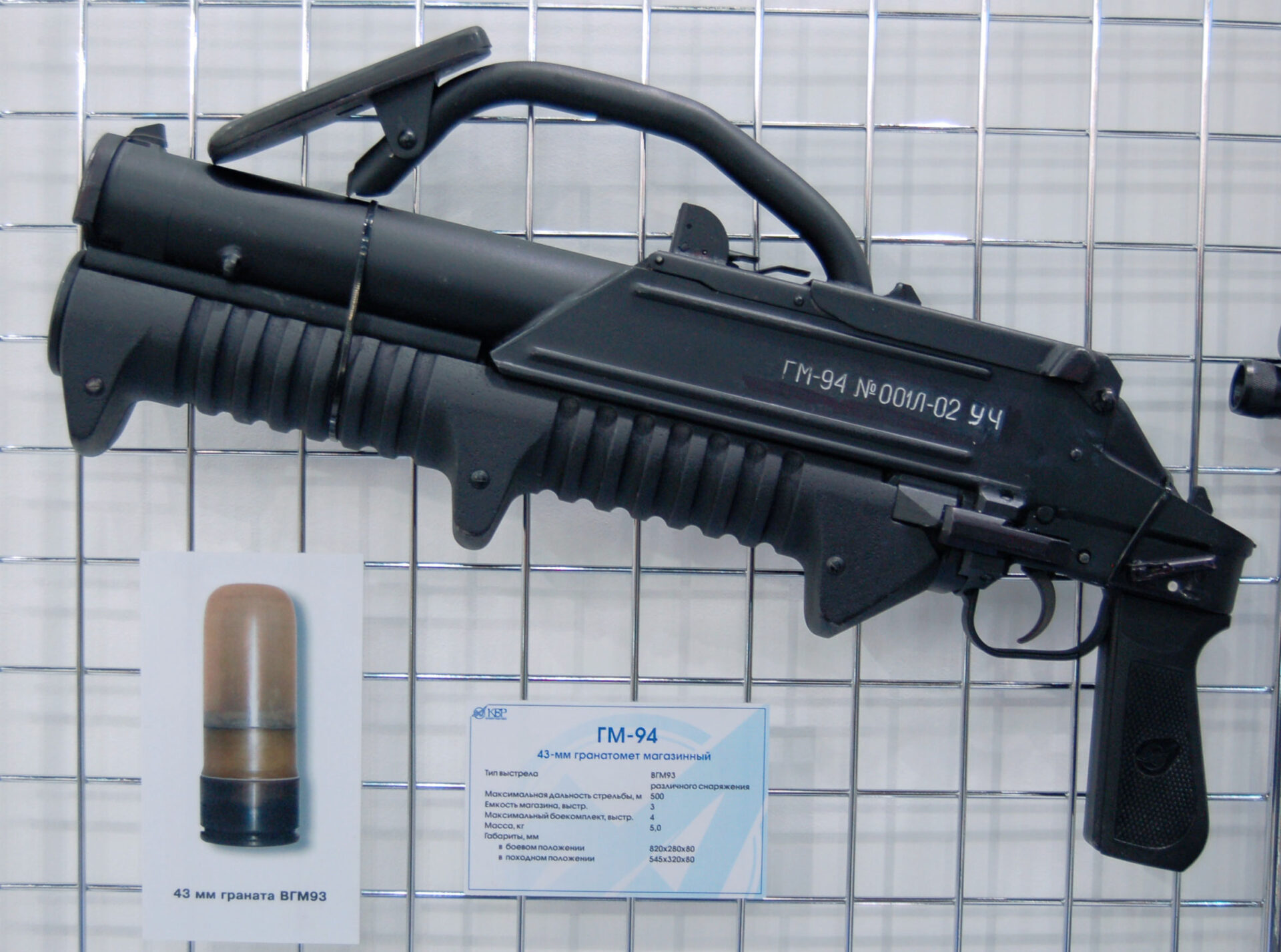
When manufacturers claim that their weapon has “no analogues,” such statements are usually met with a healthy dose of skepticism. In the modern world of small arms, most technical solutions have long been explored, and new weapons are often little more than refinements of existing concepts. Yet every so often, a genuine exception appears. The Russian GM-94 grenade launcher is one of those rare cases.
Developed in the late 1990s by the Tula Instrument Design Bureau (KBP), the GM-94 features such an unusual design that even more than twenty-five years later it remains a truly unique example of firearms engineering. Moreover, recent combat experience has shown that many of the ideas incorporated into the weapon during the era of local conflicts in the North Caucasus have proven remarkably relevant on today’s battlefield.
Neither a Revolver Launcher Nor an Underbarrel System
The history of multi-shot grenade launchers began long before the GM-94 appeared. During the second half of the twentieth century, militaries around the world realized that traditional single-shot underbarrel launchers could not always provide the required volume of fire, particularly during urban combat and special operations.
The most famous representative of the new generation was the South African Milkor revolver grenade launcher, which later inspired numerous foreign variants. Its design provided a high rate of fire and substantial ammunition capacity, but it also had drawbacks. The large-diameter cylinder made the weapon bulky and wide, while its weight reduced comfort during prolonged carry.
Russian engineers chose a completely different path. Instead of a revolving-cylinder design, they created a compact pump-action grenade launcher with a tubular magazine resembling that of a shotgun. However, the similarities ended there.
The Most Unusual Feature
The GM-94’s defining characteristic lies in its operating mechanism.
In most pump-action shotguns and grenade launchers, the fore-end moves to cycle the action. In the GM-94, the barrel itself moves.
This became one of the most unusual solutions ever adopted in a modern grenade launcher.
After firing, the shooter pushes the barrel forward. The spent casing is ejected downward, while a new round is fed from the tubular magazine mounted above the barrel. The barrel is then pulled back into position, and the weapon is ready to fire again.
At first glance, the mechanism may seem unnecessarily complicated. In reality, it allowed designers to significantly reduce the weapon’s overall length. Unlike conventional systems, there was no need to reserve space for a long bolt carrier and its travel.
The result was an exceptionally compact grenade launcher for its class.
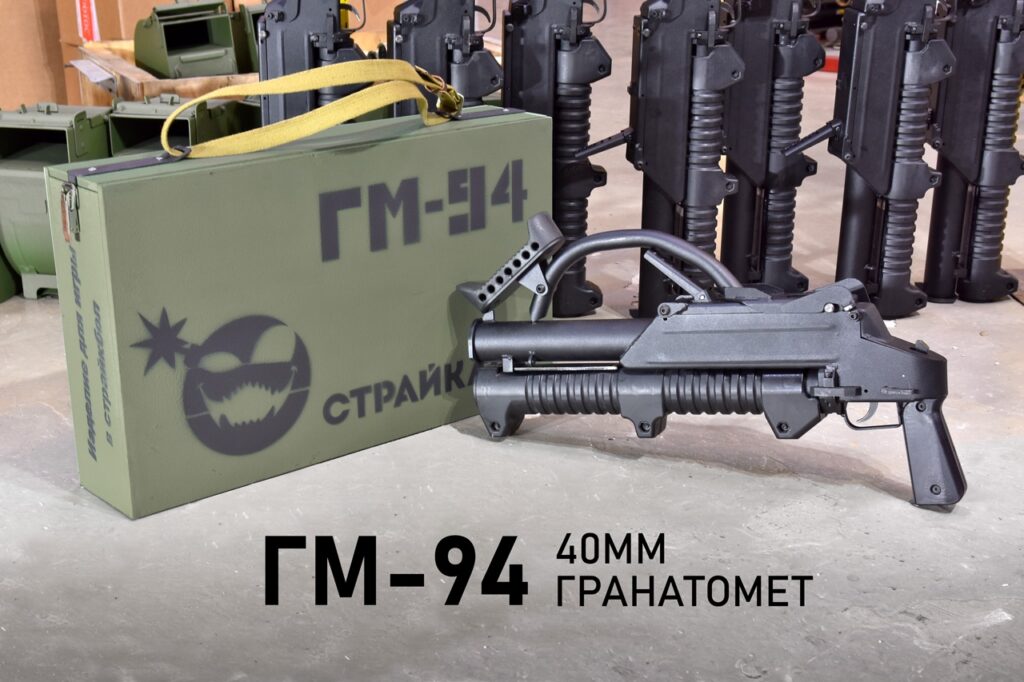
The layout is equally interesting. The rifled 43 mm barrel is positioned below, while the three-round tubular magazine sits above it. The stock folds upward and doubles as a carrying handle when folded. Importantly, the weapon can still be fired with the stock folded, making it useful when operating from vehicles or in confined spaces.
A Weapon Built for Assault Teams

Compactness became one of the GM-94’s greatest strengths.
In combat, assault troops often operate in stairwells, basements, trenches, and narrow corridors. In such environments, every extra centimeter of weapon length becomes a disadvantage. For this reason, the GM-94 was specifically designed with urban combat and fortified positions in mind.
The sighting system is also noteworthy. The rear sight automatically flips into firing position when the stock is unfolded. This simple solution eliminates unnecessary actions and improves handling speed.
Controls are kept to an absolute minimum. The launcher features only an ambidextrous safety lever, while the trigger mechanism operates in double-action mode. In the event of a misfire, the shooter can immediately pull the trigger again without manipulating the action. It is also possible to safely unload a round without firing it, a useful feature for a weapon of this type.
The designers paid particular attention to safety. Since the shooter’s support hand remains on the barrel assembly during reloading, the barrel is enclosed within a large heat shield featuring deep ribbing and prominent stops that prevent the hand from slipping forward.
The Ammunition That Made the GM-94 Famous
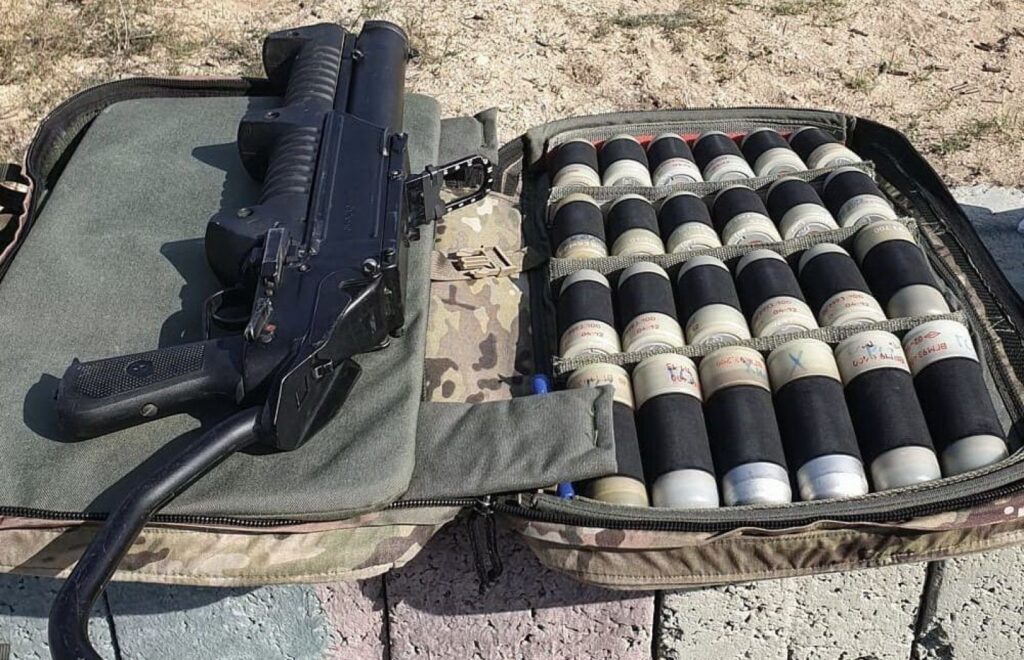
Although an entire family of ammunition types was developed for the launcher, the weapon became best known for its thermobaric rounds.
Unlike conventional fragmentation grenades, a thermobaric warhead creates its destructive effect through a powerful pressure wave and extreme heat. Such ammunition is especially effective against enemies located inside buildings, bunkers, trenches, and other protected positions.
This capability proved highly valuable for assault units.
At the same time, the absence of large, high-velocity fragments reduces the risk of injuring friendly troops at close range, a critical advantage during urban operations.
However, the GM-94 is far more versatile than a simple thermobaric launcher. Its proprietary 43 mm ammunition family includes smoke, illumination, training, less-lethal, and irritant rounds. This versatility has made it useful not only for military forces but also for law enforcement and special operations units.
Why It Remains Relevant
Compared to automatic grenade launchers or heavy rocket systems, the GM-94’s specifications may appear modest. Its magazine holds only three rounds, with a fourth chambered in the barrel. Yet the weapon was never intended to compete with heavy support systems.
Its mission is to accompany assault teams directly on the front line, providing immediate firepower against targets in buildings, bunkers, trenches, and other fortifications.
Over years of service, the GM-94 has earned a reputation as a simple, reliable, and rugged weapon. The unusual moving-barrel system, once considered an overly ambitious engineering experiment, has proven itself in real-world conditions.
As a result, the GM-94 remains a rare example of a weapon that does not merely differ from foreign designs—it represents an entirely separate branch in the evolution of multi-shot grenade launchers. Many weapons are successful. Very few are instantly recognizable. The GM-94 belongs firmly in the latter category.
GM-94 Technical Specifications

Type: Multi-shot pump-action grenade launcher
Developer: Tula Instrument Design Bureau (KBP)
Entered Service: 1994–1995
Caliber: 43 mm
Ammunition: VGM-93 family of grenade rounds
Operating System: Manual action with moving barrel
Magazine Capacity: 3 rounds in tubular magazine + 1 chambered
Length (stock extended): 810 mm
Length (stock folded): 540 mm
Weight (unloaded): Approximately 4.8 kg
Effective Range: Up to 300 m
Maximum Range: Up to 600 m
Practical Rate of Fire: Up to 20–25 rounds per minute
Available Ammunition Types: Thermobaric, smoke, illumination, less-lethal, irritant, and training rounds
The Key Advantage
The GM-94’s greatest strength is its successful combination of compact dimensions, reliability, and highly effective thermobaric ammunition. Thanks to its unusual moving-barrel design, Russian engineers created a grenade launcher that is equally effective in urban combat and assaults on fortified positions. Although it was developed more than a quarter-century ago, the weapon is experiencing a second life today and remains one of the most distinctive and recognizable grenade launchers ever produced in Russia.