The U.S. Is Building the $185 Billion Golden Dome. So Why Has Congress Already Calculated $1.2 Trillion?

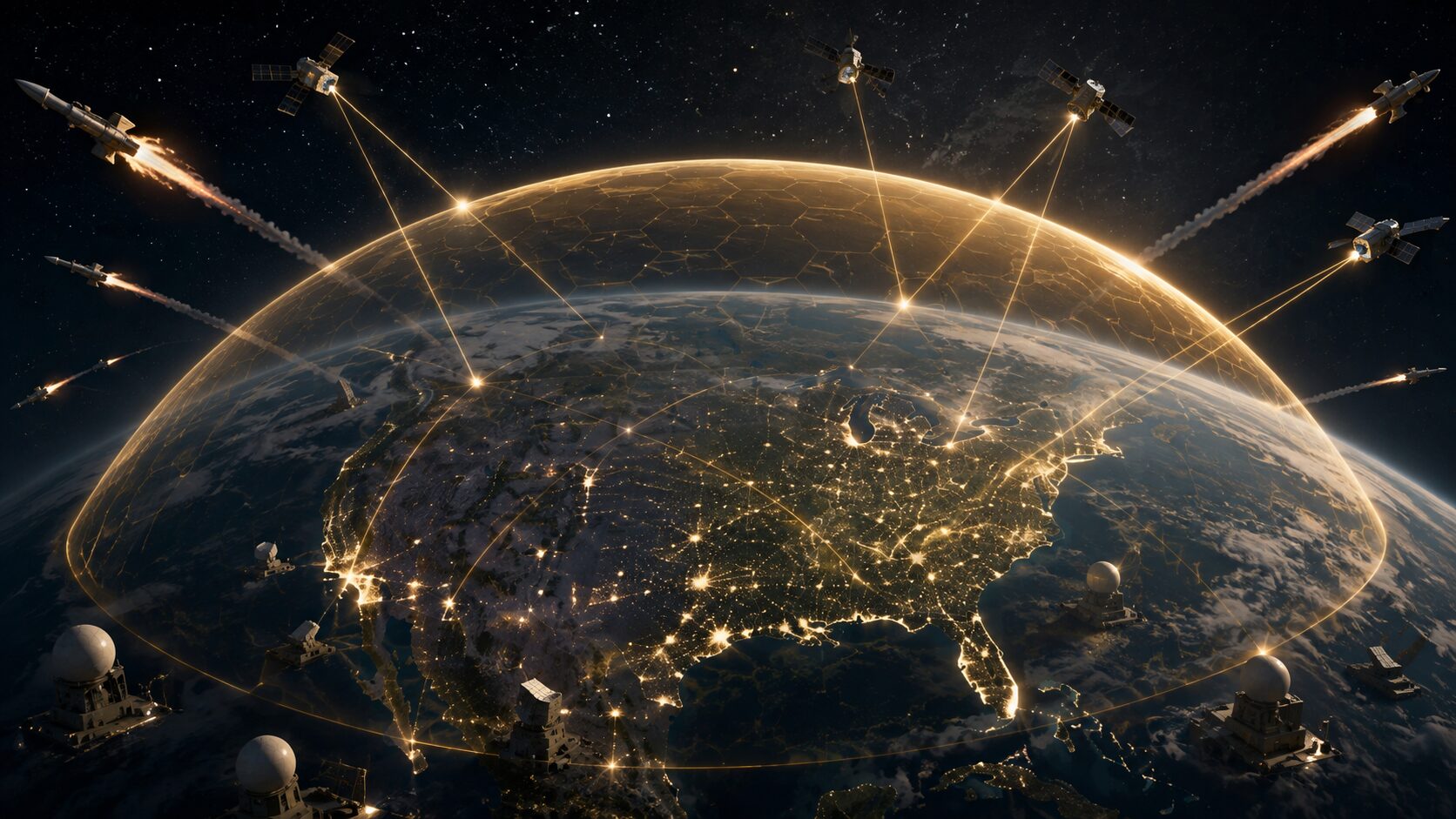
In May 2025, Donald Trump announced one of the most ambitious defense projects in modern American history. The United States was to receive Golden Dome — a missile-defense shield designed to protect the country against ballistic, hypersonic and cruise missiles. The program was initially estimated at around $175 billion, later rising to $185 billion, while the U.S. military hopes to field its first capabilities as early as the summer of 2028.
Work has already begun. Tens of billions of dollars have been allocated, contracts are being awarded, new detection systems are being developed, space-based interceptors are under consideration, and the military is conducting integrated tests of elements that could eventually become part of the architecture. Golden Dome is no longer just a collection of presidential slides — the enormous machinery of the American defense industry has started moving.
And then another number appears.
$1.2 trillion.
That is how much, according to an August 2026 estimate by the Congressional Budget Office, the development, deployment and operation over twenty years of a national missile-defense system with capabilities broadly similar to those envisioned for Golden Dome could cost.
The result looks rather strange. The White House talks about $185 billion. The CBO calculates more than six times that amount. Meanwhile, money has already been appropriated and contracts are moving forward, yet Golden Dome program manager Gen. Michael Guetlein has warned that a congressional budget impasse could effectively bring work to a halt.
How can a project already receiving tens of billions of dollars suddenly run out of money? And how can a system costing $185 billion simultaneously cost $1.2 trillion?
There is not necessarily a contradiction.
Behind the attractive Golden Dome name lies one of the most difficult engineering challenges the United States has ever attempted.
And America tried to do something remarkably similar more than forty years ago.
What Exactly Is Golden Dome?
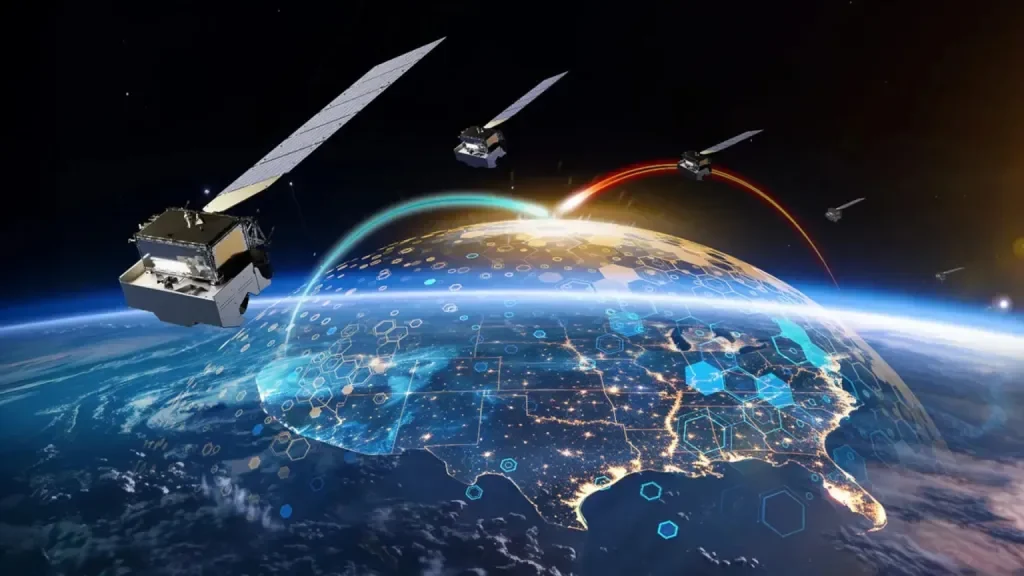
The name is somewhat misleading. There will obviously be no physical “dome” covering the United States. Golden Dome is not a single weapon system like Patriot, or even a single defensive layer like Israel’s Iron Dome. It is intended to become a vast network connecting detection systems, command centers, satellites, radars and several types of interceptors into one integrated architecture.
On a diagram, the mission looks relatively straightforward. The system detects a missile launch, identifies the threat and its trajectory, determines whether it is heading toward a protected target, passes that information to the appropriate defensive weapon and destroys the incoming missile. In reality, all of this has to happen within minutes, while some decisions may need to be made almost instantaneously.
The problem becomes even more complicated because missiles are very different from one another. An intercontinental ballistic missile spends much of its flight high above the Earth before its warhead descends toward the target at enormous speed. A cruise missile can instead fly at low altitude, exploiting terrain and the curvature of the Earth to remain hidden. A hypersonic glide vehicle can maneuver through the atmosphere, making its future position more difficult to predict.
There is no single radar and no single interceptor capable of dealing optimally with all of these threats. Golden Dome therefore has to become a system of systems: space-based sensors, land- and sea-based radars, satellite communications networks, existing missile-defense systems and entirely new interceptors all working as a single organism.
In effect, the United States wants to build a missile-defense internet spanning an entire continent.
And once the problem is viewed that way, the initial $185 billion begins to look very different.
The Problem Starts With the Size of America
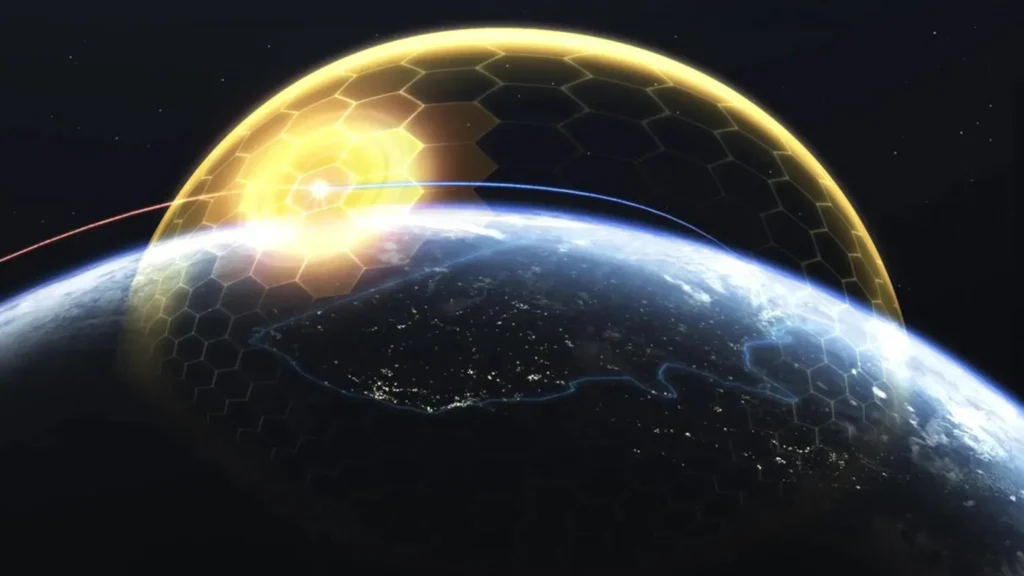
The name Golden Dome inevitably invites comparisons with Israel’s Iron Dome, but directly comparing the two systems makes little sense. Israel is a relatively small country. The United States covers almost 10 million square kilometers.
That alone radically changes the scale of the required infrastructure.
The threats are different as well. Iron Dome was developed primarily to intercept relatively simple short-range rockets. An American national defense system would have to contend with intercontinental ballistic missiles, hypersonic weapons and cruise missiles, among other threats.
Protecting the United States therefore cannot be accomplished simply by placing several dozen batteries around major cities. Vast areas have to be monitored, including approaches through the Arctic, across the Pacific and Atlantic, as well as potential routes that could be exploited by low-flying cruise missiles.
That inevitably makes space one of the first layers of the system.
And this is where the most expensive part of the story begins.
Why Thousands of Space-Based Interceptors Appear in the Calculations
One of the most unusual concepts associated with Golden Dome is the deployment of interceptors in space.
The logic is perfectly rational. A ballistic missile is particularly attractive as a target during the early stages of flight, when it is large, hot and highly visible, and before it has released warheads and penetration aids.
Then orbital mechanics enters the equation.
A satellite cannot simply be parked above a potential launch area and ordered to wait. A spacecraft in low Earth orbit is constantly moving around the planet at several kilometers per second. Within minutes, it can be hundreds or thousands of kilometers away from its previous position.
Consequently, if several interceptors are to be in the right place at the right moment, a huge orbital constellation is required. That is why CBO models of different space-based missile-defense architectures involve thousands of spacecraft. In one scenario, the constellation could require approximately 7,800 space-based interceptors.
Nearly eight thousand spacecraft.
They would all have to be manufactured, tested, launched, connected to a common command network and eventually replaced. An interceptor used against a missile would obviously be lost, while spacecraft in low Earth orbit also have finite operational lives even if they never fire.
Forty years ago, the idea of building something on this scale looked almost like science fiction.
Today it does not.
Ronald Reagan Wanted to Build Something Remarkably Similar
On March 23, 1983, President Ronald Reagan proposed changing the fundamental logic of nuclear deterrence. Instead of relying exclusively on the threat of devastating retaliation, the United States would attempt to build defenses capable of intercepting Soviet strategic missiles.
The proposal became the Strategic Defense Initiative, much better known by its popular nickname: Star Wars.
SDI explored a remarkable variety of technologies. Space-based interceptors, lasers, satellite detection systems, ground-based missiles and other, sometimes highly exotic, weapons were considered. The basic idea was to create several successive defensive layers and attempt to destroy incoming missiles at different stages of their flight.
Conceptually, this is surprisingly similar to Golden Dome.
The difference was technology.
During the 1980s, almost every component required for such a system was either experimental or extraordinarily expensive. Satellites were large and often essentially hand-built, computing capabilities were incomparable with those available today, and placing payloads in orbit cost enormous amounts of money. Building and continuously replenishing a constellation consisting of thousands of spacecraft was close to fantasy.
Over the following four decades, almost everything changed.
Starlink Proved That a Huge Space Network Can Actually Be Built
Microelectronics became dramatically smaller and cheaper. Satellites became suitable for serial production. Launch costs fell sharply, while reusable first stages moved from experimental technology to routine operation.
Perhaps the most important demonstration of the new model, however, is Starlink.
A constellation consisting of thousands of satellites belonging to a single network is already operating in low Earth orbit. Spacecraft are mass-produced, launched dozens at a time, autonomously manage their orbits, interact with ground infrastructure and are continuously replaced with newer satellites.
That represents an enormous technological shift.
SDI-era engineers first had to demonstrate that such a vast orbital network could be built at all. Golden Dome engineers no longer need to answer that question.
A network on that scale already exists.
Golden Dome can therefore be viewed as a kind of return of SDI four decades later — at a time when industry has finally caught up with much of the original concept.
But an important limitation remains.
Space has become cheaper.
It has not become cheap.
Modern Rockets Solved One Problem and Exposed Another
The CBO has specifically examined how lower launch costs could affect the price of a space-based missile-defense system. The impact is substantial: cheaper modern launch services could reduce the cost of some orbital architectures by tens of percent.
That is enormous savings.
But if the original system costs hundreds of billions of dollars, even a dramatic reduction in launch prices does not suddenly make the project inexpensive.
Launch is only one component of the bill. Each interceptor still has to be developed and manufactured. It needs propulsion, sensors, communications equipment, electronics, navigation and guidance. The spacecraft then has to be integrated into the broader architecture, tested and delivered to the correct orbit.
The more difficult part begins after deployment.
Satellites age. Electronics become obsolete. Orbits require maintenance. Spacecraft fail. Interceptors expended in combat have to be replaced.
In other words, the enormous cost does not end when Golden Dome is built.
In many respects, that is when it begins.
Because an Interceptor First Has to Know Where to Go
Another extraordinarily expensive part of the architecture is detecting and tracking targets.
A conventional ballistic missile is relatively easy to detect immediately after launch because its engines create an enormous infrared signature. But detecting a launch is not enough. The target has to be continuously tracked, its trajectory calculated and its coordinates transmitted to the weapon that will attempt the interception.
Hypersonic glide vehicles create an especially difficult challenge. They fly lower than traditional intercontinental ballistic missile trajectories and can maneuver, making their future position harder to predict. Low-flying cruise missiles create a different problem: ground-based radars may detect them relatively late because of terrain and the curvature of the Earth.
The United States is therefore already developing new satellite networks intended to detect and track these kinds of threats. One spacecraft may initially detect the target, another has to take over the track, and the network must continuously refine its position while simultaneously determining the best interception opportunity.
Golden Dome is consequently not only a missile and space program.
To a significant extent, it is also an enormous IT project.
Thousands of satellites, ground radars, ships, aircraft and launchers must exchange information almost in real time. The network has to determine within seconds which data are reliable, which targets pose the greatest danger and which interceptor is best positioned to engage them.
At that point, it becomes much easier to understand how the final price can acquire twelve digits.
$185 Billion and $1.2 Trillion Are Not Really Measuring the Same Thing
This is the key point.
It would be misleading to claim that the White House priced one identical system at $185 billion and the CBO then discovered that it actually costs $1.2 trillion.
The methodologies are different.
The official $185 billion figure relates to the announced Golden Dome program and a particular set of capabilities the administration wants to deploy. The CBO examined a broader question: how much might it cost to develop, procure and operate over twenty years a national missile-defense architecture corresponding broadly to the requirements associated with Golden Dome?
Operations dramatically change the arithmetic.
Satellites have to be replaced. New interceptors have to be purchased. Radars have to be modernized. Software must be continuously updated. Personnel need training. Replacement spacecraft must be launched year after year.
According to the CBO’s latest estimate, the total cost of such a national architecture could reach approximately $1.2 trillion over twenty years, with the space-based interceptor layer becoming the most expensive element.
That means both figures can exist simultaneously without necessarily contradicting each other.
One describes the cost of building a particular phase and set of capabilities.
The other attempts to answer a much less comfortable question:
How much will the system cost to keep alive after it has been built?
So How Can Golden Dome Run Out of Money Already?
This is where the story takes an almost absurd turn.
The problem did not arise because American engineers suddenly discovered that the necessary satellites or interceptors were impossible to build. Nor did Congress simply see the trillion-dollar estimate and decide to cancel the project.
The problem is how Golden Dome is being funded.
Around $22.5 billion has already been allocated to the program through a 2025 reconciliation package. According to program manager Gen. Michael Guetlein, the overwhelming majority of that money has already been assigned or earmarked for specific work.
But this funding differs from the Pentagon’s normal annual appropriations.
When Congress fails to pass a complete federal budget on time, the U.S. government can operate temporarily under a continuing resolution, which in simplified terms keeps existing programs funded at roughly previous levels.
Golden Dome has a peculiar problem under that system.
It does not have a mature previous-year baseline budget that can simply be extended at the scale the program now requires. Much of its initial money came through a separate mechanism.
That creates an unusual situation. The program exists. Contracts are being awarded. Tests are taking place. Engineers are working. Yet another federal budget impasse could prevent it from receiving the new funding required to continue at the planned pace.
Guetlein has described the problem in stark terms: unless lawmakers find a solution, the future of Golden Dome funding is at risk.
A system intended to protect the United States from intercontinental missiles has therefore encountered an opponent no interceptor can destroy.
The American budget process.
And a Few Months Really Matter
For an ordinary infrastructure project, a delay of several months is frustrating but often manageable. Golden Dome is different because the U.S. military wants to field its first substantial capabilities by the summer of 2028.
For a defense program of this scale, that is an extraordinarily short timetable.
Golden Dome also does not exist in an industrial vacuum. The United States is simultaneously building Columbia-class strategic submarines, developing the Sentinel intercontinental ballistic missile, moving the B-21 Raider into production, expanding military satellite constellations and modernizing its nuclear infrastructure.
All of these programs compete for more than money.
They compete for engineers, production lines, microelectronics, rocket motors, satellite platforms and launch capacity.
If one contract is delayed, specialists will not necessarily sit around waiting. A company may move them to another program. A supplier may give the available production slot to another customer. A scheduled satellite launch may have to be moved.
A budget delay lasting several months can therefore translate into a much more serious program delay.
Could Golden Dome Really Protect America From a Nuclear Attack?
The program’s name creates another potentially misleading impression. No realistic missile-defense system can turn the United States into an impenetrable bubble.
The reason is simple mathematics.
If several interceptors are required to ensure the destruction of a single warhead, an attacker can increase the number of warheads. Decoys can be added, trajectories changed, while submarines, cruise missiles and other means can be used to complicate the defensive problem.
Defending against a full-scale strike by a major nuclear power possessing hundreds of strategic delivery systems would be especially difficult.
That does not make missile defense useless. Even the ability to intercept a significant share of incoming weapons can dramatically increase the cost and complexity of an attack. An adversary may need additional delivery systems, warheads and penetration aids, while having to account for the possibility that part of the strike will fail.
But this exposes the fundamental economic problem of missile defense.
The closer a system attempts to approach the ideal of an “impenetrable shield,” the more sensors, radars, satellites and interceptors it requires.
And the cost rises accordingly.
This Is Exactly Where SDI Once Ran Into Trouble
The Strategic Defense Initiative encountered a similar fundamental problem during the 1980s. The idea of destroying nuclear missiles rather than relying exclusively on the threat of retaliation was enormously attractive. But creating truly reliable defenses required vast numbers of extremely sophisticated systems, while a potential adversary could respond in a comparatively straightforward way — by increasing the number of warheads and penetration aids.
SDI ultimately never became the fantastical space shield imagined in popular culture.
Yet something remarkable happened over the following four decades.
Almost every individual technology required for such a system became much more realistic.
Reusable rockets exist.
Mass-produced satellites exist.
Constellations consisting of thousands of spacecraft exist.
High-speed satellite networks exist.
Modern phased-array radars exist.
Intercepting ballistic targets ceased to be purely experimental technology long ago.
Modern computers can process quantities of information that engineers in the early 1980s could barely have imagined.
The problem has therefore gradually moved from one category into another.
What was once science fiction has become an engineering problem.
But that engineering problem is extraordinarily expensive.
America Learned How to Build “Star Wars.” It Has Not Learned How to Build It Cheaply
That is what makes Golden Dome much more interesting than just another enormous American defense program. It demonstrates how dramatically the boundary of what is technically possible has shifted in forty years.
In 1983, the idea of thousands of interconnected spacecraft continuously observing the planet and exchanging information almost in real time existed somewhere between advanced military science and science fiction. Today, infrastructure of a comparable scale already exists in the commercial sector.
But physics has not changed.
A satellite still moves along an orbit. A ballistic missile still covers thousands of kilometers in a matter of minutes. Ensuring that the right interceptor is in the right place still requires enormous numbers of spacecraft. Every one of them still has to be manufactured and launched — and eventually replaced.
Modern technology therefore did not make Golden Dome cheap.
It made Golden Dome possible.
Those are fundamentally different things.
That is why the program now finds itself in such a peculiar position. The administration talks about $185 billion. The Congressional Budget Office shows that a broad national missile-defense architecture maintained over a twenty-year life cycle could approach $1.2 trillion. The military is simultaneously trying to field its first capabilities by 2028, while the program manager warns that the next budget impasse could slow the entire effort.
In a sense, history has come full circle.
Forty-three years ago, Ronald Reagan asked America to build a system for which many of the necessary technologies barely existed.
Today, much of the required technology has arrived. Thousands of satellites can be mass-produced. Rockets can return to Earth and fly again. Space networks can move enormous quantities of data. Sensors can detect missile launches almost in real time, while computers can connect thousands of individual components into a single network.
It would seem that “Star Wars” finally has a chance to move from political vision to engineering reality.
And that is when the final problem appears.
America has learned how to build almost everything SDI once required.
Except a cheap SDI.
So the first serious threat to Golden Dome did not arrive from space, at hypersonic speed, or from across an ocean.
It came from Washington.
In the form of a budget line.