
S-71M Monochrome: Russia Has Created a Missile That May No Longer Need to Know Its Exact Target Before Launch

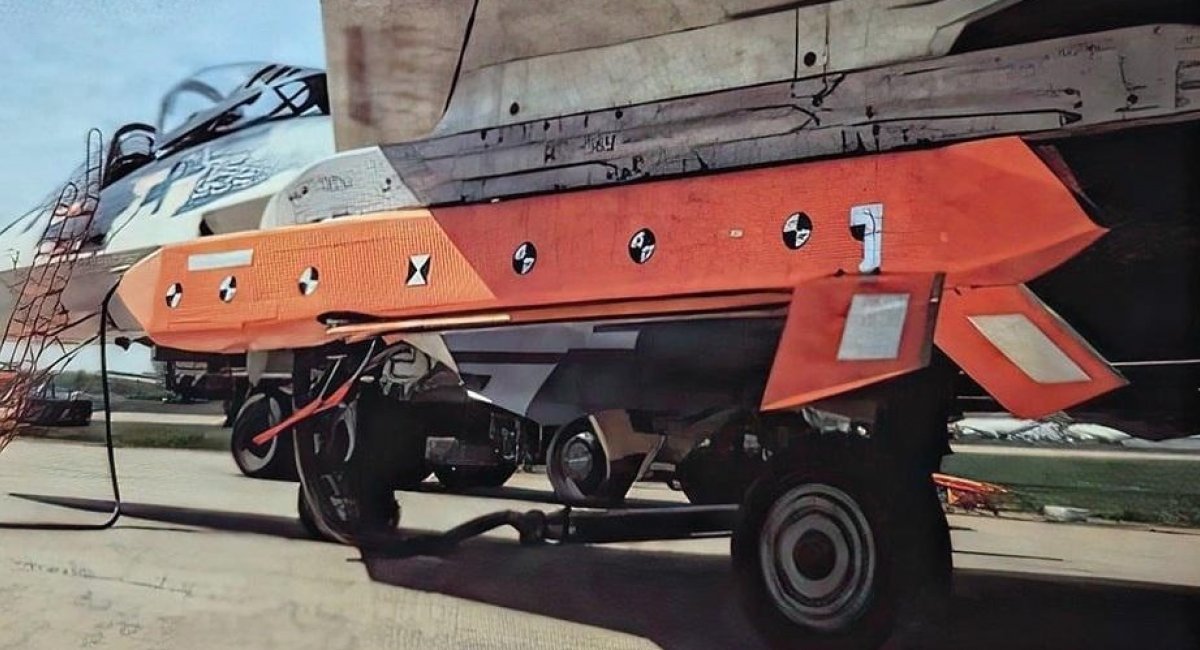
A conventional cruise missile usually receives the coordinates of its target before launch. From that point on, its task is relatively straightforward: follow the programmed route, avoid terrain and air defenses, and strike a predetermined point. Russia’s S-71M Monochrome is being developed around a different concept. Its carrier is supposed to deliver it to a search area, after which the weapon can potentially detect and classify objects and select a target on its own. The result is an unusual hybrid of a cruise missile, loitering munition, and unmanned aircraft — one developed specifically with the Su-57 in mind. And it is this concept, rather than the claimed range or warhead size, that makes the S-71M particularly interesting.
When a Missile Becomes a Drone
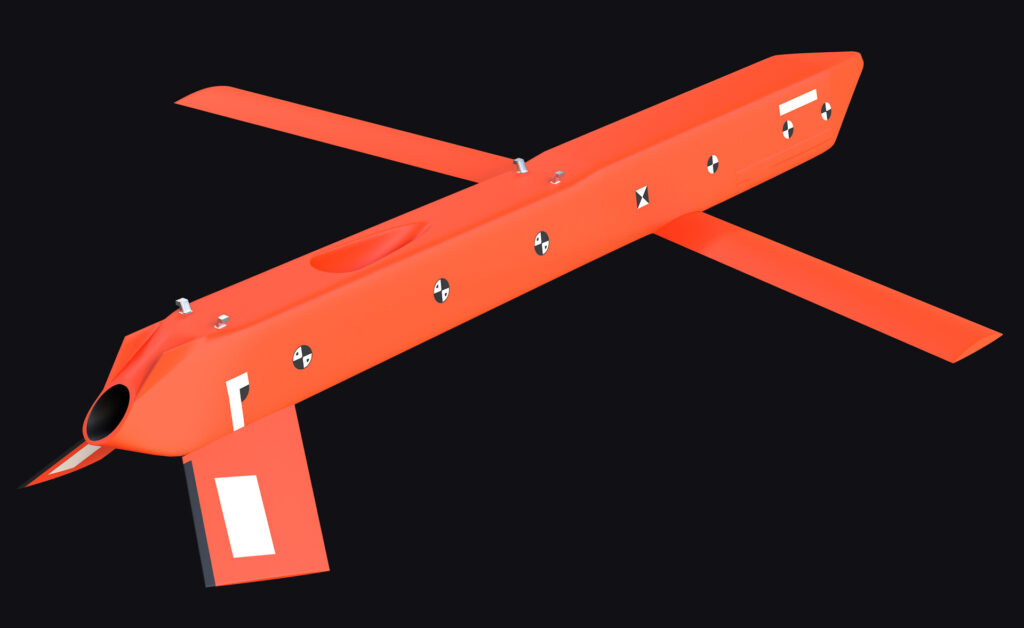
Drawing a clear line between a modern cruise missile and a strike drone is becoming increasingly difficult. Both have engines, guidance systems, navigation equipment, onboard electronics, and warheads. The difference increasingly lies not in their physical construction, but in how they are intended to operate.
A conventional cruise missile such as the Kh-101 or the American Tomahawk is primarily designed to destroy a predetermined target. Its coordinates are known before launch, a flight mission is programmed, and the missile’s guidance system takes it to the designated location.
The S-71M proposes a somewhat different concept.
According to the Russian patent associated with the project, the guidance architecture provides for autonomous target search and the possibility of selecting targets according to predetermined priorities. In other words, instead of being given one specific object to hit, the weapon could potentially receive a search area and a set of characteristics describing what it should look for.
At that point, it stops looking like a conventional missile.
It becomes closer to a disposable jet-powered strike drone capable of searching for its own target.
It is therefore no coincidence that the S-71M has also been described in open sources as an air-launched loitering munition. The program is reported to have conducted its first flight in April 2023, while available information indicates that testing has continued into 2026.
And this is where the story becomes particularly interesting.
The S-71 Actually Has Two Personalities
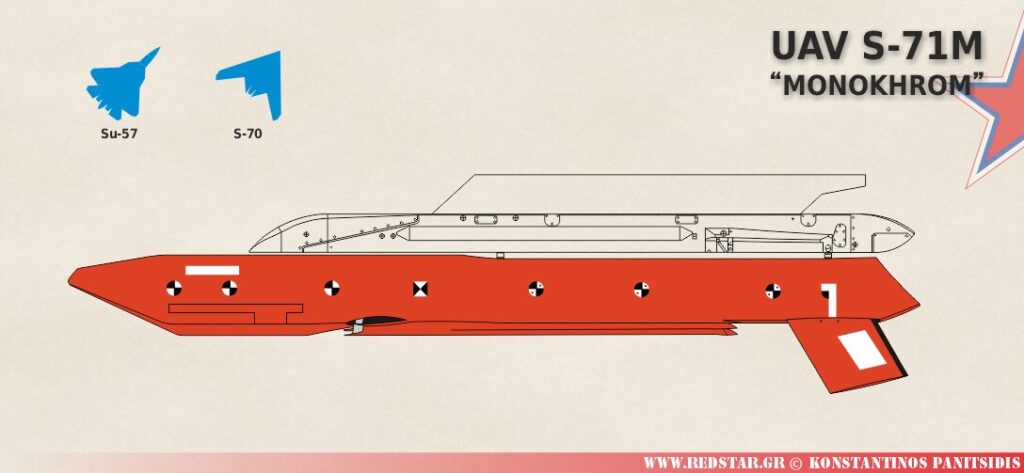
The S-71 family is known to include at least two versions — the S-71K Kover and the S-71M Monochrome.
Externally and structurally, the two are closely related, but their intended roles appear to differ substantially.
The S-71K represents the more conventional approach: an air-launched weapon intended to attack predetermined stationary targets. The S-71M is considerably more ambitious, as it is the variant associated with autonomous target search and selection.
This makes the Monochrome more interesting as an attempt to combine the advantages of several weapon categories rather than simply another Russian cruise missile.
From the cruise missile, it takes speed, range, and a substantial warhead.
From the loitering munition, it takes the ability to search for a target after entering a designated area.
From the drone, it takes sophisticated onboard computing and electro-optical observation.
And from conventional air-launched weapons, it gains the ability to have an aircraft carry it hundreds of kilometers before it even begins its own mission.
The result is something of a military matryoshka doll: an aircraft carries an unmanned vehicle that is itself a disposable carrier for a warhead.
What Does the Su-57 Have to Do With It?
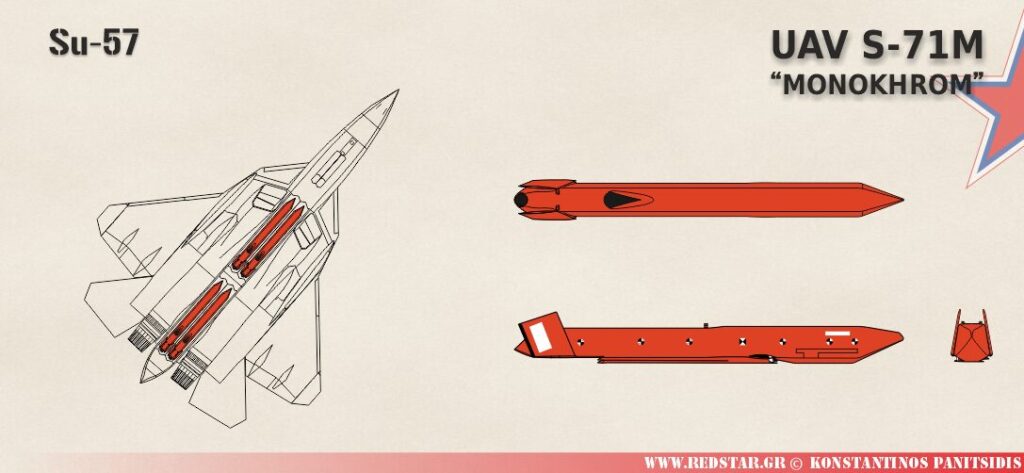
The S-71 has been developed in close association with the Su-57 program.
That relationship is apparent even in the shape of the weapon. Instead of a conventional cylindrical fuselage, the designers adopted a more angular cross-section together with folding aerodynamic surfaces. Such a configuration makes better use of the limited volume inside an aircraft’s internal weapons bays while potentially reducing the munition’s radar signature.
Early photographs showed S-71 prototypes carried externally by the Su-57, but the geometry of the weapon clearly points toward internal carriage as an important design consideration. Open-source reports have also discussed the possibility of integrating the S-71 family with the heavy S-70 Okhotnik unmanned combat aircraft.
This matters.
One of the principal advantages of a low-observable aircraft can be significantly compromised if large conventional weapons are hung beneath its wings. External stores increase the radar signature of the entire aircraft.
The Su-57 therefore benefits from compact weapons that can fit inside its fuselage.
In that context, the S-71 is a logical addition to the aircraft’s weapons architecture.
The Su-57 would not necessarily have to approach the target itself. Its task could be to carry several autonomous weapons close enough to the designated search area, release them, and withdraw.
What happens next would be an entirely different kind of engagement.
200 Kilometers or 350?
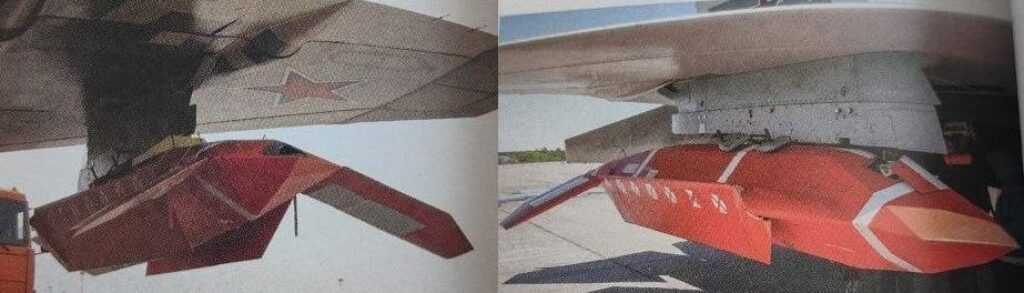
This is where the numbers need to be treated carefully.
Various open sources cite a range of around 200 kilometers for the S-71M, while some Russian sources claim figures approaching 350 kilometers. Similar uncertainty surrounds several other characteristics. Estimates of radar cross-section as low as approximately 0.007 square meters have also circulated, but such numbers should not be treated as independently verified characteristics of an operational production weapon.
The S-71 is generally described as subsonic. Depending on the source and variant, published estimates range from approximately Mach 0.6 to Mach 0.95.
Its propulsion system is more interesting.
Unlike the electric motors commonly used by many loitering munitions, the S-71 uses a compact turbojet engine. This places it somewhere between inexpensive propeller-driven one-way attack drones and conventional air-launched cruise missiles.
The result should be substantially faster than most propeller-driven strike UAVs while still being capable of covering hundreds of kilometers.
But speed is only half of the story.
The other half is hidden inside the airframe.
The Most Interesting Part of Monochrome Is Neither Its Engine Nor Its Warhead
Reports examining components associated with the S-71M have pointed to an Nvidia Jetson Orin computing module. This is a commercially available computing platform designed for machine vision, artificial intelligence processing, and other demanding tasks directly onboard a device.
And that provides an important clue about what the Monochrome is intended to do.
A conventional missile does not need to understand what it sees.
It only needs to know its position, its route, and the coordinates of its target.
An autonomous hunter needs considerably more.
It has to receive imagery from its electro-optical system, detect objects, separate them from the surrounding terrain, classify them, and compare them with characteristics stored in its mission software.
In simplified terms, the onboard computer has to decide:
this is a truck; this is a building; this is an armored vehicle; this object is irrelevant; that one matches the assigned priority.
And ideally, it must do this without constantly transmitting video back to a human operator.
That last point is particularly important.
Why Does a Missile Need Autonomy When There Is an Operator?
A conventional FPV drone has a fundamental weakness: it requires a communications link.
If an operator must watch the camera feed and send control commands, there is a continuous radio connection between the human and the aircraft. That link can potentially be detected, jammed, disrupted, or severed.
An autonomous weapon does not necessarily require constant communications.
An aircraft could release an S-71M toward a designated area, after which the weapon could continue its mission independently.
That potentially addresses one of the most difficult problems faced by long-range precision weapons: attacking mobile targets.
Consider a conventional cruise missile.
Reconnaissance detects a mobile missile launcher. Its coordinates are passed to the aircraft. The aircraft launches a missile. The missile then spends twenty minutes flying toward the target.
During those twenty minutes, the launcher travels ten kilometers.
When the missile reaches the coordinates, it finds an empty road.
An autonomous weapon could approach the problem differently.
Instead of being given only a precise coordinate, it could be directed toward an area where the target is believed to be located. Once there, it could begin searching independently.
That is the conceptual boundary between a conventional cruise missile and what the Monochrome program appears to be trying to create.
But There Is No Artificial-Intelligence Magic Here
The term “AI” is now used so enthusiastically in military marketing that it often creates a misleading impression of what systems like this can actually do.
The S-71M does not become a thinking robot.
The relevant technology is primarily machine vision: neural-network algorithms analyze imagery and attempt to determine whether an observed object matches predefined criteria.
And that creates plenty of problems.
Image quality changes with weather, lighting, altitude, and viewing angle. A vehicle can be concealed beneath trees or camouflage netting or parked among other objects. A civilian truck may resemble a military vehicle. A decoy may look remarkably similar to the real thing.
A human operator can interpret context.
An algorithm works with what it has been trained to recognize.
Claims about fully autonomous target search and selection should therefore be understood as intended system capabilities, not proof of flawless artificial intelligence. Russian patent documentation does describe such a concept, but the actual performance of the recognition algorithms remains classified.
Nevertheless, the broader trend is more important than any specific recognition percentage.
Monochrome Could Be More Interesting Than a Much More Powerful Missile
Judged only by its specifications, the S-71M does not look like a wonder weapon.
Its range is measured in hundreds of kilometers rather than thousands.
Its speed is subsonic.
The weapon itself is relatively compact.
In those respects, it is clearly outperformed by large cruise missiles and especially by ballistic missiles.
But directly comparing them misses the point.
A ballistic or conventional cruise missile is extremely good at solving the problem:
“Destroy the object located at these coordinates.”
The Monochrome is being developed for a somewhat different problem:
“Find a particular type of object somewhere in this area and destroy it.”
On paper, the distinction appears minor.
In practice, it represents an entirely different level of automation.
If the concept proves reliable, weapons of this type could potentially be used against mobile air-defense systems, radars, command vehicles, and other equipment whose exact position cannot be guaranteed tens of minutes before impact.
And this is why the S-71M is more interesting than simply being another new weapon for the Su-57.
The Next Step Beyond the Cruise Missile
Military aviation has followed a fascinating technological path.
At first, an aircraft had to find the target itself, approach it, and drop an unguided bomb.
Then guided bombs appeared.
Missiles allowed aircraft to attack from tens or hundreds of kilometers away.
Modern cruise missiles subsequently learned to navigate extremely complex routes at very low altitude without continuous pilot control.
Now the final part of the chain is gradually being automated as well — the selection of the target after launch.
This is what makes the S-71M Monochrome interesting as a representative of a transitional generation of weapons.
Too much about it remains unknown to call it revolutionary. Its actual range has not been independently confirmed. Radar-signature figures remain estimates. The capabilities of its recognition algorithms are classified. Even the final configuration of a production version could still differ from what has been shown publicly.
So declaring the Monochrome a breakthrough would be premature.
But the direction of development is already clear.
In the past, a missile was told: “Fly here and destroy this target.” Now designers increasingly want to tell it: “Fly to this area, find the right target yourself, and determine when to attack.”
If that approach becomes reliable and can be produced at scale, it may represent a far more important change in precision air-launched weapons than simply adding another hundred kilometers of range.
In that case, the S-71M will matter not merely as another missile developed for the Su-57.
It will matter as one of the steps toward a generation of weapons that may no longer need the exact coordinates of their target before they are launched.






