The Sword That Was Never Meant for Battle: Why European Executioners Needed a Weapon of Their Own

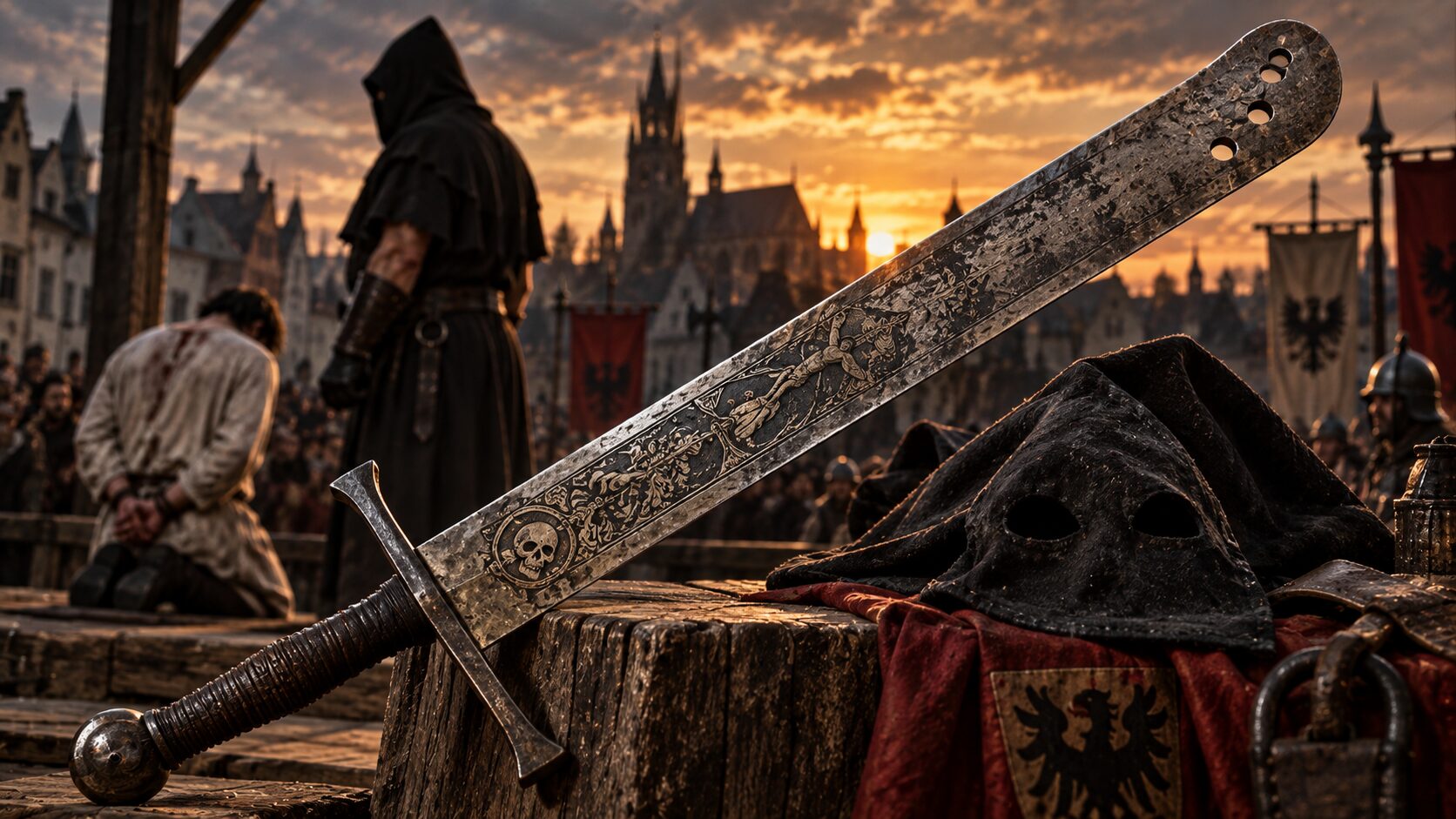
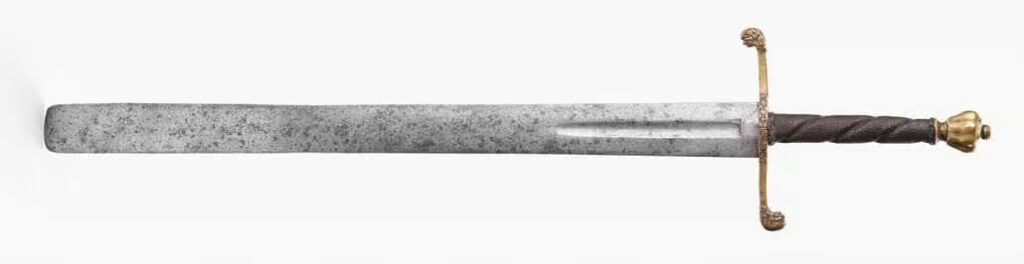
At first glance, it looks like an ordinary European two-handed sword. A long grip, a straight crossguard, a massive steel blade—the weapon seems perfectly suited to the battlefield. But look at the end of the blade and something immediately feels wrong: there is no point. The blade terminates in a blunt, rounded, or almost square-cut end, sometimes pierced by two or three mysterious holes. Such a sword was poorly suited for thrusting, made little sense as an ordinary sidearm, and, by tradition, was not intended for “honorable” combat at all. This was not a battlefield weapon. It was the Richtschwert—the executioner’s sword, or Sword of Justice, a specialized instrument of judicial execution. Its entire design served one grim purpose: to sever a condemned person’s head with a single powerful and precise stroke. And that is why the history of the Richtschwert ultimately tells us less about weapons than about how European society understood crime, honor, death, and the state’s right to take a human life.
An Executioner Had No Need for a Point
A fighting sword is a compromise. It must be agile enough to change direction, allow its wielder to attack and defend, and, depending on its design, both cut and thrust. With the Richtschwert, most of these requirements simply disappeared. The executioner was not fencing. His target was stationary or restrained, and the stroke was prepared in advance and delivered with both hands. The blade could therefore be optimized not for combat but for the most efficient possible cutting motion. A typical executioner’s sword had a broad, relatively heavy blade approximately 80–90 centimeters long, a long two-handed grip, and a short, straight crossguard. There was no point because nobody intended to thrust with it.
Surviving museum examples illustrate the proportions remarkably well. A German Richtschwert made around 1673 and now held by the Metropolitan Museum of Art measures about 108 centimeters overall, with an 84.1-centimeter blade, and weighs just over 2 kilograms. Another Saxon example from around 1700 has an 83.2-centimeter blade and weighs approximately 2.18 kilograms without its scabbard. So the popular image of the executioner wielding some monstrous five-kilogram steel cleaver is misleading. These were heavy swords, certainly, but still weapons—or rather tools—that a trained person could control. Their defining characteristic was not extraordinary weight but a broad cutting blade and a mass distribution suited to a powerful stroke.
And there was an important reason for this. The sword had not merely to possess considerable energy; ideally, it had to pass through the neck in one clean motion. Failure meant a second stroke, sometimes even a third. For the condemned, this turned a comparatively swift death into an agonizing one. For the authorities, it transformed a carefully staged public execution into a gruesome spectacle. For the executioner himself, it could become a professional humiliation. The balance of the Richtschwert was therefore suited to a powerful cutting action, while its long grip allowed both hands—and the movement of the entire body—to contribute to the blow. It was less a “very large sword” than a specialized instrument for an exceptionally precise cut.
The Condemned Person Often Did Not Put Their Head on a Block
Cinema has distorted our image of European executions in another important way. When someone is beheaded with an axe, the familiar execution block makes obvious sense: the condemned bends or lies forward, the neck is positioned, and the blow descends from above. A sword allowed the executioner to work differently. The condemned person could remain standing or, more commonly, kneel upright. The executioner stood to one side and delivered an almost horizontal stroke across the exposed neck. This meant that physical strength alone was not enough. He also needed an exceptional sense of distance.
That changes the way we should understand the weapon itself. The executioner had to guide a long blade through a relatively small target without striking too high into the skull or too low into the shoulders. Accounts of executioners’ training emphasize the amount of practice required, and apprentices could gain experience on animals before being allowed to conduct an execution themselves. The famous ideal of “one stroke, one head” was therefore not merely a dramatic cliché. It was a professional standard.
This also exposes another popular misconception. An executioner was not simply an enormous man hired because he could swing a piece of steel harder than anyone else. A clean beheading with a sword demanded technique. The executioner needed the correct stance, distance, acceleration, and follow-through, without changing the trajectory at the last moment. Even the condemned person could introduce an unpredictable variable: a sudden movement of the head, a shift of the body, or an attempt to rise could ruin an otherwise perfect stroke. That is why the skill of a professional executioner mattered far more than brute strength alone.
Beheading Was Not Just Death—It Could Be an “Honorable” Death
The most important characteristic of the Richtschwert has nothing to do with metallurgy. In the hierarchical societies of medieval and early modern Europe, different methods of execution carried different social meanings. Hanging was traditionally regarded as a dishonorable death. The body of a criminal might remain displayed on the gallows as a public symbol of disgrace. Breaking on the wheel and certain other punishments were not merely methods of killing but rituals intended to humiliate and physically destroy the criminal before the eyes of society. Beheading by the sword, by contrast, was generally regarded as a comparatively honorable form of execution. It became particularly associated with people of higher social standing.
The reason went beyond a desire to make death less painful. The sword itself was a symbol of status. In European culture, the right to carry one had long been associated with the warrior estate, nobility, and political authority. Rulers were depicted with swords, swords appeared in ceremonies, and the phrase “Sword of Justice” could be understood quite literally. The result was a striking paradox: a person was being deprived of life, yet the manner of death could still acknowledge that person’s place within the social hierarchy.
This should not be reduced to the simplistic rule that “nobles were beheaded and commoners were hanged.” Judicial traditions differed from one region to another and depended on the crime, the status of the accused, local law, and historical period. Nevertheless, a symbolic hierarchy of punishments unquestionably existed. Beheading could be perceived as less degrading than hanging, and in some legal cultures it did not transmit dishonor to the condemned person’s family in quite the same way as other punishments might. The Richtschwert was therefore simultaneously an instrument of death and, in a strange sense, a symbol of a final privilege.
Why Were Gallows, Wheels, and Saints Engraved on Executioners’ Swords?
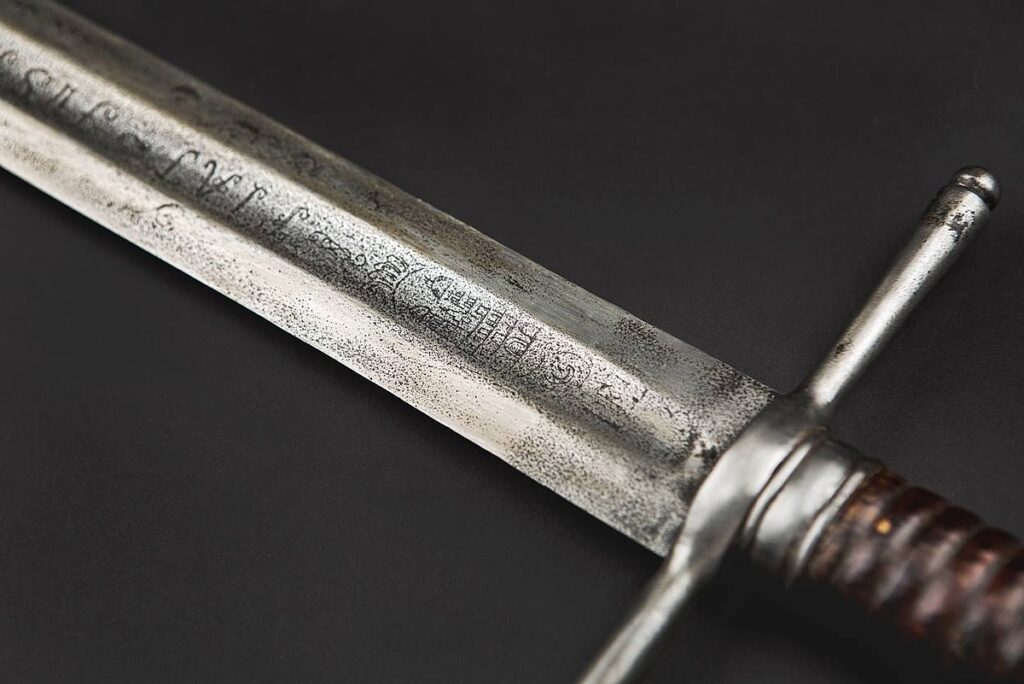
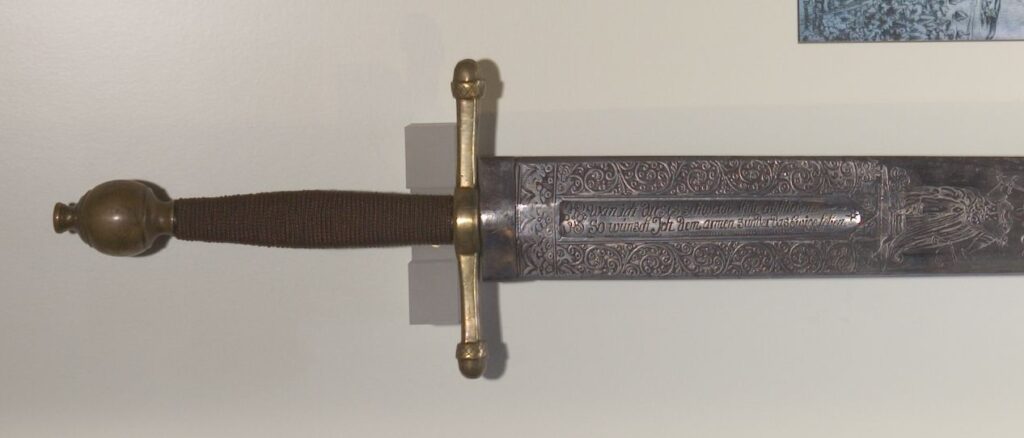
If the Richtschwert was simply a tool for removing a head, we might expect it to be entirely utilitarian. Yet many surviving executioners’ swords are anything but plain. Their blades bear inscriptions, religious imagery, and representations of different forms of punishment. Gallows and breaking wheels appear alongside Christ, the Virgin Mary, Saint Catherine, the Archangel Michael, or personifications of Justice. A Saxon executioner’s sword from around 1700 in the Metropolitan Museum’s collection, for example, bears engraved images of the Archangel Michael, Satan, and the Virgin Mary.
One late seventeenth-century German sword carries an even more revealing inscription: “When I raise this sword, I wish that this poor sinner may receive eternal life.” In that short sentence lies much of the ideology surrounding judicial execution in early modern Europe. The executioner was not supposed to be understood as a private murderer. He was the final agent of a judicial process: the court determined guilt, political authority sanctioned the punishment, and his hand carried out the sentence. Physical death could meanwhile be interpreted through the Christian concepts of repentance and the possible salvation of the condemned person’s soul.
This is why the term “Sword of Justice” is particularly appropriate. The blade almost explained its own existence. The image of a wheel or gallows represented punishment; the religious figures invoked divine judgment; the moralizing inscriptions transformed execution from an ordinary killing into a ritualized act of law. In early modern society, a public execution functioned simultaneously as punishment, warning, spectacle, and demonstration of the state’s ability to maintain order.
What Were Those Strange Holes Near the End of the Blade?
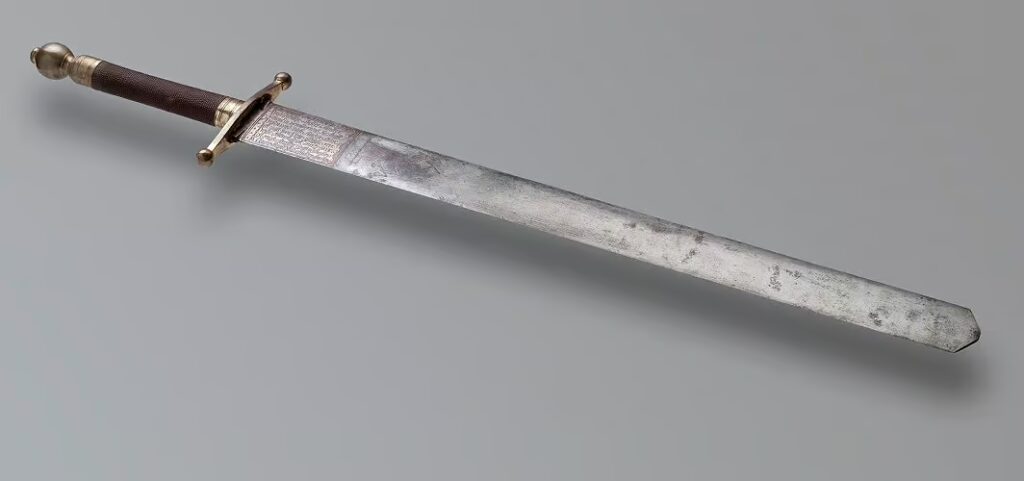
Some Richtschwerter really do have two or three circular holes near the blunt end of the blade, and those holes have generated a remarkable collection of legends. According to one theory, they made the sword whistle during the swing, increasing the psychological terror of the final moment. Another claims that lead weights were inserted into them to make the front of the sword heavier. A third associates three holes with the Holy Trinity. A fourth suggests that they prevented the executioner’s sword from later being reground into an ordinary fighting weapon. In some cases, a hole may simply have served as a convenient way to hang the sword. The problem is that historians cannot confidently assign a single universal function to all of them.
The famous story of the “whistling sword” deserves particular caution. It fits perfectly into the modern gothic image of the executioner, but convincing historical documentation for it is lacking. The same applies to some of the more exotic claims about additional weights. Nineteenth-century literature does contain stories about lead being inserted into executioners’ swords to increase the force of the blow, and even more extraordinary tales of blades supposedly containing mercury. But late accounts cannot simply be projected backward onto every surviving Richtschwert. Even if some craftsmen experimented with additional weighting, that does not explain every hole on every executioner’s sword.
There is, however, an important symbolic point. The blunt end visually separated the Richtschwert from an ordinary fighting sword. It was not intended for thrusting and was not supposed to return to the battlefield. Its specialization was obvious from its appearance alone. The holes, unusual tip, and characteristic engravings may therefore have combined practical and symbolic functions: anyone looking at the object could understand that it belonged to the world of justice and punishment rather than war.
The Executioner Occupied a Strange Position: Feared, Despised—and Indispensable
This is where the history becomes even more interesting. The executioner represented public authority and performed work considered necessary by the judicial system of the time, yet his constant contact with death, torture, and the bodies of criminals could make him socially “unclean.” In many towns, executioners and their families faced serious restrictions in everyday social life and marriage. As a result, the profession often became hereditary. The son of an executioner might find it difficult to enter an ordinary craft or trade, but he already had access to his father’s knowledge, professional connections, and occupation. Entire dynasties of professional executioners emerged.
Executions themselves formed only a small part of their work. Executioners carried out corporal punishment, participated in torture, disposed of animal carcasses, and performed other tasks considered dishonorable or impure. Some acquired surprisingly extensive practical knowledge of human anatomy. Constant exposure to wounds, dislocations, fractures, and bodies made certain executioners sought-after folk healers—another paradox of a profession in which a man could earn his living by injuring and killing people while simultaneously developing a reputation for treating them.
For an apprentice executioner, the Richtschwert could become the ultimate professional test. One of the best-documented members of the profession, Franz Schmidt, who later served as executioner of Nuremberg, was trained under his own father. His journal, covering a career spanning the late sixteenth and early seventeenth centuries, has become an extraordinary source on the life of a professional executioner. Such evidence reveals that behind the familiar image of a hooded man stood a genuine occupation with its own techniques, professional reputation, and transmission of expertise from one generation to the next.
And the Famous Black Hood Is Largely a Later Image
Popular culture has made the executioner instantly recognizable: a huge man dressed in black, his face hidden beneath a hood, carrying an axe or sword. Historical reality was usually far less theatrical. Executioners did not necessarily conceal their faces—and often there was little reason to do so. Townspeople generally knew perfectly well who held the office, where he lived, and which family he belonged to. He was a municipal official, albeit one with an exceptionally peculiar social position, not a mysterious anonymous figure who appeared only on the scaffold.
Indeed, during a public execution his professional identity mattered. The authorities needed to demonstrate that the condemned person was being killed not by an unknown avenger but by an authorized official carrying out a lawful sentence. The sword, clothing, place of execution, presence of officials, and sequence of events therefore formed part of a single public ritual. Within this system, the Richtschwert could function almost as strongly as a symbol of public authority as judicial robes or a city’s coat of arms.
Why the Guillotine Eventually Defeated the Master Swordsman
The need for human skill ultimately became one of the weaknesses of the system. However experienced an executioner might be, the result still depended on a person. He could misjudge the distance, make a technical error, or be thrown off by an unexpected movement from the condemned. History contains numerous examples of botched beheadings in which several strokes were required to complete the execution. For eighteenth-century societies gradually reconsidering the nature and purpose of punishment, such unpredictability became increasingly difficult to accept.
The guillotine offered a fundamentally different solution. After the French Revolution, beheading in France was mechanized and simultaneously stripped of much of its former association with social privilege. The machine did not require years of practice to master a perfect sword stroke, while its heavy falling blade was intended to produce a standardized, repeatable result. Symbolically, the guillotine did not abandon the idea of decapitation itself—it eliminated the need for the master craftsman, the human being whose precision determined whether the procedure succeeded. In this sense, the transition from the Richtschwert to mechanical execution was part of a much larger transformation: punishment was gradually changing from a personalized public craft into a standardized administrative procedure.
The executioner’s sword did not disappear overnight, however. In the German states, beheading by sword survived considerably longer than the French Revolution, and some European practices continued into the nineteenth century. It is therefore more accurate to speak not of the guillotine instantly “killing” the Richtschwert, but of the gradual disappearance of an entire culture of judicial execution in which the sword functioned simultaneously as a tool, a marker of social rank, and a symbol of justice.
A Sword That Became Useless the Moment a Fight Began
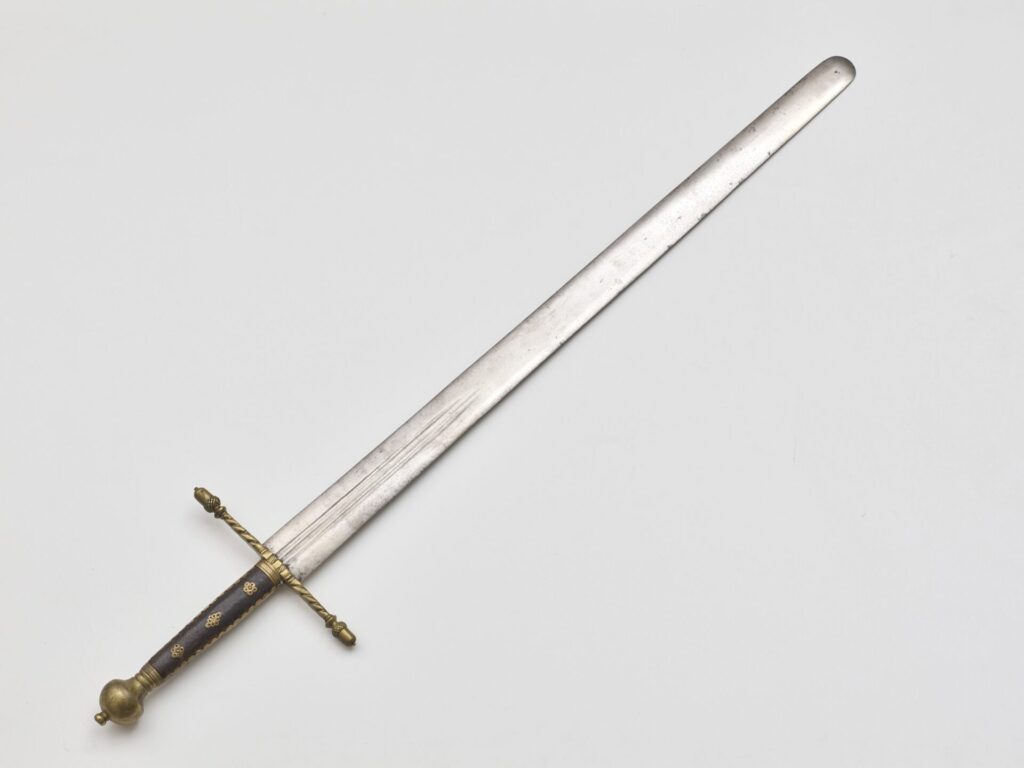
This is what makes the Richtschwert so unusual among historical edged weapons. Its makers deliberately removed one of the defining features of a sword: an effective point. They simplified or shortened the guard, created a broad cutting blade, and optimized the weapon for one predetermined movement. The result still looked like a sword, yet functionally it belonged to an entirely different world. Its purpose began not when two men entered combat, but when combat, trial, and the right to resist had already ended.
Calling the Richtschwert simply an “executioner’s weapon” therefore understates its historical role. It was a material symbol of judicial authority. On its blade, the gallows could appear beside the Virgin Mary, the breaking wheel beside an archangel, the death of the criminal beside a prayer for the salvation of his soul. The executioner, whom society often shunned, held an object that represented the authority of society itself. The condemned might receive death by the sword precisely because such a death was considered more dignified than the gallows. And this enormous sword, never intended for battle, existed for a single stroke after which there could be no struggle at all.
That is the central paradox of the Sword of Justice. A fighting sword gave its owner the means to defend his own life. The Richtschwert was designed so that such a possibility would never be required. It was a sword not for duels and not for war. It was drawn only after the state had already decided who had won.