The New Power of the 21st Century: How Palantir Turned Data Into a Weapon — and States Into Digital Systems

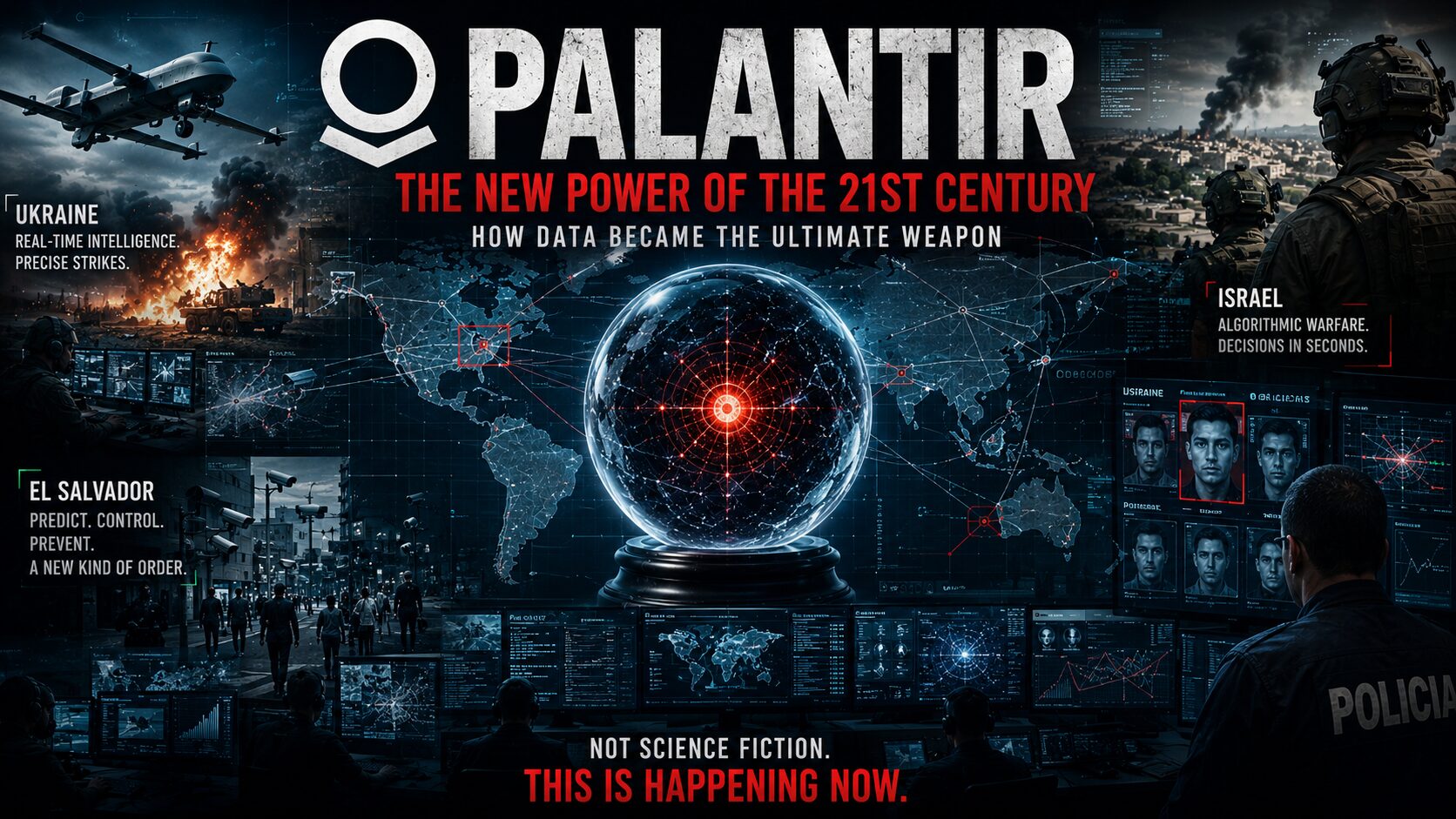
At the beginning of 2025, Palantir Technologies once again found itself at the center of a global controversy. The trigger was not only the company’s expanding military contracts, its systems operating in Ukraine, or its cooperation with Israel, but also something far more unsettling — the publication of a kind of ideological manifesto in which Palantir’s leadership effectively declared that the era of “soft power” was ending, and that the future belonged to states capable of merging artificial intelligence, total data collection, and military force into a single system.
For most people, it looked like yet another futuristic text from Silicon Valley. The problem, however, is that unlike thousands of other techno-prophets, Palantir already possesses tools that are actively operating in real wars, real police operations, and real governments.
That is precisely why the company has gradually acquired an almost mythical reputation. It has been described as a “digital CIA,” an “operating system for war,” a “Skynet without Terminators,” and even a prototype for a future global surveillance machine. Many of these descriptions are exaggerated, politically charged, or openly conspiratorial. Yet behind all the noise lies a far more important reality: systems like Palantir are genuinely reshaping the modern world in ways that would have seemed like science fiction only a decade ago.
Because this is no longer just another military software package or AI startup. What is emerging before our eyes is an entirely new form of power — the power of an algorithm capable of simultaneously observing the battlefield, transportation networks, phones, satellite feeds, financial transactions, human behavior, and the connections between millions of people.
That is what makes Palantir one of the most important — and one of the most disturbing — companies of the 21st century.
From Tolkien’s Seeing Stones to Digital Intelligence
The name Palantir Technologies comes from The Lord of the Rings. In Tolkien’s world, the palantíri were “seeing stones” — magical artifacts that allowed their users to observe events across vast distances. But those stones also carried a darker implication: anyone who looked through them risked becoming observed in return.
For the company, the name proved almost prophetic.
Palantir was founded in 2003, shortly after the September 11 attacks. America was still in shock. Intelligence agencies were given unprecedented freedom to develop systems capable of preventing future terrorist attacks through massive-scale data analysis. It was in this atmosphere that PayPal co-founder Peter Thiel and his partners proposed the idea of a platform capable of combining enormous amounts of fragmented information into a single analytical framework.
In theory, the idea was simple. Phone calls, bank transfers, satellite imagery, camera footage, geolocation data, transportation routes, and social relationships all appear meaningless when viewed separately. But once combined into a unified network and processed by algorithms searching for patterns, the system begins to detect things no human analyst could ever notice alone.
That became the core philosophy of Palantir.
The company was not building a Hollywood-style killer AI. It was creating something arguably more powerful — a universal platform for integrating and analyzing data. In essence, a digital nervous system for both governments and armies.
What Data-Driven Warfare Actually Looks Like
Palantir first gained serious attention during America’s wars in the Middle East. According to U.S. media reports, the company’s systems were used in Iraq and Afghanistan to analyze insurgent activity, predict attacks, and assist intelligence operations. It was there that the U.S. military first encountered a new reality: the speed of information processing was becoming more important than the quantity of armored vehicles.
In the classic armies of the 20th century, hours — or even days — could pass between detecting a target and striking it. Information traveled through layers of headquarters staff, officers, analysts, and command structures. Modern digital warfare demands something radically different.
Today, a drone spots a target.
A satellite updates imagery.
Signals intelligence intercepts communications.
Algorithms correlate coordinates.
And within seconds, artillery or strike drones receive targeting data.
This is precisely where Palantir’s systems became invaluable.
The transformation became especially visible during the war in Ukraine. By 2022, company leadership openly acknowledged cooperation with Kyiv. Palantir CEO Alex Karp personally visited Ukraine, met with senior officials, and publicly stated that the company’s technologies were helping accelerate intelligence processing and improve battlefield effectiveness.
What mattered most, however, was not a specific software product, but the broader concept of war as a continuous stream of data.
FPV drones, satellite reconnaissance, thermal imaging, mobile networks, radio intercepts, digital maps, logistics information, and troop movement data all began merging into unified situational-awareness systems. Modern armies are gradually transforming into gigantic digital networks in which information processing speed becomes just as important as tanks or aircraft.
That is why many analysts now describe Ukraine as the world’s first truly data-driven war.
Ukraine as a Laboratory for the Next Military Era
The conflict in Ukraine effectively transformed Palantir Technologies from a relatively niche intelligence contractor into a global technological giant.
Before 2022, the company spent years balancing enormous government contracts against chronic financial struggles. Palantir faced criticism for secrecy, dependence on U.S. intelligence agencies, and political entanglements. But the war in Europe changed everything.
The world suddenly realized just how critical data-processing systems had become on the modern battlefield.
And the implications extended far beyond intelligence alone. Such platforms increasingly manage entire military ecosystems:
— logistics,
— supply chains,
— casualty analysis,
— battlefield performance assessments,
— equipment maintenance,
— strike prediction,
— resource allocation.
What is emerging is essentially a next-generation digital command center capable of observing war in real time on a massive scale.
And that raises a deeply uncomfortable question.
If oil, industry, and weapons production defined global power in the 20th century, are data systems becoming the decisive strategic resource of the 21st?
Because a state possessing such capabilities gains the ability to react faster than its opponents on virtually every level.
From Warfare to Governing Society
Yet the greatest fears surrounding Palantir are not even military.
The real concern is that technologies originally designed for war and counterterrorism are steadily moving into civilian life.
The most widely discussed example is El Salvador.
President Nayib Bukele built his popularity through an extremely aggressive campaign against criminal gangs. A country once considered among the most dangerous in the world has rapidly become one of the most debated examples of what some critics call “digital authoritarianism.”
Mass arrests, relationship mapping, phone-data analysis, and behavioral monitoring have become part of a new model of governance.
Supporters point to the dramatic decline in violent crime and the restoration of state control over public spaces.
Critics ask a different question:
what happens when an algorithm begins deciding who represents a threat — and who does not?
And this question no longer concerns El Salvador alone.
In France, data-analysis systems expanded significantly after the wave of terrorist attacks in the mid-2010s. In the United Kingdom, digital analytics were used to identify corruption and misconduct inside police forces. During the COVID-19 pandemic, similar platforms were employed to manage logistics, medical supplies, and resource distribution.
Each time, the justification appeared rational.
Each time, governments found compelling reasons to expand data collection.
And each time, the line between security and total surveillance became thinner.
Israel, Gaza, and the Rise of Algorithmic Warfare
Another major source of controversy involves Palantir Technologies and its cooperation with the Israel Defense Forces.
The Israeli military is already considered one of the most digitally integrated armed forces in the world. The use of intelligence-analysis systems, automated targeting, and algorithmic data processing has become a key part of modern Israeli military operations.
Debates intensified after several remarkably precise strikes against infrastructure and individual targets in the Middle East. This once again raised concerns about how deeply algorithms are already involved in lethal decision-making.
Officially, humans still remain the final authority in the use of force. But the real issue lies elsewhere: when systems process amounts of information impossible for humans to manually verify, operators increasingly rely on algorithmic conclusions.
That is gradually changing the very philosophy of war.
Humans still press the button.
But more and more often, the machine selects the target.
Why Even the West Fears Palantir
Interestingly, some of the harshest criticism of the company comes not from Russia or China, but from within the West itself.
Palantir has repeatedly been accused of maintaining excessively close relationships with American intelligence agencies, immigration enforcement systems, and national security structures. In Europe, concerns have frequently emerged regarding where exactly the data collected by these platforms ultimately goes.
In 2024, Swiss military officials reportedly raised concerns after auditing systems linked to Palantir technologies. Germany and France have also repeatedly debated issues of digital sovereignty and Europe’s growing dependence on American tech giants.
And that is a profoundly important development.
For the first time in modern history, governments are beginning to fear not only foreign armies — but foreign algorithms.
If a country relies on external platforms to process critical national data, who ultimately controls the system?
Who owns the infrastructure?
Who has access to the information?
And can a state truly remain sovereign if its digital nervous system depends on a foreign corporation?
The 21st century is quietly redefining the meaning of independence itself.
The World After Palantir
The most fascinating aspect of Palantir Technologies is not the company itself.
It is what the company represents.
The future no longer resembles the classic dystopias of old science fiction filled with robots marching through ruined cities. Instead, it arrives quietly.
Through cameras.
Through smartphones.
Through satellites.
Through financial transactions.
Through facial recognition.
Through behavioral analytics.
Through platforms that increasingly observe society as a single interconnected system.
And the paradox is that most of these technologies are genuinely useful.
They help fight crime.
Improve military intelligence.
Optimize logistics.
Increase efficiency.
Accelerate crisis response.
But every technology eventually leads to the same question:
who controls the tool?
That is why the story of Palantir is no longer merely the story of one technology company.
It is the story of a new world emerging — a world in which the ultimate weapon is no longer tanks or missiles, but the ability to observe, analyze, and predict the behavior of millions of people faster than they themselves can understand what is happening.