
Americans Put a 50mm Cannon on a Combat Robot. But Has the Gun Become Too Big for the Vehicle?

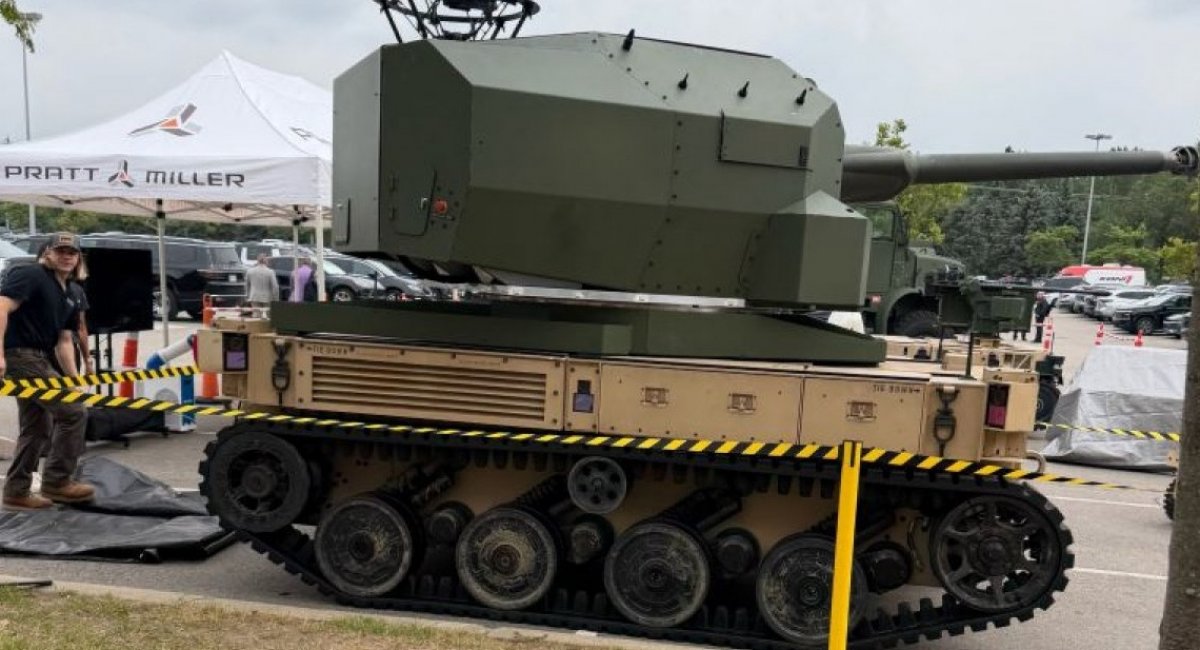
The idea behind unmanned ground combat vehicles has long seemed fairly straightforward: remove the crew, reduce the size of the vehicle, eliminate the need for a large protected crew compartment, and create a compact platform that can be sent into places where using conventional armored vehicles would put soldiers at excessive risk. At GVSETS 2026, however, Pratt Miller demonstrated an interesting downside to this concept. The company fitted the relatively small tracked EAMV MCA robot with a massive turret carrying the 50mm XM913 automatic cannon — the same weapon intended for the future U.S. Army XM30 infantry fighting vehicle that is being developed to replace the M2 Bradley.
The result is a vehicle that looks almost exaggerated: a low, compact tracked chassis topped by an enormous weapon station more appropriate for a full-size next-generation IFV. Yet behind its unusual appearance lies a serious experiment. The Americans are effectively trying to determine whether a relatively small unmanned ground vehicle can be given the firepower of a next-generation infantry fighting vehicle — without sacrificing the very advantages that made the robot attractive in the first place.
The question is particularly interesting because the XM913 is gradually becoming one of the key U.S. Army weapons of the next generation. If these experiments prove successful, the same family of 50mm ammunition could eventually be used by heavy IFVs, unmanned ground vehicles, and even counter-drone systems.
From Cargo Robot to Small Unmanned IFV
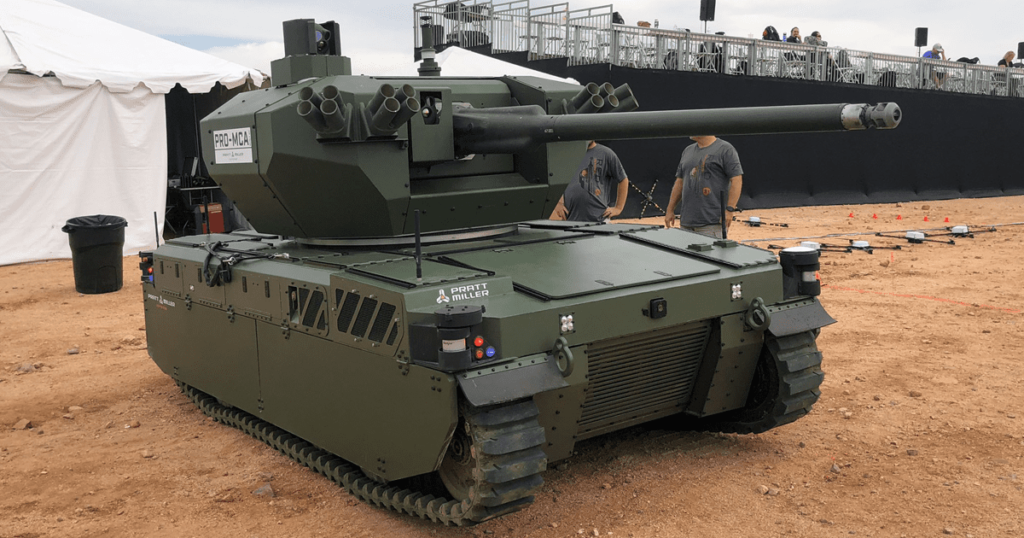
The EMAV — Expeditionary Modular Autonomous Vehicle — was not originally designed as a miniature tank. Pratt Miller developed it as a universal, highly mobile tracked unmanned platform capable of carrying cargo, equipment, and interchangeable mission modules. The manufacturer emphasizes the vehicle’s low profile, autonomous capabilities, and substantial payload capacity. Its compact dimensions also allow it to be transported by various military transport aircraft, including two vehicles inside a C-130.
Over time, however, it became clear that the platform’s payload capacity was sufficient to turn this transport robot into a fairly serious combat vehicle. Back in 2021, Pratt Miller demonstrated the EAMV MCA armed with the 30mm XM813 Bushmaster. For a small unmanned chassis, that was already formidable firepower: a 30mm automatic cannon can engage light armored vehicles, trucks, firing positions, and many other typical battlefield targets. By GVSETS 2026, however, the developers had decided to take the next step and install the 50mm XM913.
This is where the experiment becomes particularly interesting. The XM913 was not developed for a lightweight robot. It is the primary armament intended for the future XM30 Mechanized Infantry Combat Vehicle, the heavy IFV that will eventually replace the Bradley. Northrop Grumman has already begun delivering guns to the U.S. Army for integration into prototypes being developed by General Dynamics Land Systems and American Rheinmetall Vehicles. In other words, an unmanned platform weighing only a few tons has effectively received the same main armament that the U.S. Army plans to install on a full-size next-generation infantry fighting vehicle.
50mm Is a Very Different Proposition From the Bradley’s Gun
The jump from the Bradley’s current 25mm M242 to the 50mm XM913 is much more significant than the increase in bore diameter alone might suggest. The XM913 fires 50×228mm ammunition, features a dual-feed system, and is designed to use both APFSDS armor-piercing ammunition and programmable HEAB rounds. The latter are particularly interesting because programmable detonation makes it possible to engage infantry behind cover and other targets against which conventional impact-fuzed ammunition is less effective.
For the future XM30, this kind of armament makes perfect sense. The new IFV is expected to offer a major increase in firepower over the Bradley and engage a much broader spectrum of threats. Putting the same cannon on a lightweight robotic platform is considerably more unusual. It represents an extreme concentration of firepower: a weapon that would traditionally require a much larger crewed vehicle can now potentially be carried by a relatively small unmanned platform.
The U.S. Army is also interested in 50mm weapons for more than just ground targets. In August 2026, the Army began seeking industry solutions for a counter-drone system based on 50mm armament. The request included the potential use of the XM913 and 50mm ammunition against Group 1, 2, and 3 unmanned aerial systems. This means that the same cannon could potentially engage light armor, infantry behind cover, and aerial targets.
For an unmanned ground vehicle, this opens up some very interesting possibilities. In theory, the EAMV MCA could evolve from a robotic IFV into a universal fire-support platform receiving targeting information from external reconnaissance assets and selecting different types of 50mm ammunition depending on the target.
But this is precisely where the advantages of heavy armament begin to collide with physics.
Remove the Crew, Shrink the Hull — Then Make the Vehicle Huge Again
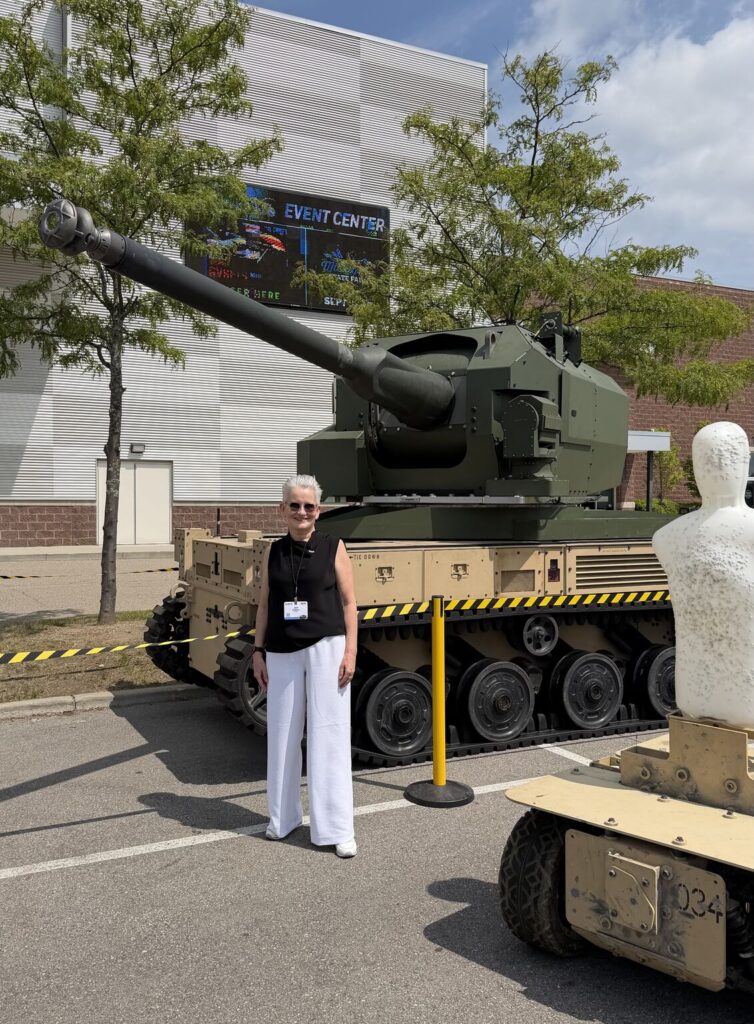
The main advantage of an unmanned platform is clearly visible on the basic EMAV. There is no need to accommodate people inside, so there is no requirement for a large crew compartment. The hull can be kept low, while more of the vehicle’s mass can be devoted to payload.
Installing the XM913 partly eliminates that advantage.
The turret shown at GVSETS 2026 is so large relative to the chassis that it dominates the vehicle’s entire silhouette. Defense Express also highlighted the unusually large profile of the weapon station and raised questions about the survivability of the resulting configuration.
The reason is obvious: a 50mm automatic cannon is much more than a barrel. The vehicle needs an ammunition-feed system, traverse and elevation mechanisms, sights, electronics, actuators, and — most importantly — ammunition. And the 50×228mm cartridge is substantial.
This makes the number of ready rounds one of the most interesting unanswered questions about the EAMV MCA. A small ammunition load would sharply limit the vehicle’s combat usefulness, while a larger one would require additional space and weight.
The designers are therefore running into the same rule that has followed armored vehicle engineers since the earliest tanks:
A bigger gun needs a bigger turret, a bigger turret requires more space and weight, and additional weight eventually requires a bigger chassis.
Removing the crew allows engineers to bend that rule somewhat.
It does not make it disappear.
Interestingly, recoil — probably the first issue that comes to mind when looking at the vehicle — may not be the only or even the biggest problem. The platform uses a tracked chassis, has a low center of gravity, and is designed to carry a substantial payload. Its actual firing stability can only be properly assessed through testing. The problems of silhouette, ammunition capacity, and protection exist regardless of how well the chassis handles the recoil.
EAMV MCA Specifications: A Small Chassis With a Very Big Gun
Available data for the RCV-L version of the platform indicates a weight of more than 3.8 tons, a payload capacity exceeding 3 tons, and a maximum speed of up to 72 km/h, or about 45 mph. The vehicle can negotiate a 60-percent grade, operate on a side slope of up to 40 percent, and climb a vertical obstacle approximately 0.61 meters high.
| Type | Unmanned tracked ground vehicle |
| Platform weight | Over 3.8 tons for RCV-L version |
| Payload | More than 3 tons |
| Maximum speed | Up to 72 km/h / 45 mph |
| Maximum grade | Up to 60% |
| Side slope | Up to 40% |
| Vertical obstacle | Approx. 0.61 m / 24 in |
| Main armament | 50mm XM913 |
| Ammunition | 50×228mm |
| XM913 ammunition types | HEAB, APFSDS |
| Onboard crew | None |
The relationship between the platform’s size and payload capacity explains why the experiment is possible at all. At the same time, it shows how quickly that payload margin can disappear. The turret, cannon, ammunition, optics, electronics, and additional protection all have to fit within a limited weight budget. Add substantial armor and an active protection system, and the small robot could very quickly stop being small.
But Does an Unmanned Robot Even Need to Survive a Hit?
This leads to perhaps the most interesting question surrounding the entire concept. A conventional IFV has to protect its crew and infantry passengers because losing the vehicle may also mean losing several soldiers. The EAMV MCA has no such problem: there should be nobody inside it. The entire philosophy of protection can therefore be reconsidered. A robotic vehicle does not necessarily have to withstand the same hits as a heavy crewed fighting vehicle if its cost makes accepting a certain number of losses possible.
That sounds attractive until the robot receives an expensive 50mm cannon, sophisticated fire-control system, advanced optics, and communications equipment. The more capable an unmanned combat vehicle becomes, the less expendable it is. Eventually a paradox emerges: removing the crew means the robot can be risked more freely, but the robot itself can become so expensive and sophisticated that commanders will not want to lose it either.
This is why the enormous turret profile is more than an aesthetic issue. An EAMV MCA armed with the XM913 is intended to engage at least some targets with direct fire, which means it will periodically have to see the enemy. The enemy, in turn, will be able to see it. If the vehicle is lightly protected, it risks rapidly losing an expensive weapon station. If engineers significantly increase protection, weight rises and a heavier chassis may become necessary.
And then the design starts moving back toward a conventional IFV — only without a crew.
Perhaps We Are Looking at This Robot the Wrong Way
There is another way to use such a vehicle, however, and in this context the strange combination of a small hull and enormous cannon begins to make considerably more sense.
The EAMV MCA does not necessarily have to find targets independently and fight them in a traditional armored duel. A modern robotic platform can operate as part of a wider reconnaissance and fire-control network. A drone or another vehicle detects the target, its coordinates are transmitted to the robot, the EAMV moves into a firing position, engages, and then relocates.
In this role, the EAMV becomes primarily a remote weapons carrier.
The most valuable and vulnerable component of a conventional combat vehicle — its crew — remains far away. The robot can be sent forward, placed in an ambush position, used to cover a dangerous sector, or deployed where sending a conventional IFV would create unacceptable risk to personnel. With an external radar and appropriate fire-control architecture, programmable 50mm ammunition could potentially add a counter-air role as well.
This is where the modular nature of the original EMAV becomes particularly important. Pratt Miller has positioned the vehicle as a carrier for different mission systems rather than as a finished “robot tank.” The machine displayed at GVSETS should therefore be viewed primarily as a demonstration of an extreme firepower configuration: engineers are testing just how much weaponry can be integrated onto a relatively compact unmanned chassis.
The 50mm Robot Shows the Future — But It Is Not Yet Clear Which Future
For now, the EAMV MCA with the XM913 is more interesting as an experiment than as a finished production combat vehicle. Too many critical questions remain unanswered. The actual ammunition capacity of the new turret is unknown, its level of protection has not been publicly detailed, the platform’s stability during firing still needs to be assessed, and the effect of the oversized silhouette on survivability remains an obvious concern.
But Pratt Miller’s experiment demonstrates a much broader trend. Removing the crew really can dramatically reduce the size of a combat vehicle, but the weapon, ammunition, sensors, communications equipment, and protection do not disappear. If engineers continue adding all the capabilities of a conventional IFV to a robot, sooner or later it begins approaching an IFV in size, weight, complexity, and cost.
On the other hand, unmanned technology offers something fundamentally new: the ability to separate firepower from personnel. A 50mm XM913 no longer necessarily needs to bring several soldiers directly into the enemy’s line of fire with it. That is why even the somewhat bizarre-looking EAMV MCA deserves attention.
This particular configuration may never enter production. The turret could prove too large, the ammunition load too small, or the entire system too expensive and vulnerable. But the direction of the experiment matters more than the prototype itself.
Until recently, the 50mm XM913 was primarily seen as the main gun for the heavy XM30 IFV that will eventually replace the Bradley. Now the same weapon is being mounted on an unmanned platform weighing only a few tons, while the U.S. Army is simultaneously exploring the 50mm caliber for counter-drone applications.
That creates a fascinating possibility. A future U.S. mechanized formation could theoretically field heavy XM30s, lightweight robotic weapons carriers, and counter-drone systems built around the same family of 50mm weapons and ammunition.
And if that happens, the most interesting question about Pratt Miller’s strange robot will no longer be:
“Why does such a small vehicle need such a huge gun?”
It may become exactly the opposite:
If you can separate the 50mm cannon from a heavy IFV and send it forward without a crew, why send soldiers forward with the gun every time?






