M7 Priest Was Surprisingly Simple. So Why Did It Become One of the Best Self-Propelled Guns of World War II?

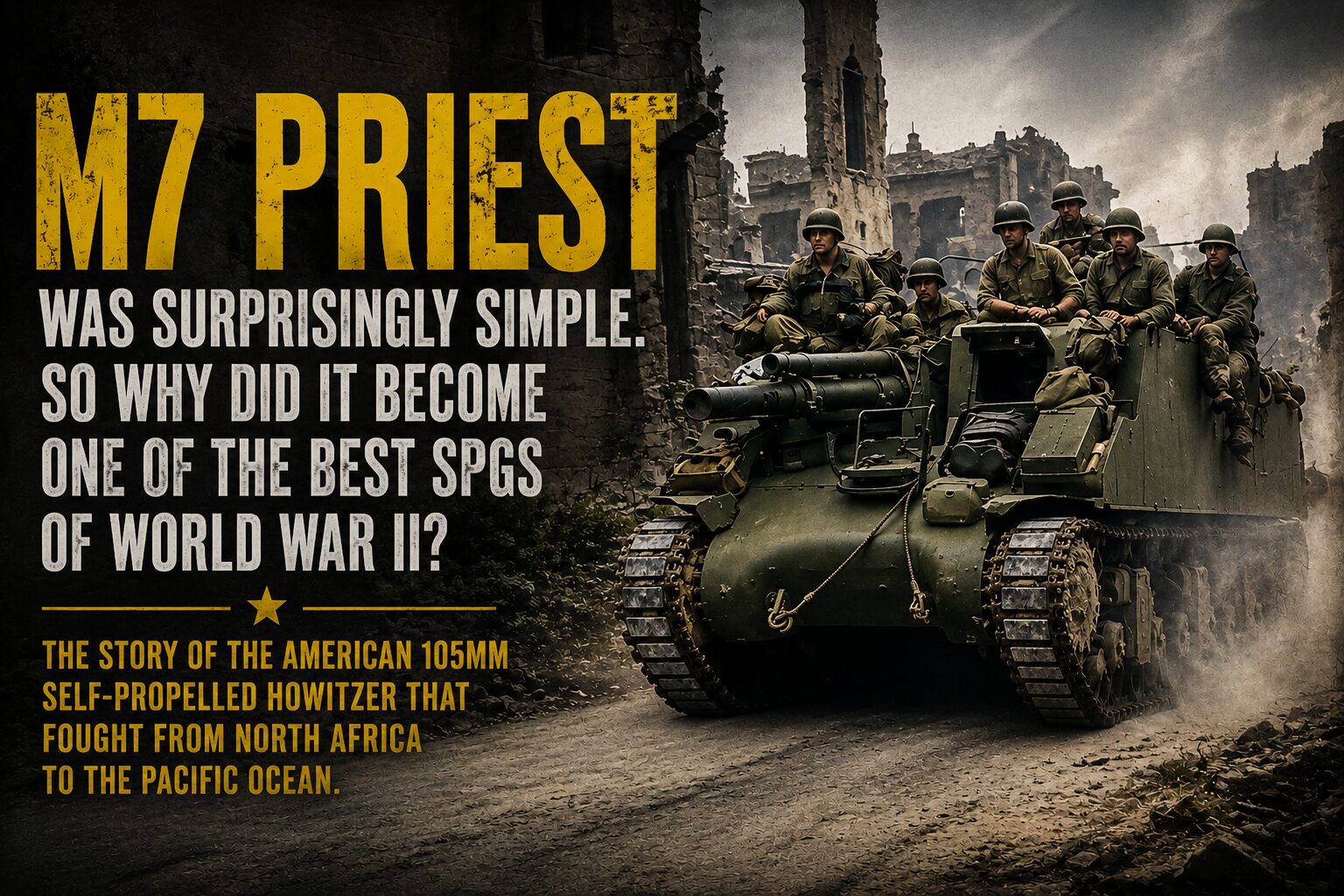
The Germans had the Hummel and Wespe, while the Soviet Union fielded an entire family of self-propelled artillery vehicles. Against them, the American M7 Priest hardly looked like an engineering masterpiece. There was no revolutionary gun, sophisticated turret, or exceptional armor. The Americans essentially took components from an existing medium tank, placed an open fighting compartment on top, installed a standard 105 mm howitzer, and sent the resulting vehicle to war. Yet the design proved so successful that more than 4,300 were built, and the M7 fought from North Africa to the Pacific before continuing its career long after World War II. So why did such a conventional machine become so successful?
The answer is that the Americans did not need the world’s most advanced self-propelled artillery system. What they needed was artillery capable of keeping pace with an armored division.
And the Priest performed that job remarkably well.
The Americans Needed a Gun That Could Keep Up With Their Tanks
By the beginning of World War II, the problem was familiar to every major army. Armored formations were becoming faster, while much of their artillery remained dependent on tractors.
As long as the front remained relatively static, this was manageable. A battery could occupy a position, deploy its guns, establish ammunition supply, and begin firing. But once tanks broke through the enemy line and advanced dozens of kilometers, the situation changed completely. Artillery had to pack up, hitch its guns to tractors, follow the advance, deploy again, and only then resume firing.
The Americans initially tried the most obvious solution: mounting a 105 mm howitzer on a half-track chassis. The result was the T19 Howitzer Motor Carriage.
It provided a quick way to obtain mobile artillery, but it also demonstrated the limitations of a half-track platform. The Army needed something more permanent — a fully tracked self-propelled gun capable of moving with armored formations.
The experience with the T19 therefore helped lead to a new vehicle.
And the Americans approached the problem in a very American way.
Instead of designing a completely new chassis, they looked at what was already being mass-produced.
The answer was obvious: the M3 Lee medium tank.
Its running gear became the basis of the T32 prototype, which received an open-topped fighting compartment and a standard American 105 mm howitzer. After trials and modifications, the vehicle was standardized in 1942 as the 105 mm Howitzer Motor Carriage M7.
There was no engineering magic involved.
And that would become one of the Priest’s greatest strengths.
It Was Essentially a Huge Armored Truck for a Howitzer
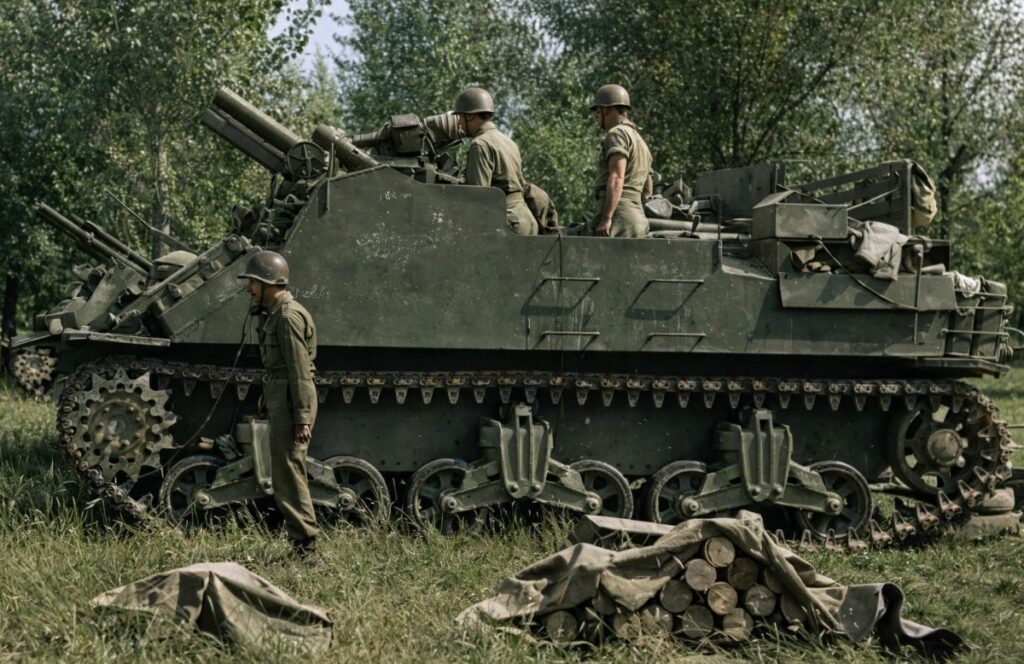
The M7’s design perfectly illustrates the American approach to mass-produced weapons during World War II.
If a component already existed, was being manufactured by the thousands, and worked well enough, why invent another one?
Early M7s relied heavily on components associated with the M3 medium tank. As the Sherman became America’s primary medium tank, the later M7B1 incorporated greater commonality with the M4A3. The self-propelled gun could therefore take advantage of the enormous industrial and logistical ecosystem supporting America’s medium tanks.
The same philosophy applied to the weapon.
The M7 carried a 105 mm howitzer from the M2 family — essentially standard U.S. Army divisional artillery. Its maximum range was around 10.4 kilometers, while the vehicle could carry as many as 69 rounds internally.
The M7 weighed roughly 23 tons and could reach approximately 39–42 km/h on roads, depending on the variant and source.
That was enough.
The Priest did not need to win a race against a Sherman. It simply needed sufficient cross-country mobility to operate alongside mechanized formations without becoming a logistical anchor every time the front moved.
Armor protection followed the same logic.
The M7 was never intended to duel enemy tanks. Its armor protected the crew against small-arms fire and shell fragments, while the open fighting compartment made it easier for the crew to handle bulky 105 mm ammunition and kept the vehicle from becoming excessively heavy.
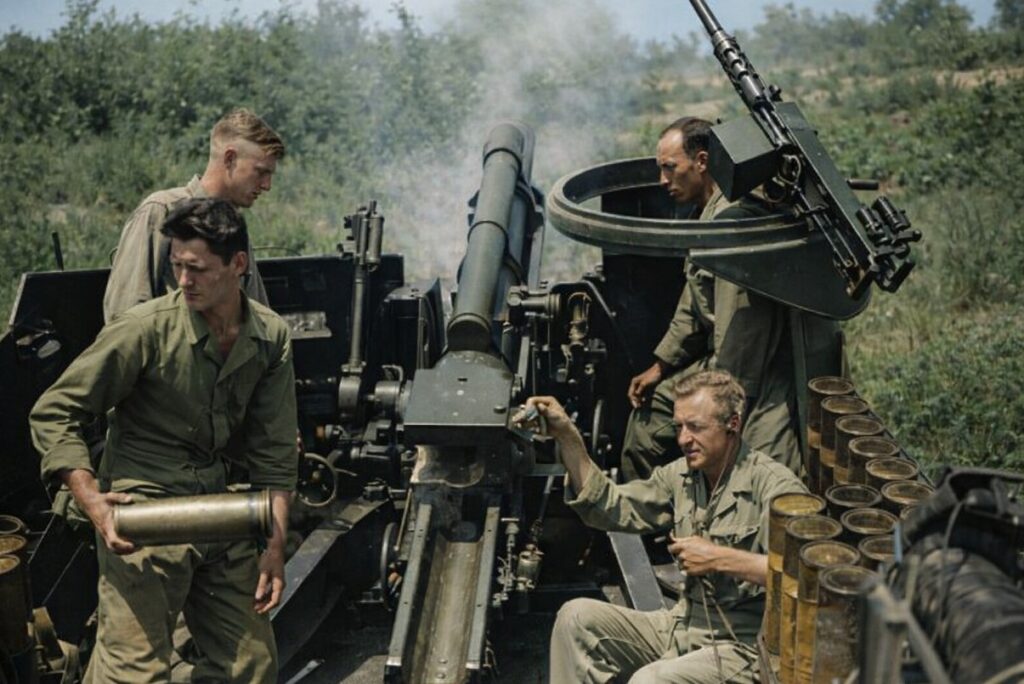
A .50-caliber Browning M2 machine gun was mounted in a distinctive raised position. British troops thought the mounting resembled a church pulpit.
Thus the famous nickname:
Priest.
Almost everything about the vehicle was subordinated to one purpose: arrive wherever the tanks had gone, start firing quickly, and move again when necessary.
And This Is Where Things Get Interesting
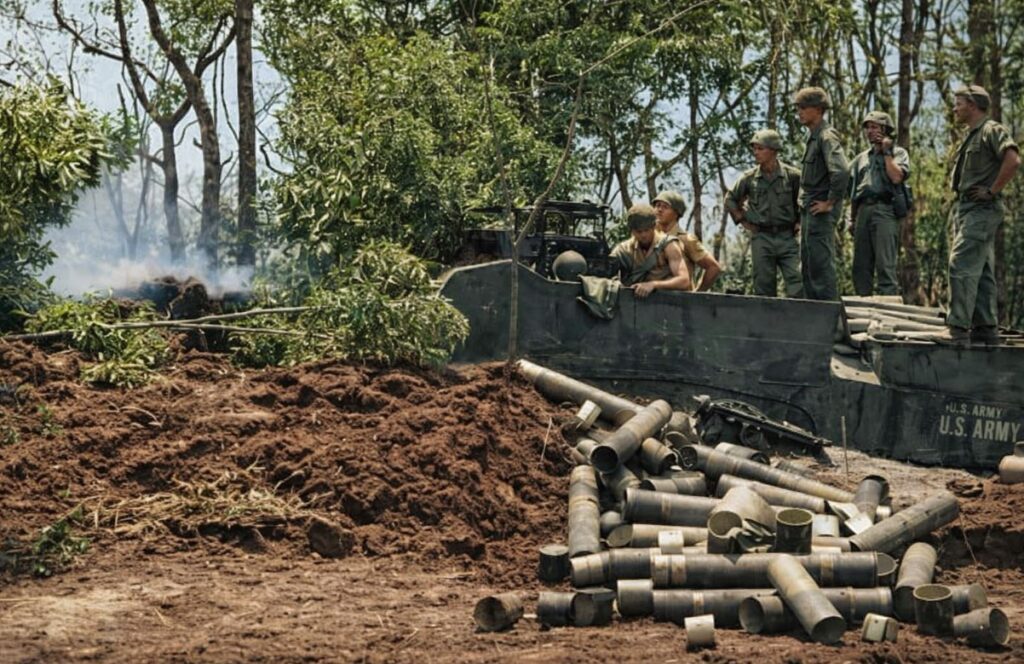
Looking only at the M7’s specifications, it can actually be difficult to understand why the vehicle mattered so much.
Its 105 mm howitzer was not revolutionary. Protection was modest. The fighting compartment was open. Maximum elevation was only around +35 degrees, while limited horizontal traverse meant that large shifts in fire direction could require repositioning the entire vehicle.
Even its maximum firing range was hardly extraordinary by the standards of heavier artillery.
But the M7 cannot be understood separately from the American artillery system surrounding it.
That was the real weapon.
American armored divisions did not receive a handful of self-propelled guns that occasionally followed their tanks. They operated complete self-propelled field artillery battalions. By the later stages of the war, a typical armored field artillery battalion consisted of three batteries of 105 mm self-propelled howitzers.
This meant an armored formation could have its own artillery moving with it almost continuously.
The M7 itself was merely the final element of a much larger machine: forward observers, radio communications, fire-direction centers, ammunition supply, and the ability to concentrate the fire of multiple batteries against a single target.
And this reveals the real secret of the Priest.
The Americans did not simply make the gun mobile. They made the entire artillery system mobile.
The tanks advanced — the artillery followed.
The formation changed its axis of advance — the batteries could relocate.
A new target appeared — its coordinates could be transmitted by radio, fire-control data calculated, and several artillery units concentrated against it.
The German soldier being shelled might never even see the M7 firing at him.
The Priest did not need to drive up to the front line and pretend to be an assault gun. Its normal job remained indirect fire from positions behind the frontline.
And that was where it was most dangerous.
North Africa Proved That the Idea Worked
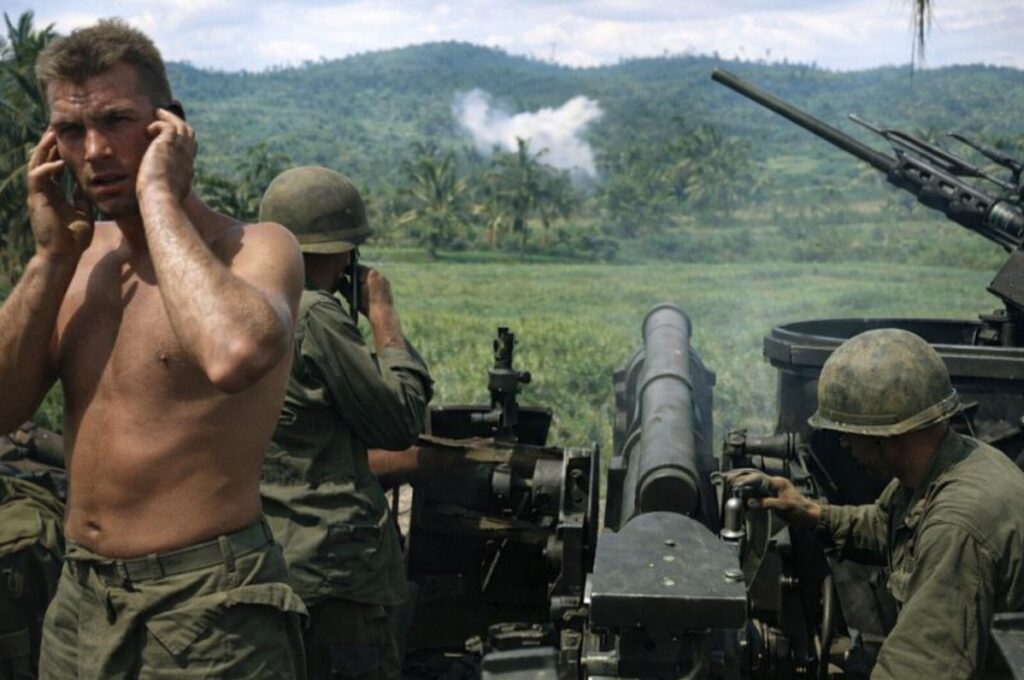
North Africa became the first major proving ground for American M7s.
The vehicles participated in Operation Torch and later fought in Tunisia. Initially, the 1st Armored Division still operated M7s alongside older T19 half-track howitzers, but by January 1943 three armored field artillery battalions equipped with M7s had been grouped into the 5th Armored Field Artillery Group.
The Americans quickly received exactly what the vehicle had been designed to provide: artillery capable of accompanying mobile armored formations.
The Priest was also versatile enough to engage targets with direct fire when circumstances demanded it. In May 1943, an M7 battery in North Africa fought enemy tanks directly, destroying one and forcing the others to withdraw.
But this should not turn the M7 into some mythical tank destroyer.
A 105 mm shell could certainly be devastating, especially against lighter armored vehicles, fortifications, or targets caught in an ambush. But the Priest had not been designed to hunt Panthers.
Its real strength was revealed when enemy tanks did not even know where the 105 mm shells falling around them were coming from.
Sixty-Nine Rounds — And Then Logistics Takes Over
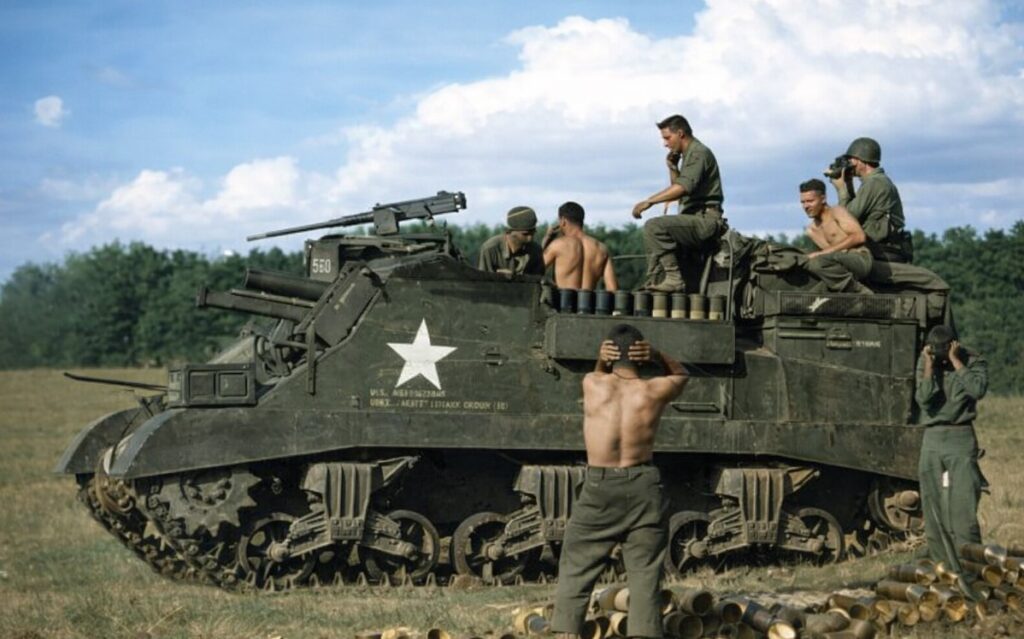
There is another reason why the M7 was such a quintessentially American weapon.
It was created by an army that could afford to keep feeding its artillery with ammunition.
The Priest carried as many as 69 rounds of 105 mm ammunition. That sounds substantial, but sustained artillery fire could consume ammunition at an astonishing rate.
Behind every dramatic photograph of an M7 battery stood an enormous and largely invisible logistical tail: trucks, ammunition dumps, fuel, maintenance units, communications networks, and thousands upon thousands of artillery shells.
This was where American industrial power became a battlefield advantage.
The M7 was successful not because it could operate completely independently. Quite the opposite. It was designed as part of an enormous military system capable of supplying advancing formations with a near-continuous stream of fuel, spare parts, and ammunition.
Its straightforward construction, commonality with mass-produced tank components, and use of a standard 105 mm howitzer made it ideally suited to that system.
The Americans did not need an artillery Ferrari.
They needed an artillery truck.
And they built thousands of them.
Sometimes the Priest Still Had to Pretend It Was a Tank
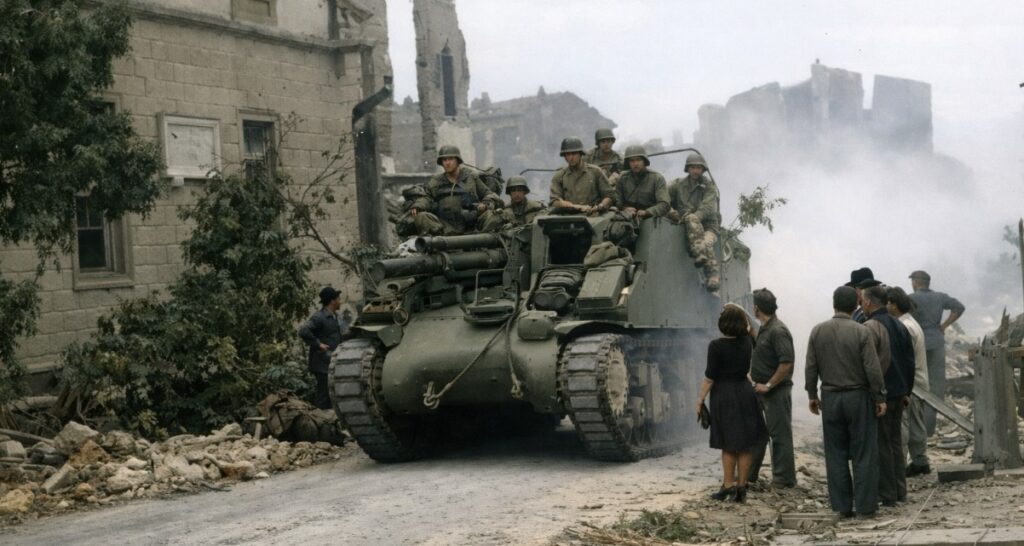
War has a habit of forcing weapons into jobs their designers never intended.
The M7 was no exception.
Priests were sometimes employed in direct-fire roles against fortifications, armored vehicles, and infantry. In the Pacific, the 105 mm howitzer proved particularly useful against Japanese bunkers and fortified positions.
For a concrete bunker, it made little difference whether the vehicle firing at it was technically classified as a tank or a self-propelled howitzer.
A direct hit from a 105 mm high-explosive shell settled the terminology rather convincingly.
But these missions also exposed the Priest’s weaknesses.
The open fighting compartment was perfectly acceptable while the vehicle remained behind the front. Under mortar fire or in close combat with infantry, however, it became a serious liability. Limited traverse meant the entire vehicle sometimes had to maneuver to engage targets, while its armor was never designed to withstand dedicated anti-tank weapons.
So yes, the Priest could serve as an assault gun.
It simply preferred not to.
More Than 4,000 Were Built
One of the most important numbers in the M7 story is the scale of production.
Some accounts cite 3,490 vehicles, but this understates total production. Depending on which variants and production batches are counted, historical sources generally put total M7-family production at roughly 4,300–4,400 vehicles.
For a self-propelled howitzer, that was a huge production run.
And its combat geography reflected that scale.
The M7 fought in North Africa, Italy, Western Europe, and the Pacific. It was supplied to Allied armies and continued serving with several countries after World War II. The U.S. Army itself returned to the Priest during the Korean War.
Korea even produced the M7B2 modification, which increased the weapon’s elevation because the original +35-degree limit proved inadequate for artillery operations in mountainous terrain.
Not a bad career for a vehicle containing almost nothing that could be described as revolutionary.
So Why Was the Priest So Successful?
Because we often judge military equipment the wrong way.
We instinctively look for wonder weapons: the biggest gun, thickest armor, fastest engine, longest range.
But wars are often fought — and won — with very different machines: equipment that is good enough, reliable, available in large numbers, and perfectly integrated into the army using it.
The M7 was exactly that kind of weapon.
It did not need to defeat a German tank in a duel. Other weapons existed for that purpose. It did not need to survive a direct hit from a heavy anti-tank gun. It did not need a turret or spectacular firing range.
Its mission was much simpler:
be wherever an armored division suddenly needed 105 mm shells.
And the Priest was extremely good at doing exactly that.
It used components already familiar to America’s automotive and tank industries, carried a standard Army howitzer, transported its own ammunition, possessed sufficient mobility, and could be manufactured by the thousands.
Behind it stood radios, forward observers, ammunition trucks, fire-direction centers, and the enormous productive capacity of the United States.
That is why the M7’s most important legacy is not really its physical design.
Postwar American self-propelled artillery would look completely different. Enclosed turrets appeared, calibers and ranges increased, and fire-control technology became vastly more sophisticated. Almost nothing about the external appearance of the Priest survives in modern self-propelled guns.
But the underlying principle survived completely:
the artillery supporting a mechanized formation must possess mobility comparable to the troops it supports.
That is why one of America’s most important artillery weapons of World War II was almost comically straightforward.
The Americans did not try to build the perfect self-propelled gun.
They took a mass-produced tank chassis, installed a standard 105 mm howitzer, and built more than four thousand of them. Then they surrounded those vehicles with such an effective system of reconnaissance, communications, fire control, and logistics that the simple Priest became far more dangerous than its specifications alone would suggest.
Sometimes that is exactly what a truly successful weapon looks like.