The Wehrmacht Was Building an Army Around Tanks — So Why Did It Need an Armored Car With No Weapons?

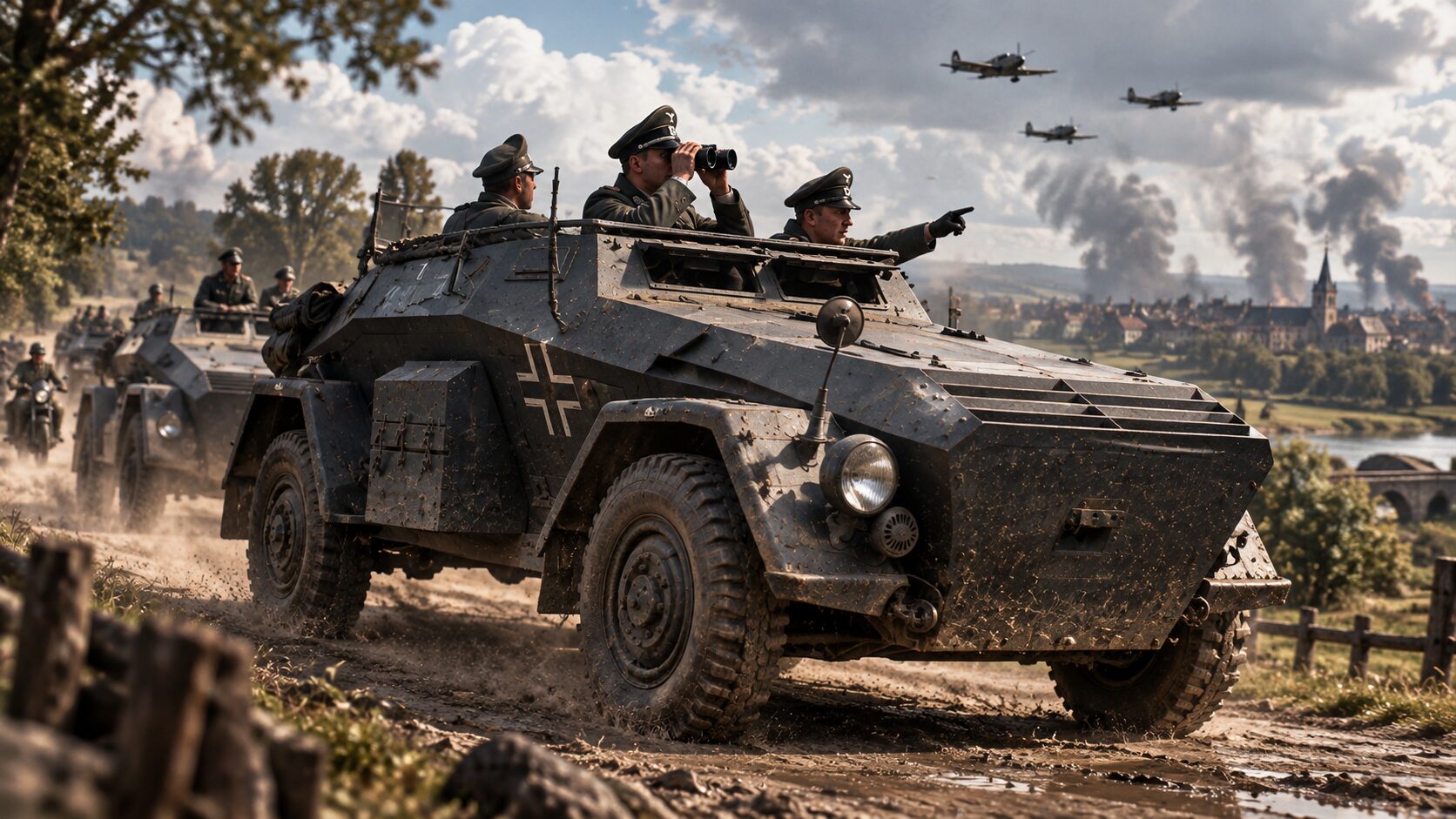
By the late 1930s, Germany was developing one of the most highly mechanized concepts of warfare of its era. Panzer formations were expected to break through enemy defenses at speed, reconnaissance units to operate far ahead of the main force, motorized infantry to keep pace with the armor, and commanders to make decisions faster than the enemy could understand what was happening. To make this possible, the Wehrmacht developed an entire ecosystem of specialized vehicles: tanks, armored personnel carriers, reconnaissance cars, radio vehicles, tractors, and command variants. Against this backdrop, the Sd.Kfz.247 looks almost absurd. It had no turret. No cannon. No standard primary armament at all. Even more strangely, a vehicle intended for commanders of motorized reconnaissance units was initially produced without a standard radio set. So why bother armoring a roughly five-ton automobile in the first place?
The answer is that the Sd.Kfz.247 was never intended to destroy the enemy. Its purpose was to allow a commander to be where his troops were and continue commanding them. In that sense, the lack of armament was not simply a design flaw but reflected a very specific philosophy. A command vehicle was not supposed to seek combat. It was supposed to survive incidental small-arms fire and shell fragments, move with a motorized formation, and provide officers with enough space and visibility to observe what was happening. The Germans therefore did not need another turreted armored car. What they needed was essentially an armored staff car.
The Commander Had to Keep Up With the Tanks Too
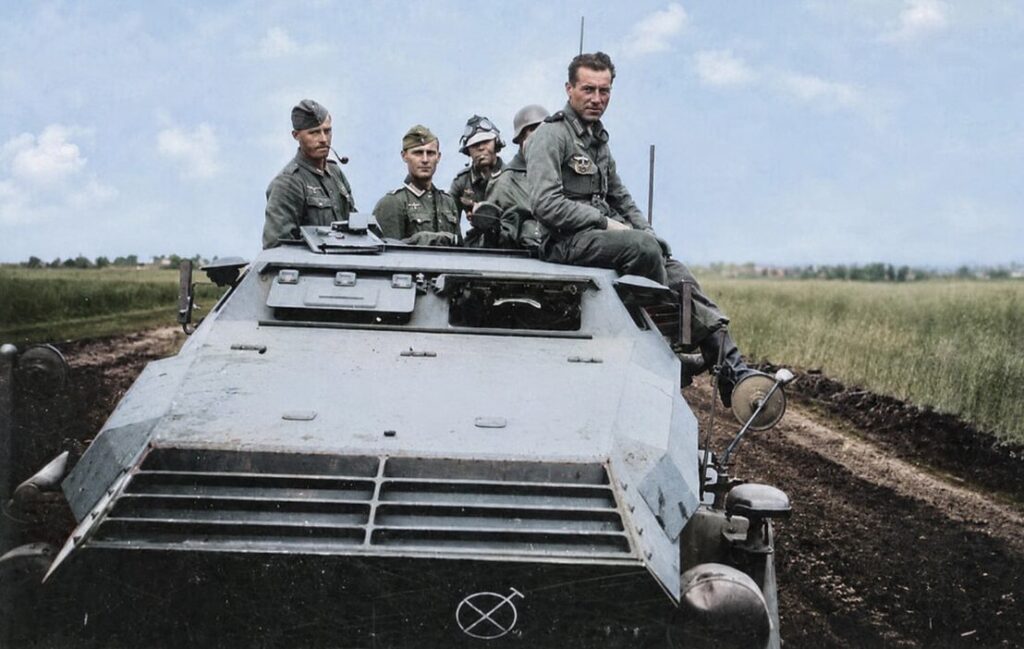
This is where the real story of the Sd.Kfz.247 begins. As long as an army moves at the speed of marching infantry, a commander can use an ordinary automobile, a horse, or establish his headquarters some distance behind the front. Mechanization radically changes the geography of battle. Tanks and reconnaissance units can move dozens of kilometers in a matter of hours. The tactical situation changes faster, reports become outdated before they reach headquarters, and a commander positioned too far behind the advance gradually begins commanding not the battle that is actually taking place, but the battle as it existed some time earlier.
The Wehrmacht recognized early that mechanizing combat units also meant mechanizing the command structure that controlled them. If a reconnaissance battalion moved on motorcycles and armored cars, its commander needed a vehicle with comparable road speed and reasonable cross-country mobility. An ordinary Horch staff car was fast enough but offered virtually no protection. A proper reconnaissance armored car, on the other hand, carried a turret and weapons that the commander did not particularly need, while taking up valuable internal space and increasing weight. The Sd.Kfz.247 represented a compromise: take the mobility of a heavy military automobile and surround the command group with a thin armored hull.
This explains the vehicle’s unusual layout. The open-topped compartment provided excellent visibility and enough room for several officers to work inside. Armor of roughly 6–8 mm was intended primarily to provide protection against small-arms fire and fragments rather than turn the Sd.Kfz.247 into a fighting vehicle. Six men inside were more important than a machine gun outside.
And this leads to the central paradox of the vehicle: the Sd.Kfz.247 was armored not because it was supposed to fight, but precisely because its commander needed to operate close enough to the fighting without becoming a direct participant in it.
The First Version Showed That Armor Alone Was Not Enough
The original Sd.Kfz.247 Ausf.A appeared before the war. Krupp built only ten vehicles on the six-wheeled Krupp L2H 143 chassis, better known as the Krupp Protze. The result was a distinctive 6×4 armored command car weighing around 5.2 tons and powered by a 66-horsepower engine, with a top road speed of roughly 70 km/h. But there was a problem: the 6×4 configuration looked more impressive than it performed in difficult terrain. Only the two rear axles were driven, and even the standard Krupp Protze had limitations in poor terrain; adding an armored body did little to improve the situation.
That was a serious weakness for a command vehicle assigned to reconnaissance formations. Reconnaissance units, by definition, were expected to operate ahead of the main force, where good roads could hardly be guaranteed. The second version was therefore a substantially different machine. Daimler-Benz built 58 Sd.Kfz.247 Ausf.B vehicles using a heavy standardized Horch-derived automotive chassis with four-wheel drive. The new version became somewhat smaller and lighter at around 4.46 tons, received a V8 producing roughly 80 horsepower, could reach around 80 km/h on roads, and had a road range of approximately 400 km.
The mission had not changed, but the vehicle was now much better suited to the pace of motorized formations. The Germans did not simply need an armored box for officers. They needed an armored box capable of remaining inside a rapidly moving formation.
But How Do You Command Without a Radio?
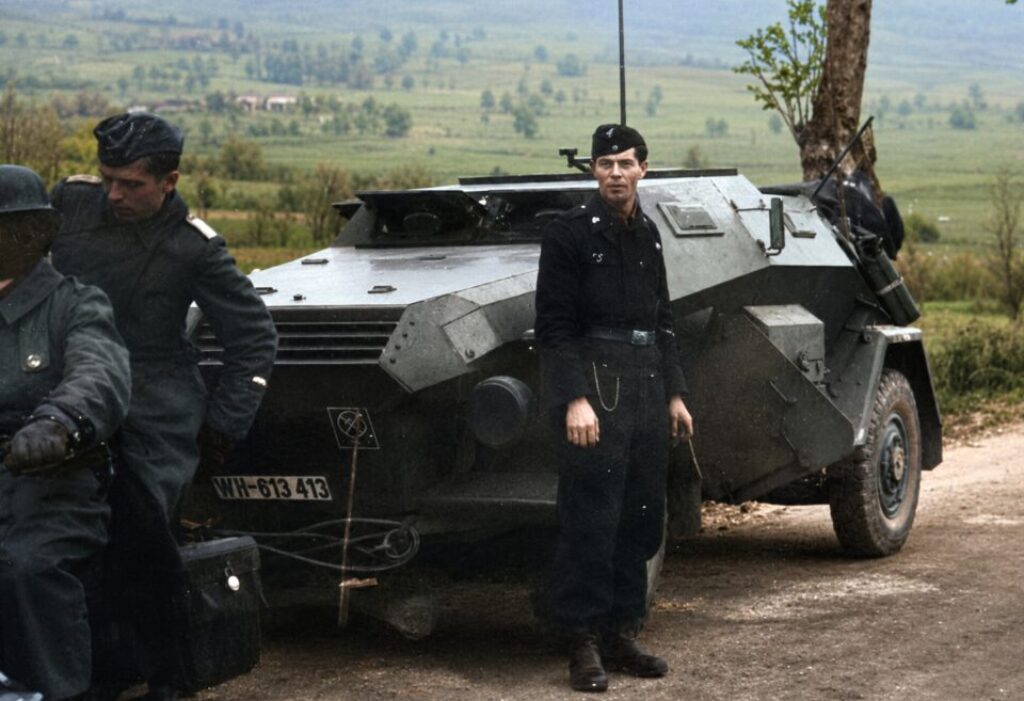
This is perhaps the strangest detail of the Sd.Kfz.247. The vehicle was intended for commanders of motorized and reconnaissance formations, yet a standard radio set was not originally part of the equipment of the main variants. Wartime photographs show Ausf.B vehicles later fitted with radio equipment and characteristic antennas, reflecting how operational practice evolved.
Today, such a design seems almost absurd. We tend to think of a command vehicle primarily as a communications node. A modern commander is surrounded by radios, data terminals, digital maps, and streams of battlefield information. But the Sd.Kfz.247 emerged during a transitional period. German mobile forces already took radio communications extremely seriously, especially within Panzer formations, yet command and control still depended heavily on visual signals, messengers, face-to-face contact, and direct observation. A reconnaissance commander was expected to see the situation personally, meet subordinates, receive reports, and move between the different elements of his unit.
The open-topped hull was therefore simultaneously a weakness and an advantage. It offered poor protection from weather, airburst fragments, and attacks from above, but gave the occupants excellent all-around visibility and allowed the commander to observe the battlefield directly. The Sd.Kfz.247 was not a mobile digital headquarters in the modern sense. It was closer to an armored observation post on wheels.
The war soon demonstrated where the command-vehicle concept was heading. Radios began appearing on Sd.Kfz.247s, while later specialized German command and communications vehicles were increasingly built around radio equipment. In this sense, the peculiarities of the Sd.Kfz.247 capture the transition between two eras of command: from a commander who had to personally see what was happening to one whose most important requirement was remaining continuously connected to an information network.
The Machine Gun Eventually Became Necessary After All
Something similar happened with armament. Officially, the Sd.Kfz.247 had no standard primary weapon. The crew relied on personal weapons for immediate protection, and small arms could be carried inside the vehicle. The logic was understandable: if the commander of a reconnaissance battalion had to fight a serious engagement from his own command vehicle, then something had already gone badly wrong.
War, however, rarely cares what the table of organization says.
A column can drive into an ambush. A small enemy group can suddenly appear on the road. The vehicle can be attacked while separated from its combat elements. As a result, wartime photographs show Sd.Kfz.247s fitted in the field with MG 34 machine guns, and later examples could also carry MG 42s. Different mounting arrangements appeared, providing at least a limited ability to defend the vehicle and disengage. This did not transform the Sd.Kfz.247 into a proper reconnaissance armored car, but it gave the crew a chance to fight back long enough to escape.
The distinction between design logic and frontline logic is especially clear here. The designer asks: “What does this vehicle require to perform its primary mission?” The soldier asks: “What am I going to need when everything goes wrong?”
The MG 34 was the answer to the second question.
Why Not Just Use a Normal Armored Car?
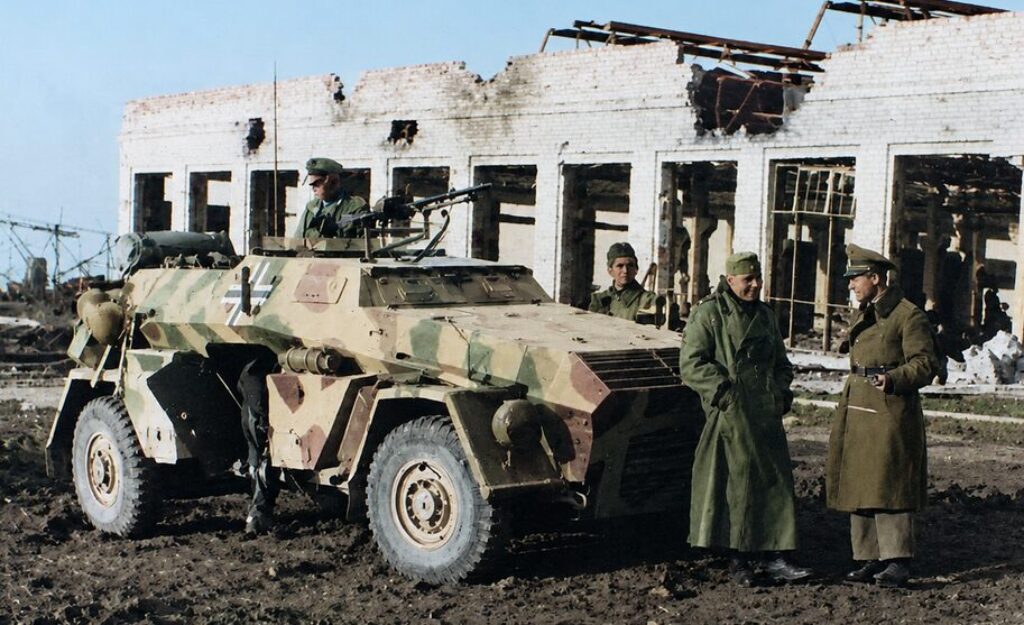
Because internal space is one of the most valuable resources inside any armored vehicle. A turret, ammunition, weapon mounts, and associated equipment occupy volume, increase weight, and require crew. A commander instead needs room for officers, maps, documents, observation equipment, communications gear, and the ability to work inside the vehicle. Turning every command car into a fully armed reconnaissance vehicle would mean paying for combat capabilities that it was not supposed to use most of the time.
This is why the idea behind the Sd.Kfz.247 survived long after the vehicle itself disappeared. It simply took different forms. Command tanks received additional radio equipment, armored personnel carriers were converted into command and communications variants, and dedicated command-post vehicles became commonplace. Eventually, virtually every mechanized army arrived at the same conclusion: a unit commander needs protected mobility, but his vehicle does not necessarily require the same firepower as frontline combat vehicles.
The Sd.Kfz.247 was therefore not merely a strange technological dead end. It was an early representative of a huge class of vehicles that today seems entirely normal: the armored command vehicle.
The Germans simply had not yet fully determined what such a vehicle should look like.
So Why Did the Sd.Kfz.247 Disappear So Quickly?
Only ten Ausf.A and 58 Ausf.B vehicles were built—an almost insignificant production run by Wehrmacht standards. The later version was manufactured in 1941–1942, after which a dedicated armored command car of this type became increasingly unnecessary. Much more versatile half-track families such as the Sd.Kfz.250 and Sd.Kfz.251 were already available and could be converted into command, communications, and observation variants without maintaining a separate low-volume vehicle type.
And this is where the story of the Sd.Kfz.247 reaches its most interesting conclusion.
It is easy to make fun of the vehicle. No cannon. No turret. Thin armor. Open roof. Initially, not even a standard radio. Just 68 vehicles across two variants. Compared with Germany’s heavily armed eight-wheeled reconnaissance cars or its tanks, the Sd.Kfz.247 can look almost unfinished.
But once we stop judging it by its weapons and start looking at its mission, the vehicle becomes much more interesting.
The Wehrmacht was among the armies that encountered a problem created by its own increasing mobility. If tanks, armored cars, and motorcycle troops could move faster than ever before, commanders could no longer remain far behind them. They needed speed as well. They needed protection. They needed room for staff personnel. What they did not necessarily need was a cannon.
The Sd.Kfz.247 was therefore unarmed not because German engineers simply forgot to put a machine gun on it.
It was unarmed because the primary weapon of the men inside was supposed to be information.
The irony was that the war would soon demonstrate that, for a vehicle built around information, the radio would ultimately prove far more important than any gun.