
German Electric Drone Reaches 699 km/h: Why the World Needs Ultra-Fast Interceptor UAVs

The race to develop unmanned aerial vehicles is no longer focused solely on extending range or endurance. Increasingly, attention is shifting toward speed—speeds that, until recently, were considered virtually impossible for fully electric aircraft.
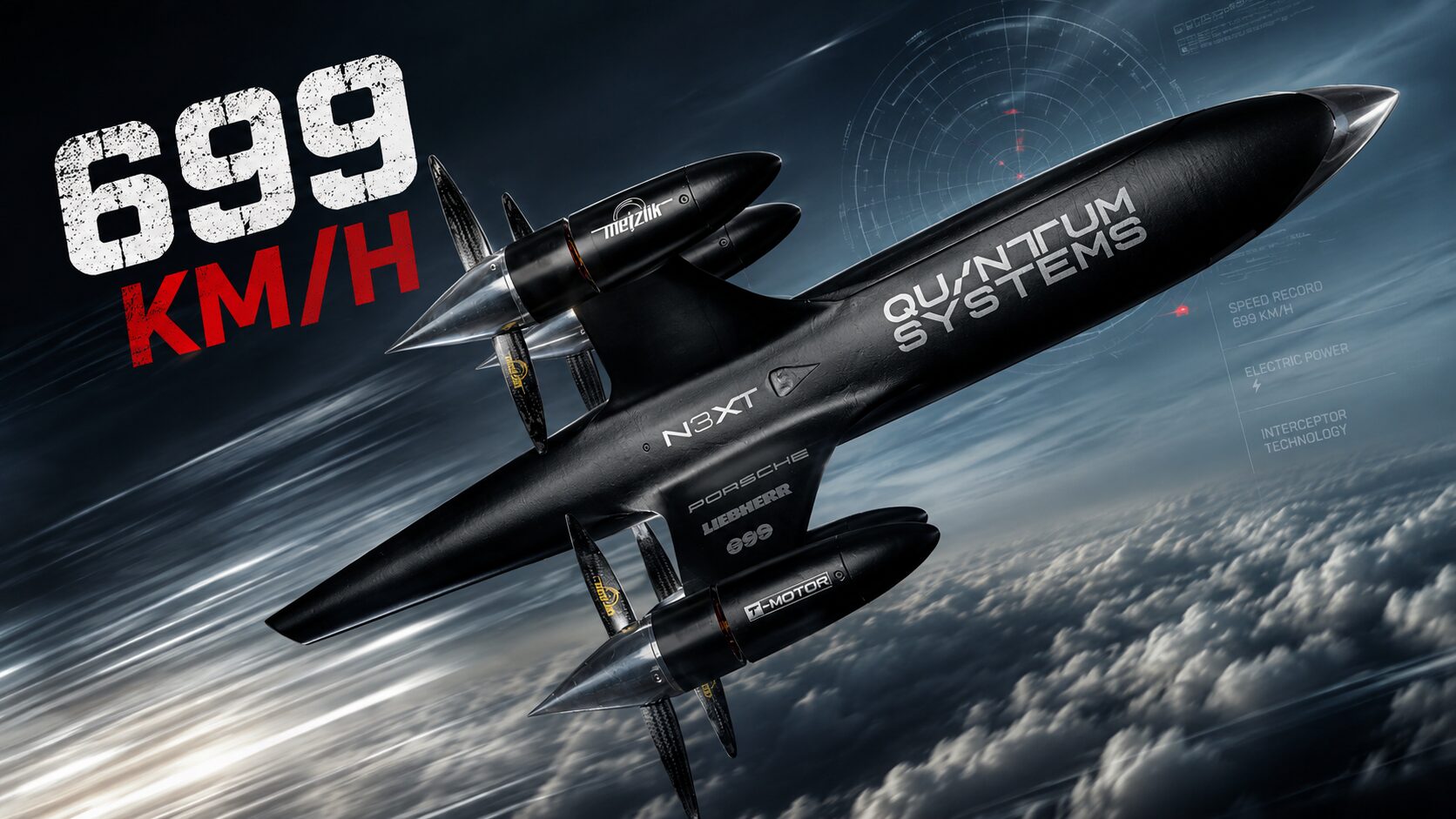
German defense technology company Quantum Systems has announced that its experimental UAV, Apex Recordhunter, reached 699 km/h (434 mph) during internal flight testing, setting what is believed to be a new unofficial world speed record for an electrically powered aircraft of its class. While the achievement still awaits official certification, the project itself is far more significant than the record. The aircraft was never intended as a record-breaker—it was designed as a technology demonstrator for a new generation of high-speed interceptor drones.
Speed Has Become the New Weapon
Only a few years ago, most military drones operated at speeds between 100 and 200 km/h.
Even FPV attack drones rarely exceeded 180–220 km/h.
Modern warfare has fundamentally changed those requirements.
Today’s air defenses increasingly face not only reconnaissance quadcopters but also jet-powered UAVs, next-generation loitering munitions, and high-speed strike drones.
Existing interceptor drones simply cannot keep up with many of these emerging threats.
As a result, defense companies are now developing an entirely new class of unmanned aircraft—high-speed drone interceptors.
Apex Recordhunter: A Flying Laboratory
Despite its impressive name, the Apex Recordhunter is not yet a combat aircraft.
It is best described as a flying research platform.
Over the past year, engineers from Quantum Systems’ N3XT division have been using the aircraft to explore the limits of modern electric propulsion, advanced aerodynamics, and high-speed flight control systems.
During testing on June 26, the aircraft achieved a horizontal flight speed of 699 km/h.
For comparison, the current officially recognized speed record for an electric aircraft of this category stands at 657.59 km/h.
Quantum Systems has already announced plans to conduct an official record attempt in the near future.
Not a Record for Its Own Sake
The real significance of the project lies elsewhere.
Quantum Systems has openly stated that the technologies demonstrated by Apex Recordhunter are intended for future production interceptor drones.
A particularly important role is being played by the company’s Ukrainian division, WIY Drones.
It is already working on several specialized unmanned systems, including FPV interceptor drones carrying explosive payloads and dedicated anti-air drones designed to engage high-speed aerial targets.
In essence, this represents the emergence of an entirely new branch of unmanned aviation.
Why Such Extreme Speeds Matter
The answer lies in the evolution of airborne threats.
Traditional propeller-driven attack drones can often be intercepted using existing FPV drones.
Jet-powered UAVs present an entirely different challenge.
Their higher speed dramatically reduces the reaction time available to air-defense units and makes interception by conventional multicopters significantly more difficult.
Interceptor drones therefore require a substantial speed advantage.
High speed also allows them to reach interception points much more rapidly, an increasingly important capability for defending cities and critical infrastructure.
Germany Is Not Alone
Germany is far from the only country pursuing this technology.
Ukraine has been actively developing interceptor drones specifically designed to destroy various types of attack UAVs.
Similar programs are underway in the United States, the United Kingdom, and several other countries.
These systems are increasingly viewed as a far more economical alternative to launching expensive surface-to-air missiles against comparatively inexpensive drones.
In effect, a new category of air defense is emerging—one where specialized unmanned aircraft increasingly complement or even replace traditional missile systems.
The Technologies Behind the Record
Reaching nearly 700 km/h using a fully electric aircraft required overcoming several major engineering challenges.
Among them were:
- Developing an extremely powerful electric propulsion system;
- Creating highly efficient battery cooling solutions;
- Minimizing aerodynamic drag;
- Maintaining stable flight at exceptionally high propeller-driven speeds;
- Designing lightweight yet extremely strong composite airframes.
Each of these technological advances has direct applications for future military UAVs.
That is why projects like Apex Recordhunter have significance far beyond setting speed records.
The Beginning of a New Competition
The Apex Recordhunter project highlights another important trend.
Until recently, drone manufacturers competed primarily on endurance and communication range.
Now, speed is becoming an equally important performance metric.
Within the next few years, production electric interceptor drones capable of exceeding 500–600 km/h may become a reality.
Such aircraft could perform missions that today still require expensive missile-based air-defense systems.
If that happens, battlefield air defense could undergo another transformation comparable to the one triggered by the mass adoption of FPV drones.
A Glimpse into the Future
The 699 km/h speed record is ultimately a demonstration of what modern electric aviation technology has become capable of achieving.
Its true importance lies elsewhere.
For the first time, such extreme speed is being pursued not as a publicity stunt but as a practical requirement for the next generation of mass-produced interceptor drones.
These aircraft may soon become one of the most effective tools for countering increasingly fast unmanned aerial threats on tomorrow’s battlefield.
Apex Recordhunter Technical Specifications
Developer: Quantum Systems (N3XT Division)
Country: Germany
Type: Experimental high-speed electric UAV
Primary Purpose: Technology demonstrator for future interceptor drones
Propulsion: Fully electric
Maximum Recorded Speed: 699 km/h (434 mph)
Record Flight Date: June 26, 2026
Record Status: Awaiting official certification
Primary Technology Applications:
- High-speed interceptor drones
- Counter-UAS systems
- FPV interceptor UAVs
- Next-generation electric aircraft






