From Truck to Combat System: What Daimler Truck Showcased at Eurosatory 2026

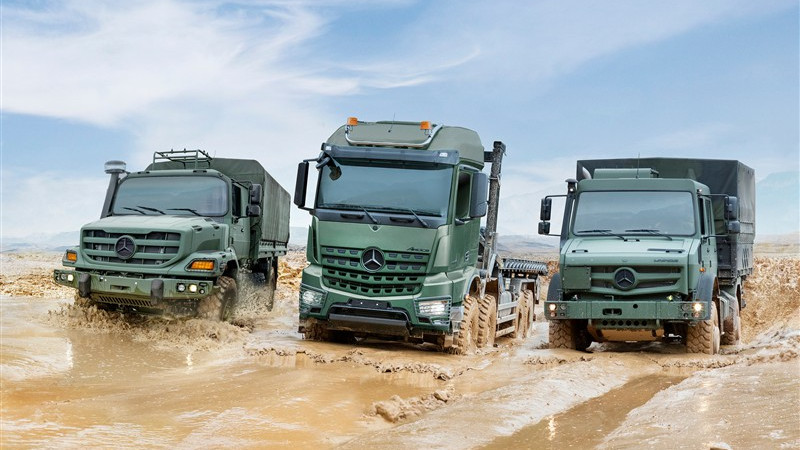
For decades, the military truck was little more than a logistical workhorse. Its mission was straightforward: transport troops, ammunition, fuel, and supplies wherever they were needed. Yet the experience of modern conflicts has shown that the line between a combat vehicle and a logistics platform is rapidly disappearing. At Eurosatory 2026, Daimler Truck demonstrated an entire family of solutions in which a conventional truck becomes a fully integrated element of the battlefield—from mobile air defense systems and drone carriers to autonomous robotic platforms.
The company’s display featured the Mercedes-Benz Zetros, Arocs, Unimog, and the new FGA platform. However, the real focus was not the vehicles themselves, but the advanced systems of weapons, reconnaissance, and battlefield support mounted on them.
The Zetros as a Mobile Air Defense Platform
One of the most interesting exhibits was the Mercedes-Benz Zetros 3848A 8×8, presented as a carrier for air defense and counter-drone systems. The concept reflects a growing military trend: rather than developing expensive specialized vehicles, armed forces are increasingly relying on production heavy-duty trucks capable of carrying a wide variety of mission modules.
Particularly noteworthy was Daimler’s demonstration of the vehicle equipped with the SKYTHUNDER 300 turret system developed by Valhalla Turrets. In practice, this creates a highly mobile short-range air defense platform capable of accompanying frontline units and providing immediate protection against aerial threats.
Such an approach allows military operators to rapidly field specialized systems without investing in entirely new vehicle designs. At the same time, the Zetros family has long been known for its excellent off-road performance and ability to operate in some of the harshest environments on Earth.
A Truck with Its Own Air Wing
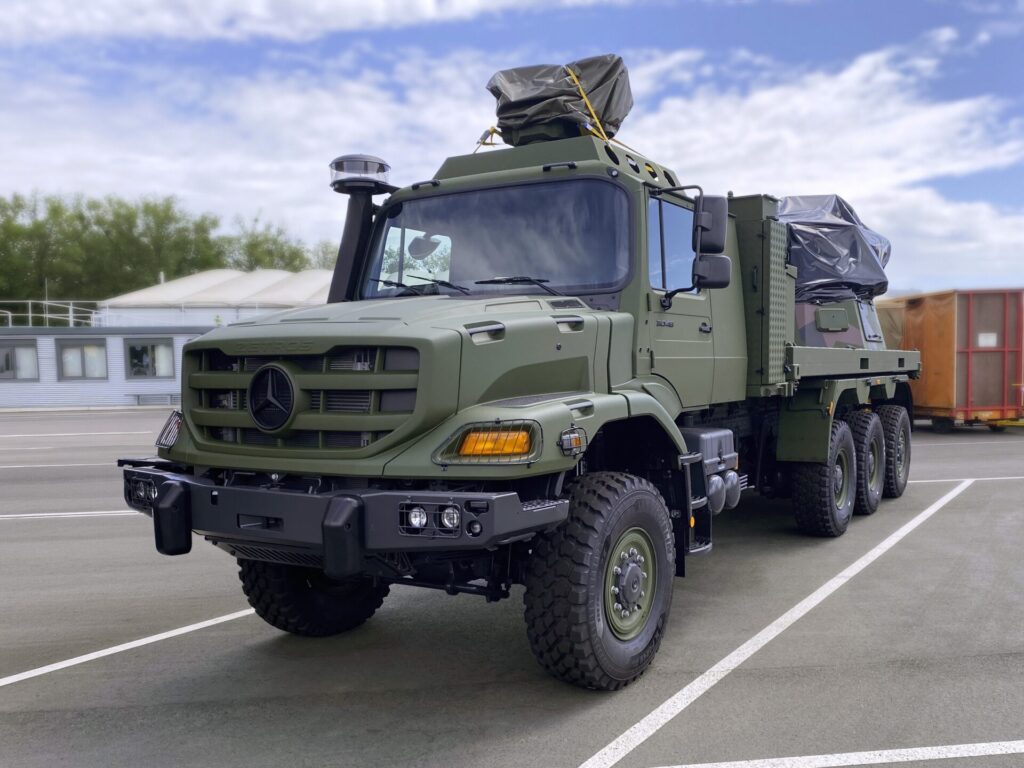
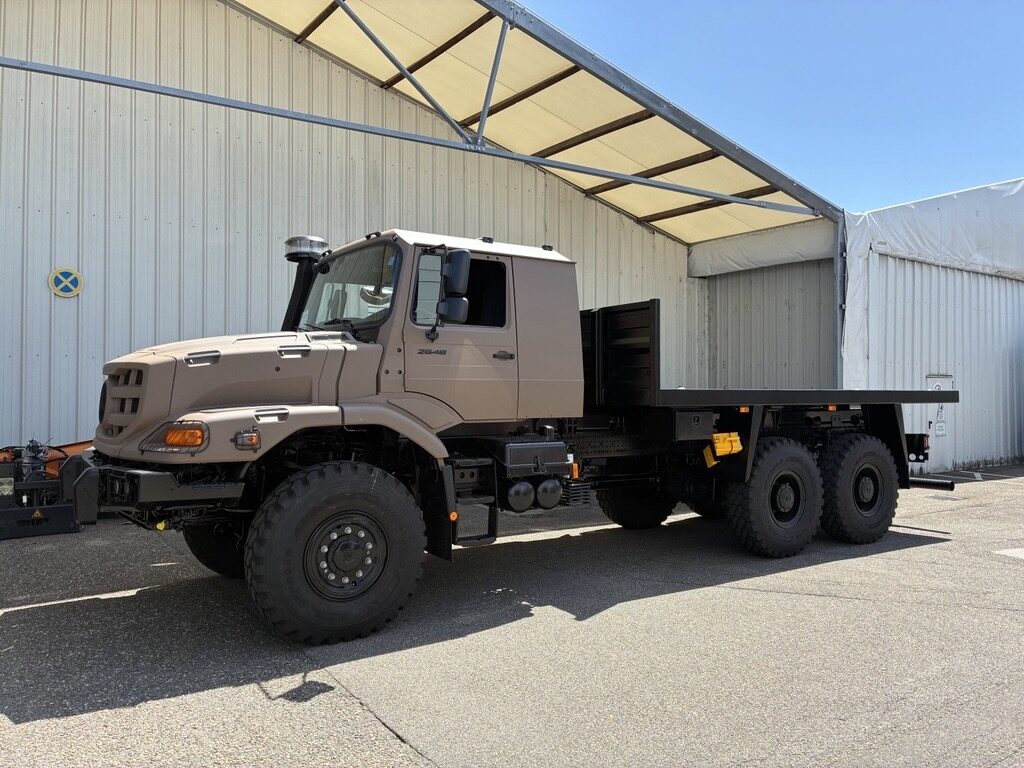
Equally intriguing was another Zetros variant—the 2648A 6×6, equipped with integrated drone deployment modules. In practical terms, this means the vehicle is not only capable of transporting unmanned aerial vehicles but also serves as a mobile launch, maintenance, and command center.
Modern armies increasingly view drones as a consumable battlefield resource, much like ammunition. As a result, there is growing demand for mobile platforms capable of transporting large numbers of UAVs while supporting rapid preparation and deployment. Daimler’s concept offers a glimpse into how such systems may operate in the near future.
Next-Generation Rocket Artillery
Another noteworthy exhibit was the Zetros 2048A 4×4, presented as a carrier for networked unmanned systems and the HX-2 missile platform. The vehicle embodies a modular approach in which a single truck can function as a mobile launcher for precision-guided munitions.
Such solutions are becoming increasingly attractive to modern armed forces. Military planners seek the flexibility to rapidly reconfigure a platform according to mission requirements, transforming the same vehicle into a missile launcher, reconnaissance platform, command post, or logistics asset as circumstances demand.
The Armored Arocs for Heavy Logistics
Eurosatory was not solely about futuristic technology. A significant portion of Daimler’s display focused on vehicles designed for traditional military logistics and support roles.
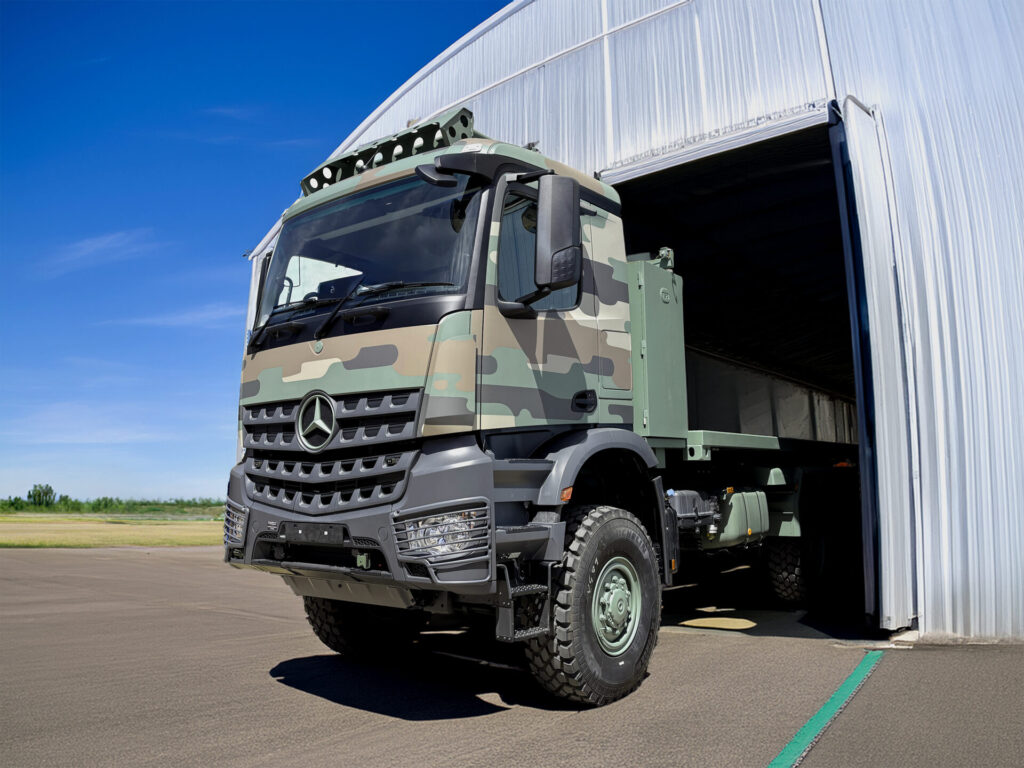
The Mercedes-Benz Arocs 4463AK 8×8 featured a protected cab developed by KNDS. Vehicles of this type are intended to transport heavy equipment and supplies in combat zones where conventional trucks would be too vulnerable to survive.
Alongside it stood the Arocs 2736A 6×6 fitted with a HIAB hook-lift system. Thanks to its modular design, the truck can quickly exchange containers, engineering equipment, or specialized mission modules directly in field conditions, greatly improving operational flexibility.
The Unimog Remains Indispensable
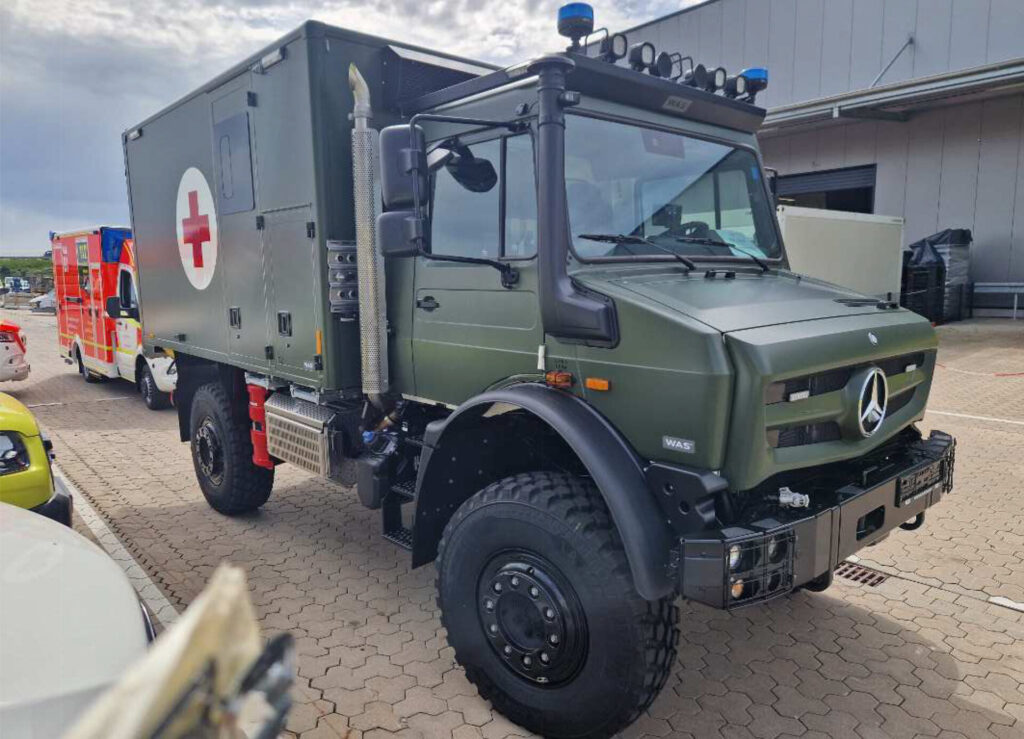
Among the larger vehicles, the legendary Unimog U 5023 occupied a special place. At the exhibition, it was displayed in a medical evacuation configuration featuring a body developed by WAS, capable of transporting up to four stretcher patients.
Despite the rise of robotic systems and high-tech battlefield solutions, armed forces continue to require compact, highly capable off-road vehicles. This enduring need explains why the Unimog has remained in production for decades and continues to serve military organizations around the world.
Robots Take Center Stage
Another notable feature of the exhibition was the GEREON unmanned ground vehicle developed by ARX Robotics. Although not a Daimler product, its presence alongside the truck platforms highlighted the direction in which military mobility is evolving.
Today, military trucks are increasingly viewed as components of a broader ecosystem that includes drones, robotic vehicles, air defense systems, and digital command-and-control networks. In essence, Daimler was not showcasing individual vehicles but rather presenting a vision of the future battlefield, where logistics, reconnaissance, and firepower are seamlessly integrated into a single operational network.
That may be the most important takeaway from Eurosatory 2026. If military trucks were once little more than transport vehicles, they are now evolving into versatile combat platforms. Judging by the systems displayed by Daimler Truck, such vehicles are likely to play a defining role in the structure of European armed forces over the coming decade.