
Europe’s Hypersonic Shield: Why There Is Still No Replacement for Patriot

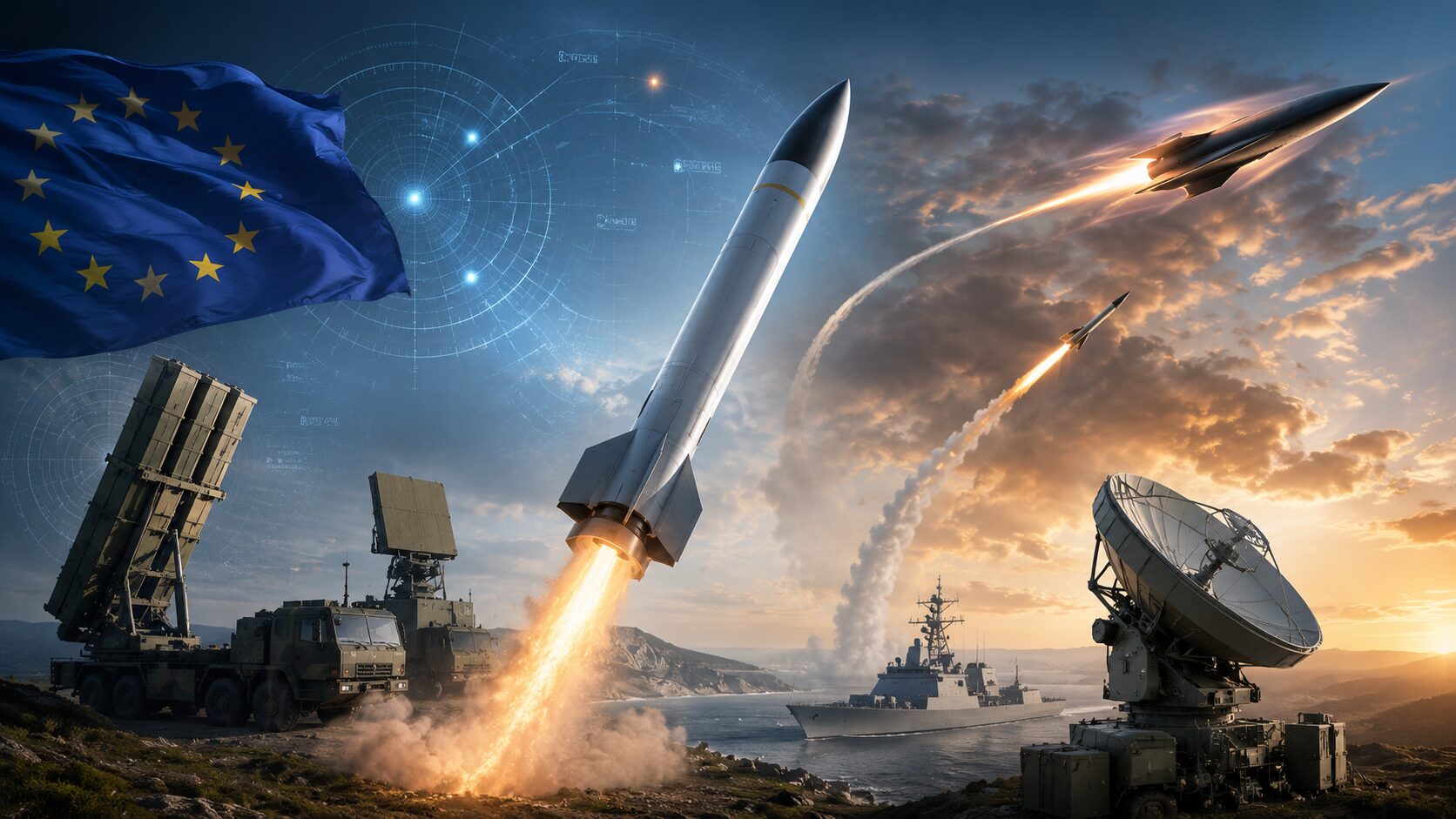
The emergence of hypersonic weapons has become one of the greatest challenges facing modern air and missile defense systems. Unlike conventional ballistic missiles, which generally follow predictable trajectories, hypersonic glide vehicles can maneuver throughout their flight, change altitude, and significantly complicate the work of radars and fire-control systems.
To address this growing threat, several European nations launched the HYDIS (Hypersonic Defence Interceptor System) program—a long-term initiative aimed at developing a next-generation interceptor capable of defeating hypersonic weapons and advanced ballistic missiles. The project recently passed a major milestone by completing its final concept selection phase. However, despite this progress, an operational missile is not expected before 2035.
Why Existing Air Defense Systems Are No Longer Enough
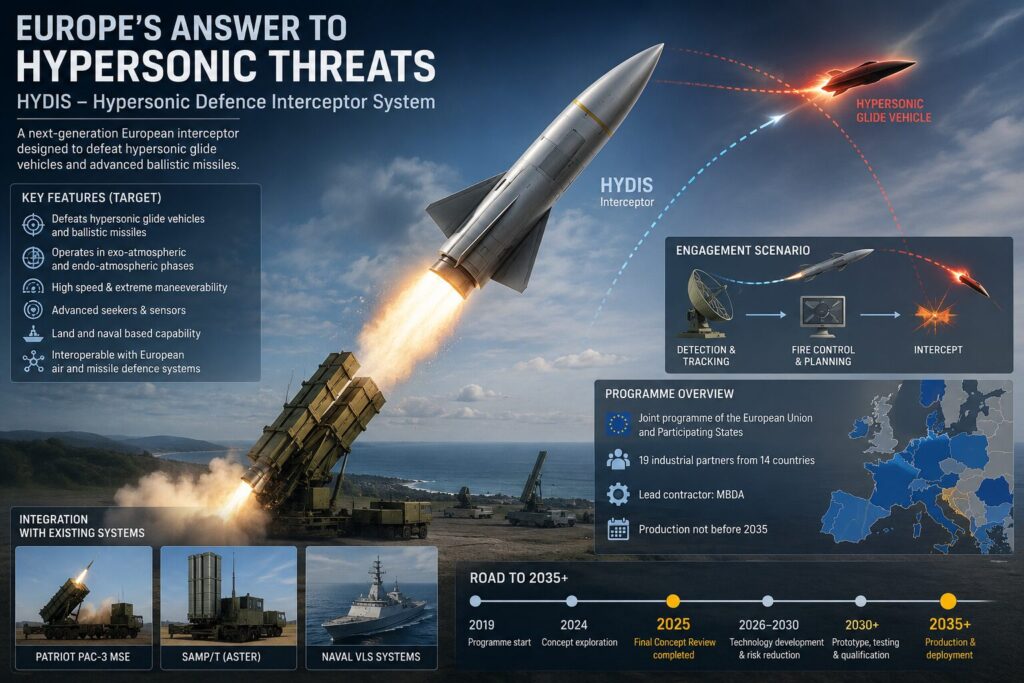
Today, Europe’s missile defense architecture relies primarily on the American Patriot PAC-3 MSE and the Franco-Italian SAMP/T system equipped with Aster missiles.
These systems have proven highly effective against aircraft, cruise missiles, and various classes of ballistic missiles. Hypersonic weapons, however, present an entirely different challenge.
Hypersonic glide vehicles travel at speeds exceeding Mach 5, but their greatest advantage is not speed alone. Their ability to perform continuous high-G maneuvers throughout much of their flight path makes interception far more difficult. Unlike traditional ballistic missiles, which largely follow predictable trajectories after the boost phase, hypersonic glide vehicles can constantly alter both course and altitude, forcing missile defense systems to recalculate interception solutions in real time.
For this reason, European engineers concluded that simply upgrading existing interceptors would not be enough. A fundamentally new generation of missile interceptors would be required.
What Is HYDIS?
HYDIS is not yet a deployable weapon system. At its current stage, it is a large-scale European research and technology development program.
The initiative is managed by OCCAR (Organisation for Joint Armament Cooperation) and jointly funded by the European Union and participating member states. The project is led by MBDA, while the industrial consortium includes nineteen major partners and more than thirty subcontractors from fourteen European countries. Participants include companies such as ArianeGroup, Thales Nederland, Avio, Roxel, ONERA, TNO, and several other leading European aerospace and defense organizations.
The ultimate goal is to develop a new European interceptor capable of engaging:
- Hypersonic glide vehicles;
- Medium-range ballistic missiles;
- Future highly maneuverable aerial threats.
Another key requirement is versatility. The interceptor is expected to be compatible with both land-based air defense batteries and naval vertical launch systems.
The First Major Milestone
The HYDIS program has recently reached one of its most significant development milestones.
After several years of modeling, simulation, and engineering studies, participating nations completed the Final Concept Review (FCR).
During the early phases of the program, engineers evaluated two competing interceptor concepts. Following extensive technical analysis, one design was selected as the foundation for future development. From this point forward, efforts will focus on refining the chosen configuration and maturing the technologies required for future testing and production.
Why Deployment Will Take So Long
Many observers have questioned why the first operational interceptor is not expected before 2035.
The answer lies in the extraordinary complexity of hypersonic interception.
A future interceptor must:
- Detect a target traveling at more than five times the speed of sound;
- Continuously predict highly dynamic flight maneuvers;
- Survive extreme aerodynamic heating and structural loads;
- Maintain precise maneuverability under enormous G-forces;
- Achieve interception accuracy measured in mere centimeters.
At closing speeds of several kilometers per second, even tiny guidance errors can result in a complete miss.
Developers must also create entirely new sensors, seekers, guidance algorithms, propulsion systems, and flight-control technologies capable of operating under these extreme conditions. Consequently, today’s work focuses primarily on technology maturation rather than immediate weapon production.
Why Patriot Will Remain Europe’s Primary Missile Defense System
Despite growing attention surrounding HYDIS, defense experts acknowledge a simple reality: there is currently no practical replacement for existing missile defense systems.
The Patriot PAC-3 MSE has already demonstrated its effectiveness against ballistic missile threats, while the European Aster family continues to receive significant upgrades.
These systems will remain the backbone of NATO’s integrated air and missile defense network for at least another decade.
Rather than replacing Patriot or SAMP/T outright, HYDIS is intended to fill a capability gap that current systems were never specifically designed to address—intercepting highly maneuverable hypersonic weapons.
A New Chapter for Europe’s Defense Industry
Beyond its military significance, HYDIS represents a major step forward for Europe’s defense industrial base.
For the first time, European nations are attempting to develop an indigenous interceptor specifically designed to counter hypersonic threats without relying entirely on American technologies.
The program brings together dozens of defense companies, research institutes, and government agencies. Many of the technologies developed under HYDIS—including advanced propulsion systems, next-generation seekers, thermal protection materials, and artificial intelligence-based guidance algorithms—are likely to influence future European missile defense programs beyond this single interceptor.
Major defense initiatives rarely produce only one weapon system. More often, they create an entire technological ecosystem that shapes military capabilities for decades.
Conclusion
Although HYDIS remains a program for the future, it already reflects the changing reality of modern warfare.
If air defense systems of the early twenty-first century were primarily designed to counter aircraft and cruise missiles, tomorrow’s battlefields will increasingly be dominated by hypersonic glide vehicles and highly maneuverable ballistic threats.
Europe has now taken its first decisive step by selecting the future architecture of its next-generation interceptor. However, transforming computer models into a combat-ready missile will require years of engineering, testing, and qualification.
Until then, proven systems such as the Patriot PAC-3 MSE and SAMP/T will continue to serve as the cornerstone of European missile defense, while HYDIS is expected to become their long-term successor once the necessary technologies reach operational maturity.






