

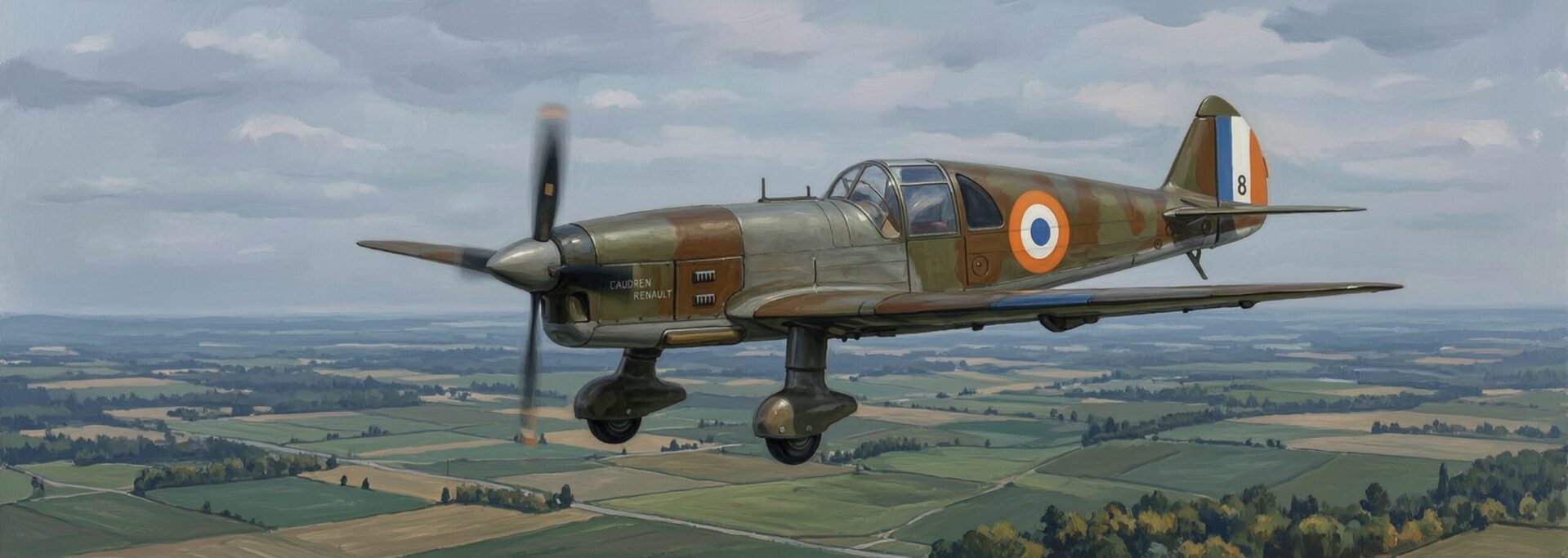
After designer Marcel Riffard joined the famous aircraft manufacturer Société des Avions Caudron in 1933, the company began producing a new generation of aircraft built around a completely different design philosophy.
Between the end of the First World War and Riffard’s arrival, Caudron, founded by brothers René and Gaston Caudron before 1914, had produced relatively unremarkable aircraft. Most were trainers, touring aircraft, passenger planes, and, to a lesser extent, military types such as bombers. In the year he joined the company, Marcel Riffard designed the Caudron C.362 for the prestigious Deutsch de la Meurthe air races.
The C.362 was revolutionary not only from an aerodynamic standpoint—approaching the limits of what was then achievable—but also technologically. The aircraft featured an all-wooden structure built using a simple yet highly efficient manufacturing method. Despite its modest dimensions and fixed landing gear, the aircraft possessed a wing loading more typical of much larger machines. The wing area was remarkably small, yet the aircraft was equipped with flaps and could reach speeds of approximately 320 km/h while powered by an engine producing only 170 horsepower (125 kW). These were performance figures comparable to those of contemporary fighters equipped with significantly more powerful engines.
From Racing Aircraft to Military Trainers
The C.362 gradually evolved into a family of racing and record-breaking aircraft, long-range twin-engine machines, as well as passenger and military aircraft. All retained the same elegant lines, advanced aerodynamic solutions, excellent performance despite relatively modest engines, and all-wooden construction.
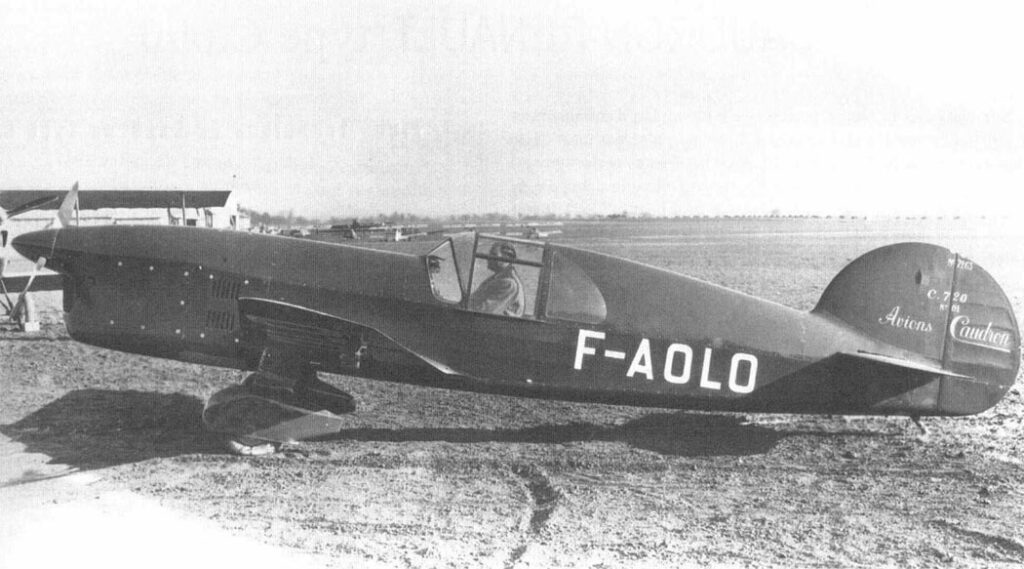
In 1935, Caudron developed the C.720, conceived as a potential lightweight fighter. Registered as F-AOLO, the aircraft remained a one-off prototype because the French Air Force (Armée de l’Air) did not consider an aircraft powered by an engine producing only 140 horsepower (103 kW) suitable for combat service. Nevertheless, its maximum speed of 280 km/h was considered highly promising.
Another major event occurred shortly after Riffard joined the company. Within a year, Caudron merged with Société Renault Frères. Riffard himself had previously worked in Renault Aviation’s engine division. The merger resulted in the creation of Société Anonyme des Avions et Moteurs Caudron-Renault, headquartered in Issy-les-Moulineaux.
Although the C.720 failed to attract military interest as a fighter, it became the foundation for a much more ambitious project: the C.690 advanced trainer. The aircraft was designed to prepare future fighter pilots by familiarizing them with the handling characteristics of modern low-wing monoplanes, making the transition from the biplanes then used for advanced flight training considerably easier.
Birth of the Rafale
In February 1936, test pilot Raymond Delmotte flew the first prototype, registered F-AOLM. Shortly afterward, he also completed the maiden flight of the second prototype, F-AOLN, which already carried the name Rafale.
Both prototypes were powered by inverted six-cylinder Renault 6Q-03 air-cooled engines producing 220 horsepower (162 kW) and driving two-bladed variable-pitch Ratier propellers. This powerplant arrangement would later be adopted for production aircraft.
Apart from the military equipment added later, the first two prototypes differed from subsequent aircraft by retaining the low, rounded vertical stabilizer inherited from the earlier C.720.
The aircraft attracted considerable attention when displayed at the Paris Air Show. The design proved so interesting that both Japan and the Soviet Union acquired production licenses. In the USSR, a prototype equipped with a locally produced licensed engine was built and tested.
Military Trials and Production
In May 1937, the French Air Force finally showed serious interest in the C.690. The second prototype was purchased and evaluated at the Air Force Flight Test Center.
During testing in June, the aircraft achieved a diving speed of 580 km/h, an impressive figure for a trainer of the period.
Following these successful trials, a modified third prototype was ordered. The aircraft featured a taller vertical tail and main landing gear positioned slightly farther forward.
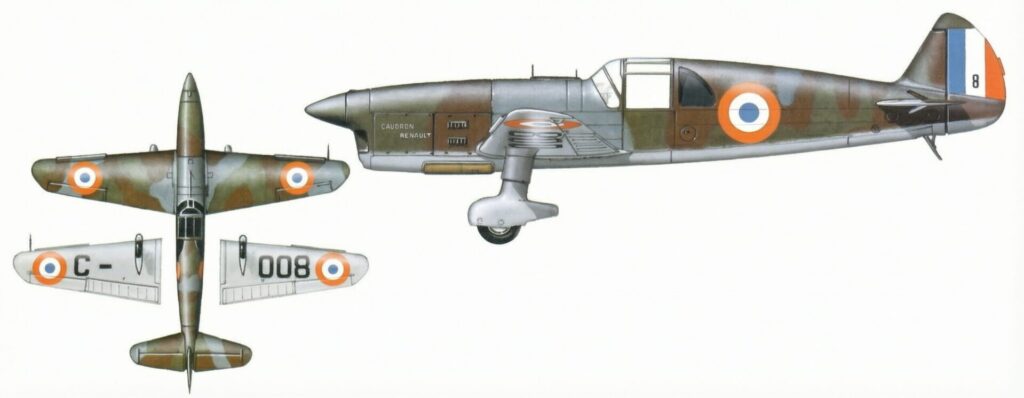
Military evaluations eventually resulted in an order for fifteen production aircraft designated C.690M Rafale. Deliveries took place during 1938 and 1939, and the aircraft were assigned to flying schools in Chartres, Avord, Reims, Dijon, Istres, Salon-de-Provence, and several other locations.
Service During the War
Following the outbreak of the Second World War, all C.690M aircraft—including the production machines numbered C-001 to C-015 and the two prototypes designated B-435 and B-436—were transferred to fighter training schools near La Rochelle, specifically at La Jarrie and Laleu.
After France’s surrender in 1940, six aircraft remained in service with the air forces of the Vichy regime. These aircraft primarily operated from Toulouse and Perpignan.
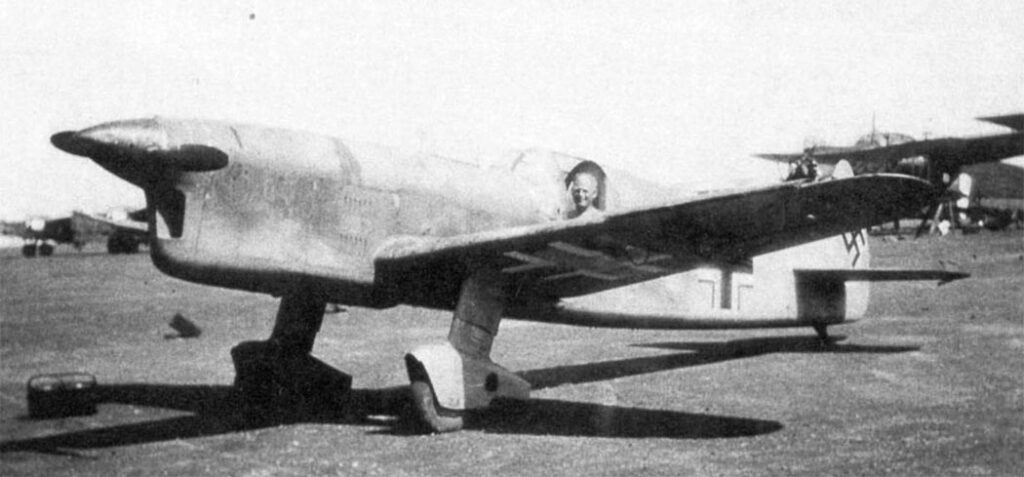
Several examples located in the occupied zone were captured by Germany and transferred to Luftwaffe training units operating in France. At least some of these aircraft remained in service until 1942.
One aircraft, C-009, had previously been returned to the manufacturer for modernization. It survived the war and, following the liberation of France, served for a period at the flight test center in Brétigny.
A Small Aircraft with Big Ambitions
It is difficult to determine whether the Caudron-Renault C.690M significantly improved the training standards of French fighter pilots before the war or during its opening stages.
One fact, however, is undeniable. The very limited production run prevented the Rafale from leaving a major mark on aviation history.
Yet the aircraft remains an intriguing example of French aeronautical engineering during the 1930s—a period when designers sought to achieve extraordinary performance through aerodynamic refinement rather than raw engine power.
Specifications
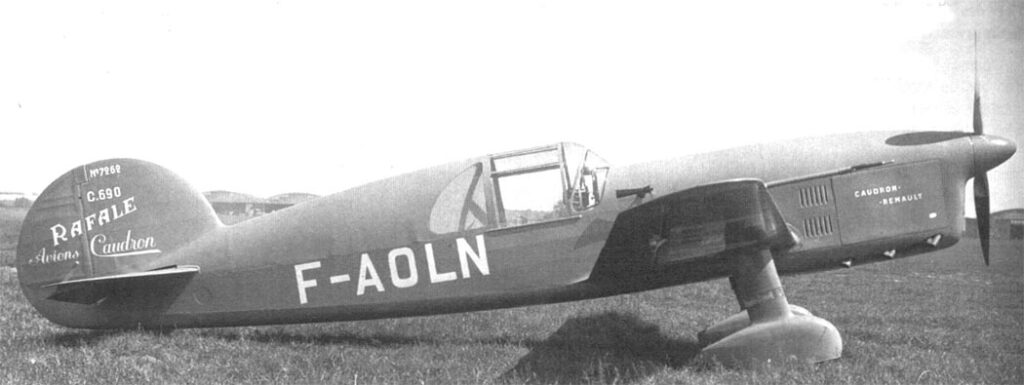
Type: Caudron-Renault C.690M Rafale
Role: Advanced training aircraft
Status: Limited series production
Manufacturer: Société Anonyme des Avions et Moteurs Caudron-Renault, Issy-les-Moulineaux and Billancourt, France
Crew: 1
Powerplant
- One Renault 6Q-03 inverted six-cylinder air-cooled engine
- Output: 220 hp (162 kW)
- Two-bladed variable-pitch Ratier propeller
Dimensions
- Wingspan: 7.70 m
- Length: 7.82 m
- Height: 1.90 m
- Wing area: 9.0 m²
Weights
- Empty weight: 777 kg
- Maximum takeoff weight: 1,005 kg
Performance
- Maximum speed at sea level: 348 km/h
- Maximum speed at 2,000 m: 378 km/h
- Stall speed: 114 km/h
- Landing speed: 92 km/h
- Initial climb rate: 10.5 m/s
- Service ceiling: 9,500 m
- Range: 1,100 km
Production
- Total built: 18 aircraft
- 1 civilian prototype
- 2 military prototypes
- 15 production aircraft






