Why Does China Need Spy Ships If an Ordinary Container Ship Can Do the Same Job and Enter Almost Any Port in the World?


In early September 2026, a story emerged that at first glance sounded almost like something out of a spy novel. Two senior U.S. administration officials told Reuters that China’s state-owned shipping giant COSCO had allegedly cooperated with Chinese intelligence services for decades and that some of its commercial vessels had been fitted with concealed signals intelligence equipment. According to the U.S. officials, these were not ordinary communications systems of the kind already found in abundance aboard modern container ships, but specialized SIGINT equipment capable of collecting signals from ships and aircraft near the coasts of North America, Europe, and Asia. The alleged priorities include military communications, encryption technologies, maritime traffic patterns, and information that could potentially be used during a crisis to locate foreign military forces and provide early warning of their activities.
The U.S. side has not publicly presented evidence proving that such a program exists. The officials did not identify specific vessels, describe the equipment allegedly installed aboard them, or explain how it was concealed. The Chinese Embassy in Washington categorically rejected the accusations as groundless, while COSCO did not respond to Reuters’ request for comment. It would therefore be premature to claim as established fact that Chinese container ships are being systematically converted into intelligence vessels. But the concept fits so naturally into the structure of modern maritime trade — and into China’s broader use of civilian maritime infrastructure — that it raises a much more interesting question: why build a dedicated intelligence ship at all if a giant commercial container vessel can legally do things that a military ship would never be allowed to do?
A Real Spy Ship Has One Major Problem: It Looks Like a Spy Ship
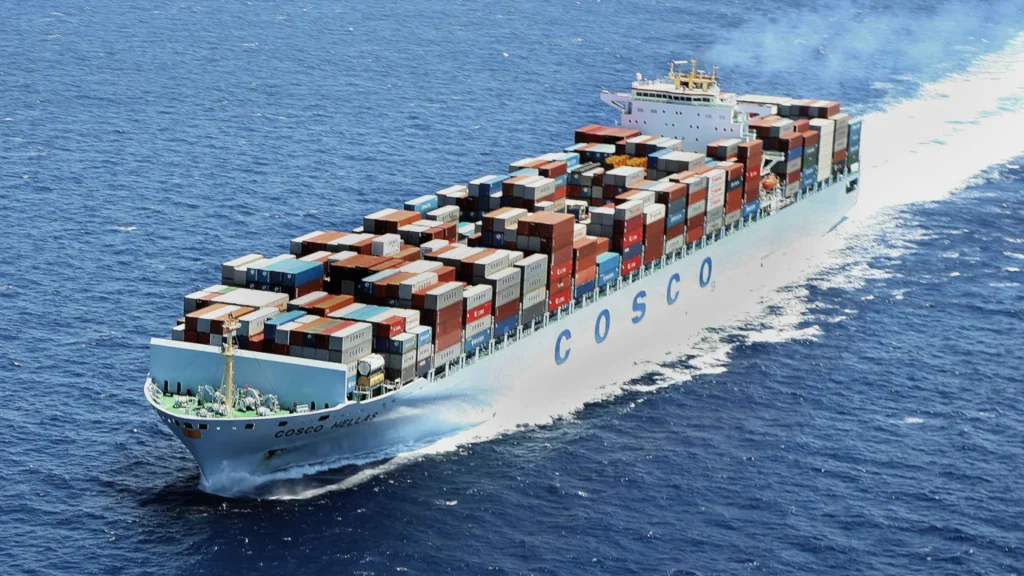
Dedicated signals intelligence vessels suffer from a fundamental disadvantage: everyone knows why they are there. Their distinctive antennas, radomes, and electronic equipment are difficult to mistake for anything else, and the appearance of such a vessel near a major naval base or exercise area immediately attracts attention. It can be monitored, its movements analyzed, and military forces can alter the operating patterns of particularly sensitive systems. An intelligence ship may be perfectly entitled to remain in international waters, but it cannot simply sail into Rotterdam, Hamburg, Singapore, or Los Angeles pretending to be an ordinary participant in global commerce.
A container ship exists in almost exactly the opposite situation. Its legitimate business requires it to cross oceans continuously, pass through strategically important straits, approach foreign coastlines, spend days along heavily traveled shipping routes, wait at anchorages, and enter some of the world’s largest ports. It can find itself next to a naval base not because Chinese intelligence sent it there to watch warships, but because ten thousand containers need to be unloaded at a neighboring terminal. The superstructure of a modern merchant vessel is already covered with navigation radars, satellite terminals, radios, communications antennas, and other electronic systems, potentially making additional receiving equipment much easier to hide among entirely legitimate hardware. This is why the U.S. officials have specifically claimed that the systems in question are specialized intelligence equipment rather than normal shipboard communications gear.
That turns the traditional intelligence problem upside down. Normally, an intelligence service must figure out how to move a sensor close enough to an interesting target without arousing suspicion. Here, nothing needs to be invented. The global economy itself delivers Chinese merchant vessels to the coastlines of potential adversaries every day, routes them through areas of intense naval activity, and leaves them near major ports for hours or even days. A spy ship needs a reason to appear near a naval base. A container ship only needs a terminal schedule.
It Does Not Even Need to Decrypt American Communications
Signals intelligence is often imagined too literally: an operator wearing headphones somewhere below deck, trying to listen to a secret conversation. In reality, the contents of a transmission are only one possible source of intelligence. Even when military communications are securely encrypted, the existence of the signal itself can reveal a great deal. Receivers can record frequencies, power levels, transmission duration and repetition, pulse characteristics, radar operating modes, directions of origin, and changes in the behavior of electronic systems. When observations are collected repeatedly and from different locations, individual signals gradually form a much larger picture.
The result is what military intelligence calls an electronic order of battle. Analysts begin to understand which radars normally operate in a particular region, which communications systems accompany specific ships or aircraft, which frequencies appear during exercises, and which unfamiliar emissions emerge after a new weapon system enters service. A single container ship passing through the area might collect relatively little. But if a merchant vessel follows the same route twenty times over several years, comparisons become possible. This is a normal day. This is a major exercise. This is what happens when a carrier strike group leaves port. This is what appears when aircraft begin launching. This radar has changed its operating mode. This signal did not exist last year. According to the U.S. officials, military communications technologies and developments in encryption are among the main targets of the alleged COSCO intelligence effort.
That is why some of the most valuable intelligence may be collected not during a war, but ten years before it begins. SIGINT builds a library of an adversary’s behavior: what normal activity looks like, what changes during exercises, and which electronic signatures appear before a major deployment. During a crisis, therefore, intelligence may be interested not only in a new signal suddenly appearing. Sometimes it is even more important when a familiar transmitter unexpectedly goes silent, a unit changes its communications pattern, or an entire group of systems simultaneously switches to a different operating mode. In this model, the container ship is not there to intercept one spectacular secret message. It becomes one of many sensors that spend years constructing an electronic portrait of a potential adversary.
And This Is Where Quantity Begins to Beat Quality
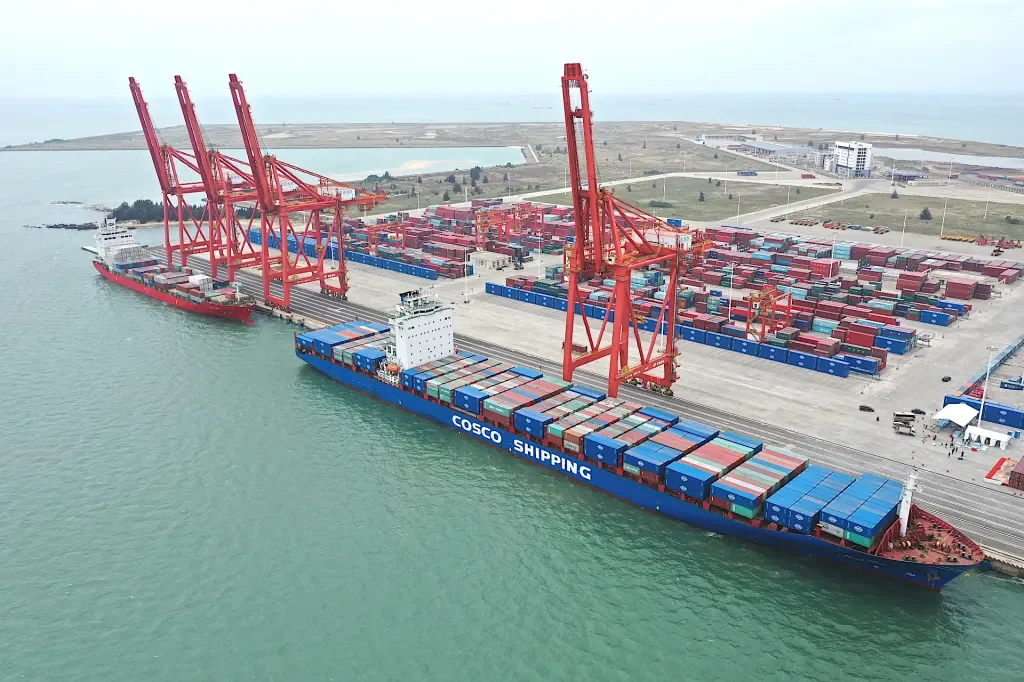
One container ship equipped with intelligence hardware would hardly transform China’s intelligence capabilities by itself. Modern states already operate satellites, electronic intelligence aircraft, ground stations, underwater surveillance systems, and dedicated intelligence vessels. The advantage of the merchant fleet lies somewhere else entirely: in scale and geography.
COSCO is one of the largest shipping companies in the world and is deeply integrated into global maritime commerce. Its vessels operate continuously between Asia, Europe, and North America, while the company is also involved in port terminal operations outside China. U.S. officials themselves acknowledge that this degree of integration makes the problem extraordinarily difficult. China maritime expert Isaac Kardon compared simply trying to remove COSCO from U.S. transportation networks to potentially dangerous surgery on the global trading system.
This is where the real power of such a concept emerges. China would not need to turn every container ship into a fully equipped equivalent of a dedicated SIGINT vessel. It would only need to fit a portion of the fleet with specialized collection systems and distribute those vessels along particularly interesting routes. One ship passes near a U.S. naval base today. Another is operating in the North Sea. A third crosses the Mediterranean. A fourth moves along the Japanese coast. Each collects only a fragment of the overall picture, but those fragments can later be combined. The result is a distributed intelligence network whose basic operating costs are largely paid by international commerce itself: the ship has already been built, the crew is already being paid, the fuel will be burned anyway, and the voyage from Shanghai to Europe has to happen regardless.
A reconnaissance satellite has to be launched specifically to collect intelligence. A SIGINT aircraft has to take off specifically to collect intelligence. A container ship has to carry containers anyway.
China Discovered the Military Value of Civilian Fleets Long Ago
This is why the current allegations do not exist in a vacuum. In April 2025, research from the U.S. Naval War College concluded that China’s People’s Liberation Army likely makes use of fishing and commercial vessels for intelligence, surveillance, and reconnaissance. In January of the same year, the Pentagon placed COSCO on a list of companies it considers linked to the Chinese military. Inclusion on such a list does not prove that a specific container ship carries secret SIGINT equipment, but it does demonstrate that U.S. concerns over the potential dual role of Chinese commercial shipping predate the latest reporting.
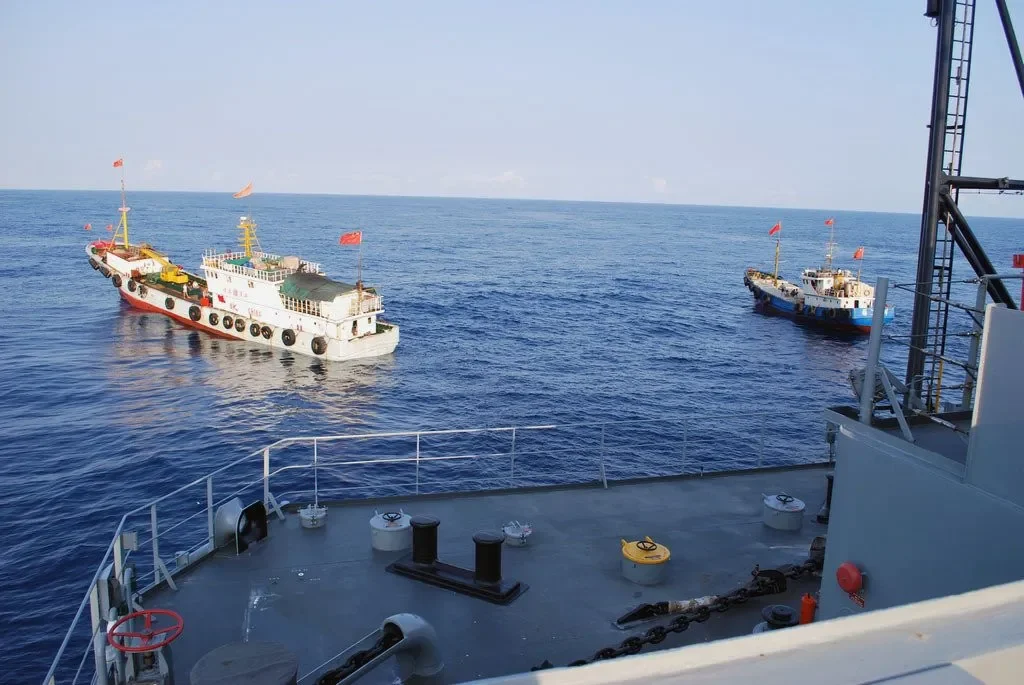
The best-known example of this blurred boundary between civilian and military activity is China’s maritime militia. It includes both purpose-built vessels resembling fishing boats and genuine commercial fishing vessels that can be mobilized for state-directed missions. Such forces have been used for presence, surveillance, access denial, and support of coast guard and naval operations, allowing Beijing to apply pressure without immediately escalating to overt military confrontation. In the South China Sea, this ambiguity has become one of the defining tools of China’s “gray-zone” strategy: the vessel confronting a foreign ship may appear civilian, while its actual mission may be anything but.
A commercial container ship is a very different instrument, and it would be wrong to treat the entire Chinese merchant fleet as an extension of the maritime militia. But the underlying logic is similar: a civilian platform already exists, already performs a legitimate economic function, and may potentially be assigned an additional state mission. This is why the most important question surrounding COSCO is not how sophisticated a hidden receiver aboard one particular vessel might be, but whether commercial infrastructure can become another layer of a much broader state surveillance system.
Now Imagine There Is No Secret Antenna at All
This is where the story becomes even more interesting. A modern merchant ship can generate intelligence of military value even without carrying a dedicated SIGINT suite.
Global maritime commerce has become an enormous digital system. Every vessel has a route, schedule, cargo, destination, and movement history. Terminals know which containers arrive and depart. Logistics platforms aggregate information about cargoes, ships, ports, and carriers. Cranes and scanners have become networked industrial systems. A state capable of accessing a sufficiently large pool of commercial data therefore does not necessarily need to intercept military radio transmissions directly in order to discover strategically useful patterns.
This is one reason U.S. maritime authorities have warned not only about Chinese ships but also about Chinese involvement in port infrastructure. Particular attention has been paid to LOGINK, a logistics platform developed by China’s Ministry of Transport. It aggregates information from ports, logistics networks, shipping companies, and other sources, while at least 24 foreign ports have entered into cooperation agreements involving the system. U.S. authorities have argued that its spread could potentially provide China access to sensitive information about ships, cargoes, and logistics operations. Separate concerns have surrounded Nuctech cargo scanners and ZPMC port cranes, which hold a major share of the global market and, in some configurations, support remote maintenance and access.
The result is a kind of intelligence nesting doll. A container ship could potentially monitor the electromagnetic environment. The shipping company knows its route and cargo. The terminal sees containers moving in and out. A logistics platform aggregates information from numerous sources. Equipment inside the port potentially creates another layer of access to data. None of these components automatically transforms global trade into an intelligence network. But if a state gains the ability to combine multiple streams of information, ordinary commercial data can suddenly acquire military significance.
Because Armies Use Ports Too
This matters particularly for the United States. American military power is global precisely because an enormous logistics system exists behind it. Tanks, ammunition, aviation equipment, spare parts, and thousands of containers have to move between continents. Much of that system inevitably interacts with civilian transportation infrastructure.
And intelligence does not necessarily need to search for a single classified document.
It can search for patterns.
If an unusual volume of military cargo suddenly begins moving through a particular port, that is information. If military transport activity increases, that is information. If certain units begin moving equipment, that is information. If electronic activity around a naval base changes at the same time that cargo movement through a nearby port increases, two entirely different datasets begin reinforcing each other.
MITRE has previously highlighted precisely this issue in relation to Chinese involvement in port infrastructure: access to large logistics datasets could potentially help track supply chains and the movement of U.S. military cargo through commercial transportation networks.
And at that point, it becomes clear why the controversy over a few allegedly hidden antennas could be much broader than it first appears.
The Most Uncomfortable Part Is That the Container Ship Does Not Need to Behave Suspiciously
A reconnaissance aircraft appears near a border — it is noticed.
A satellite passes over a facility — its orbit can be calculated.
A dedicated intelligence ship approaches an exercise area — another vessel may be sent to shadow it.
But what do you do with a ship that really is carrying commercial cargo and really is supposed to enter the port?
It does not need to circle a naval base. It does not need to turn off its transponder. It does not need to alter its route. The more normally it behaves, the better the concept works. Several days later, it unloads, takes aboard new containers, and sails for another port, potentially collecting information somewhere else.
This is the fundamental advantage of a civilian platform: its camouflage is not the appearance of the ship, but its perfectly normal economic activity.
That also creates a serious counterintelligence problem. If a government suspects that a particular container ship is collecting SIGINT, it must first prove that the equipment exists and determine what it does. Then it has to establish who operates it. Next comes the legal question of whether passive collection of radio emissions violates the laws applicable where the ship is operating. After that come the diplomatic and economic consequences of detaining a huge commercial vessel. And if the equipment is distributed across multiple ships, the problem expands from inspecting one suspicious vessel to scrutinizing a significant portion of a commercial fleet.
With a dedicated military intelligence ship, there is little ambiguity about what it is.
With a container ship, ambiguity is built into the concept itself.
But This Is Also Where the American Allegations Become Vulnerable
There is an important reason not to turn this story into a sensational account of thousands of Chinese spy ships. What is publicly known so far is that two U.S. officials told Reuters that such a program exists and claimed specialized equipment had been installed aboard COSCO vessels. No photographs of the systems, technical descriptions, list of ships, or other evidence that could be independently examined have been released. China rejects the allegations.
The statement that “COSCO uses container ships for SIGINT” therefore remains a U.S. intelligence assessment rather than a publicly proven fact.
But that does not make the underlying problem disappear.
In fact, this leads to the most interesting paradox in the entire story: even if it eventually turns out that the specific U.S. allegations were exaggerated, incomplete, or partly mistaken, the possibility of using a global commercial fleet for intelligence collection would remain.
All of the necessary technology already exists.
Global satellite communications exist.
Compact digital radio receivers exist.
Massive data-storage systems exist.
Automated signal analysis exists.
Thousands of commercial ships exist.
And most importantly, the global trading network that legally carries those ships into virtually every region of strategic interest to a major power already exists as well.
China’s Most Effective Intelligence Ship May Not Look Military at All
In the 20th century, building a global intelligence infrastructure required enormous amounts of money. Governments had to construct specialized ships, aircraft, listening stations, and satellites, then move those assets to wherever the target happened to be. In the 21st century, part of that infrastructure can potentially be layered on top of the global economy that already exists.
China is in a particularly advantageous position because over the past several decades it has become one of the central powers of global trade. Chinese companies build ships, move containers, manufacture port cranes, operate or participate in terminals, and develop digital logistics platforms. Every one of these systems was created primarily for commercial purposes. Yet virtually all of them also generate information.
If the allegations against COSCO are eventually substantiated, the most interesting aspect will therefore not be the existence of a few hidden antennas. The real achievement would be the architecture of the system itself.
China would not need to build hundreds of dedicated intelligence vessels, maintain separate crews for them, or explain why they constantly appear near foreign coastlines. It would only need to exploit a small portion of a fleet that already exists, is already subsidized by the normal economics of international commerce, and has a perfectly legitimate reason to be almost everywhere.
At that point, the traditional logic of maritime intelligence is reversed.
Normally, an intelligence ship has to go looking for the adversary.
A container ship sometimes only has to follow its normal route — and the adversary comes to it.
That is why the story of alleged hidden SIGINT equipment aboard COSCO vessels could be much more significant than another espionage scandal. If the U.S. assessment is correct, China may have found a way to transform one of its greatest economic advantages into a distributed intelligence infrastructure operating on a global scale.
And in such a system, the hardest intelligence ship to notice is the one that does not look like an intelligence ship at all.