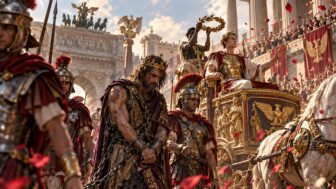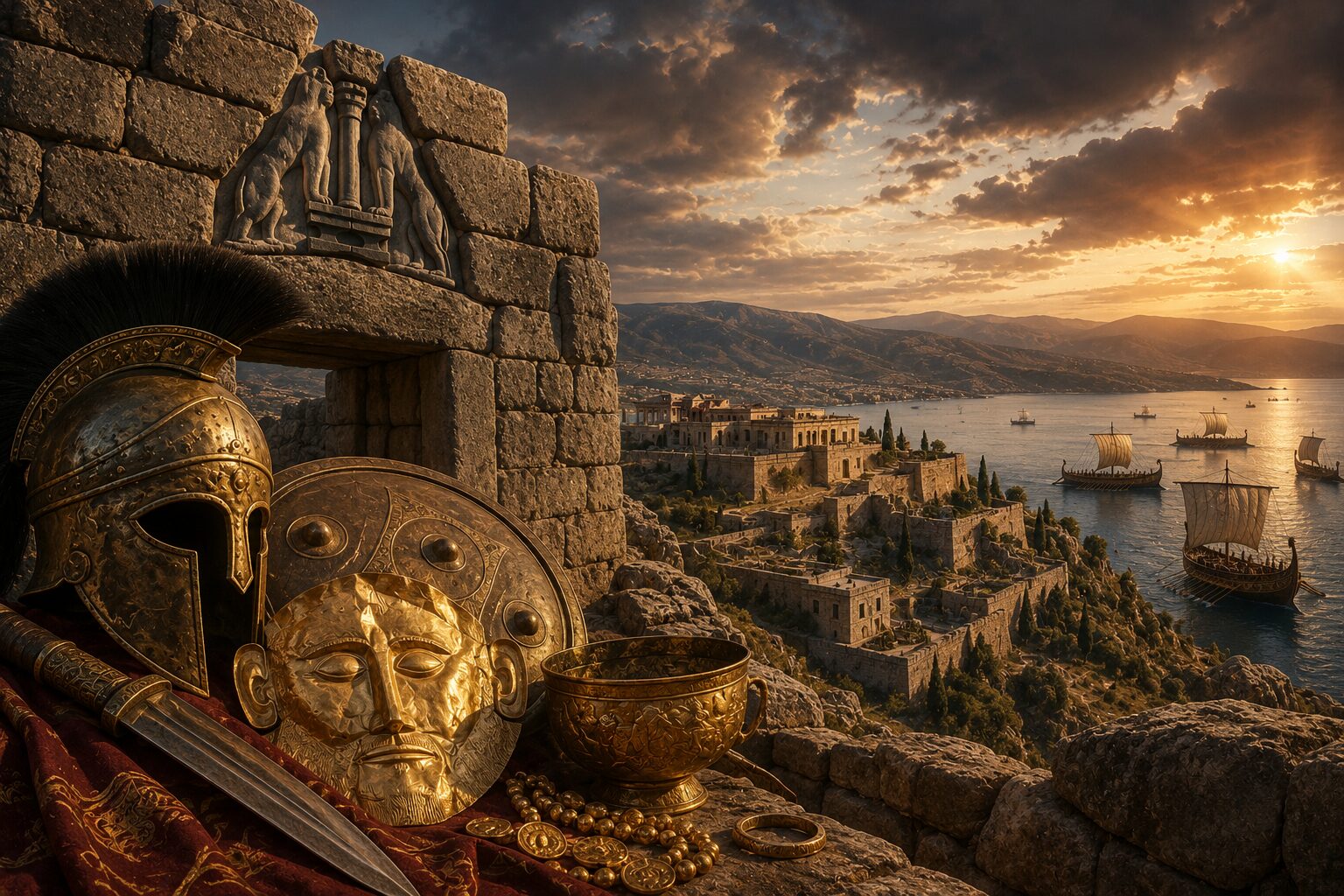
Several centuries before the supposed Trojan War, the Minoan palaces of Crete were flourishing, ships connected the island with the wider Eastern Mediterranean, and Knossos remained one of the great centers of the Aegean world. Across the sea, however, something equally important was taking shape. On the Greek mainland, new centers of power were emerging, local elites were growing richer, trading with their neighbors, and gradually adopting many achievements of the more developed Cretan civilization. Yet the result was anything but a copy of the Minoan world. Where Knossos impressed visitors with its vast courtyards, storerooms, and remarkable lack of monumental fortifications, Mycenae and Tiryns surrounded themselves with walls built from stone blocks so enormous that later Greeks refused to believe ordinary human beings could have moved them. They attributed the work to the Cyclopes. Behind those walls lived rulers known as wanakes; officials recorded quantities of grain, oil, wool, bronze, and laborers on clay tablets; craftsmen produced swords and spears; and warriors used chariots and sophisticated bronze armor. This was the real world that, centuries later, would become the setting for stories about Agamemnon, Menelaus, Nestor, Odysseus, and the Trojan War.
We call this society the Mycenaean civilization, although its inhabitants almost certainly did not think of themselves as a single “Mycenaean people.” The modern name comes from Mycenae, one of the richest and most impressive centers of Late Bronze Age mainland Greece. But Mycenae was not the capital of a unified Greece, and the famous Agamemnon remains a figure of epic tradition whose historical existence cannot be demonstrated. Instead, this was a world of several palace states united by language and many cultural features but possessing their own centers of power. Nevertheless, the Mycenaeans can reasonably be described as the earliest Greek-speaking societies known to us from written records. Their script has been deciphered, their language is the oldest documented form of Greek, and their tablets preserve the names of deities such as Zeus, Poseidon, Hera, and others who survived the collapse of the Bronze Age. This creates a strange continuity between Mycenae and later Greece: the palace civilization vanished, its writing system was forgotten, and its political institutions collapsed, yet its language, parts of its religious tradition, and memories of its heroic world proved far more durable than its fortresses.
Greece Before Greece
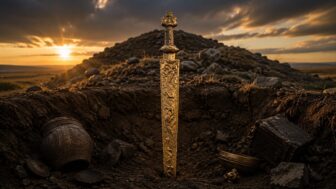
The prehistory of Mycenaean civilization began long before the construction of the Lion Gate. Mainland Greece had been inhabited by agricultural communities for thousands of years, but during the second millennium BC important social changes became increasingly visible. They are particularly striking from around the seventeenth and sixteenth centuries BC, when extraordinarily wealthy military and political elites emerged in some regions. The famous shaft graves at Mycenae belong to this period. Archaeologists found weapons, gold ornaments, vessels, seals, and other objects inside them, demonstrating not only immense wealth by local standards but also close connections with the wider Mediterranean world. Mainland Greece was no longer merely a peripheral neighbor of the more developed Minoan Crete. Its own centers were emerging, capable of concentrating resources and participating in long-distance exchange.
Minoan influence on early Mycenaean culture was enormous. Mainland elites adopted artistic forms, luxury objects, elements of administrative organization, and eventually the very principle of written record-keeping. The Mycenaeans adapted the Minoan Linear A script to the Greek language, creating Linear B. Yet relations between the two worlds cannot be reduced to a simple formula in which “civilized Minoans taught mainland barbarians.” Mycenaean societies developed on their own foundations and gradually became more powerful. After around 1450 BC, when many Cretan palace centers were destroyed, a Greek-speaking administration using Linear B appeared at Knossos. The balance of power in the Aegean had clearly shifted: people associated with the Mycenaean world were no longer simply absorbing Cretan influence but had themselves become dominant at the island’s most important center.
The period from roughly the fifteenth to the thirteenth centuries BC marked the height of Mycenaean palace civilization. Major centers existed at Mycenae, Tiryns, Pylos, Thebes, and elsewhere. Athens was also an important Bronze Age settlement, although the archaeological picture there is more difficult to reconstruct because of thousands of years of later occupation. Each major center controlled a surrounding territory, agricultural production, craft industries, and flows of resources. These were no longer village chieftains living in unusually large houses. They were sophisticated administrative systems capable of recording people and property, organizing specialized production, collecting agricultural goods, and redistributing resources among groups dependent on the palace.
Not Agamemnon’s Empire, but a World of Kingdoms
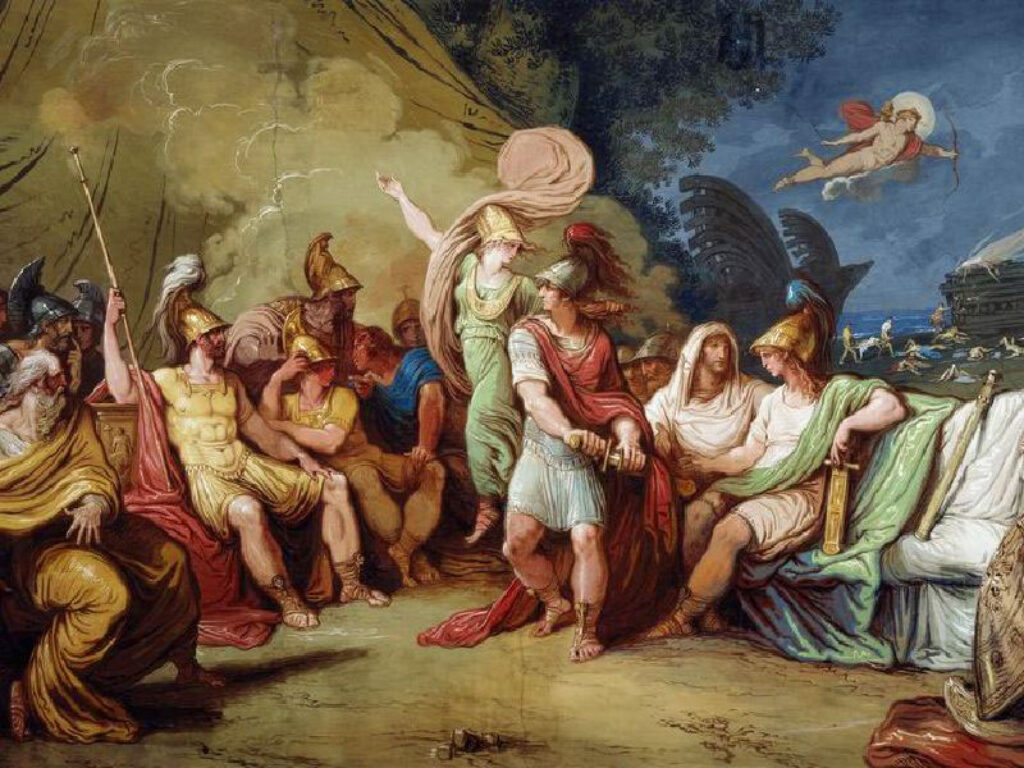
Homer creates the impression of a world in which numerous Greek rulers sail against Troy while Agamemnon, the “lord of men,” occupies a privileged position among them. From there, it is tempting to take another step and imagine Mycenae as the capital of a great state controlling much of Greece. Archaeology does not reveal such an empire. Mycenae was certainly an exceptionally wealthy and powerful center, but Pylos, Tiryns, Thebes, and other palace states possessed their own administrative systems. We do not know the exact borders of most of these territories or the precise nature of their relationships. Alliances, rivalries, dynastic connections, and periods of political dependence are all possible, but a unified “Mycenaean Empire” ruled by Agamemnon cannot be reconstructed from the evidence.
The organization of one such state is best known from Pylos. The reason is almost accidental. Around the end of the thirteenth or beginning of the twelfth century BC, the so-called Palace of Nestor at Pylos was destroyed by fire. Its archive consisted largely of unbaked clay tablets that under normal conditions might eventually have dissolved or been discarded once they had served their immediate administrative purpose. The fire that destroyed the palace baked many of them hard enough to survive for roughly three thousand years. The result is a remarkable historical paradox: the catastrophe that destroyed the administration preserved its paperwork.
At the top of the palace hierarchy stood the wanax, the supreme ruler. The word survived the Mycenaean age and later appears in Greek epic tradition as anax, although its political meaning had changed. Below him stood other members of the elite and administrative officials, including a figure known as the lawagetas, whose precise function remains debated. The palace controlled land, livestock, craft production, and the distribution of certain resources. The tablets list workers, textiles, vessels, animals, weapons, metal, and offerings to the gods. This does not mean that the palace managed every sack of grain produced within its territory. Rather, it suggests a sophisticated system focused on particular sectors of the economy and on resources especially important to the elite, specialized production, religion, and military organization.
Fortresses Built by “Cyclopes”
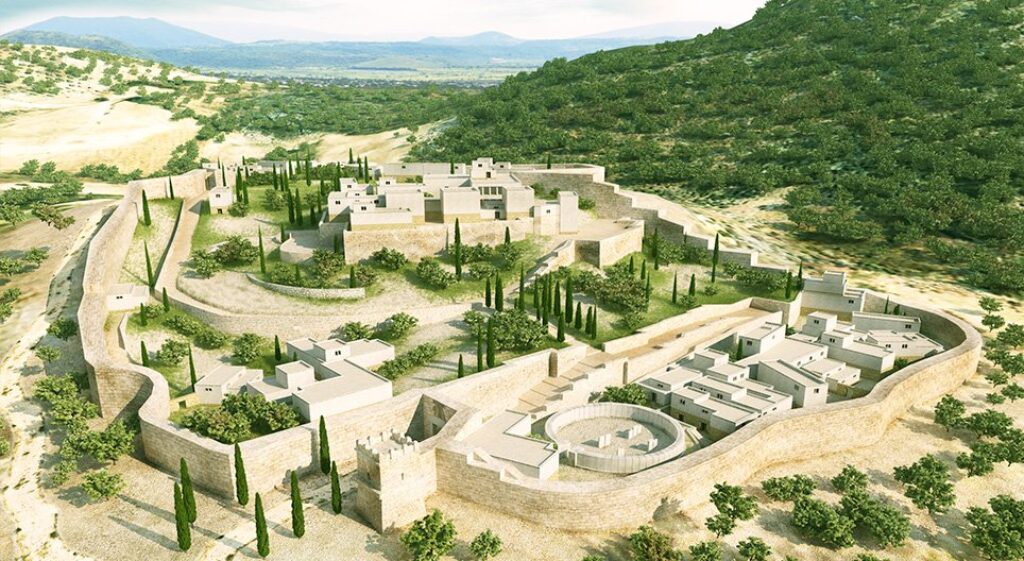
If Minoan Knossos gives the impression of an enormous and comparatively open complex, Mycenae seems almost deliberately designed to express the opposite model of power. The citadel stands on naturally defensible ground and is surrounded by fortifications constructed from massive stone blocks. In places, the walls are several meters thick. Later Greeks, living centuries after the disappearance of the Mycenaean palace system, called this masonry Cyclopean because they believed stones of such size could not have been moved by ordinary humans. In reality, the walls were products of highly organized human labor and of rulers capable of mobilizing large workforces.
The most famous entrance to the citadel is the Lion Gate, constructed in the thirteenth century BC. Above the gateway is a relief showing two animals facing a central column. Their heads have not survived, so the conventional identification as lions is not absolutely certain, but the monument remains one of the most recognizable works of Mycenaean architecture. Palace and economic structures stood inside the fortifications, while the central element of palace architecture was the megaron, a large hall with a central hearth surrounded by columns. Scholars have long considered this layout one of the architectural antecedents of certain forms later found in Greek temples.
Tiryns is perhaps even more impressive as a fortified complex. Its enormous walls incorporated internal galleries and chambers, while the approach to the citadel forced visitors through carefully controlled spaces. Yet Mycenaean fortifications should not be understood merely as shelters in wartime. They were political symbols as well. A ruler capable of assembling workers and organizing the quarrying, transportation, and placement of thousands of tons of stone demonstrated his power before a visitor ever entered the palace itself. In this respect, Mycenaean architecture spoke a very different language from that of Minoan Crete.
Why this difference emerged remains uncertain. Mainland geography made overland warfare much easier: a neighboring state did not need a fleet to bring an army to another ruler’s territory. Relations among Mycenaean states may themselves have been sufficiently violent to encourage fortification. But the walls also reveal something about elite ideology. Military power was an important element of status, and weapons accompanied members of the elite even into their graves.
The Gold Schliemann Mistook for Agamemnon’s Treasure
It was the graves that first made Mycenae famous in modern European archaeology. In 1876, Heinrich Schliemann, already celebrated for his excavations at Troy, began digging at Mycenae and uncovered wealthy shaft graves. The quantity of gold was astonishing: funerary masks, diadems, cups, ornaments, and other objects had belonged to an elite that existed long before classical Greece. Schliemann was convinced that he had found the world of Homer’s heroes. According to the famous story, after discovering one of the gold masks, he proclaimed that he had gazed upon the face of Agamemnon.
But Agamemnon, even if the epic figure was ultimately inspired by a real ruler, could not have been the owner of this mask. The burials date broadly to the sixteenth century BC, while the archaeological destruction of Troy most commonly associated with a possible historical background to the Trojan War occurred several centuries later. The so-called Mask of Agamemnon is therefore roughly three centuries too old for the traditional Agamemnon. The name survived because it was irresistible, but the actual discovery tells an arguably more interesting story: as early as around 1600–1500 BC, Mycenae possessed an elite capable of concentrating enormous wealth and acquiring expensive materials and goods through international connections.
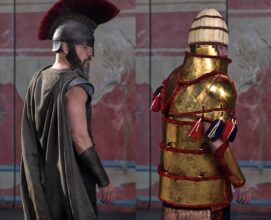
The evidence for Mycenaean military culture is equally impressive. Warriors used long swords, daggers, spears, bows, and several forms of shields. The famous bronze armor from Dendra, dating to the fifteenth century BC, consists of large bronze plates protecting the torso and shoulders and demonstrates how specialized defensive equipment could become. Archaeological and artistic evidence also shows helmets reinforced with plates made from boars’ tusks. Centuries later, precisely such a helmet unexpectedly appears in the Iliad—one of several details suggesting that the epic tradition preserved fragments of genuine Bronze Age memory.
The First Greeks We Can Read
The most important Mycenaean legacy was discovered not in gold or weapons but on small pieces of clay. Linear B remained a mystery for decades. It was clearly related to Minoan writing, but the language behind the signs was unknown until the middle of the twentieth century. In 1952, British architect and self-taught linguist Michael Ventris concluded that the tablets recorded Greek. The subsequent work of Ventris and philologist John Chadwick demonstrated that the administrators of the Mycenaean palaces were writing an early form of the Greek language.
The discovery pushed the documented history of Greek back by many centuries. Before the decipherment, some scholars had considered the possibility that the Mycenaean world belonged to an entirely different population and that Greek speakers arrived later. Linear B demonstrated that Greek was already the language of palace administrations during the second millennium BC. And the tablets gave historians something in some ways more valuable than epic poetry or royal chronicles: ordinary bureaucracy. Officials recorded numbers of sheep, quantities of wool and oil, plots of land, groups of workers, bronze, chariots, weapons, and religious offerings. These texts were written for immediate administrative purposes, so their authors had no interest in impressing future generations.
That is precisely why they bring us unexpectedly close to the real Mycenaean world. Instead of Agamemnon assembling kings for the expedition against Troy, we meet an administrator counting livestock. Instead of Achilles choosing between glory and a long life, we find officials allocating bronze to workshops. The tablets reveal a society with specialized textile production, numerous groups of dependent workers, palace supervision of parts of agricultural production, and a sophisticated accounting system. Even the word do-e-ro appears, corresponding to later Greek doulos, “slave.” The world of heroes turns out to have been a world of accountants as well.
The names of gods are particularly striking. Mycenaean documents already mention Poseidon, Zeus, Hera, Dionysus, and several other deities familiar from later Greek religion. Their functions and relative importance may have differed from those of the classical period, while some later Olympian gods are either absent from the surviving tablets or their identification remains disputed. Nevertheless, a degree of religious continuity is unmistakable. The palaces burned, the writing system vanished, and the political institutions collapsed, but some divine names survived.
Warriors, Craftsmen, and the Palace Economy
The military image of the Mycenaeans is so powerful that it is easy to imagine a society of professional warriors living primarily from raids and conquest. Reality was much more prosaic. Agriculture remained the foundation of the economy. People cultivated grain, olives, and grapes and raised sheep, goats, pigs, and cattle. Wool and textile production were especially important. Tablets from Pylos and Knossos reveal a complex textile economy in which palace officials kept records of flocks, raw materials, and the labor of specialized groups of workers.
Craftsmen produced bronze weapons and tools, pottery, jewelry, furniture, chariots, and many other goods. At the same time, the Mycenaean economy was anything but isolated. Bronze itself forced the palace states to participate in international exchange: copper and, above all, tin had to move through long-distance trading networks. Mycenaean sites contain materials and objects connecting Greece with Cyprus, Egypt, Anatolia, and the Levant, while Mycenaean pottery has been found far beyond the Aegean. After the weakening of Minoan Crete, Mycenaean participation in maritime exchange became especially prominent.
The familiar contrast between “trading Minoans” and “warrior Mycenaeans” is therefore far too simple. Both societies depended heavily on the sea and international exchange, both possessed elites and sophisticated systems of economic administration, and both used writing primarily for bureaucratic purposes. Their differences were real, especially in architecture and the public expression of power, but the Mycenaeans could not have survived by the sword alone. Their fortresses ultimately rested on a foundation of grain, wool, oil, specialized labor, and trade.
Did the Trojan War Really Happen?
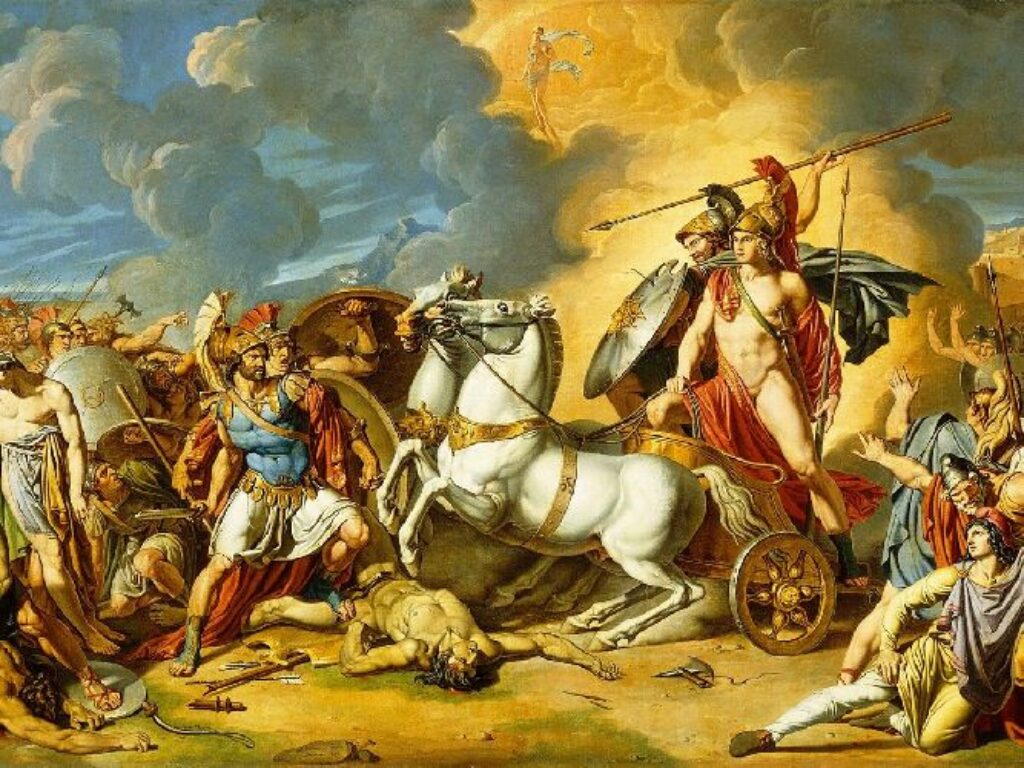
No account of Mycenaean civilization can completely avoid Troy. The problem begins when the Iliad is treated as if it were a military report written in the thirteenth century BC. The Homeric poems were recorded centuries after the disappearance of the Mycenaean palace system and contain elements from several different periods. Some details correspond surprisingly well with the Bronze Age, while others reflect later Greek society. Agamemnon, Achilles, and Odysseus therefore cannot simply be placed on a historical map as documented rulers and warriors.
Troy itself, however, was real. The mound of Hisarlık in northwestern modern Turkey contained a settlement that was repeatedly destroyed and rebuilt. Troy VI and Troy VIIa belong to the Late Bronze Age, and one of these phases—or a sequence of conflicts involving the city—may have contributed to the much later epic tradition. Even more intriguing evidence comes from the archives of the Hittite Empire. Hittite texts mention a land called Wilusa, which many scholars associate with Greek Ilios, another name for Troy. They also refer to a western power or political entity called Ahhiyawa. The proposed connection between this name and Homer’s Achaeans is widely taken seriously, although the precise identification and political geography remain debated.
If Ahhiyawa was indeed connected with the Mycenaean world, we gain the remarkable possibility of seeing Bronze Age Greeks through the records of another great power. Hittite documents indicate that Ahhiyawa was politically active in western Anatolia and maintained contacts, sometimes tense, with Hittite rulers. This is not evidence for Agamemnon’s expedition, much less proof of a ten-year siege of Troy. But the general historical background is entirely plausible: Mycenaean states possessed ships, maintained connections with Anatolia, and could become involved in conflicts along its western coast. Behind the later legend of one enormous war may lie memories of genuine confrontations, combined and transformed over centuries of oral tradition.
The Last Tablets Before the Catastrophe
Around 1200 BC, this world began to collapse. The crisis extended far beyond Greece. Much of the Eastern Mediterranean was affected: the Hittite Empire disappeared, Ugarit was destroyed, numerous cities in the Levant suffered destruction or disruption, and Egypt faced serious external and internal pressures. The palace system of mainland Greece also ceased to exist. Pylos was destroyed and never re-emerged as a Mycenaean palace center. Mycenae and Tiryns experienced destruction and transformation, while their political and economic importance gradually declined.
The final documents from Pylos are especially dramatic. Some tablets indicate heightened administrative attention to coastal areas and the organization of personnel, evidence that has often been interpreted as preparation for a threat from the sea. Caution is necessary: we do not possess the diary of the last king of Pylos identifying the approaching enemy. Nevertheless, the archive does give the impression of a state operating under unusual pressure shortly before the palace was destroyed. Then came the fire, the administrative system disappeared, and tablets intended to survive perhaps only for a short accounting period became the sole surviving voices of the palace’s final months.
Older textbooks often offered a convenient explanation: the “Dorian invasion.” Another popular account blamed everything on the mysterious “Sea Peoples.” Today the picture is considerably more complicated. Warfare, internal political instability, earthquakes, climatic pressures, disruptions to international trade, and the breakdown of an interdependent palace economy have all been considered as contributing factors. There was probably no single cause that destroyed the Bronze Age in one dramatic moment. The system may have become so complex and interconnected that several crises reinforced one another. If a palace lost access to metal, could no longer support specialists, failed to collect agricultural goods, or lost political control over its territory, the consequences could spread far beyond the palace itself.
The Kingdoms Vanished, but Their Heroes Remained
After the destruction of the palaces, something almost equally remarkable happened: the Greeks stopped writing. Linear B had been an instrument of palace administration, and when the system that required it disappeared, the script disappeared with it. For several centuries, Greek history once again becomes almost silent in terms of indigenous written sources. The population did not vanish. Greek continued to be spoken, people continued farming, trading, fighting, and forming new communities, but the enormous bureaucratic machinery of the Bronze Age was never restored. Later, the Greeks adopted an alphabet derived from Phoenician writing, and their written history effectively began again.
By then, the ruins of Mycenae already belonged to a distant past. The enormous walls remained, but the society that had built them was gone. People looked at the massive stone blocks and explained them as the work of Cyclopes. Ancient tombs became the resting places of legendary kings. Events from the remote Bronze Age were transformed into stories passed down through generations of singers. Real wars may have merged with one another, historical rulers may have acquired fictional biographies, and events spanning several generations may gradually have been transformed into a single grand expedition against Troy.
This is why Mycenaean civilization occupies such an extraordinary place in European history. The Egyptians left royal inscriptions, the Hittites diplomatic treaties and archives, and the states of Mesopotamia chronicles, laws, and epics. The Mycenaeans left us mostly accounting records—and received their great history only after they were gone. Agamemnon, Achilles, Odysseus, and Menelaus belong primarily to the world of legend, but the cities, weapons, ships, palaces, and political environment into which later Greeks placed those heroes were real.
Mycenae is therefore more than simply “Greece before classical Greece.” It offers a rare opportunity to watch history turn into myth almost in reverse. First there was a real world of palaces, fortresses, administrators, farmers, craftsmen, and warriors. Then that world collapsed so thoroughly that its states disappeared and its writing system was forgotten. What remained were gigantic walls, ancient tombs, old names of gods, and perhaps fragmented memories of wars and rulers. Centuries later, those fragments became the heroic age of Homer.
Later Greeks looked at Mycenae much as we look at the ruins of a vanished civilization today. But they had no archaeology, radiocarbon dating, or deciphered Linear B tablets. Where we see the engineering and administrative capabilities of a Bronze Age state, they saw the work of Cyclopes. Where archaeologists discovered sixteenth-century BC shaft graves, they could imagine the tombs of heroes. And the complicated world of multiple palace states gradually became an age of great kings and one great war.
Mycenaean civilization died. Yet it achieved something far rarer: it survived its own death in the memory of a people who continued to speak its language. And when the Greeks began to write again centuries later, one of the first great stories of their new literature was about a world they could barely remember.