
The U.S. Marines Needed a “Sea Truck”: Why Build the ASC-1 Instead of Another Large Amphibious Ship?

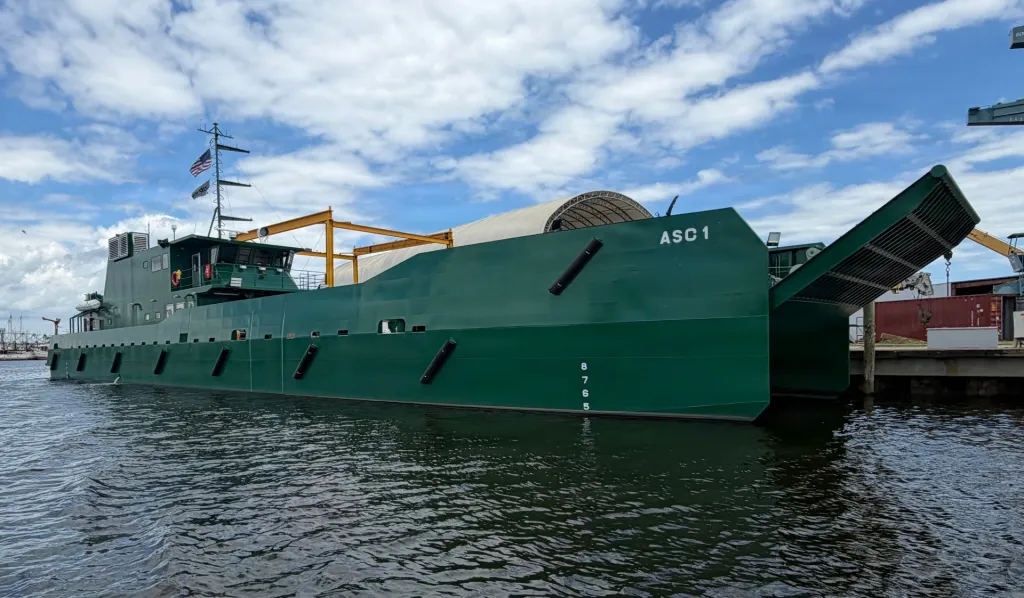
The U.S. Marine Corps has received a rather unusual vessel. There are no missile launchers, massive superstructure, or helicopter flight deck. The new ASC-1 — Ancillary Surface Craft — looks more like a landing craft enlarged into a small ship: a flat open cargo deck, a wheelhouse positioned aft, and a large bow ramp that allows it to drive directly onto an unimproved beach.
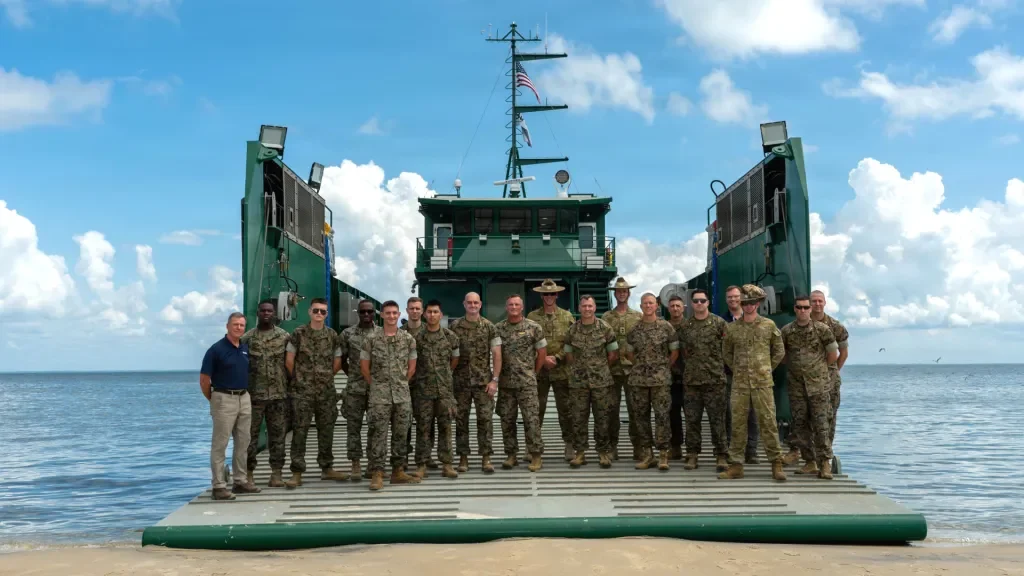
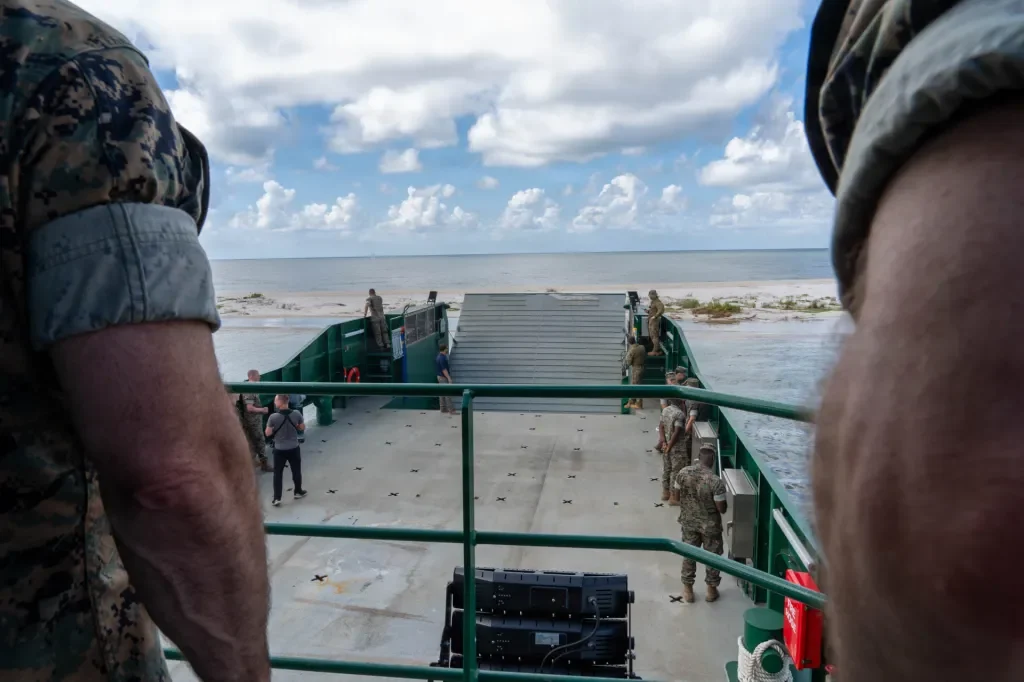
In August 2026, the Marine Corps revealed the completed ASC-1 in Bayou La Batre, Alabama. The Marines have already confirmed technical acceptance of the vessel. It can carry up to 40 fully equipped Marines and approximately 46 tons of cargo, operate in conditions up to Sea State 5, and survive conditions as severe as Sea State 7. It does not require a port or pier for unloading — only a suitable stretch of coastline.
At first glance, this appears to be just another landing craft.
But if the U.S. Navy already operates huge amphibious assault ships, amphibious transport docks, LCAC hovercraft, and a whole family of conventional LCUs, why does the Marine Corps need yet another small, relatively slow vessel?
This is where the ASC becomes much more interesting.
Because the Americans are experimenting not so much with a new ship as with a new way of supplying Marine units scattered across Pacific islands.
ASC-1: A Small Ship for a Very Big Job
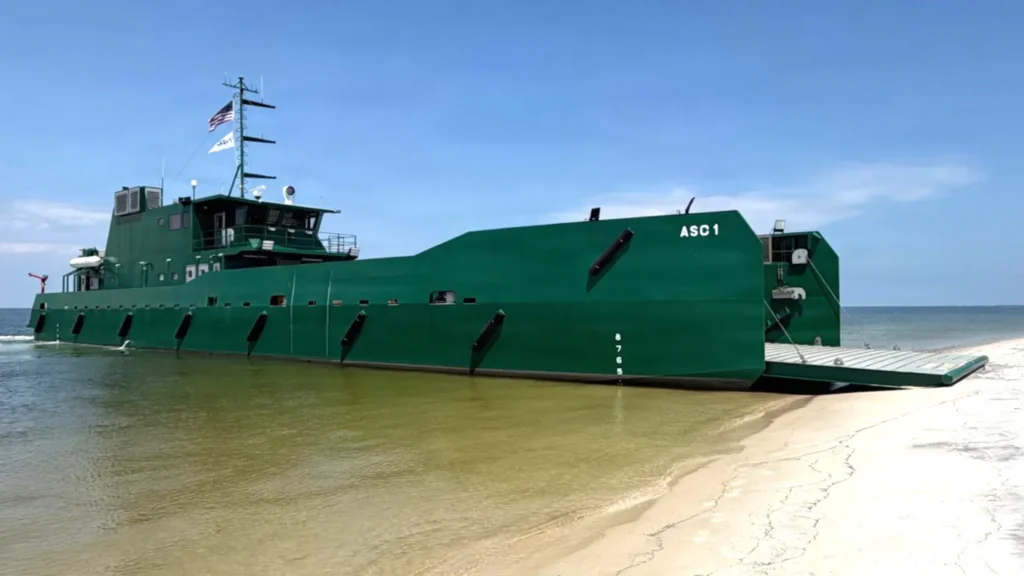
The ASC was developed by Birdon, an Australian-founded company that also has substantial operations in the United States. In 2025, the Marine Corps Warfighting Laboratory ordered two prototypes, intended less as production combat vessels than as experimental platforms.
The ASC itself is relatively simple.
It is approximately 150 feet, or 45.7 meters, long and about 30 feet, or 9.1 meters, wide. Most of the hull is occupied by an open cargo deck. At the bow is a large lowering ramp through which vehicles can drive directly onto a beach.
Its basic characteristics can be summarized as follows:
Developer: Birdon
Type: Medium landing and transport vessel
Length: approximately 45.7 m
Beam: approximately 9.1 m
Troop capacity: up to 40 fully equipped Marines
Payload: approximately 46 tons according to USMC technical acceptance data
Landing capability: directly onto an unimproved beach
Operational sea conditions: up to Sea State 5
Survivability: up to Sea State 7
Loading and unloading: bow ramp
Additional system: forward-looking sonar
Primary role: transporting personnel, light and medium vehicles, ammunition, fuel, and other supplies between islands and coastal positions
That last point is considerably more important than everything else.
The ASC is not designed to independently conduct a classic amphibious assault in the style of Normandy.
Its purpose is to ensure that a small Marine unit already deployed on a remote island does not run out of fuel, food, ammunition, or equipment.
Why Are the Americans Returning to Small Landing Vessels?
To understand the ASC, we need to temporarily forget the traditional image of the U.S. Marine Corps.
For decades, Marine amphibious operations have been closely associated with large U.S. Navy amphibious ships. An amphibious assault ship can carry aircraft, landing craft, hundreds or thousands of personnel, and enormous quantities of equipment.
It is an extremely powerful system.
But there is a problem.
A large amphibious ship is also a very large and very expensive target.
The American concept of Expeditionary Advanced Base Operations, or EABO, is built around a somewhat different model. Instead of concentrating major forces in one location, smaller Marine units are expected to disperse across islands and temporary forward positions.
They can deploy reconnaissance systems, anti-ship missiles, air-defense weapons, drones, and other equipment, perform their mission, and then relocate.
The Marine Corps describes some of these units as stand-in forces.
And that creates a logistical puzzle.
Landing Marines Is Easy. Feeding Them Every Day Is Harder
Imagine a small island.
A Marine unit is deployed there with several vehicles, drones, communications equipment, and a missile battery.
The unit itself may be relatively compact.
But it constantly needs supplies:
fuel, ammunition, food, water, spare parts, batteries, and countless other items.
At the same time, damaged equipment, empty containers, and personnel may need to be evacuated.
Sending a huge amphibious ship for every such mission makes little sense.
Sometimes that ship may not even be able to approach the required location.
The Marines therefore need something resembling a naval equivalent of an army truck.
Cheap and simple enough to be used routinely.
Seaworthy enough to move independently between islands.
And capable of unloading cargo where there is no port at all.
That is the niche the ASC is intended to fill.
The Most Interesting Feature Is Underwater
The bow ramp itself is hardly revolutionary. Landing ships have used similar arrangements for many decades.
The real problem is something else.
Imagine trying to beach a nearly 46-meter vessel on a coastline the crew has never visited before.
There may be submerged rocks, reefs, sudden changes in depth, or other obstacles. A mistake could damage the hull before unloading even begins.
That is why Birdon integrated a forward-looking sonar into the ASC.
The system allows the crew to examine the area ahead of the vessel, identify underwater obstacles, and evaluate the seabed profile while approaching an unfamiliar shore. The design is also intended to operate on significantly shallower beach gradients than many existing landing craft can handle.
This capability is extremely important.
If a landing vessel requires a previously surveyed beach every time it operates, much of the value of distributed logistics disappears.
The ASC is supposed to go where normal infrastructure simply does not exist.
And It Can Carry More Than Boxes
A 46-ton payload does not sound particularly impressive compared with a large amphibious ship.
But the intended cargo mix matters.
The Marine Corps specifically describes the ability to transport medium, light, and ultra-light tactical vehicles, together with the full range of supplies required by dispersed units.
The deck can therefore carry vehicles, trailers, containers, ammunition, equipment, or combinations of different cargoes.
The ASC also has another interesting capability — fuel transfer equipment.
The vessel can be used to transfer fuel either to another vessel or directly ashore.
That effectively turns this small landing ship into a mobile tanker.
For dispersed Marine units, that is extremely useful: fuel does not necessarily have to be unloaded exclusively in drums or separate tank containers.
But Isn’t 46 Tons Very Little?
Compared with traditional American landing craft, it certainly is.
For comparison, the new American LCU 1700 is approximately 42 meters long — actually somewhat shorter than the ASC — yet has a payload capacity of around 170 tons and can carry as many as 350 personnel.
That creates an obvious question.
The ASC is longer.
Yet it carries almost four times less cargo.
Why?
Because maximum payload was not the only priority.
The ASC was designed around independent movement, shallow-water operations, access to gently sloping unimproved beaches, and the ability to handle what the Marine Corps Warfighting Laboratory describes as the “last tactical mile.”
This is not an attempt to build a better LCU.
It is an attempt to create a different tool.
The Original ASC Looked Much More Aggressive
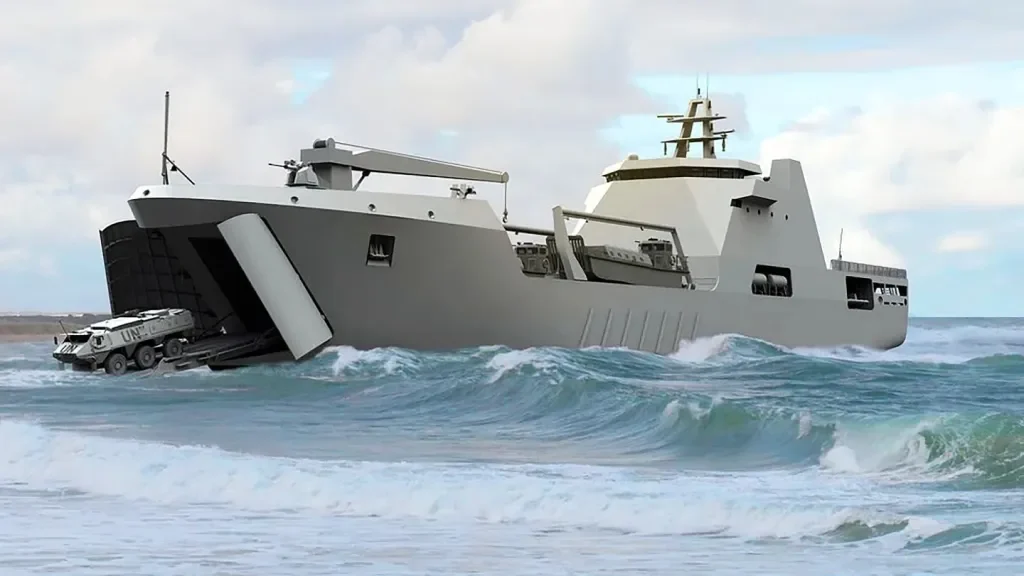
There is another interesting detail.
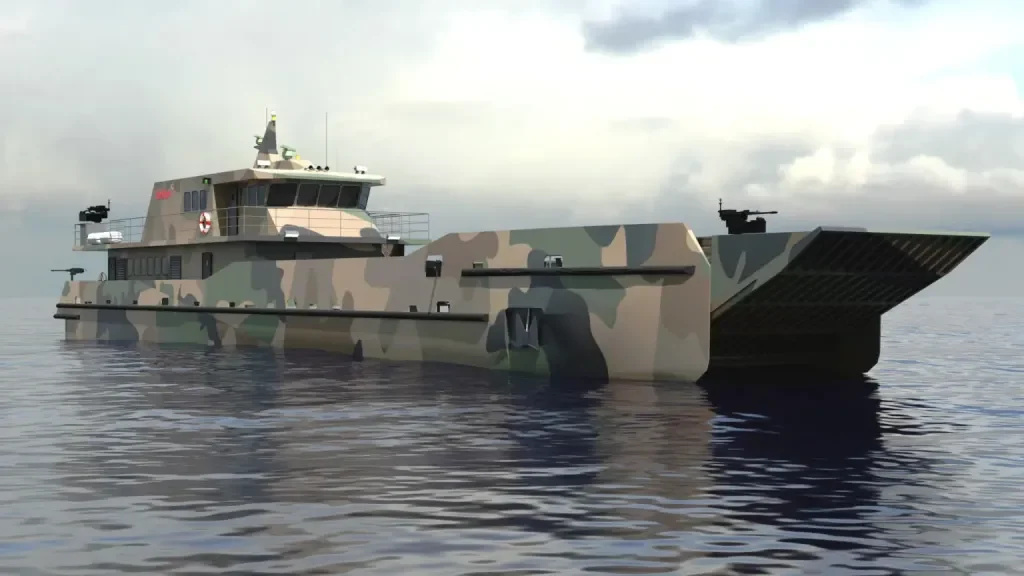
When Birdon first showed imagery of the future ASC in 2025, the vessel appeared considerably more heavily armed.
The rendering showed at least two remotely operated mounts with 30mm automatic cannons, an M2 .50-caliber machine gun, and a more elaborate mast arrangement.
The completed ASC-1 does not currently carry those systems.
Above the wheelhouse are a conventional navigation radar, mast, and other relatively simple equipment.
This highlights the experimental nature of the project.
The Marine Corps is not yet building a finalized production combat vessel. It is acquiring a platform with which it can test the concept itself.
If the ASC proves useful, its weapons, sensors, and communications systems can be developed further.
Or the Marines may conclude that two 30mm cannons are unnecessary.
Because the ASC’s Main Protection Is Not Armor
This is where the concept becomes more controversial.
The ASC does not look like a vessel designed to survive a hit from a modern anti-ship missile.
It is not supposed to.
The logic behind EABO is based on dispersion.
Instead of one large and extremely valuable logistics node, there are many smaller elements. Losing one is undesirable, but it should not collapse the entire system.
The same philosophy is gradually being applied to logistics vessels.
One large ship can transport enormous quantities of cargo, but an adversary only has to find and disable one target.
Dozens of small vessels create a very different problem.
They have to be found.
Tracked.
Distinguished from other contacts.
Weapons have to be allocated against each one.
In that sense, the ASC relies less on steel for protection and more on dispersion and the relatively low value of each individual vessel.
Of course, this approach has limits.
A small, slow vessel remains vulnerable to aircraft, missiles, drones, and even artillery.
But the Marine Corps is not planning to use it like a destroyer.
ASC Is Not the Ship the Marines Are Really Waiting For
This is where the growing collection of American abbreviations can become confusing.
ASC does not replace the Landing Ship Medium, or LSM, program.
The LSM is significantly larger and is intended to become a primary means of moving Marine units and equipment independently over much greater distances.
The Navy plans to receive the first LSM in 2029. In July 2026, a $2.2 billion contract was awarded to TOTE Services to manage construction of the initial group of vessels.
The baseline LSM design is based on the Dutch Damen LST-100 concept. Published specifications point to a capacity of roughly 800 tons of troops, vehicles, and supplies, together with a range of approximately 3,400 nautical miles.
That is an entirely different scale.
ASC — 46 tons.
LSM — roughly 800 tons.
So why are both necessary?
One Brings Cargo to the Area, the Other Brings It to the Beach
This is where the complete logistics system begins to make sense.
A larger LSM can move substantial quantities of cargo between distant bases and islands.
The ASC operates one level below.
The Marine Corps Warfighting Laboratory describes its mission as delivering supplies across the “last tactical mile” — into locations where larger vessels may be unable to operate effectively because of draft, shallow beach gradients, or the complete absence of infrastructure.
The result is a kind of maritime logistics ladder.
Large transport ships move cargo across the ocean.
LSMs distribute it between forward areas.
ASCs take it to locations without proper ports or piers.
Even smaller boats, unmanned systems, and other platforms can then distribute supplies directly to individual positions.
Within such a system, the ASC suddenly makes much more sense.
The Americans Are Effectively Returning to an Old Idea
The amusing thing is that there is nothing revolutionary about the ASC from a purely technological standpoint.
A shallow-draft vessel.
An open cargo deck.
A bow ramp.
The ability to beach itself.
Remove the modern radar, electronics, and sonar, and the basic idea would be perfectly familiar to anyone studying amphibious operations during World War II.
What has changed is the context.
Back then, such vessels were used to land large numbers of troops on hostile coastlines.
Now the Marine Corps sees them as elements of a distributed logistics network.
That is why the ASC simultaneously looks old-fashioned and very modern.
The hull solves a problem that is almost a century old.
But its operational concept is designed for a battlefield where satellites, drones, radars, and long-range missiles make large fixed logistics hubs increasingly vulnerable.
Australia’s Involvement Is Not Accidental
Birdon has Australian roots, and the program includes close U.S.-Australian cooperation. Australian Army personnel are also involved in ASC testing.
After technical acceptance, the vessel is expected to undergo limited technical evaluation involving Birdon specialists, Australian personnel, and the Marine Corps Warfighting Laboratory.
Australia itself is developing a new generation of amphibious vessels, including the larger Landing Craft Medium.
Geography explains the interest of both countries.
The Pacific consists of enormous distances, thousands of islands, and a relatively limited number of well-equipped ports.
If future operations genuinely require small military units to move continuously between islands, traditional large amphibious ships alone will not be sufficient.
An entire hierarchy of landing and logistics vessels will be needed.
The ASC Matters More as an Experiment Than as a Ship
Only the first of two prototype vessels has been completed so far. It would therefore be premature to conclude that the Marine Corps has already decided what a future production ASC fleet will look like.
The Corps is trying to determine what this type of vessel should actually be.
How much cargo does it really need to carry?
What range is necessary?
How shallow should its draft be?
What is the optimal crew size?
Does it need heavy defensive armament?
How useful is the forward-looking sonar?
Can it safely use unfamiliar unimproved beaches?
How quickly can vehicles and cargo be unloaded?
How should it operate alongside LSMs and other landing craft?
And most importantly, can small vessels genuinely sustain dispersed Marine units while operating under enemy pressure?
Computer simulations cannot fully answer those questions.
At some point, actual hardware has to be built and Marines have to take it to sea.
That is why ASC-1 exists.
A Sea Truck Instead of Another Floating Airfield
And this is why the seemingly unremarkable ASC is more interesting than it first appears.
For decades, the U.S. Marine Corps has relied on extremely capable and expensive Navy amphibious ships.
Distributed operations require something different.
If combat forces are divided into numerous small groups, logistics have to become distributed as well.
It makes little sense to disperse missile batteries across twenty islands and then supply all of them from one enormous ship sitting in a predictable location.
That is why small utilitarian vessels with open decks and bow ramps are appearing alongside multibillion-dollar amphibious assault ships.
Not because American shipbuilding has suddenly returned to 1944.
But because modern high-tech warfare has unexpectedly created demand for a very simple tool again — a sea-going truck capable of carrying several dozen tons of cargo directly onto the sand.
ASC-1 remains only a prototype.
But vessels like it could become critically important to the entire American EABO concept. Building a stealth aircraft, a long-range missile, or a new radar is difficult.
There is, however, a much more mundane problem.
Once a missile battery has been deployed to a tiny island somewhere in the Pacific, someone still has to bring it another load of missiles, fuel, spare parts, and food tomorrow.
That is exactly what the ASC is being built to do.






