The British Spent Two Years Preparing a Single Explosion. Why 440 Tons of Explosives Still Couldn’t Break World War I

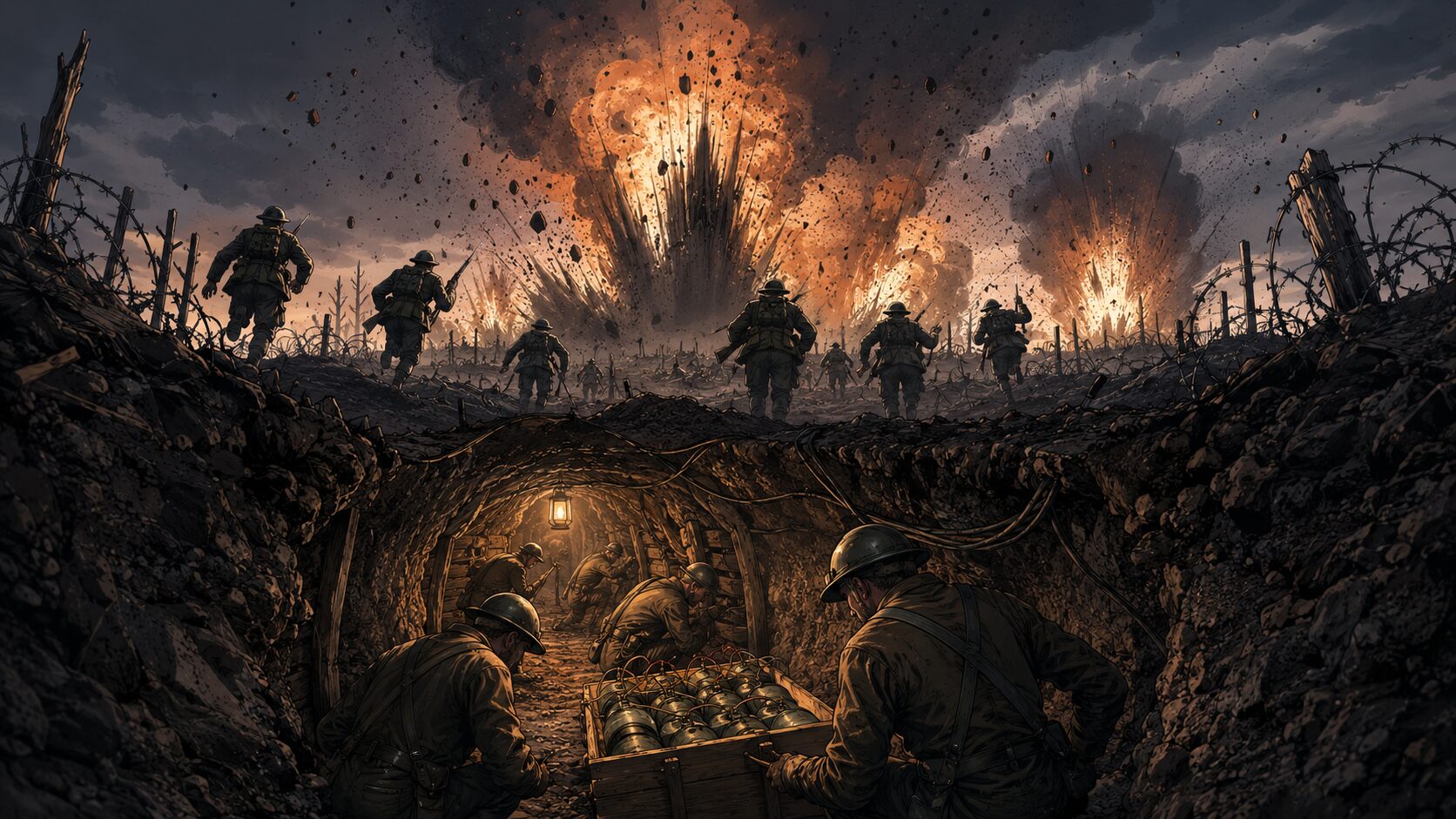
At 3:10 a.m. on June 7, 1917, something happened beneath Messines in Belgium that looked less like an artillery strike and more like a localized geological disaster. Nineteen massive mines exploded almost simultaneously beneath German positions, containing roughly 440 tons of explosives. The ground itself seemed to open under the fortifications: thousands of tons of earth were thrown into the air, trenches and dugouts disappeared along with the men inside them, and enormous craters appeared where defensive positions had stood. According to the Imperial War Museums, around 10,000 German troops may have been killed directly by the explosions. There is also the famous story that the blasts were heard in London, though it is better treated as a dramatic detail that cannot be verified with confidence.
Within minutes, British infantry moved forward. And then something unusual happened for the First World War: the carefully prepared plan largely worked. The initial objectives were taken, the Messines Ridge that had dominated Allied positions for years fell under British control, and more than 7,000 German soldiers and officers were captured. It seemed that the British Army had finally found a way to break positional warfare. If fortifications could not be destroyed from above, perhaps they could simply be lifted into the air together with the ground beneath them.
But this is where the story becomes much more interesting. The Messines operation really was one of the most impressive tactical victories achieved by the British Army during the war. The preparation had taken almost two years, the vast underground system worked almost exactly as the engineers intended, and the German defenses were ruptured — yet no strategic breakthrough followed. Within weeks, the British Army was once again bogged down in the bloody fighting around Ypres.
It is almost the perfect paradox of the First World War: the British learned how to blow entire sections of the front apart, but they still had not learned how to turn such breakthroughs into a quick victory.
When You Cannot Go Through the Front, You Go Under It
By the end of 1914, Europe’s armies had encountered a problem for which almost no one had been prepared. Mobile warfare had ended, and from the North Sea to the Swiss border there gradually emerged a gigantic system of trenches, dugouts, machine-gun positions, artillery batteries, and barbed-wire defenses. Every attack became an exercise in almost mathematical brutality: artillery had to destroy the defenses, infantry then had to cross exposed no man’s land, and the attackers had to seize the trenches before the enemy could bring up reserves. Even a successful breakthrough of the first line often ended with the attackers simply running into a second.
Military planners searched for solutions in every direction. Artillery became more sophisticated, fire-control methods improved, aircraft evolved from exotic reconnaissance machines into a real branch of warfare, and in 1916 the first tanks appeared on the battlefield. But there was another direction as well — literally downward. If a fortified position could not be destroyed from above, why not place explosives directly underneath it?
The idea itself was older than gunpowder. Tunneling had been used in sieges since antiquity and the Middle Ages, and once gunpowder appeared, engineers could do more than undermine walls — they could blow them apart from below. But the First World War transformed mining warfare into an industrial process. Kilometers of galleries, dedicated shafts, ventilation systems, underground stores, and explosive chambers began to appear beneath the front. Ordinary infantrymen were not enough for such work. Armies needed professional miners.
A Second Front Existed Beneath the Ground
The British Army began creating specialized tunnelling companies within the Royal Engineers. Professional miners were especially valuable — men who could drive galleries quickly, reinforce ceilings, and understand the behavior of different soils. Underground, there was a separate war, almost entirely unlike the one being fought above. Narrow passages, darkness, water, poor air, the constant danger of collapse — and always the knowledge that somewhere nearby the enemy was digging too.
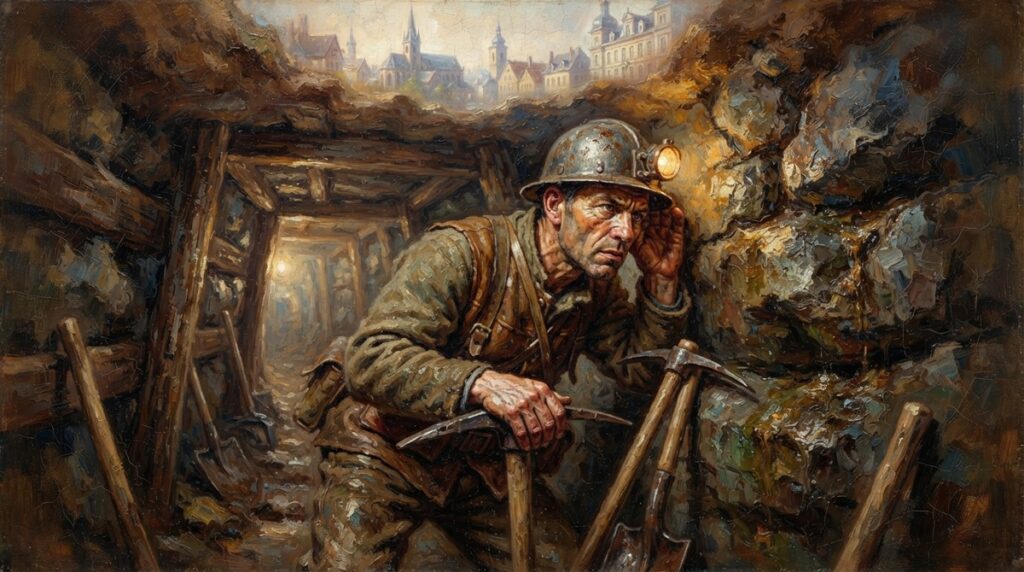
The Germans were also building their own mining and counter-mining galleries. That made hearing one of the most important weapons underground. Engineers literally listened to the earth using specialized devices, trying to detect the sound of enemy picks. Sometimes only a few meters of soil separated two teams. Once the enemy was located, there was a race to place a small charge and collapse his tunnel before he could do the same.
Hundreds of artillery pieces might be firing overhead, but for the men underground the most frightening sound was often a faint tapping from the other side of a wall. The louder it became, the less time remained. In this way, a second front emerged beneath the Western Front — invisible, slow, and psychologically brutal.
And in 1916, the British tried to use it on a massive scale.
The Somme Proved That a Giant Explosion Was Not Enough
On July 1, 1916, the Battle of the Somme began. Before the British infantry attack, a number of mines beneath German positions were detonated. The most famous was the Lochnagar Mine near the village of La Boisselle. Engineers of the 179th Tunnelling Company drove a gallery almost 300 meters underground and placed around 60,000 pounds — roughly 27 tons — of ammonal in two chambers.
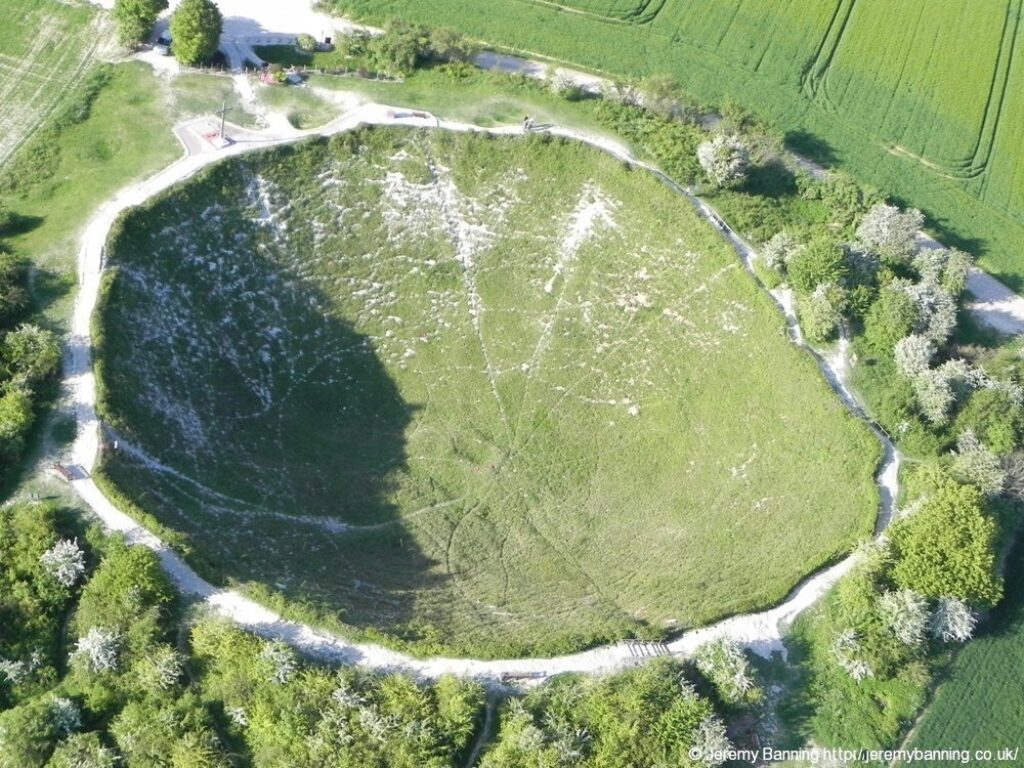
At 7:28 a.m., the charge exploded. Tens of thousands of tons of earth were thrown into the air, and a crater roughly 90 meters across appeared where the German position had been. It still exists today and remains one of the most striking physical scars left by the First World War. The logic seemed obvious: the fortification had been destroyed, so the way forward should have been open.
But the Somme exposed a fundamental problem. A mine could destroy one section of trench, but it could not destroy the German defensive system as a whole. The enemy still had neighboring positions, machine guns, artillery, reserves, and deeper defensive lines. The huge craters could themselves become obstacles to attacking infantry, and the Germans adapted quickly to the altered terrain.
The first day of the Somme became the bloodiest day in British military history: around 57,000 casualties, including more than 19,000 dead. Underground mines had demonstrated extraordinary destructive power, but they had also proved something crucial — a giant explosion does not win an offensive by itself.
At Messines, the British decided to apply that lesson differently.
For Two Years, the British Built a Giant Bomb Beneath the German Army
The Messines Ridge south of Ypres was a major tactical problem. German forces occupying the high ground had excellent observation over British positions, and as long as they held the ridge, preparing a major offensive in Flanders remained extremely difficult. Simply storming well-prepared defenses meant paying once again with thousands of lives.
So work beneath Messines began long before the offensive itself — as early as 1915. British tunnellers gradually went deeper under German positions, driving long galleries toward the most important defensive strongpoints. Above them, the ordinary war continued: artillery fired, units rotated, raids took place. Tens of meters below, another operation was unfolding, one measured not in days or even months, but years.
The Germans understood the danger perfectly well and conducted aggressive counter-mining operations. They dug their own tunnels, listened for British activity, and destroyed galleries they managed to detect. Some mine systems were lost in exactly this way. At times British engineers stopped work because they could hear German miners only a few meters away. In other cases, underground explosions collapsed entire sections of gallery with the men inside.
The British engineers’ greatest achievement, therefore, was not simply the number of tunnels they excavated. They managed to preserve enough of the system either undetected or beyond the reach of German counter-miners until the summer of 1917. Beneath key positions, tens and then hundreds of tons of explosives gradually accumulated.
In effect, the British Army spent two years building a giant distributed bomb beneath the German front.
On June 7, 1917, They Switched It On
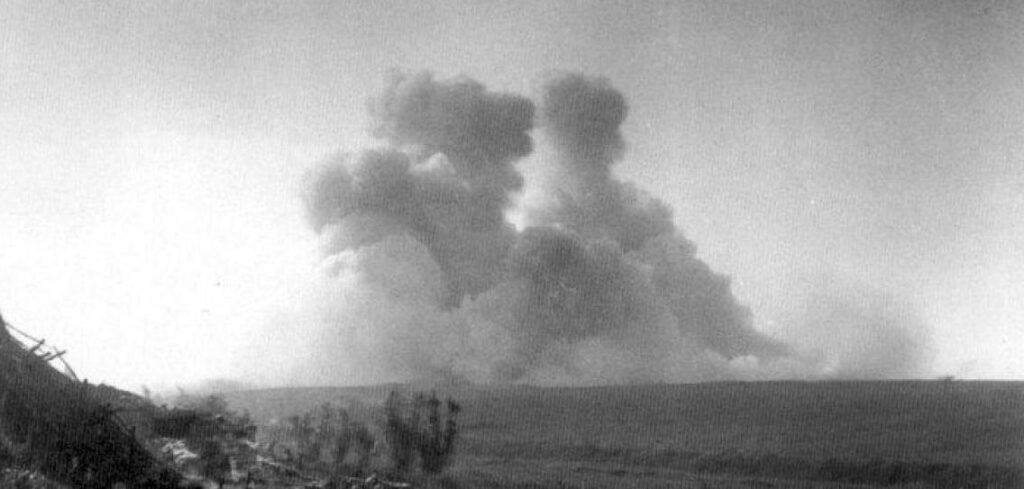
By the time of the assault, around 440 tons of explosives lay beneath the Messines Ridge. At 3:10 a.m. on June 7, nineteen mines were detonated almost simultaneously. Several other prepared charges were not used for various reasons, but the nineteen that did explode were enough to produce one of the most spectacular man-made explosions of the era.
The destruction was enormous. Giant craters opened where German fortifications had stood, trenches and dugouts collapsed, communication lines were severed. The Imperial War Museums estimates that around 10,000 German soldiers may have been killed directly by the blasts. Even in a war already accustomed to horrific casualties, the destruction of so many men within seconds was staggering.
But the critical difference between Messines and the Somme was not that the British used more explosives. This time, the explosions were only the first stage of a carefully coordinated operation. Artillery immediately supported the infantry advance, a creeping barrage was used, units had clearly defined objectives, and the entire offensive was designed to exploit the few minutes of chaos created by the destruction of the forward German defenses.
That is why Messines worked.
The British Finally Learned Not Just to Blow Up the Front, but to Move Through It
After the explosions, nine Allied divisions advanced. German troops who survived the underground blast were disorganized, many fortifications had been destroyed, communications were disrupted, and British infantry moved directly behind the artillery barrage. Within hours, the main initial objectives had been achieved.
The Messines salient, which had dominated British positions for years, was lost by the Germans. More than 7,000 German troops were captured. By the standards of the First World War, it was an extraordinarily clean tactical success: the preparation produced almost exactly the result the planners had intended.
And the concept was far more sophisticated than simply “bury more explosives.” The mines destroyed and disorganized the forward line, artillery suppressed the next positions, infantry exploited the breach, and reserves developed the attack. For perhaps the first time, underground warfare was not an isolated trick but one component of an integrated system of battle.
It seemed that the British Army had finally answered the central question of trench warfare: how do you break through a fortified front?
And this is precisely where the story of Messines becomes so interesting.
Because it turned out that this was no longer the main question.
The Front Could Be Broken. The Problem Was What Came Next
Imagine that the underground operation succeeds completely. The first defensive line is destroyed, infantry occupies it and advances several kilometers. The Germans retreat.
What happens next?
The tunnels cannot move forward with the attacking troops. You cannot dig new kilometer-long galleries beneath the next defensive line within a few hours. You cannot pre-position hundreds of tons of ammonal beneath positions the enemy will only occupy tomorrow.
This revealed the fundamental limitation of tunneling warfare. It was extraordinarily effective against a fixed target. The longer the front remained in one place, the more time engineers had to prepare. But a successful offensive itself destroyed the conditions required to use the weapon again.
This created a strange paradox: the better an underground mine worked, the faster it made itself useless.
Once the breakthrough occurred, the attacking army again confronted all the ordinary problems of the First World War. Artillery batteries had to be moved forward. Shells and food had to travel over shattered roads. Communications lagged behind. Infantry suffered casualties. The enemy brought up reserves and formed a new defensive line. The farther the attackers advanced, the weaker their own supply system became and the closer German troops moved toward their supporting formations.
Messines showed how to break down a door.
Behind that door was another corridor.
And then another.
A Few Weeks Later Came Passchendaele
The capture of Messines Ridge was not intended as an isolated objective. It was preparation for a much larger British offensive in Flanders. The high ground had been secured, the southern flank stabilized, and the German defenses had taken a serious blow. It appeared that the opportunity had arrived to exploit the success.
But the main offensive did not begin until late July 1917. By then, the German command had time to prepare. Then factors entered the battle for which no underground bomb could provide an answer: artillery destroyed the drainage system, the rains came, the fields turned into mud, and supplying the advancing troops became a nightmare.
The Third Battle of Ypres, better known as Passchendaele, lasted for months and became one of the darkest symbols of the First World War. Soldiers once again fought through mud, shell holes, and machine-gun fire; progress was measured in kilometers while casualties were counted in the tens and hundreds of thousands.
It became almost a cruel historical experiment. In June, the British demonstrated how a local breakthrough could be prepared almost perfectly. A few weeks later, they discovered that they still did not know how to turn such a breakthrough into the strategic collapse of the German front.
Four hundred and forty tons of explosives solved a tactical problem.
The strategic problem was much larger.
The Strangest Part of the Operation Is Still With Us
Not all of the mines prepared beneath Messines were detonated on June 7, 1917. Some became unnecessary because the front line changed, while others were abandoned or lost. After the war, part of the information about their exact locations disappeared along with the men who had built the underground system.
And the mines remained beneath the Belgian fields.
On June 17, 1955, a thunderstorm passed over the Messines area. Lightning struck a power line, triggering the detonation of one of the charges left over from the First World War. The explosion created a new crater. The only known casualty was a cow grazing nearby.
Other charges are believed to remain underground to this day. In other words, a weapon created for an offensive in 1917 may still retain some of its destructive potential more than a century later. It is one of the strangest memorials of the First World War: not a museum object or a rusting artillery piece, but an actual bomb simply forgotten beneath the earth.
This is also connected to a common misunderstanding about the famous Pool of Peace near Messines. It is sometimes linked to the 1955 explosion, but in reality it is the water-filled Spanbroekmolen crater created by one of the mines detonated on the morning of June 7, 1917. Today it is surrounded by water, trees, and grass, and it is almost impossible to imagine that the quiet Belgian landscape was literally shaped by a First World War explosion.
440 Tons of Explosives Did Not Change the Outcome of the War. That Is Exactly Why Messines Matters
It is easy to turn the Messines operation into a dramatic story about a miracle weapon. For two years British miners secretly tunnel beneath the enemy, place hundreds of tons of explosives, and then with a single signal destroy an entire section of the front. In that version, the only thing left is to claim that the explosion changed the course of the First World War.
But the real story is much more interesting.
Messines did not decide the war. Germany was not pushed to the brink of defeat, the Western Front did not collapse, and seventeen months still remained before the Armistice. Yet the operation was one of the clearest examples of how far the Allied war machine had evolved by 1917. Professional miners, engineers, artillerymen, and infantry spent nearly two years preparing an operation in which enormous underground charges were only one element of a much larger system.
And the system worked.
German positions were destroyed. The ridge was taken. Thousands of enemy soldiers were killed or captured. The tactical objective was achieved.
And the war continued.
That is the real paradox of Messines. By 1917, the First World War had reached a stage where armies could do things that only a few years earlier would have seemed impossible. They could dig kilometers of tunnels beneath an enemy front, secretly place hundreds of tons of explosives, detonate dozens of charges almost simultaneously, collapse the defenses, and launch a coordinated offensive immediately afterward.
But even such an operation did not solve the central problem.
The British learned how to literally blow the ground out from under the enemy. They learned how to win a battle. But the First World War had become such a vast and complex machine that even 440 tons of explosives could not answer the much harder question — how to win the war itself.