Poland Is Building Europe’s Strongest Army. But Its Shell Production Might Not Last a Week of Major War

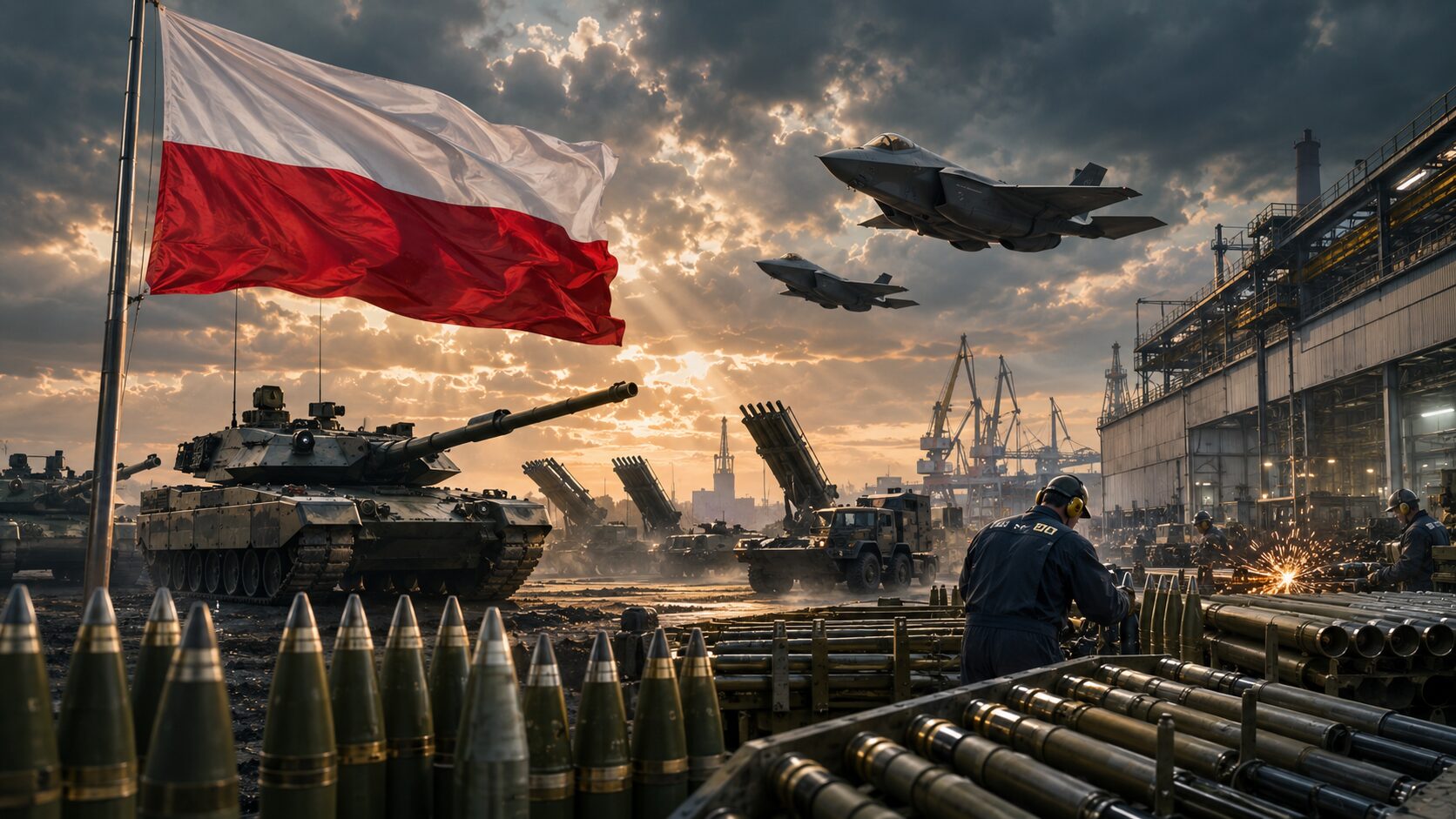
Poland is undergoing what is probably the largest modernization of its armed forces since the end of the Cold War. The country is buying American Abrams tanks, South Korean K2s and K9s, HIMARS and Chunmoo rocket systems, F-35 fighters, Apache attack helicopters and Patriot air-defense systems. Military spending has risen to levels that would have seemed almost unimaginable for a European country only a few years ago: in 2026, Warsaw plans to spend around 200 billion zlotys on defense, equivalent to 4.81% of GDP. If the current programs are completed, Poland’s ground forces could indeed become among the most powerful in Europe.
At the same time, Poland’s defense industry appears to be thriving. The country’s largest state-owned defense group, Polska Grupa Zbrojeniowa — PGZ — reportedly ended 2025 with a net profit of around 2.8 billion zlotys, or roughly $750 million. At first glance, this looks like an almost perfect success story: a huge defense budget, hundreds of new tanks, modern combat aircraft, a growing defense industry and a country that was among the first in Europe to begin seriously preparing for the possibility of a major war.
But there is one number that makes Poland’s military transformation look very different.
25,000.
That is roughly how many 155 mm artillery shells the Polish defense industry could produce in an entire year until recently. In a major war, that quantity could potentially be consumed within several days. And this reveals a problem facing not only Poland, but much of Europe: buying a modern army has proved considerably easier than building the industrial system required to sustain that army in a real high-intensity war.
Poland Really Is Rearming at an Extraordinary Pace
The scale of Poland’s military buildup is difficult to overstate. Since 2022, Warsaw has effectively moved away from the model of a relatively small professional military favored by many European states and decided to create large ground forces capable of conducting high-intensity operations. Tanks became one of the most visible symbols of that policy: Poland purchased American M1 Abrams while simultaneously signing enormous agreements with South Korea centered on the K2 Black Panther.
They are being joined by hundreds of K9 Thunder self-propelled howitzers, American HIMARS and South Korean K239 Chunmoo multiple-launch rocket systems, F-35A fighters, FA-50 light combat aircraft, AH-64E Apache attack helicopters and Patriot air- and missile-defense systems. Domestic programs involving the Krab, Rosomak, Piorun and other systems are developing in parallel. This is no longer an ordinary modernization program in which aging equipment is gradually replaced. Poland is attempting to change the scale of its armed forces within a remarkably short period.
But the amount of equipment purchased answers only one question: what will Poland have available on the first day of a war? There is another, far less comfortable question: what will it have left to fight with a month later? This is where impressive lists of tanks, aircraft and missile systems collide with a less glamorous but fundamental component of military power — industrial capacity.
The War in Ukraine Brought Back the Old Arithmetic
After the end of the Cold War, European militaries became accustomed to a very different kind of warfare. Yugoslavia, Afghanistan, Iraq and Libya were conflicts in which Western forces generally enjoyed enormous technological advantages and, in many cases, air superiority. Relatively small professional contingents could employ precision weapons while operating behind logistics systems that their opponents had little ability to disrupt.
Large-scale artillery warfare increasingly appeared to belong to the 20th century. Thousands of shells fired every day, hundreds of armored vehicles lost, artillery barrels rapidly wearing out, enormous minefields and the constant need to replace equipment seemed more appropriate to a hypothetical NATO–Warsaw Pact confrontation than to the wars Europe expected to fight. European governments therefore reduced stockpiles, closed production lines, consolidated defense companies and downsized their armies. Ammunition could be produced in relatively small batches sufficient for training, replenishing stocks and supporting limited overseas operations.
The war in Ukraine demonstrated how dangerous that assumption could be. When two large armed forces cannot quickly destroy each other and a conflict becomes prolonged, technological competition gradually becomes an industrial contest as well. Millions of artillery shells are needed again, along with tens of thousands of drones, replacement barrels, engines, armored vehicles, communications equipment and enormous quantities of spare parts. Eventually, what matters is no longer simply how much weaponry a country possessed on the morning the war began, but how much it can produce on the hundredth or five-hundredth day.
25,000 Shells a Year
That is why the Polish figure is so revealing. Since the beginning of Russia’s full-scale invasion of Ukraine, Poland reportedly managed to increase its production of 155 mm ammunition by roughly five times. That sounds impressive until the absolute numbers are considered: from approximately 5,000 rounds per year to around 25,000.
Now compare that with the requirements of an actual artillery war. If an army consumes an average of 4,000 155 mm shells per day, Poland’s entire annual industrial output would correspond to roughly six days of firing. At 5,000 rounds per day, it would be five days. During particularly intense periods of modern warfare, ammunition expenditure can be considerably higher.
An important distinction is necessary here. This does not mean that the Polish military has only five or six days of ammunition available. Poland has existing stockpiles, buys ammunition abroad and belongs to NATO. What we are comparing is the potential rate of consumption with the ability of domestic industry to replenish what has been used. But that comparison illustrates the scale of the industrial challenge better than almost any defense-budget statistic.
An Artillery Shell Is an Entire Industrial Supply Chain
At first glance, the solution appears obvious: if Poland needs 250,000 shells rather than 25,000, it simply has to build more factories. In practice, artillery ammunition is considerably more complicated. A shell requires a metal body, explosive filling, a fuze, a propelling charge, propellant and primers, while each of these components depends on its own industrial supply chain.
As a result, the entire system moves at the speed of its weakest link. A factory might be capable of machining bodies for 200,000 shells per year, but if the chemical industry can supply propelling charges for only 80,000, actual output will remain around 80,000. A new assembly line can be built, but without enough explosives it will simply sit underused.
Increasing ammunition output therefore means much more than constructing one large production hall. In practice, an entire industrial ecosystem has to be expanded or rebuilt: metallurgy, chemical plants, propellant and explosive production, precision machining, electronics for modern fuzes, quality control and logistics. Finally, qualified engineers and industrial workers are required, and they cannot be trained overnight either. Large amounts of money can accelerate the process, but they cannot eliminate time.
Poland Has Already Recognized the Problem
Warsaw is not ignoring the issue. The Polish government has allocated around 2.4 billion zlotys to expand ammunition production, with funds directed toward PGZ companies to create additional manufacturing capacity. The objective is to raise annual production of 155 mm ammunition to approximately 150,000 rounds within the next several years. PGZ is also cooperating with foreign partners, including Britain’s BAE Systems, on artillery-ammunition manufacturing technology.
If these plans succeed, the increase will be enormous. Going from approximately 25,000 rounds to 150,000 represents a sixfold expansion. Compared with the prewar level of roughly 5,000 shells, output would increase by a factor of thirty.
Yet this creates another paradox. Even 150,000 rounds per year is not an extraordinary quantity in the context of a major war. At an expenditure rate of 5,000 rounds per day, it represents only about one month of intensive operations. Of course, no modern European country expects to fight using only its current domestic production: strategic stockpiles, imports and allies all matter. But the ability of industry to replenish those stockpiles rapidly is becoming an increasingly important component of military power.
Why Did a Country Buying Hundreds of Tanks Produce So Little Ammunition?
The answer is relatively straightforward: for decades, Poland operated within the same security model as the rest of Europe. After the Cold War, the possibility of a major land war on the continent was considered remote. During the 1980s, NATO and the Warsaw Pact maintained enormous armies, stockpiles and industrial systems designed for a potential confrontation involving millions of troops. After the collapse of the Soviet Union, much of that capacity appeared unnecessary.
The era of the so-called peace dividend began. Armies shrank, mobilization stocks were reduced, and defense factories were closed or consolidated. Maintaining a plant capable of producing hundreds of thousands of artillery shells annually made little economic sense when the armed forces required only a fraction of that output. Production lines still needed workers, machinery, security and infrastructure even when there were few orders.
Economically, this optimization was perfectly rational. The mistake was not necessarily that Europe reduced excess Cold War capacity, but that it increasingly assumed such capacity would never be required again. Political reality changed much faster than industry could reverse three decades of contraction.
Tanks Can Be Bought Faster Than Factories Can Be Built
Poland’s rearmament demonstrates a fundamental limitation of modern defense policy. If domestic industry cannot produce a particular weapon quickly enough, it can be purchased abroad. Need tanks? There are American Abrams or South Korean K2s. Need artillery? K9s can be ordered. Need multiple-launch rocket systems? HIMARS and Chunmoo are available. Need a fifth-generation fighter? Buy the F-35.
Money can dramatically accelerate military modernization. Poland has used that instrument more aggressively than almost any other European state, ordering in a few years quantities of equipment that some countries might take decades to acquire. But a major war introduces a fundamental problem: importing consumable supplies becomes much more difficult precisely because everybody suddenly needs them.
If a conflict affects several allied countries simultaneously, each begins consuming its own stockpiles while attempting to purchase replacement ammunition from a limited number of producers. Waiting lists grow, prices increase, and production capacity cannot be expanded instantly. In such circumstances, a domestic factory is no longer merely an industrial asset. It becomes a strategic reserve almost as important as an ammunition depot.
Why Poland Turned to South Korea
It is no coincidence that South Korea has become one of Warsaw’s most important defense partners. Seoul has spent decades living next to one of the most heavily militarized borders in the world, while the Korean War technically ended with an armistice rather than a peace treaty. South Korea therefore never enjoyed the same full-scale peace dividend as most European countries.
It retained a large military, a mobilization system and, crucially, a defense industry capable of producing weapons in significant quantities. K2 tanks, K9 self-propelled howitzers, missile systems, armored vehicles and ammunition were developed not simply as expensive high-technology products, but as weapons that might potentially have to be manufactured at scale.
When Poland suddenly wanted hundreds of tanks and howitzers as quickly as possible after 2022, South Korean industry proved capable of offering delivery schedules that European manufacturers struggled to match. Poland’s agreements with Seoul therefore tell us more than the story of Warsaw’s rearmament. They demonstrate the difference between two industrial models: Europe spent decades optimizing its defense industry for peacetime, while South Korea continued maintaining a system built around the possibility of major war.
So What Does PGZ’s Record Profit Actually Mean?
Against this background, the financial performance of Polska Grupa Zbrojeniowa becomes particularly interesting. PGZ brings together dozens of Polish defense companies, so the rapid expansion of government orders naturally translated into higher revenue and profits. According to published figures, the group’s net profit for 2025 reached around 2.8 billion zlotys — roughly $750 million.
But high profits at a state-owned defense conglomerate do not automatically demonstrate that the entire industrial system is efficient. Polish politician Michał Dworczyk, who served as vice-chair of the European Parliament’s Committee on Security and Defence, has pointed to several structural weaknesses, including poor exports, delayed programs, frequent management changes and insufficient production capacity in critical areas.
The management instability is particularly striking: PGZ reportedly went through roughly nine leadership changes in about a decade. Frequent executive turnover is disruptive for any business, but the consequences can be particularly serious in defense, where developing and industrializing a new weapon can take ten or fifteen years. If leadership and corporate strategy change every year or two, long-term programs inevitably come under additional pressure.
Orlik Shows Another Side of the Problem
The PGZ-19R Orlik tactical unmanned-aircraft program provides a useful example. A contract for 12 systems was signed in 2018, with the program valued at close to 800 million zlotys. Initial deliveries were expected during the 2021–2023 period, but the project encountered significant delays.
Against the background of the war in Ukraine, this looks particularly uncomfortable. While drones were becoming one of the defining technologies of modern warfare, one of Poland’s important UAV programs spent years struggling to reach full serial delivery. It illustrates the difference between allocating money and achieving industrial results.
A government can increase the defense budget. It can sign a contract and finance development. A state-owned group can even report high profits. But the final product of a defense industry is not its financial statement. It is tanks, missiles, drones and shells delivered in the required quantities and at the required time.
Exports Reveal What the Domestic Market Can Hide
There is another useful test of a defense industry: whether it can sell weapons abroad. A state-owned company receiving enormous orders from its own government can rapidly increase both revenue and profits, but its domestic market is effectively guaranteed. International competition is considerably harsher.
Polish companies have to compete against American, French, German, South Korean, Turkish, Israeli and other manufacturers. Weapon performance matters, but so do price, delivery schedules, the ability to scale production, financing, training, maintenance and long-term support. That is why relatively weak export performance across parts of PGZ has generated its own debate in Poland.
It would nevertheless be wrong to suggest that Polish industry is incapable of developing competitive weapons. One of the clearest successes is the Piorun man-portable air-defense system produced by Mesko, which has secured export orders and built a strong international reputation. Mesko itself has significantly improved its financial performance amid growing demand. Poland’s problem, therefore, is not a complete absence of technology. It is the ability to scale successful products and turn them into large-volume industrial production.
This Is Where Poland’s Story Becomes Europe’s Story
The most important point is that almost all of these problems extend far beyond Poland. France, Germany, Britain, Italy and other European countries went through similar transformations after the Cold War. Production lines were reduced, companies consolidated, stockpiles shrank and military procurement shifted away from huge production runs toward relatively small batches of extremely sophisticated and expensive weapons.
That model worked extremely well in peacetime. It allowed Europe to preserve technologically advanced defense industries without spending enormous amounts maintaining factories that would otherwise sit idle. But a major war imposes completely different requirements. It needs not only sophisticated systems, but quantity — sometimes on a scale that modern European industry had not considered realistic for decades.
Europe is therefore attempting to solve two very different problems simultaneously. It must continue developing extraordinarily complex systems — fighters, missiles, air defenses, electronic warfare and drones — while restoring the ability to mass-produce relatively mundane items such as artillery shells, propellant, explosives, spare parts and replacement barrels. In some ways, the second challenge is harder, because it does not require a single technological breakthrough. It requires rebuilding a vast industrial network.
The Real Arms Race Is Taking Place Inside Factories
Poland really is building one of Europe’s most powerful land forces. If current programs are completed, its inventory of tanks, artillery, rocket systems and modern combat aircraft will be formidable. Warsaw also recognized earlier than many European capitals that previous levels of defense spending were no longer sufficient and has demonstrated a willingness to invest enormous resources in its armed forces.
But the war in Ukraine has revived a lesson Europe had largely forgotten after the Cold War: buying a tank is much easier than creating the industrial system capable of supplying that tank with ammunition, spare parts and repairs for years. A country can order a thousand modern vehicles, but their military value gradually declines if industry cannot replace losses and sustain the consumption of material resources once a major war begins.
That is why Poland’s most important arms race is taking place not on training grounds, and not even in the offices where multibillion-dollar contracts for K2s, Abrams or Apaches are signed. It is happening inside Mesko, Dezamet and other industrial facilities, where billions of zlotys must be transformed into new production lines for propellants, explosives, shell bodies and complete ammunition.
The PGZ paradox is therefore much more interesting than a simple story about the problems of a state-owned defense conglomerate. A company can report record profits at exactly the same time that the country discovers a severe shortage of industrial capacity. Poland can purchase one of Europe’s largest tank forces while only beginning to rebuild the ability to mass-produce the ammunition that force would consume. There is no contradiction here, because money and industrial capacity are not the same thing.
And perhaps Poland is now providing one of the clearest previews of what the new European arms race will actually look like. Its most important metric will not be the number of contracts signed, or even the percentage of GDP devoted to defense. What will matter far more is how many tanks, missiles, drones and artillery shells European factories can produce every year after the original stockpiles begin to run low.
Because in a real major war, the advantage does not necessarily belong to the country with the most equipment on the morning of the first day.
It belongs to the country that can still produce weapons on the hundredth, five-hundredth and thousandth day of the war.