A Power Plant the Size of a City in Space: Why Iceland Could Receive Solar Energy Directly From Orbit

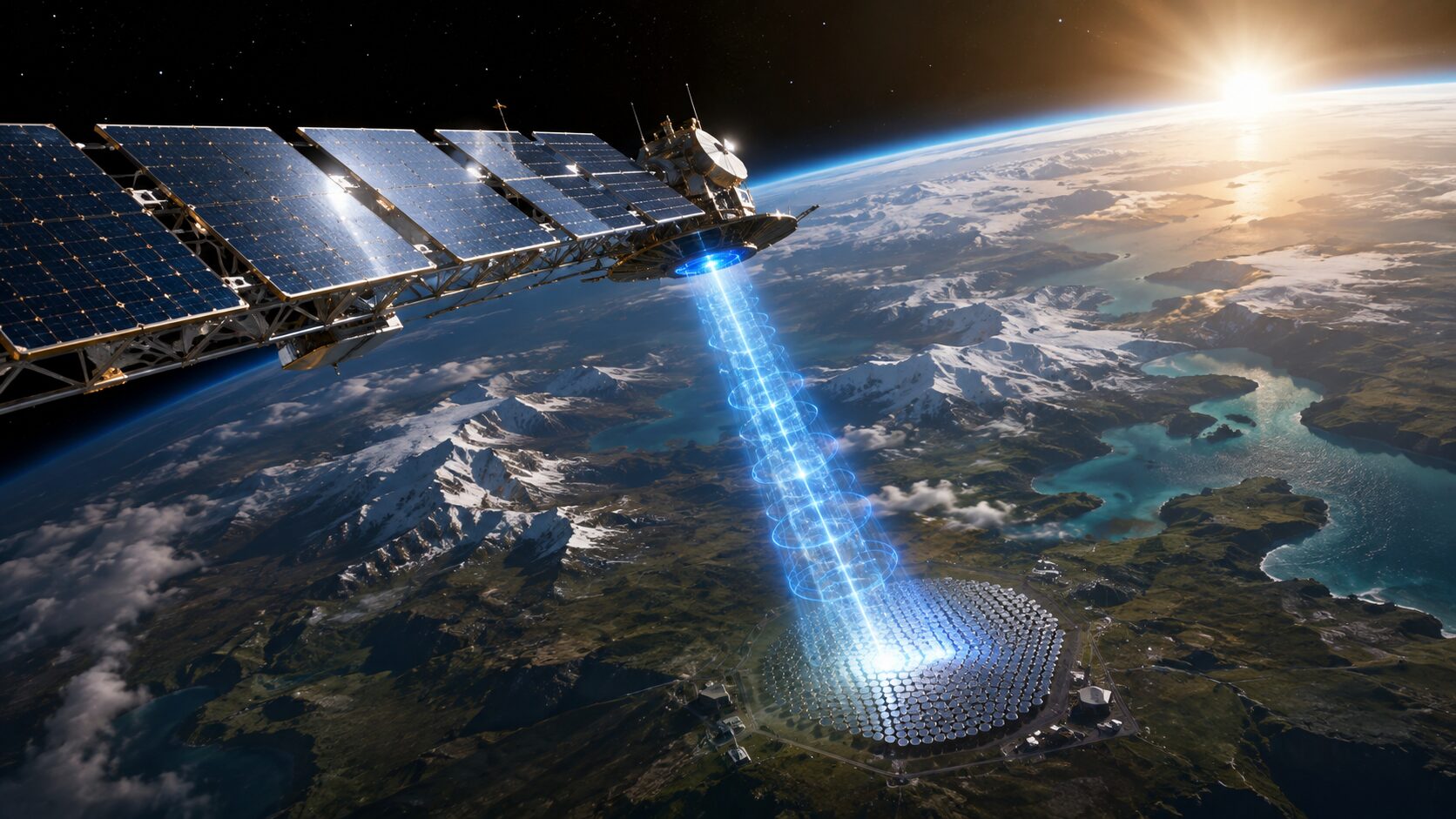
A solar power station in orbit, a giant receiving antenna on Earth, and an invisible microwave beam delivering electricity around the clock. Until recently, this sounded like pure science fiction. Now British company Space Solar aims to build the first commercial system in the next decade, with Iceland expected to become its first customer. But an enormous engineering gap still separates the concept from a functioning orbital power plant.
There is something almost ironic about the choice of country.
Iceland is arguably one of the last places on Earth desperately in need of another renewable energy source. The volcanic island has vast hydroelectric and geothermal resources and already generates virtually all of its electricity from renewables.
Yet Iceland could become the first country to receive commercial electricity from space.
At first glance, this seems paradoxical.
But the real purpose of the project is not to rescue Iceland’s energy system. It is to demonstrate a technology that could eventually solve one of solar power’s oldest problems.
On Earth, the Sun sometimes simply does not shine.
In space, that problem largely disappears.
The Idea Is More Than Half a Century Old
Space-based solar power is much older than it might seem.
In 1968, American engineer Peter Glaser proposed the Solar Power Satellite concept: an enormous satellite that would collect sunlight in space and transmit the resulting energy to Earth using microwaves.
The idea attracted enough attention that NASA and the U.S. Department of Energy seriously investigated it during the 1970s.
The basic principle is surprisingly simple.
A vast array of solar cells is deployed in orbit.
The electricity it generates is converted into electromagnetic radiation.
A directional transmitter beams that energy toward Earth.
On the ground, a huge receiving antenna known as a rectenna converts the microwave energy back into electricity and feeds it into the grid.
The principal advantage is obvious.
A terrestrial solar farm depends on clouds, seasons, and the day-night cycle. A properly positioned orbital system could receive sunlight almost continuously.
Caltech researchers have estimated that space-based systems could potentially harvest, on average, roughly eight times more solar energy than comparable installations on Earth’s surface.
Yet for the next half-century, the idea remained largely confined to studies and experimental concepts.
The reason was simple.
It was enormously expensive.
The Biggest Problem Weighed Thousands of Tons
Generating meaningful amounts of electricity in space requires much more than launching a few solar panels.
Serious power generation would require structures covering hundreds of thousands—and potentially millions—of square meters.
Every kilogram first has to be launched into space.
Then the enormous structure has to be deployed, assembled, oriented toward the Sun, cooled, maintained, and capable of precisely directing energy toward a receiving station thousands of kilometers away.
For decades, this made space-based solar power economically absurd compared with the obvious alternative:
put the solar panels on the ground.
But several things have changed over the past twenty years.
Launch costs have fallen.
Solar cells have become lighter.
Reusable rockets have emerged.
Robotic assembly in space is advancing.
Most importantly, engineers are developing extremely lightweight modular structures that can be folded for launch and deployed after reaching orbit.
Suddenly, an old science-fiction idea is back on the table.
In 2023, Something Small but Historic Happened
An important technological milestone came with the Space Solar Power Demonstrator, or SSPD-1, developed by the California Institute of Technology.
The roughly 50-kilogram spacecraft was launched into orbit in January 2023. Among the experiments onboard was MAPLE, an array of lightweight microwave power transmitters.
The system first demonstrated wireless power transfer in space.
Then a signal transmitted by the experiment was detected on Earth.
This was a historic demonstration of the underlying technology, but it is important not to exaggerate what happened.
Caltech did not power homes from orbit.
It demonstrated key elements of controlled wireless power transmission from a lightweight space-based platform.
In other words, humanity is not yet at the stage of:
“We have built a space power station.”
We are closer to:
“We have demonstrated that one of its crucial technologies can actually work in space.”
The difference is enormous.
And This Is Where Iceland Enters the Story
British company Space Solar wants to make the next leap dramatically larger.
The company is developing an orbital solar power architecture designed to collect sunlight in space and transmit energy to terrestrial receivers using microwaves.
In 2024, Space Solar and Icelandic climate-technology company Transition Labs announced plans for a system intended to begin supplying electricity to Iceland around 2030.
The proposed initial commercial capacity is approximately 30 megawatts.
That is no longer a laboratory experiment.
Thirty megawatts is the output of a small terrestrial power plant.
If the project is actually completed as proposed, Iceland could therefore become the first country to receive commercially supplied electricity from an orbital solar power station.
But the word “if” matters enormously.
Thirty Megawatts Is Both Huge and Tiny
For the first commercial space power station, 30 MW sounds extraordinary.
For the modern electricity industry, however, it is modest.
A single large nuclear reactor commonly generates around 1 gigawatt of electrical power.
In other words, it would take more than 30 orbital systems producing 30 MW each to approach the output of one large reactor.
That is why the first station should be viewed primarily as a demonstration.
The real ambition is far greater.
Supporters of space-based solar power envision future systems operating in the gigawatt class—full-scale power plants capable of competing with major terrestrial generating stations.
And that is when the dimensions become truly extraordinary.
An Orbital Power Plant Would Be Enormous
The central engineering paradox is that rockets are becoming more compact and efficient, while the power stations themselves would have to become gigantic.
Solar energy has relatively low power density.
Producing hundreds of megawatts or several gigawatts therefore requires an enormous collecting area.
Future orbital solar stations could consequently measure kilometers across.
For comparison, the solar arrays of the International Space Station span roughly a hundred meters.
A commercial orbital power plant could eventually be an order of magnitude larger.
As part of SSPD-1, Caltech tested another technology known as DOLCE—a foldable structure measuring only about 1.8 by 1.8 meters.
The experiment itself was tiny.
The architecture behind it was designed to explore something much larger: modular structures that could ultimately be scaled to kilometer-sized installations.
Humanity would effectively have to learn how to construct an entirely new category of megastructure in space.
Wouldn’t the Microwave Beam Fry Everything Below It?
This is probably the most obvious question.
When someone hears:
“Gigawatts of energy will be transmitted from orbit using microwaves,”
the imagination quickly produces something halfway between the Death Star and an orbital weapon.
The real concept is very different.
The energy would be distributed over a very large receiving area, keeping the power density relatively low.
That is precisely why the rectenna itself needs to be so large.
Nevertheless, major safety questions remain.
The system would need extremely precise beam control.
Transmission would have to stop automatically if the beam moved outside its designated area.
Potential effects on aviation, communications, wildlife, and the surrounding environment would all have to be studied and regulated.
These are not problems that can be resolved with theoretical calculations alone.
They would have to be demonstrated through real-world operation.
Why Not Just Build a Solar Farm in the Desert?
And this brings us to the central argument against the entire concept.
Terrestrial solar power is vastly simpler.
No rocket is required.
There is no orbital assembly.
Energy does not have to be transmitted across thousands of kilometers of space.
If a panel fails, a maintenance crew can drive out and replace it instead of launching a spacecraft.
Battery technology is also improving rapidly.
Space-based solar power will therefore not be competing against the energy technology of the 1970s, when Glaser proposed his original concept.
It will have to compete against the solar farms, wind turbines, battery storage systems, and nuclear power plants of the 2030s.
Its primary advantage will have to justify all that additional complexity:
continuity.
An orbital solar station could potentially provide electricity almost around the clock regardless of local weather.
There is another intriguing possibility.
In the long term, a power satellite could theoretically redirect energy toward different receiving stations.
Europe today.
Another region tomorrow.
An area suffering from destroyed or damaged energy infrastructure after a natural disaster the next day.
For the first time, a power station could become not merely a generator but a geographically flexible source of electricity.
That would be a fundamentally new concept.
Why 2030 Should Be Treated with Caution
This is where the original story requires an important correction.
It would be premature to say that Iceland will definitely have a space-based power station by 2030.
The more accurate formulation is:
the developers are targeting approximately 2030.
There is still an enormous gap between an experiment such as MAPLE and a commercial orbital installation delivering tens of megawatts.
Engineers must develop enormous lightweight solar arrays.
They must demonstrate orbital deployment and assembly.
They must achieve extremely precise power-beam control.
Ground infrastructure must be built.
Safety and regulatory questions must be resolved.
And, perhaps most importantly, the entire system must prove economically viable.
The history of spaceflight is full of ambitious projects whose launch dates slipped by five, ten, or even twenty years.
For now, 2030 should therefore be regarded as a target, not a guarantee.
But If It Works, the Consequences Could Be Enormous
The first orbital power plant does not need to revolutionize the global energy industry overnight.
It only has to prove one thing:
electricity generated in space can be delivered and sold at an economically acceptable cost.
If that happens, economies of scale could begin to take effect.
Larger rockets could launch heavier components.
Mass production could reduce module costs.
Robotic assembly could simplify construction.
Power output could grow from tens of megawatts to hundreds, and eventually perhaps to gigawatts.
At that point, an idea first seriously proposed in 1968 could finally become an entirely new industrial sector.
Conclusion
The most interesting part of Iceland’s space-power story is not the promised 30 MW.
Nor is it the 2030 target date.
What really matters is the technological distance humanity is attempting to cover in little more than a decade.
In 2023, Caltech launched a roughly 50-kilogram experimental spacecraft that demonstrated key technologies for wireless power transmission in space and allowed a directed signal to be detected on Earth.
The proposed next step is measured not in experimental signals, but in tens of megawatts.
Beyond that, advocates envision gigawatts.
Perhaps the timeline will prove too optimistic. Perhaps the economics will never work, and terrestrial solar farms combined with energy storage will remain far cheaper.
But if even the first commercial system succeeds, its significance will extend far beyond the construction of another power station.
For the first time in history, part of humanity’s energy infrastructure will begin to physically move beyond the Earth.