

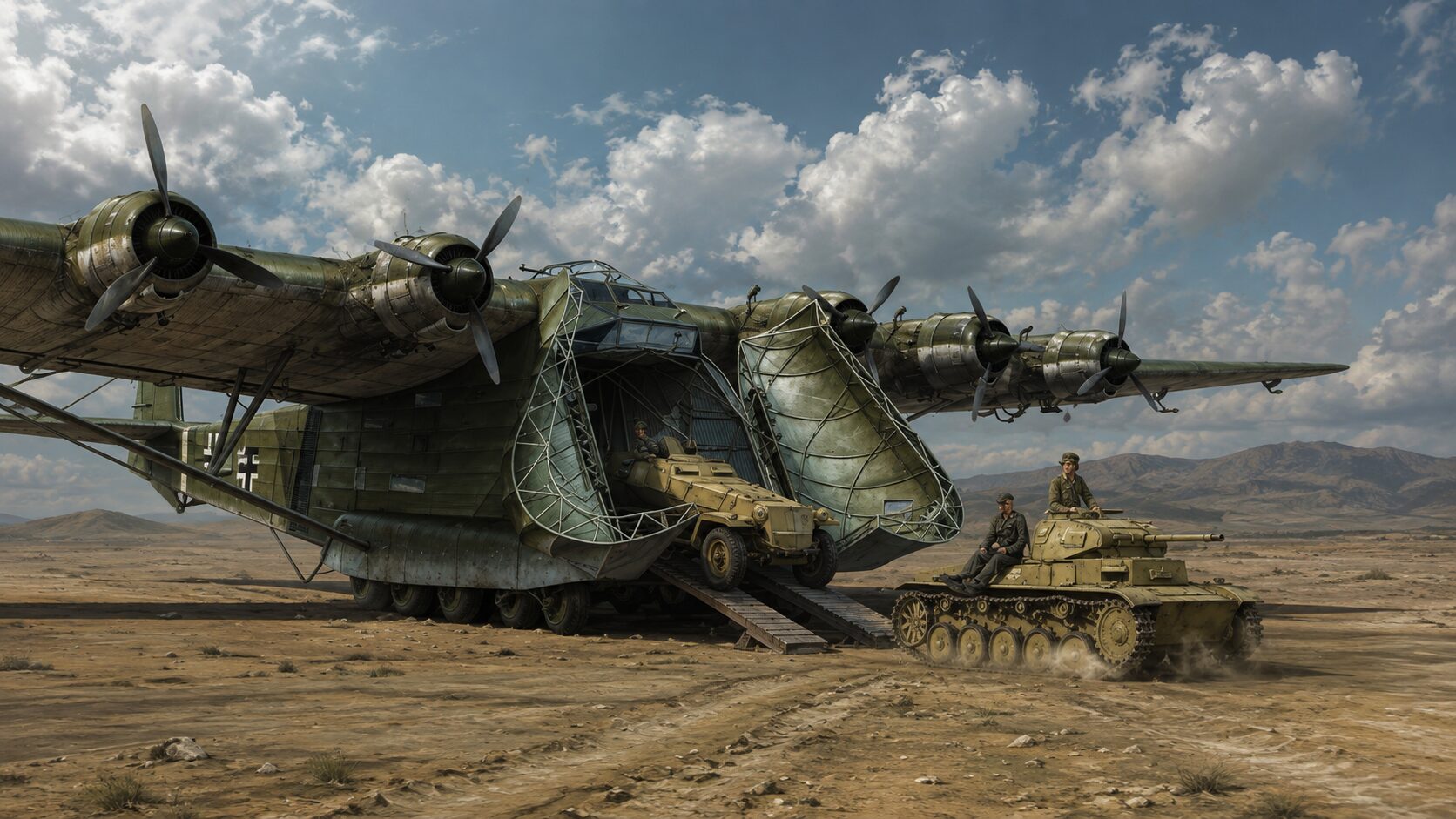
At first glance, the Messerschmitt Me 323 Gigant looked like one of the strangest aircraft ever built. Slow, enormous, and covered largely in fabric, it seemed more like a flying warehouse than a military airplane. Yet once you understand the problem it was designed to solve, its existence suddenly makes perfect sense.
When people think of German aviation during World War II, they usually picture the Messerschmitt Bf 109, the Focke-Wulf Fw 190, or perhaps the revolutionary Me 262 jet fighter. Far fewer remember the largest land-based transport aircraft of the war—a six-engine giant so massive that many still wonder whether it could actually fly.
It could.
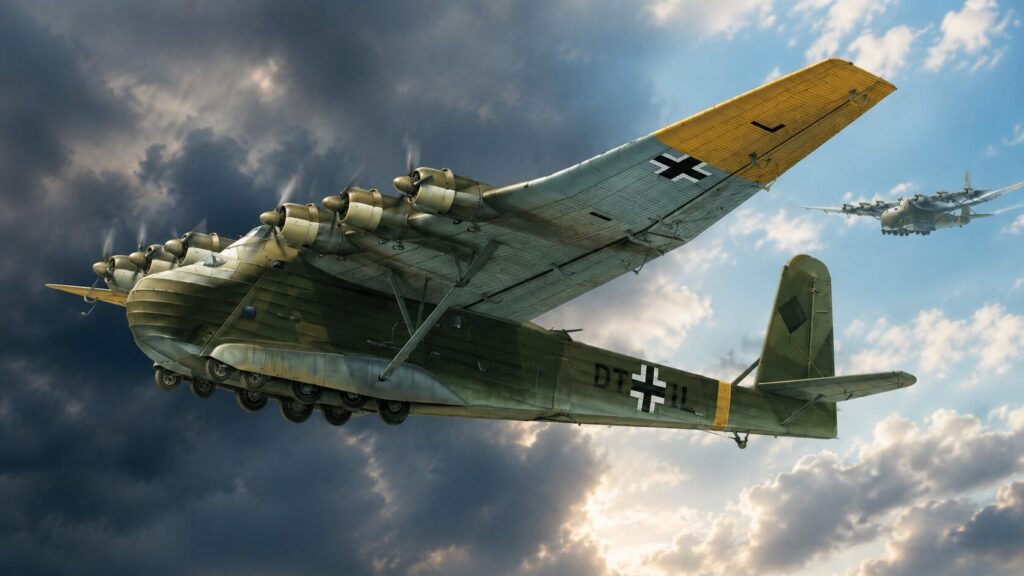
The Messerschmitt Me 323 Gigant had a maximum takeoff weight of up to 45 tons, a 55-meter wingspan, and a cargo compartment large enough to carry light tanks, artillery pieces, trucks, or more than 120 fully equipped soldiers.
But the real question is not how it flew.
The real question is why Germany decided to build such an enormous aircraft in the first place.
It Didn’t Begin with an Airplane
The story of the Me 323 actually began with one of Nazi Germany’s greatest strategic dilemmas.
Following the fall of France in 1940, Adolf Hitler began preparing Operation Sea Lion, the planned invasion of Britain. German forces could move infantry across the English Channel, but transporting heavy equipment—tanks, artillery, and vehicles—was an entirely different challenge.
The Kriegsmarine was no match for the Royal Navy, while the Luftwaffe failed to secure air superiority during the Battle of Britain. Conventional transport ships would have been highly vulnerable.
That forced German planners to consider an idea that sounded almost impossible:
If heavy equipment could not safely cross the sea, perhaps it could fly over it instead.
The result was not an airplane—but an enormous military glider.
The Largest Glider of Its Time
Before the Me 323 ever existed, there was the Messerschmitt Me 321.
Even by modern standards, it was astonishingly large.
Its 55-meter wingspan exceeded that of the famous American B-17 Flying Fortress.
The glider itself weighed approximately 12 tons empty but could carry more than 20 tons of cargo, including a Panzer IV, a StuG III assault gun, multiple military vehicles, or around 200 airborne troops.
It solved one problem.
It immediately created another.
How do you get a 20-ton glider into the air?
Germany Invented One of the Most Unusual Aviation Concepts of World War II
The first solution became known as Troikaschlepp.
Three twin-engine Messerschmitt Bf 110 fighters simultaneously towed a single Me 321.
The operation demanded extraordinary precision. Every pilot had to maintain identical speed, altitude, and heading. A small mistake by one aircraft could snap the tow cables or send the entire formation into a catastrophic collision.
German engineers eventually proposed something even more extraordinary.
The answer became the Heinkel He 111Z Zwilling.
Instead of designing a completely new towing aircraft, they literally joined two Heinkel He 111 bombers with a new center wing section and installed a fifth engine between the fuselages.
The result looked surreal—but it worked.
Even so, launching the giant glider remained dangerous, complicated, and required exceptionally long runways.
Six Engines Were Simpler Than One Tow Aircraft
By 1942 it had become obvious that operating such a massive glider was impractical.
Every flight required multiple support aircraft, experienced crews, and perfect weather conditions.
Messerschmitt engineers reached an obvious conclusion.
If the glider constantly needed to be towed, why not give it engines of its own?
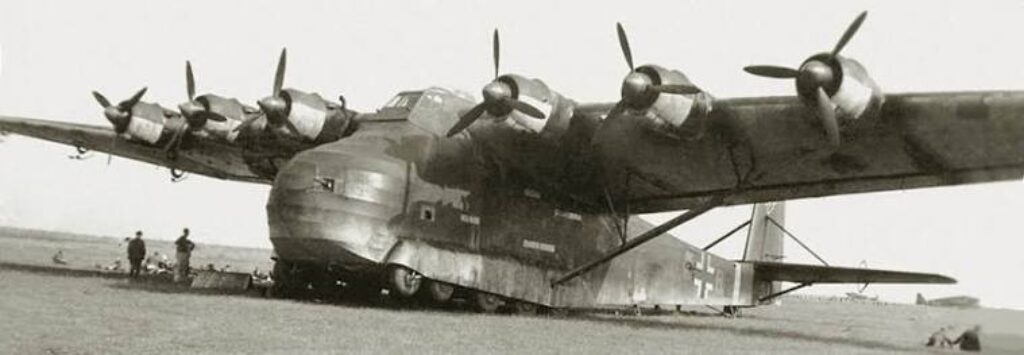
That decision created the Messerschmitt Me 323 Gigant.
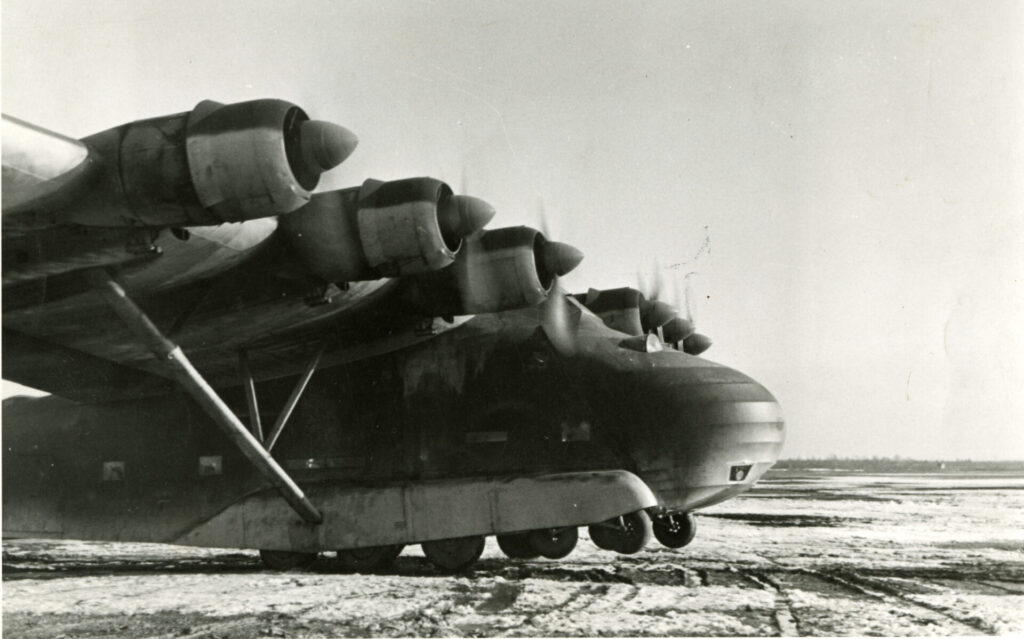
The aircraft received six captured French Gnome-Rhône 14N radial engines, each producing approximately 1,140 horsepower.
Combined output exceeded 6,800 horsepower.
Even that proved only barely sufficient.
The Me 323’s maximum speed reached just 285 km/h (177 mph), while its cruising speed was only about 220 km/h (137 mph).
A True Flying Truck
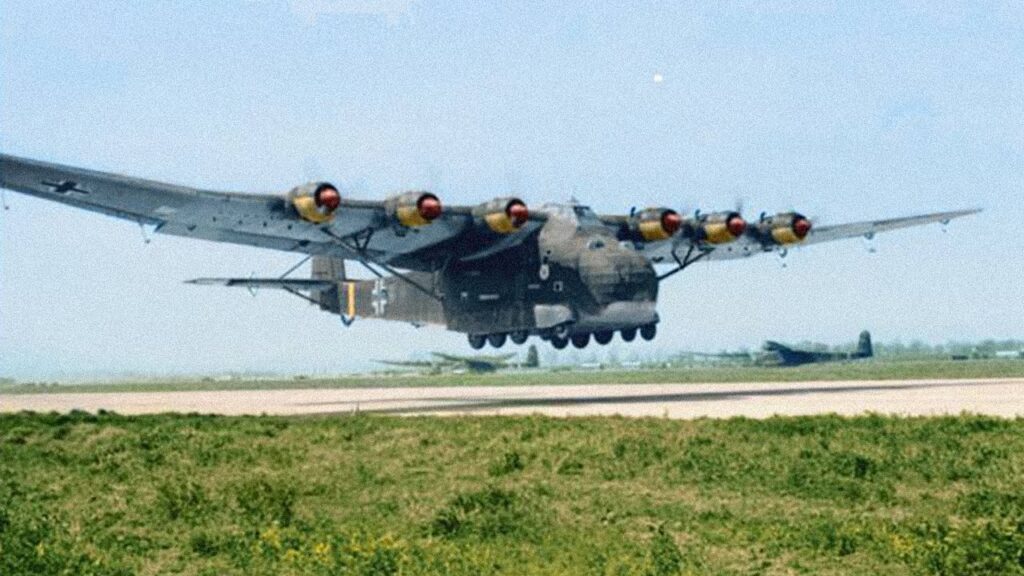
Despite its unusual appearance, the Me 323 was designed with one purpose: transporting massive cargo.
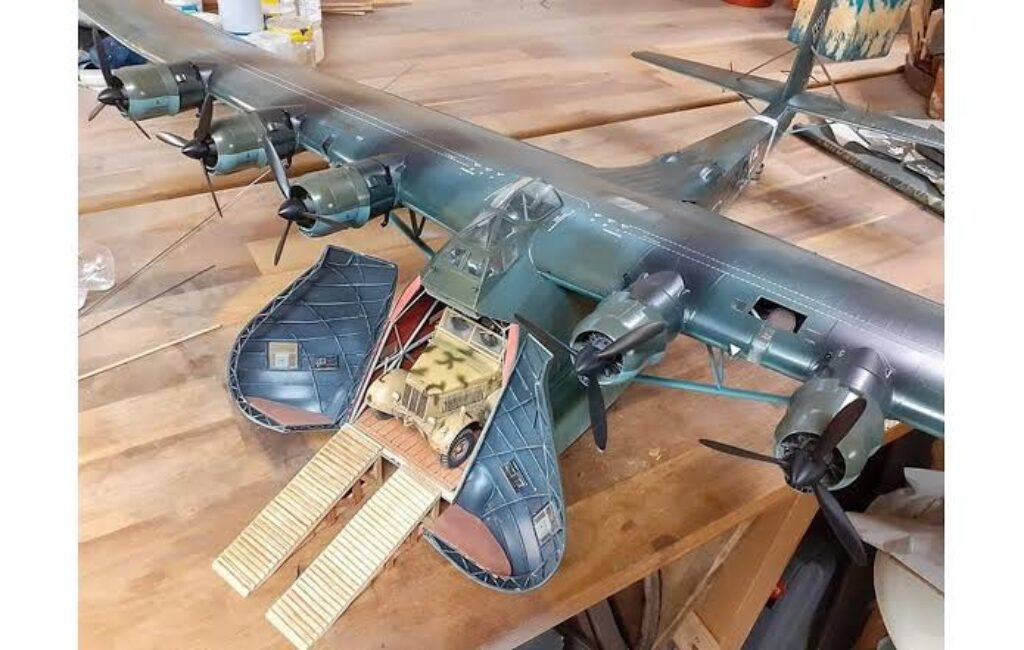
Its huge clamshell nose doors allowed vehicles to drive directly into the cargo compartment.
The aircraft could carry:
- light tanks;
- armored cars;
- anti-tank guns;
- military trucks;
- more than 130 fully equipped soldiers;
- or approximately 10–12 tons of cargo.
Its fixed landing gear featured ten main wheels, allowing the enormous 45-ton aircraft to operate from relatively primitive airfields.
At the time, no other transport aircraft in the world could match its internal cargo volume.
Why the Giant Was Doomed
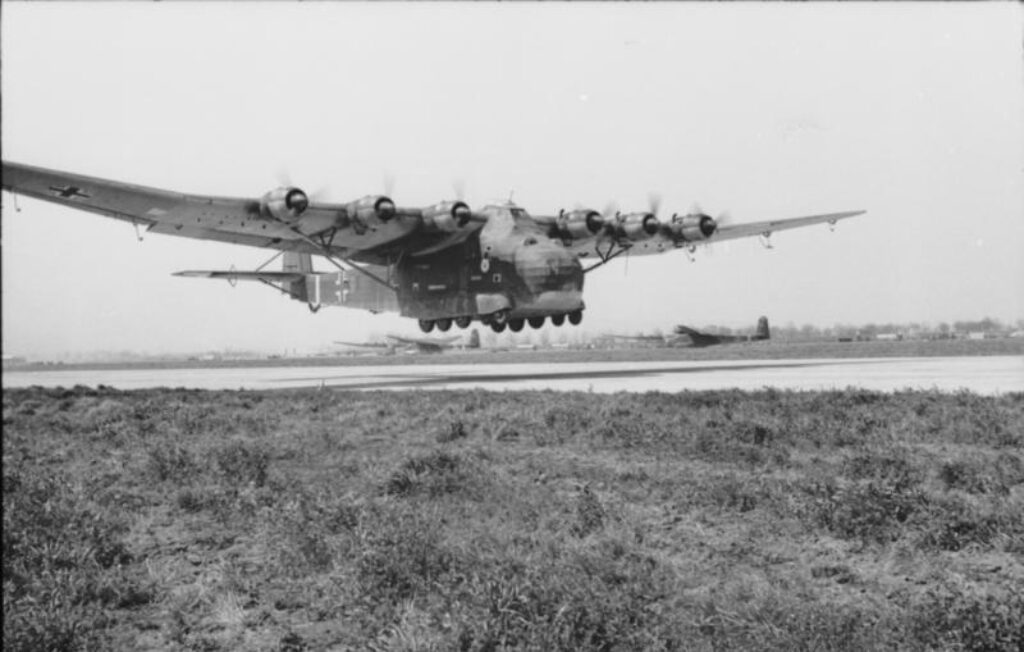
Unfortunately for Germany, the Me 323 entered service just as the strategic situation was beginning to change.
By 1943, the Allies had gained increasing control of the skies over North Africa and the Mediterranean.
An aircraft with a top speed below 300 km/h became an easy target for modern fighters.
The disaster reached its peak on 22 April 1943.
A formation of Me 323 transports flying toward Tunisia was intercepted by British and South African Spitfires and Kittyhawks.
At least 14 Gigants were destroyed in a single engagement, making it one of the worst losses ever suffered by German military transport aviation during the war.
From that moment onward, operating such enormous aircraft without complete air superiority became almost impossible.
Was the Me 323 a Failure?
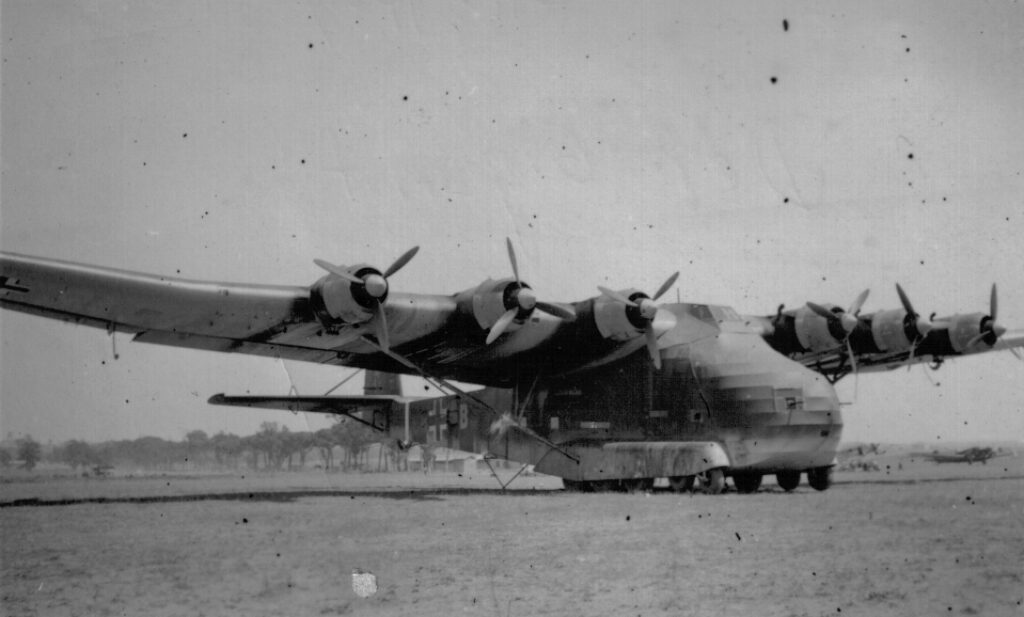
Looking back today, it is easy to dismiss the Gigant as an engineering dead end.
But the aircraft itself was never the real problem.
German engineers were attempting to solve a logistical challenge for which no good technological solution yet existed.
They needed to transport tens of tons of equipment through the air at a time when heavy military airlift was still in its infancy.
In many respects, the Me 323 became a precursor to the modern strategic transport aircraft.
Today, missions that once required the Gigant are performed by aircraft such as the C-17 Globemaster III, the Antonov An-124 Ruslan, and the Airbus A400M. These aircraft fly much faster, farther, and far more safely—but they are solving essentially the same logistical problem.
Conclusion
The Messerschmitt Me 323 Gigant is often remembered as a symbol of Nazi Germany’s obsession with gigantic engineering projects.
That description is only partly true.
The aircraft also demonstrates something far more important.
Some of history’s strangest machines were not created because engineers wanted to build something extraordinary. They emerged because war demanded solutions to problems that existing technology simply could not solve.
The Me 323 was never the perfect transport aircraft.
But it became one of aviation history’s earliest attempts to build a true heavy airlifter—decades before the world was finally ready for one.






