Whose Satellites Never Fail? NASA’s First Private Space Tug Runs Into Trouble Before Its Historic Mission

Space is gradually becoming a place where satellites are no longer abandoned once they reach the end of their planned service life. Instead of turning into expensive orbital debris, more and more spacecraft are being designed to refuel satellites, raise their orbits, repair damaged equipment, or even tow aging spacecraft to new destinations.
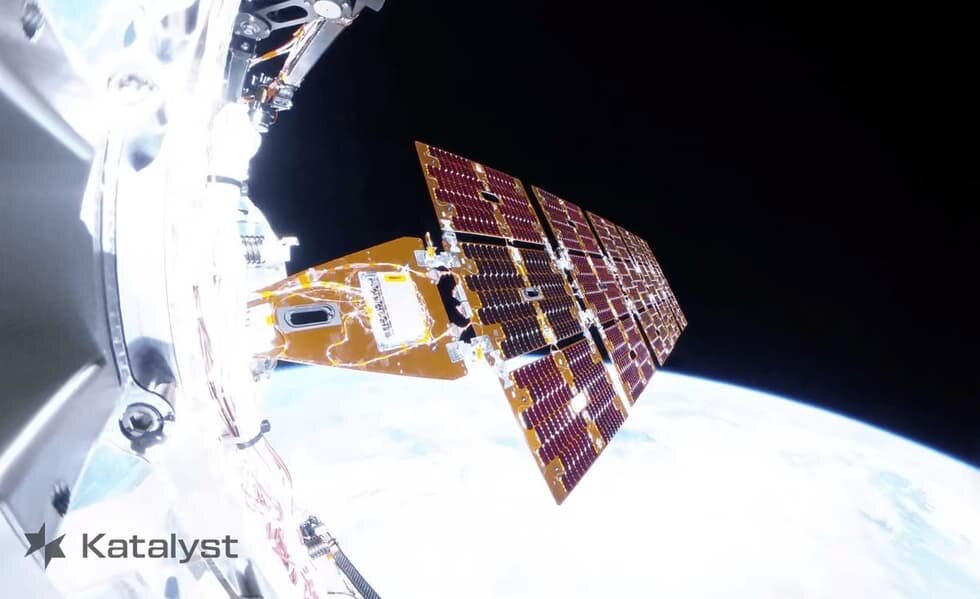
One of the most ambitious projects in this field is LINK, a spacecraft developed by the American startup Katalyst Space. NASA selected it to perform something never attempted before by a private company—extend the life of an operational scientific observatory by moving it into a higher orbit.
However, before the mission could even begin, the spacecraft encountered a serious technical problem.
Why NASA Needed a Space Tug
The Neil Gehrels Swift Observatory has been orbiting Earth since 2004.
Its primary mission is to detect and study gamma-ray bursts, among the most energetic explosions in the universe.
For more than two decades, Swift has often been the first observatory to detect these events, allowing telescopes around the world to immediately begin follow-up observations.
But there is one problem that software updates cannot solve.
The satellite’s orbit is slowly decaying.
Even hundreds of kilometers above Earth, traces of the upper atmosphere create drag that gradually slows spacecraft and lowers their altitude.
Eventually, every low-Earth-orbit satellite faces reentry unless its orbit is boosted.
Rather than launching an expensive replacement observatory, NASA decided to try something different—raise Swift into a higher orbit and give it several more years of scientific life.
To accomplish this, the agency turned to a private company for the first time.
What Is LINK?
LINK is far more than an ordinary satellite.
It is essentially one of the first commercial orbital service vehicles designed to approach another spacecraft, rendezvous with it, and change its orbit.
In the future, similar spacecraft could perform a wide variety of missions, including:
- Extending satellite service life
- Raising or lowering orbital altitude
- Removing space debris
- Inspecting damaged spacecraft
- Supporting on-orbit repairs
- Servicing military satellite constellations
In other words, LINK represents an entirely new class of spacecraft.
What Went Wrong?
LINK was successfully launched on July 3 aboard Northrop Grumman’s Pegasus rocket.
Following orbital insertion, it began its commissioning phase, during which engineers activated and tested all onboard systems before attempting to rendezvous with Swift.
It was during this period that problems emerged.
According to NASA’s preliminary assessment, two of the spacecraft’s three reaction wheels failed almost simultaneously.
Reaction wheels allow satellites to change orientation without consuming propellant.
Engineers also reported a partial degradation of the propulsion system.
As a result, LINK lost stable attitude control and began slowly tumbling through space.
The uncontrolled rotation caused intermittent communication outages with ground controllers.
Why Are Reaction Wheels So Important?
Most modern satellites do not rely on thrusters every time they need to rotate.
Instead, they use rapidly spinning reaction wheels housed inside the spacecraft.
By changing the speed of these spinning wheels, the spacecraft rotates in the opposite direction without using fuel.
This system offers several major advantages:
- No propellant consumption
- Extremely precise attitude control
- Longer operational lifetime
Losing two out of three reaction wheels therefore represents a serious technical challenge.
The Mission Is Not Over Yet
Despite the malfunction, NASA says the situation is not yet critical.
Most of LINK’s onboard systems remain operational.
Communications with the spacecraft continue, although not continuously.
Engineers are now using the spacecraft’s electric propulsion system to gradually stop the unwanted rotation and restore stable attitude control.
Once stability is recovered, the team plans to update the spacecraft’s guidance and control software to compensate for the damaged hardware.
Only then will NASA determine whether LINK can safely approach and capture the Swift observatory.
Why This Mission Matters
At first glance, this may appear to be nothing more than an attempt to rescue a single scientific satellite.
In reality, much more is at stake.
If LINK successfully completes its mission, it will demonstrate that expensive spacecraft no longer have to be discarded simply because their orbits decay.
Future orbital servicing vehicles could:
- Refuel satellites
- Raise spacecraft into higher orbits
- Repair damaged systems
- Upgrade satellites already in space
Such capabilities could fundamentally change the economics of the space industry.
Instead of replacing satellites every decade, operators might extend their useful lives by many additional years.
The Military Is Watching Closely
NASA is not the only organization interested in orbital servicing technology.
The U.S. military has also expressed growing interest in spacecraft capable of inspecting satellites, servicing orbital assets, and supporting national security space infrastructure.
Future orbital tugs could become valuable tools for maintaining communications, reconnaissance, navigation, and surveillance satellites.
For that reason, LINK is about much more than one scientific observatory.
It represents an important step toward a future where spacecraft are routinely serviced rather than abandoned.
Conclusion
LINK’s technical malfunction is undoubtedly a significant setback for Katalyst Space, but it is far too early to call the mission a failure.
The spacecraft remains in contact with mission controllers, recovery efforts are underway, and the planned orbit-raising mission has been delayed rather than canceled.
Regardless of the final outcome, LINK has already made history.
For the first time, NASA entrusted a private company not with launching a new satellite, but with servicing an operational scientific observatory already in orbit.
If technologies like LINK ultimately prove reliable, the coming decades may transform Earth orbit from a graveyard of aging satellites into a place where spacecraft are routinely repaired, upgraded, and given entirely new operational lives.