Have We Finally Learned to Harness the Ocean? The World’s First Certified Wave Energy Converter Is Ready for the Market

For more than half a century, wave energy has been regarded as one of the most promising—and one of the most frustrating—forms of renewable power. The oceans contain an immense and virtually endless reserve of energy. Unlike solar panels, waves do not stop at sunset, and unlike wind, ocean swells are often more predictable days in advance.
Yet nearly every ambitious wave-energy project has encountered the same obstacle: surviving the ocean itself.
Mechanical systems failed under relentless stress, mooring lines snapped during storms, corrosion shortened equipment lifespans, and maintenance costs often exceeded the value of the electricity generated. As a result, wave power remained an engineering curiosity rather than a commercially viable industry.
Now, Swedish developer CorPower Ocean believes it has crossed the industry’s most important milestone. Its C4 Wave Energy Converter (WEC) has become the first device of its kind to receive DNV Prototype Certification under the DNV-SE-0120 standard, following a seven-year independent verification process covering everything from engineering design to real-world operation in the Atlantic Ocean.
More Than Just Another Certificate
At first glance, certification may sound like little more than paperwork.
In reality, this is one of the biggest breakthroughs the wave energy industry has seen in decades.
It is important to clarify that CorPower’s achievement is prototype certification, not full certification of a commercial wave farm. Future commercial installations will still require additional approvals and project-specific assessments.
Nevertheless, the significance is enormous.
DNV is one of the world’s leading independent organizations responsible for technical standards and certification in the maritime, offshore, and energy industries. Its approval serves as a trusted benchmark for investors, insurers, banks, and utility companies considering large-scale infrastructure projects.
Over seven years, DNV engineers evaluated every major aspect of the C4 system, including structural design, manufacturing quality, material fatigue, offshore installation, maintenance procedures, operational safety, and survival under extreme sea conditions.
For CorPower Ocean, this certification represents a transition from experimental technology to a platform that can realistically attract commercial financing.
A Giant Buoy That Works Like a Pump
The C4 belongs to a category known as point absorber wave energy converters.
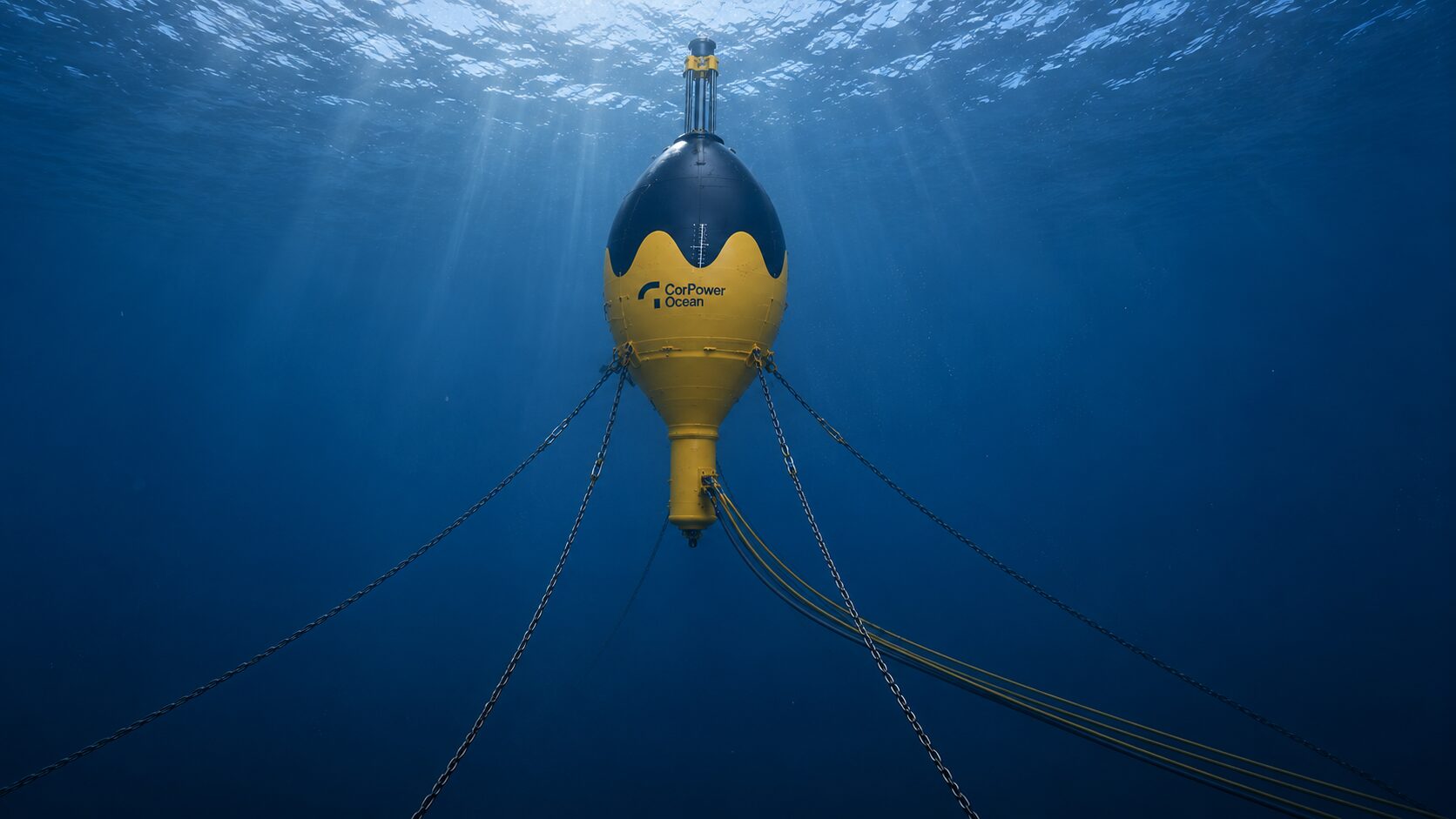
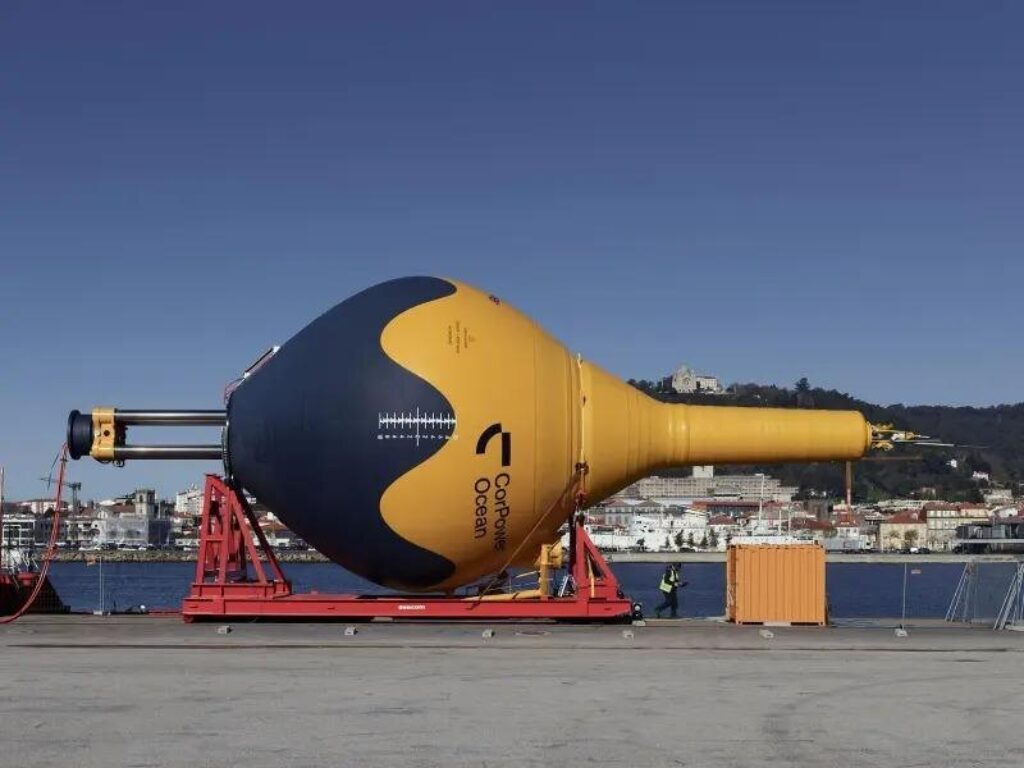
From the surface, it resembles a massive teardrop-shaped buoy floating in the ocean.
The structure measures approximately 9 meters in diameter, 18–19 meters in height, and weighs about 60 tonnes. Some publications have cited figures approaching 100 tonnes, but CorPower’s official specifications for the Portuguese prototype indicate a mass of roughly 60 tonnes. The higher estimates may include additional offshore infrastructure or complete system weight.
The buoy is connected to a seabed anchor through a tensioned mooring system.
As waves pass beneath it, the buoy rises and falls. This vertical motion drives a mechanical transmission that converts the movement into rotational energy, which in turn powers an electrical generator.
The electricity is then delivered ashore through a subsea power cable before entering the national grid.
Although the concept appears simple, generating electricity from waves has never been the greatest challenge.
The real engineering problem has always been extracting as much energy as possible from ordinary waves while preventing the ocean from destroying the machine during storms.
The Secret Behind C4: WaveSpring Technology
The heart of CorPower’s innovation is its patented WaveSpring system.
Traditional wave energy devices generally follow the motion of incoming waves, limiting their energy capture.
WaveSpring takes a completely different approach.
By actively controlling resonance, the system synchronizes the buoy’s movement with the incoming waves, allowing it to oscillate much more efficiently than a passive floating structure.
CorPower compares the mechanism to the pumping action of the human heart.
An internal pneumatic system stores and releases energy, helping the buoy move with significantly greater amplitude than the surrounding waves alone would produce.
For example, a wave approximately one meter high can generate buoy motion of roughly three meters, dramatically increasing electricity production.
The truly remarkable feature, however, appears during severe weather.
Instead of amplifying motion, the WaveSpring system automatically detunes itself, preventing resonance and reducing structural loads.
In simple terms, the buoy becomes less responsive to massive storm waves, allowing them to pass with far less mechanical stress.
The concept is similar to modern wind turbines pitching their blades during hurricanes: maximize efficiency during normal operation, protect the machine during extreme conditions.
How Much Electricity Can One Buoy Produce?
The CorPower C4 has a rated output of approximately 300 kW.
During offshore testing, engineers also recorded short-term power peaks approaching 600 kW under favorable wave conditions.
Those peak figures should not be confused with continuous output—they represent brief maximum performance during particularly energetic sea states.
If the generator could operate at full rated capacity every hour of the year, it would theoretically produce around 2.63 GWh of electricity annually.
Actual production is naturally lower because wave conditions vary throughout the year and maintenance periods reduce operational availability.
Assuming a capacity factor between 35% and 50%, one C4 could realistically generate approximately 0.9–1.3 GWh per year.
That amount of electricity would be sufficient to supply several hundred average European households.
However, CorPower’s commercial strategy is not based on individual buoys but on arrays consisting of dozens of identical wave energy converters.
CorPower C4 Specifications
- Type: Point absorber wave energy converter
- Rated power: Approximately 300 kW
- Peak recorded output: Up to 600 kW
- Diameter: Approximately 9 m
- Height: Approximately 18–19 m
- Mass: Around 60 tonnes
- Deployment depth: Approximately 45 m
- Distance from shore: About 4 km
- Maximum recorded wave survived: 18.5 m
- Power transmission: Subsea export cable to the electrical grid
Tested by the Atlantic Ocean
The C4 prototype has been operating off the coast of Aguçadoura, Portugal, since 2023.
Installed roughly four kilometers offshore in waters about 45 meters deep, the unit has been connected directly to Portugal’s electrical grid through a subsea export cable.
The testing program evaluated far more than electricity generation.
Engineers monitored remote operation, autonomous control systems, maintenance procedures, towing operations, and the overall durability of the offshore installation.
Its greatest challenge came during Storm Domingos, when the buoy encountered individual waves reaching 18.5 meters in height.
The structure successfully survived the storm without suffering critical damage—a key milestone that played an important role in achieving DNV certification.
Many previous wave-energy projects demonstrated excellent performance under moderate sea conditions but failed when exposed to the true power of the open Atlantic.
From One Buoy to Entire Power Plants
The C4 itself is only the beginning.
CorPower’s long-term vision is based on modular wave farms known as CorPack, where dozens of identical converters operate together as a single power station.
The company has previously outlined arrays consisting of approximately 25–30 units, producing around 10 MW of installed capacity. Larger commercial developments could eventually scale to 30 MW modules and, ultimately, offshore power plants generating hundreds of megawatts.
The modular approach offers significant operational advantages.
If one converter requires maintenance, the rest of the array continues producing electricity. Standardized manufacturing should also reduce production costs as deployment expands.
CorPower is currently preparing its first commercial projects in Portugal and Scotland, although final deployment schedules will depend on financing, permitting, and continued technical validation.
Why Wave Energy Could Complement Wind and Solar
Wave energy is unlikely to replace wind turbines or solar farms.
Its greatest advantage lies elsewhere.
Ocean swells possess considerable inertia. Even after the winds that created them have subsided, waves can continue traveling for hundreds of kilometers, providing a relatively stable source of energy.
Wave conditions can also be forecast several days in advance with a high degree of accuracy.
For that reason, wave farms could become an important complement to offshore wind and solar generation, helping smooth fluctuations in renewable electricity production.
CorPower also envisions future wave farms sharing subsea cables, maintenance vessels, and offshore infrastructure with existing wind farms, reducing overall costs.
Certification Is Only the Beginning
Despite this major milestone, important questions remain unanswered.
Commercial success will ultimately depend on manufacturing costs, offshore installation expenses, maintenance requirements, equipment longevity, and the final cost of electricity produced.
The marine environment remains one of the harshest operating conditions for any engineering system.
Saltwater corrosion, biofouling, metal fatigue, and limited weather windows for offshore maintenance continue to pose serious challenges.
Furthermore, DNV’s approval certifies the prototype—not yet the economic viability of large commercial wave farms.
Nevertheless, CorPower now possesses something the wave energy industry has rarely had before: an independently certified machine that has generated electricity, survived powerful Atlantic storms, and demonstrated its reliability through years of real-world operation.
Conclusion
For more than fifty years, engineers have searched for a way to build a wave energy converter that could move aggressively enough to harvest energy from ordinary waves while remaining resilient enough to survive the worst storms the ocean could deliver.
CorPower Ocean believes it has finally found that balance.
With its WaveSpring technology, the C4 can amplify motion under favorable conditions, produce around 300 kW of rated power, and automatically switch into a protective mode during extreme weather.
Prototype certification does not mean wave energy has already become a mainstream power source.
But it does represent a turning point.
For the first time, the industry has a wave energy converter that has moved beyond laboratory demonstrations and experimental promises toward something investors, insurers, and utilities can begin evaluating as real commercial infrastructure.
The next chapter will be written not by a single buoy, but by entire offshore wave farms operating together in the open ocean.