
This material is based on reporting by The War Zone and Reuters.
The story surrounding the White House’s new ballroom looked strange from the very beginning. Officially, the project was presented as a renovation and expansion of the presidential residence — a grand venue for diplomatic receptions, ceremonies, and state events. But the more details that emerge, the clearer it becomes that this is about far more than a luxurious event hall.
In reality, the United States appears to be constructing an entirely new hardened underground complex beneath the White House — something that looks far closer to a modern government survival bunker than a traditional architectural expansion. And judging by recent comments from Donald Trump, the project has already evolved far beyond a simple reconstruction effort.
Six Underground Levels and a “Drone Port” on the Roof
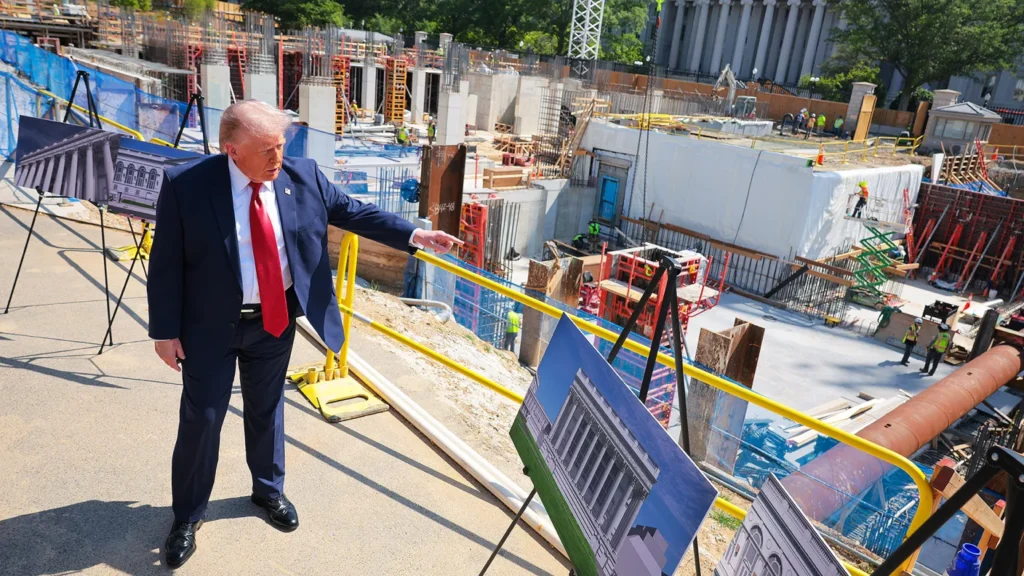
The most striking detail is the sheer scale of the underground structure.
According to Trump, the new complex extends six levels underground, with two of those levels already actively under construction. The subterranean sections are expected to include a military hospital, research facilities, secure conference rooms, and infrastructure designed to support government operations during national emergencies.
But what may be even more interesting is what will exist above ground.
Trump stated that the roof of the complex will function as a full-scale “drone port” with the capacity to host large numbers of unmanned aerial systems. He openly described the system as part of Washington’s future defensive infrastructure against emerging threats.
At first glance, the idea sounds almost futuristic. But the logic behind it is increasingly clear.
After the war in Ukraine and the explosive rise of FPV drones, even heavily protected government facilities are now viewed as potentially vulnerable targets. A decade ago, the primary threats to the White House were considered aircraft, cruise missiles, or terrorist attacks. Today, inexpensive mass-produced drones have become part of that threat equation.
The new complex appears to be designed specifically for the age of drone warfare.
The White House Is Being Rebuilt for a New Cold War
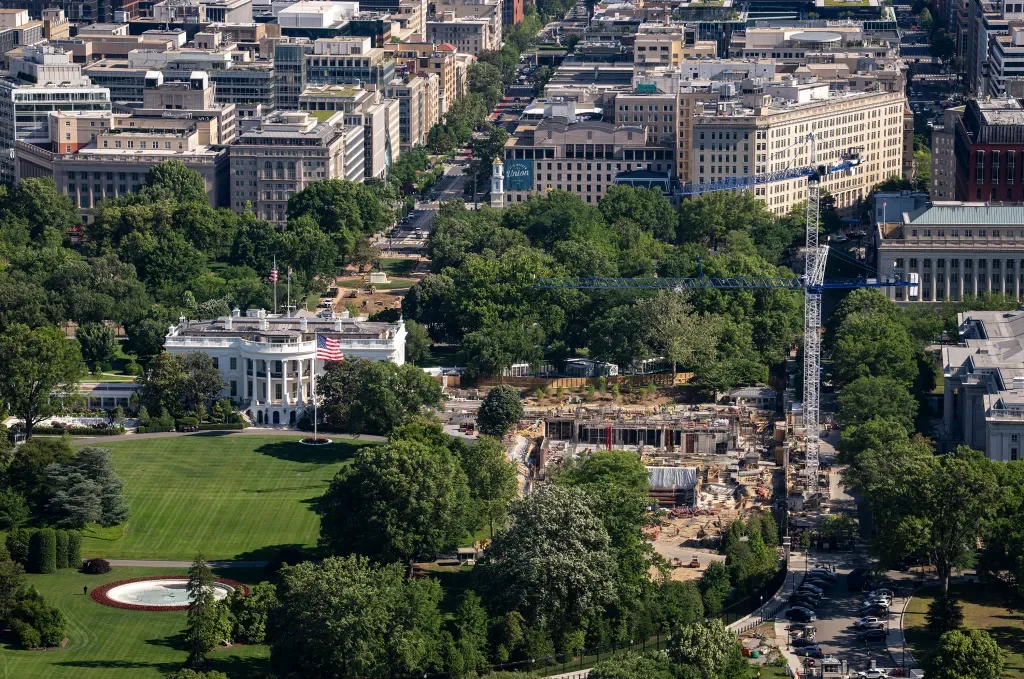
Perhaps the most important aspect of the entire project is what it reveals about American strategic thinking.
For the first time in decades, the United States appears to be investing heavily in continuity-of-government infrastructure on a truly large scale.
After the Cold War ended, many of America’s hardened bunkers and protected command centers gradually lost priority. The global security environment seemed relatively stable, and military focus shifted toward counterterrorism and regional conflicts.
Now that mindset is changing again.
Growing tensions between the United States, China, and Russia — combined with the rise of hypersonic weapons, drones, and precision-guided strike systems — are pushing Washington back toward Cold War-style concepts of national survivability.
That is why the new White House complex increasingly resembles a modern crisis-management and command facility rather than a ceremonial building expansion.
Trump described the structure as virtually “impenetrable,” mentioning titanium security barriers, heavily armored glass, and specially reinforced steel roofing.
In effect, the White House may be evolving into a hybrid political headquarters, military coordination center, and anti-drone defense hub for the American capital.
Drone Warfare Has Reached Washington

Ten years ago, the idea of a “drone port” on the roof of the White House would have sounded like science fiction.
Today, it no longer does.
The war in Ukraine demonstrated that inexpensive drones can do far more than strike isolated military targets. They can disrupt entire regions, airfields, infrastructure networks, and command systems.
At the same time, drone technology is evolving at extraordinary speed. FPV drones, autonomous swarms, loitering munitions, and fiber-optic-controlled UAVs are making traditional security systems increasingly obsolete.
That helps explain why Washington may want large numbers of defensive drones stationed directly at the White House itself.
Based on public statements, the goal is not merely passive protection, but an active counter-drone defense network capable of maintaining persistent airborne interception capabilities and rapidly responding to aerial threats.
The Ballroom May Only Be the Cover Story
That is why the “new ballroom” narrative has generated so much attention in the United States.
Officially, the project is framed as a ceremonial and architectural expansion of the White House. But the more information that becomes public, the more obvious it seems that the ballroom is merely the visible portion of a much larger strategic project.
In reality, Washington appears to be building a hardened government survival complex adapted not for the nuclear threats of the 20th century, but for the drone warfare and precision-strike environment of the 21st century.
And if even part of the reported capabilities become reality, the new structure could become the most heavily protected facility at the White House since the construction of Cold War-era nuclear bunkers during the Cuban Missile Crisis.