After the Second World War, heavy armored cars appeared to belong to a disappearing age. Tracked vehicles were becoming faster, armored personnel carriers more versatile, and tanks increasingly powerful. Most armies gradually concluded that a wheeled reconnaissance vehicle should be light, simple, and relatively inexpensive.
France chose a different path.
The French military wanted an armored car capable of making long road marches, operating effectively across difficult terrain, conducting reconnaissance, engaging enemy armor, and withdrawing from danger in reverse almost as quickly as it could advance.
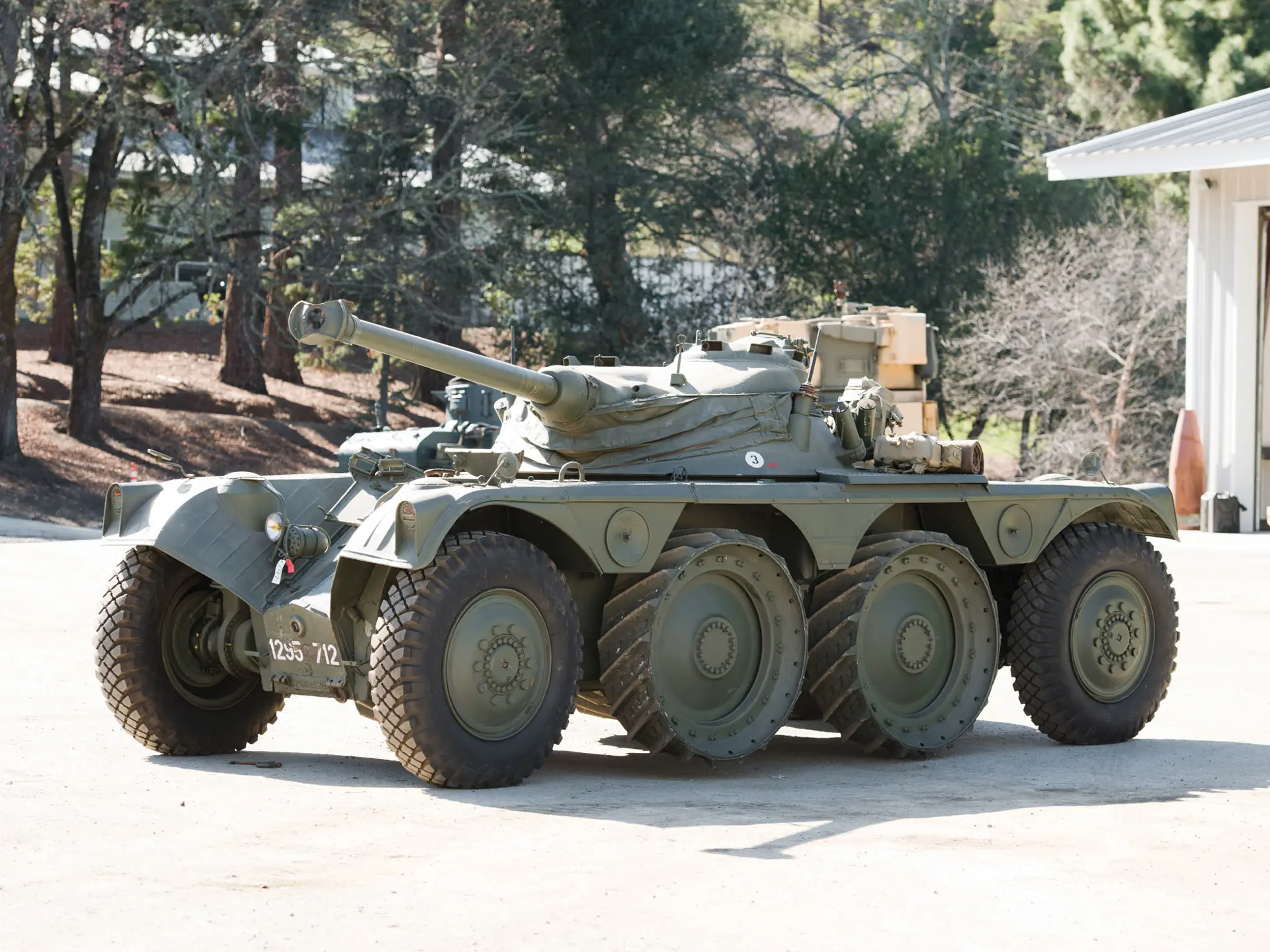
The result was the Panhard EBR — Engin Blindé de Reconnaissance, one of the most unusual production armored cars of the twentieth century. It had eight driven wheels, two driving positions, retractable metal wheels, an engine mounted beneath the fighting compartment, and an oscillating turret armed with a full-size tank gun.
It was more than a reconnaissance vehicle. The Panhard EBR represented the final attempt to bring the classic gun-armed armored car to technical perfection.
A Vehicle Born Before the War
The origins of the EBR can be traced back to the late 1930s, when the French Army began looking for an advanced reconnaissance vehicle combining high road speed with good cross-country mobility.
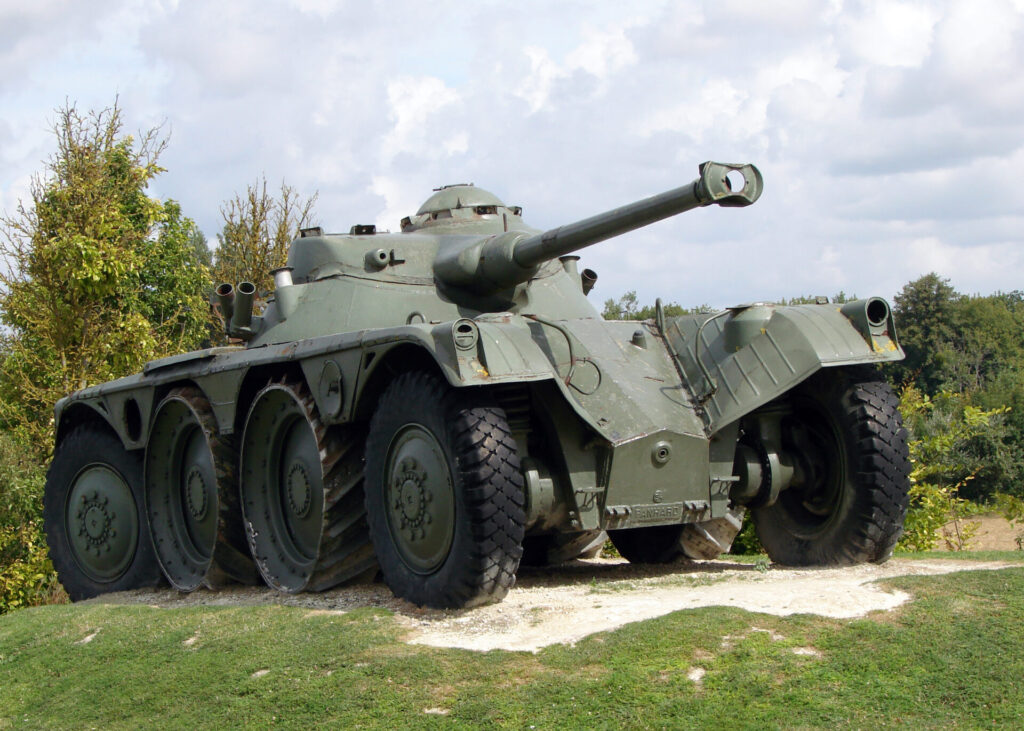
Panhard responded with the experimental Panhard 201, also known as the AM 40 P. Many of the features that later became hallmarks of the EBR were already present: a symmetrical hull, two driving positions, and eight wheels, four of which could be raised while travelling on firm roads.
The concept was remarkably ambitious. On paved surfaces, the vehicle was intended to run on conventional pneumatic tires, giving it high speed and good handling. On soft ground, the driver could lower the four inner metal wheels, transforming the vehicle into a true eight-wheeler with much lower ground pressure.
Testing began shortly before France’s defeat in 1940. The country never had the opportunity to place the design into production, but the basic idea survived the war.
In 1945, the French military issued a new requirement for a wheeled reconnaissance vehicle weighing less than 12 tonnes, with long range, high mobility, and a 75 mm gun. Panhard’s postwar design ultimately won the competition.
A Scout Armed Like a Light Tank
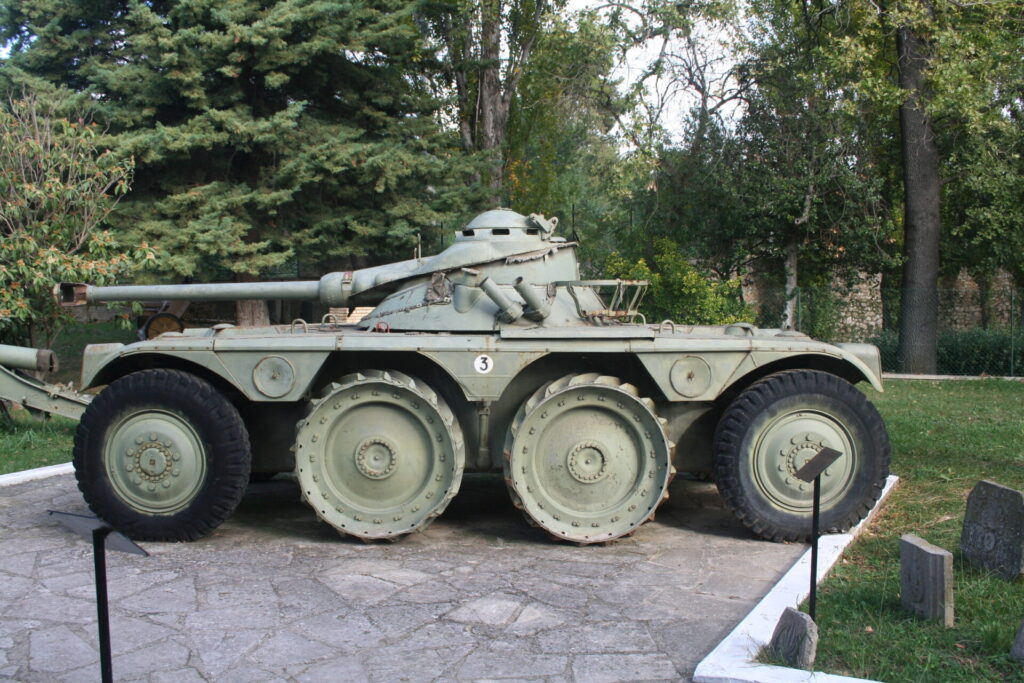
At first glance, the Panhard EBR looked like a collection of several different engineering concepts combined into one machine.
Its long, low hull was almost symmetrical, with separate driving stations at the front and rear. This meant the vehicle did not need to turn around after encountering the enemy. The second driver could simply take control, allowing the EBR to retreat in the opposite direction almost immediately.
For a reconnaissance vehicle, this was not a gimmick but a practical battlefield feature. A narrow road, mountain track, city street, or crowded column might leave no room for a conventional turn. The EBR merely changed drivers and reversed direction.
The four outer wheels used pneumatic tires. Between them were four metal wheels fitted with pronounced traction ribs. On hard roads, these inner wheels were raised to reduce rolling resistance. On soft ground, they were lowered, bringing all eight wheels into use.
This arrangement allowed the EBR to combine high road speed with cross-country performance approaching that of some tracked vehicles. The price of this capability, however, was an exceptionally complex suspension and transmission.
An Engine Beneath the Crew
One of the most unusual aspects of the design was its powerplant arrangement.
The Panhard EBR used a 12-cylinder, horizontally opposed, air-cooled engine of roughly six litres displacement and around 200 horsepower. Instead of being placed in a conventional engine compartment, it was mounted horizontally beneath the floor of the fighting compartment.
This layout helped preserve the vehicle’s low silhouette and made room for both driving stations at opposite ends of the hull. It also made maintenance extremely difficult. For major repairs, the turret sometimes had to be removed so that the engine could be lifted out through the top of the hull.
Despite weighing around 13 tonnes, the EBR could reach approximately 100 km/h on roads. Its operational range was roughly 650 to 700 kilometres, making it highly suitable for long reconnaissance patrols and rapid movement between distant garrisons.
This range was particularly valuable for France, which expected to deploy armored vehicles not only in Europe but also across the vast territories of its colonial empire.
The French Oscillating Turret
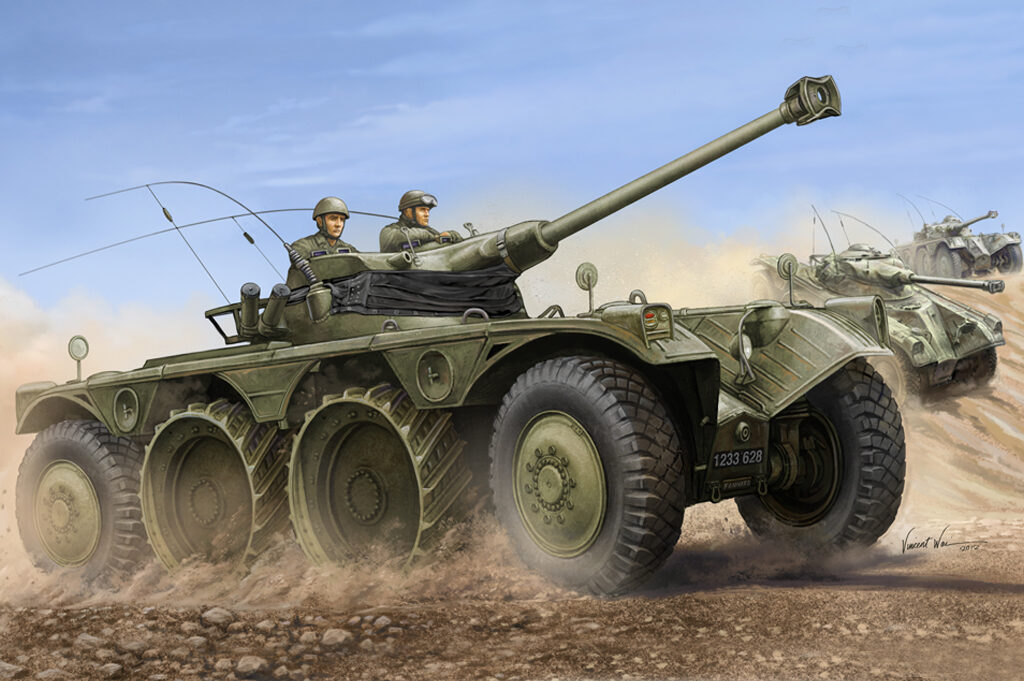
The unusual running gear was matched by an equally unconventional turret.
Instead of using a traditional arrangement in which the gun moved inside a fixed turret structure, the French adopted an oscillating design. The lower section rotated horizontally, while the upper section, together with the gun, moved vertically.
This configuration reduced turret size and simplified the installation of an autoloader. Oscillating turrets later became one of the most distinctive features of French armored vehicles of the 1950s.
The first production model, known as the EBR modèle 1951, received the FL 11 turret with a short-barrelled 75 mm SA 49 gun. Its ballistic performance and ammunition were broadly comparable to American guns used on the M4 Sherman and M24 Chaffee.
For a reconnaissance vehicle, this was substantial armament. The EBR could engage infantry, field fortifications, and light or medium tanks of the early postwar period.
Between 1951 and 1954, 836 vehicles of this version were built.
The Version Armed Like the AMX-13
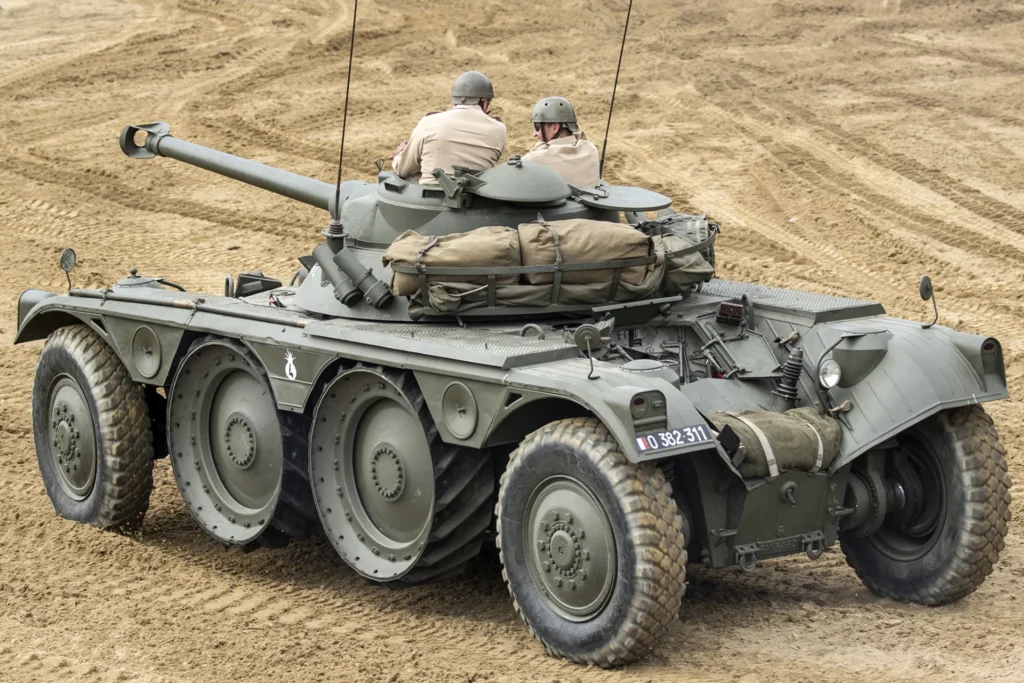
The French Army soon demanded more firepower.
This led to the EBR modèle 1954, equipped with the FL 10 turret from the AMX-13 light tank. It carried the long-barrelled 75 mm SA 50 gun, developed partly from lessons learned through the study of German wartime tank guns.
The turret’s main advantage was its autoloader, using two six-round revolver magazines. The crew could fire a rapid sequence of twelve rounds without manually loading each shell.
For a wheeled reconnaissance vehicle of the mid-1950s, this was formidable firepower. The EBR now carried the armament of a light tank while retaining the road speed of an armored car.
The heavier turret, however, required suspension improvements. Vehicle weight increased, the silhouette became higher, and the design grew even more complicated. A total of 279 vehicles of this type were produced between 1954 and 1956.
Not a Tank, but More Than a Scout
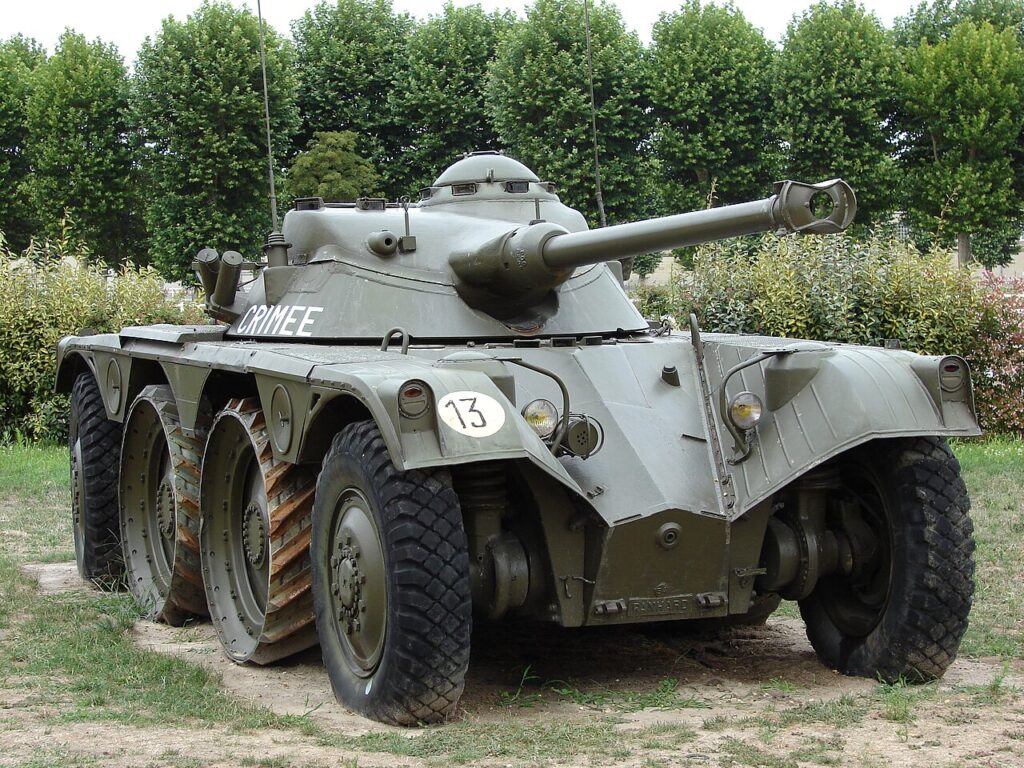
The Panhard EBR is often described as a wheeled tank, although its official role remained reconnaissance.
The comparison was understandable. In terms of firepower, the EBR surpassed most armored cars of its era. On roads, it was much faster than a tank, had greater range, and could reverse direction almost instantly. Its crew consisted of four men: two drivers, a commander, and a gunner.
Its armor, however, remained relatively thin and was intended mainly to protect against small-arms fire and shell fragments. In a direct confrontation with a proper medium tank, the EBR’s survival depended heavily on detection, surprise, and firing first.
That was the essence of the French concept. The vehicle was not expected to fight prolonged tank battles. Its missions included reconnaissance, screening, flank security, pursuit, support of advance units, and delaying the enemy until heavier forces arrived.
Its powerful gun gave reconnaissance units the ability to defend themselves and destroy targets that a lighter armored car would have been forced to avoid.
War in Algeria
The EBR’s most important field of service was not Central Europe, but France’s colonial territories.
The vehicle was widely used in North Africa, particularly during the Algerian War. Its high road speed, long range, and ability to conduct extended patrols made it well suited to the region’s road network and distances.
EBRs escorted convoys, patrolled routes, guarded strongpoints, and supported operations against insurgent groups. Their guns could destroy fortified positions, while the machine guns provided significant firepower against infantry.
Algeria also exposed the limitations of the design. The EBR was heavy, cramped, mechanically complex, and demanding to maintain. Its unusual transmission required well-trained mechanics, while the engine beneath the turret complicated repairs.
Even so, the vehicle became one of the symbols of French colonial warfare during the 1950s and 1960s.
Ninety Millimetres Instead of Seventy-Five
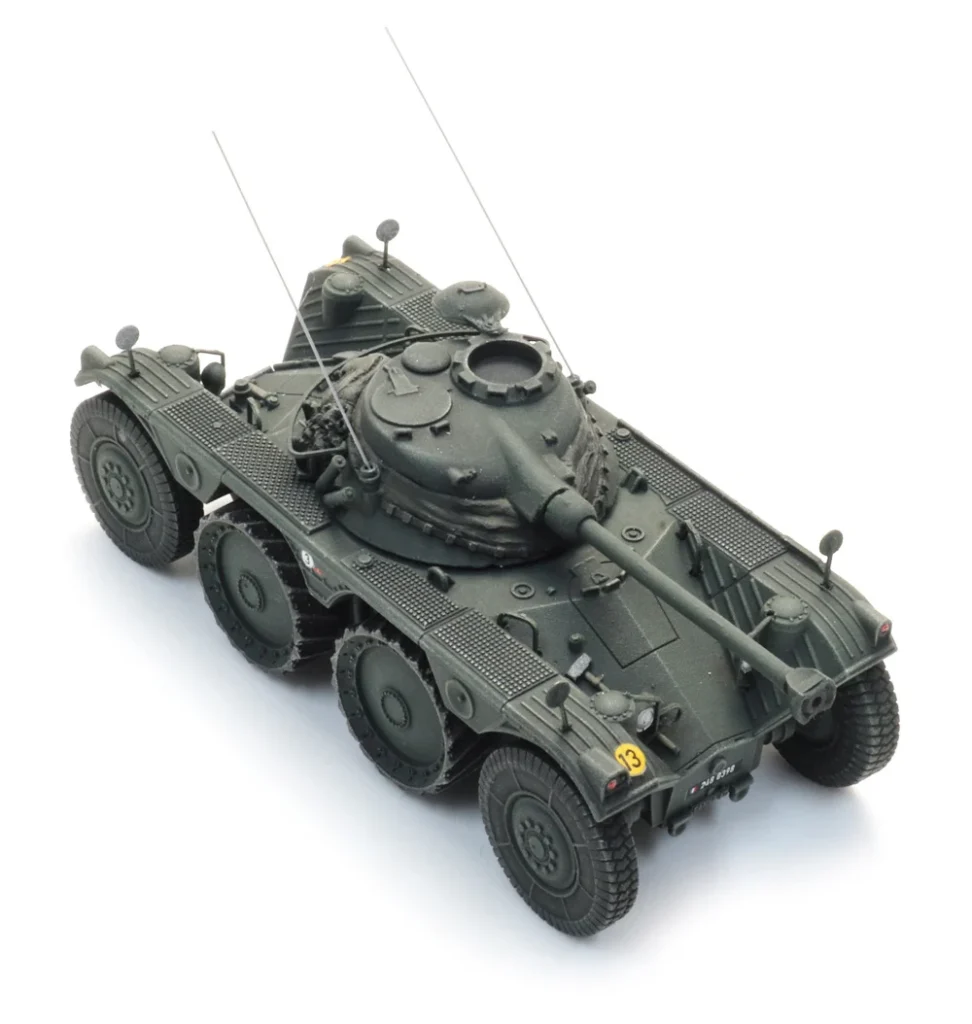
By the early 1960s, the short-barrelled 75 mm gun of the original production model was becoming obsolete.
Rather than replace the entire fleet, France launched a major modernization program. Around 650 modèle 1951 vehicles were refitted between 1964 and 1968 with the low-pressure 90 mm CN 90 F2 gun.
This weapon fired shaped-charge ammunition and gave the relatively light vehicle a useful capability against more modern armored targets without imposing excessive recoil forces on the chassis.
The upgraded version is generally known as the EBR-90 or EBR revalorisé. It became the most recognizable late model and significantly extended the vehicle’s service life.
Vehicles fitted with the FL 10 turret and long 75 mm gun were gradually withdrawn from frontline service. Some were converted into command vehicles by disabling or removing the main armament and installing additional radio equipment.
More Than a French Vehicle
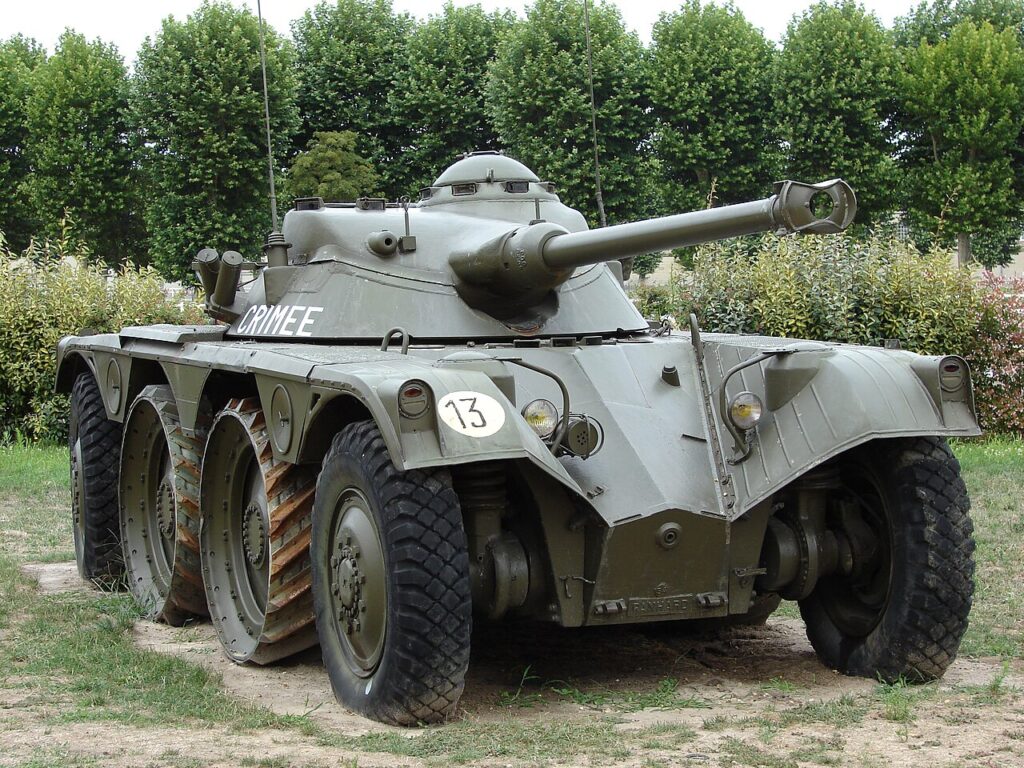
Although the Panhard EBR was designed primarily for the French Army, it was also exported.
Portugal became its most important foreign operator. Portuguese EBRs served during the colonial wars in Angola, Mozambique, and Portuguese Guinea.
For Portugal, the vehicle’s advantages were obvious: long range, powerful armament, and the ability to move quickly between distant areas. Yet maintenance complexity once again became a serious problem, especially far from established repair facilities.
Portugal also acquired 28 EBR-ETT armored personnel carriers, based on the same chassis. France tested two prototypes in 1956–1957 but did not adopt the troop-carrying variant.
Smaller numbers of EBRs were also operated by Indonesia and West Germany.
Why the Concept Had No Successor
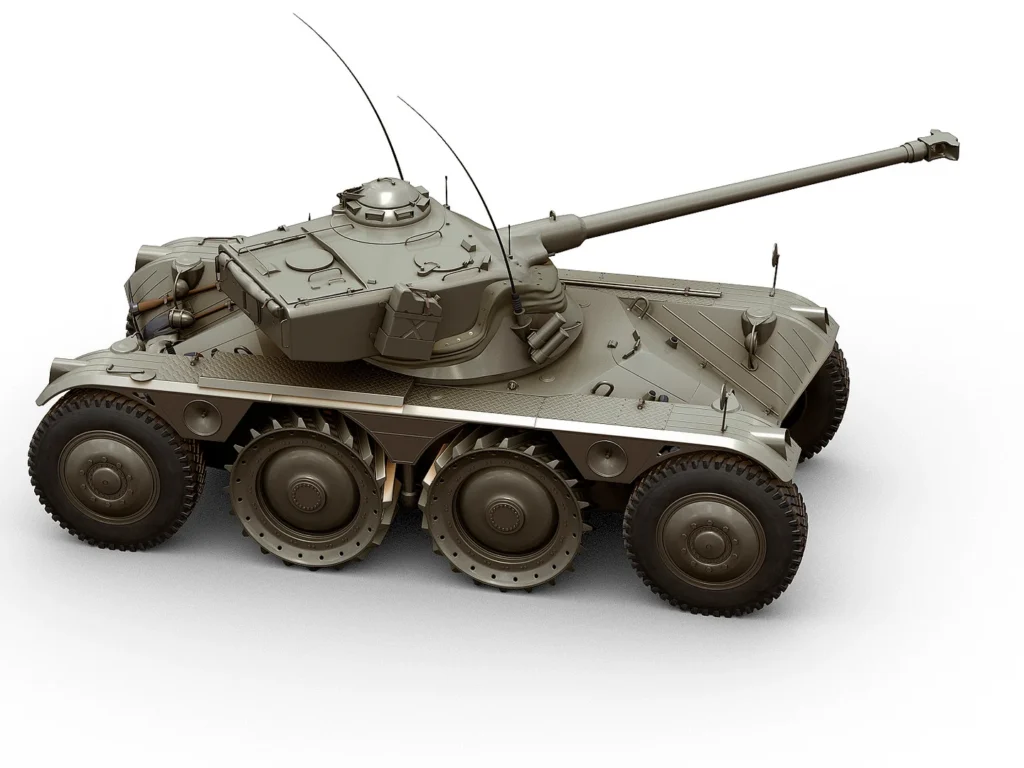
On paper, the Panhard EBR looked almost ideal. It was fast, long-ranged, heavily armed, and unusually mobile for a wheeled vehicle.
But those qualities came at a high price.
The complex eight-wheel running gear, retractable metal wheels, two driving stations, unconventional transmission, and difficult-to-access engine made the vehicle expensive to manufacture and maintain.
Meanwhile, conventional wheeled armored vehicle technology was advancing rapidly. Improved tires, central tire-pressure systems, more powerful engines, and better independent suspension allowed later vehicles to achieve excellent cross-country mobility without retractable metal wheels.
Armored cars also became simpler and more versatile. Specialized designs gave way to families of vehicles sharing a common chassis for reconnaissance, transport, anti-tank, and command roles.
The EBR was eventually replaced in French service by the more modern AMX-10RC. The French Army finally retired it in 1984, more than three decades after it first entered service.
The Last Vehicle of General de Gaulle
One of the most unusual episodes in the history of the Panhard EBR had nothing to do with combat.
After Charles de Gaulle died on 9 November 1970, his family requested a simple funeral without an elaborate state procession. A specially modified Panhard EBR, with its turret removed, was used to carry his coffin.
On 12 November, the vehicle, draped in the French tricolour, transported the general’s body during the funeral ceremony in Colombey-les-Deux-Églises.
The choice was deeply symbolic. De Gaulle represented the rebirth of France after the defeat of 1940, while the EBR was one of the first truly original armored vehicles created by the restored French defense industry after the war.
The vehicle has survived and is now preserved at the Musée des Blindés in Saumur.
Technical Specifications of the Panhard EBR
Crew: 4
Combat weight: approximately 13 tonnes
Wheel configuration: 8×8
Engine: Panhard 12HD, 12-cylinder, air-cooled petrol engine
Power: approximately 200 hp
Maximum road speed: up to 100 km/h
Operational range: approximately 650–700 km
Main armament: 75 mm or 90 mm gun, depending on version
Secondary armament: 7.5 mm machine guns
Distinctive features: two driving positions, four retractable metal wheels, oscillating turret
Specifications varied depending on turret type and production series.
The Last of Its Kind
The Panhard EBR was neither simple nor practical. It was cramped, mechanically complicated, expensive to maintain, and a constant challenge for repair crews.
But it also represented a rare moment when engineers were not searching for the cheapest or easiest solution. They were trying to build the finest reconnaissance vehicle the technology of the era would allow.
The EBR combined prewar ideas about gun-armed armored cars, postwar French enthusiasm for unconventional engineering, and the operational experience of colonial warfare. It could race along highways at near passenger-car speed, withdraw from an ambush without turning around, cross soft ground on eight wheels, and engage enemy armor with a tank gun.
It left almost no direct successors. Later wheeled combat vehicles followed a different path based on simplicity, modularity, and commonality.
That is why the Panhard EBR became the last great armored car: the final and perhaps most sophisticated expression of a vehicle class that began to disappear soon after it reached its peak.