
The F-117 Was Retired 18 Years Ago. Why Is the U.S. Buying Explosives for It Again?

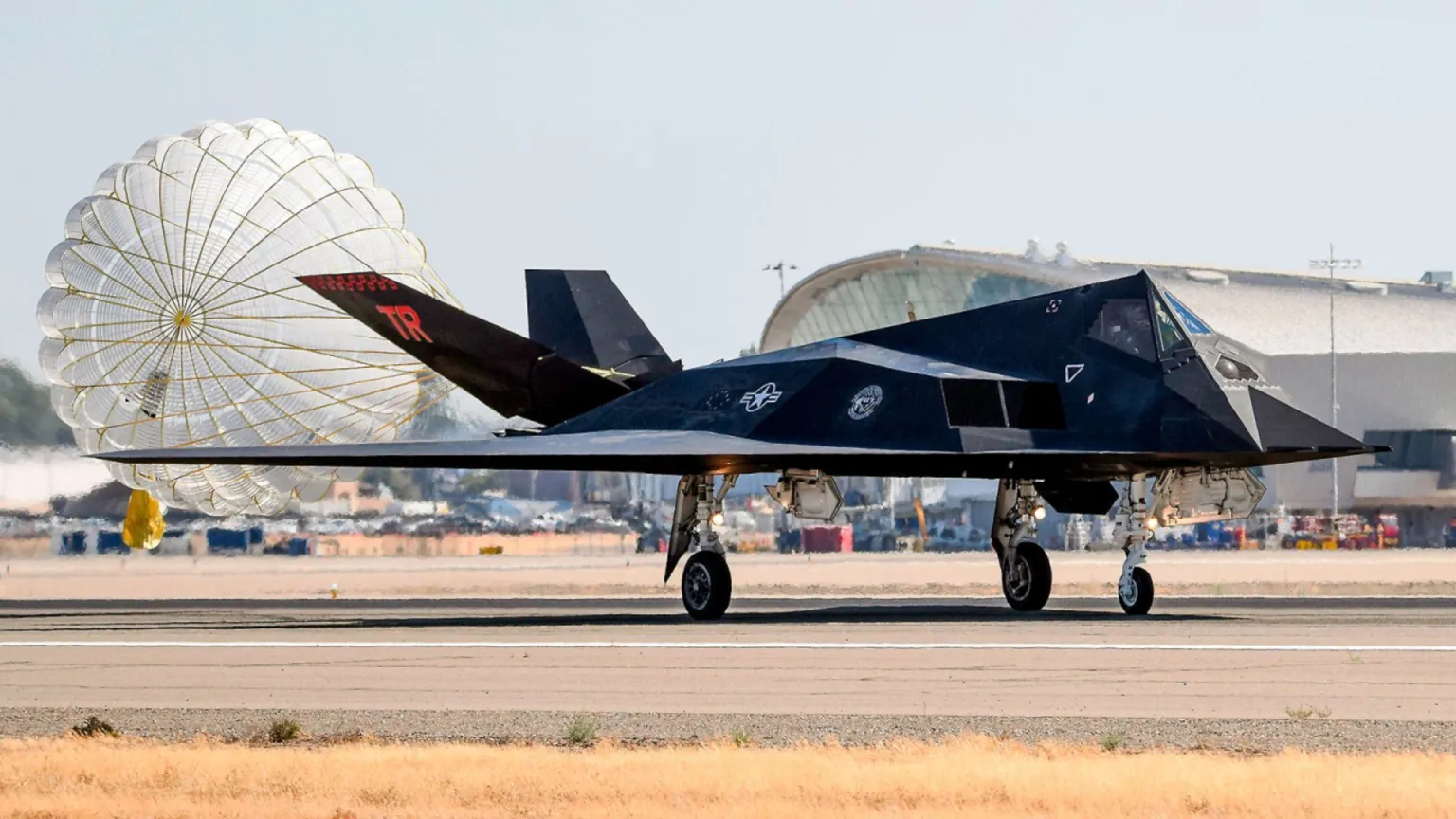
The F-117 Nighthawk officially left U.S. Air Force combat service in the spring of 2008. Eighteen years have passed since then. The F-22 and F-35 have arrived, American aviation has moved into an entirely new generation of stealth aircraft, and many of the surviving Nighthawks have already been sent to museums or dismantled. The story of the world’s first operational combat aircraft designed around stealth technology should, by all appearances, have ended long ago.
Yet in August 2026, the U.S. Air Force needed to acquire a new batch of pyrotechnic devices for the F-117. And among them were not only the relatively understandable charges associated with the aircraft’s emergency escape system, but also two much stranger components: the Tail Hook Panel Pyrotechnic Assembly and Tail Hook Panel Initiator — pyrotechnic devices connected with the aircraft’s emergency arresting hook.
That immediately raises two questions.
Why does a land-based stealth aircraft even need a tailhook, something most people associate with carrier-based fighters? And why, in 2026, is the Pentagon still buying specialized consumable components for an aircraft that officially retired in 2008?
The answer to the first question tells us a great deal about just how unusual the F-117 was.
The answer to the second explains why its story still is not over.
Why Does a Land-Based F-117 Need a Tailhook at All?
First, there is a common misconception worth clearing up. Arresting hooks are not exclusive to carrier aircraft.
Many U.S. land-based combat aircraft also have them, although they are used very differently. Some military airfields are equipped with emergency arresting systems that stretch a cable across the runway. If an aircraft suffers damage, experiences brake problems, or cannot stop normally for some other reason, the pilot can lower the hook and engage the cable.
The principle resembles a carrier landing, but on land it is an emergency procedure rather than the normal way to end every flight.
For a conventional fighter, this creates no extraordinary engineering problem. The hook can remain exposed or be partially recessed into the rear fuselage.
But the F-117 was not a conventional aircraft.
Its shape was designed primarily to reduce radar cross-section. Any protruding component could alter the way radar energy reflected from the airframe, meaning that even something as mundane as an emergency arresting hook became a separate engineering challenge for Lockheed.
The solution was spectacularly unconventional.
The F-117’s hook was completely concealed inside the aircraft. To access it during an emergency, the panel covering it is literally blown away.
Explosives Open the Door for the Tailhook
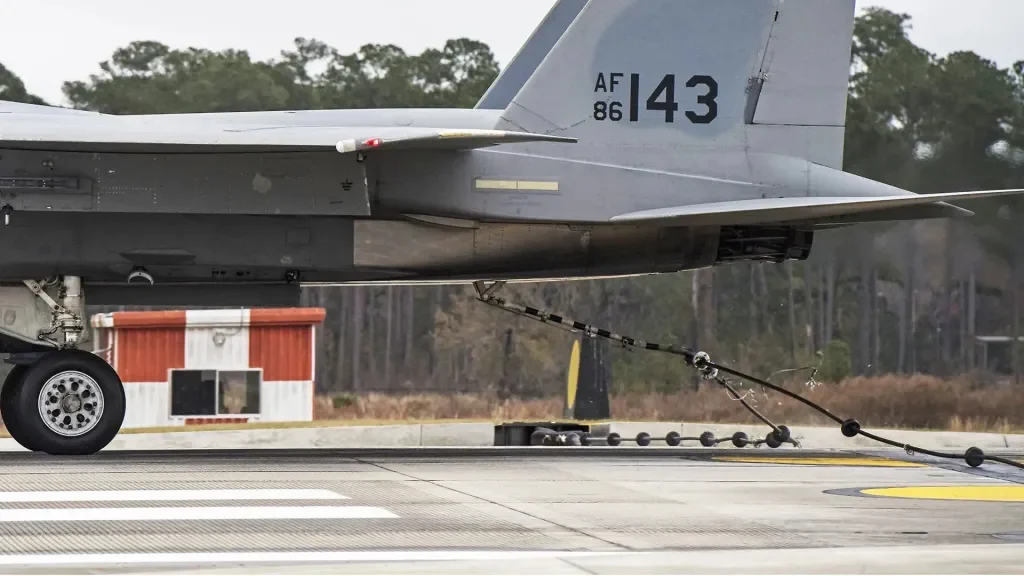
During normal flight, the hook remains hidden behind a panel mounted flush with the aircraft’s surface. There is no protruding structure to compromise its carefully controlled radar signature.
But if emergency arrestment is required, pyrotechnics come into play.
Small specialized charges release the panel covering the compartment, allowing the arresting hook to deploy and engage the airfield arresting system. After such an event, the assembly has to be restored on the ground.
Those are among the components the Air Force now needs again.
The procurement documentation includes the Tail Hook Panel Pyrotechnic Assembly and Tail Hook Panel Initiator. The former is the pyrotechnic assembly itself, while the latter initiates its operation.
And this is not some new modernization of the F-117.
The reason for the purchase is much more mundane.
Pyrotechnic devices have limited certified storage and service lives. Even if they have never been activated, a decades-old charge cannot simply be assumed to remain reliable indefinitely. As a result, CAD/PAD components — cartridge-actuated devices and propellant-actuated devices — have to be periodically replaced.
And if the Air Force intends to keep flying F-117s, it needs fresh pyrotechnic components.
Including those for the tailhook.
It Perfectly Illustrates Just How Strange the F-117 Was
Today, stealth is almost taken for granted as a requirement for new American combat aircraft. The F-22, F-35, and B-2 have made the distinctive shapes associated with low-observable aviation familiar.
But the F-117 was developed when engineers were still discovering what a genuine operational stealth aircraft should look like.
Its first flight took place in 1981, and the program remained classified for years. The Air Force did not publicly reveal the aircraft until 1988.
Technology at the time imposed severe limitations on the designers.
The Nighthawk’s famous faceted shape did not appear because aerodynamicists considered it ideal. Quite the opposite: aerodynamically, the aircraft was highly unconventional. Its geometry was primarily intended to control radar reflections, while the computing power available at the time made calculating complex curved stealth surfaces much more difficult.
As a result, stealth requirements penetrated virtually every aspect of the aircraft.
Weapons were carried internally. The engines received shielded intakes and an unusual exhaust arrangement. Components that could simply remain exposed on an ordinary aircraft had to be hidden.
The emergency tailhook was another victim of this philosophy.
But that explains only half of the mystery.
Because the much more interesting question is this:
The Aircraft Was Retired. So Why Is It Still Flying?
The official history seems completely unambiguous.
In April 2008, the F-117 formally left active Air Force service. The remaining aircraft were sent to the Tonopah Test Range in Nevada, while the Air Force explained the accelerated retirement as a way to free resources for modernization of the broader combat aircraft fleet.
At the time, the decision made sense.
The F-117 had been revolutionary, but the revolution had already happened.
The much more sophisticated B-2 was operational. The F-22 was entering service. The F-35 was approaching. Maintaining a small fleet of aging Nighthawks with specialized coatings, spare parts, and infrastructure was becoming increasingly difficult to justify.
But the aircraft were not sent to an ordinary aircraft graveyard.
They were initially stored at Tonopah in a condition that allowed them to be returned to service.
Then something curious began to happen.
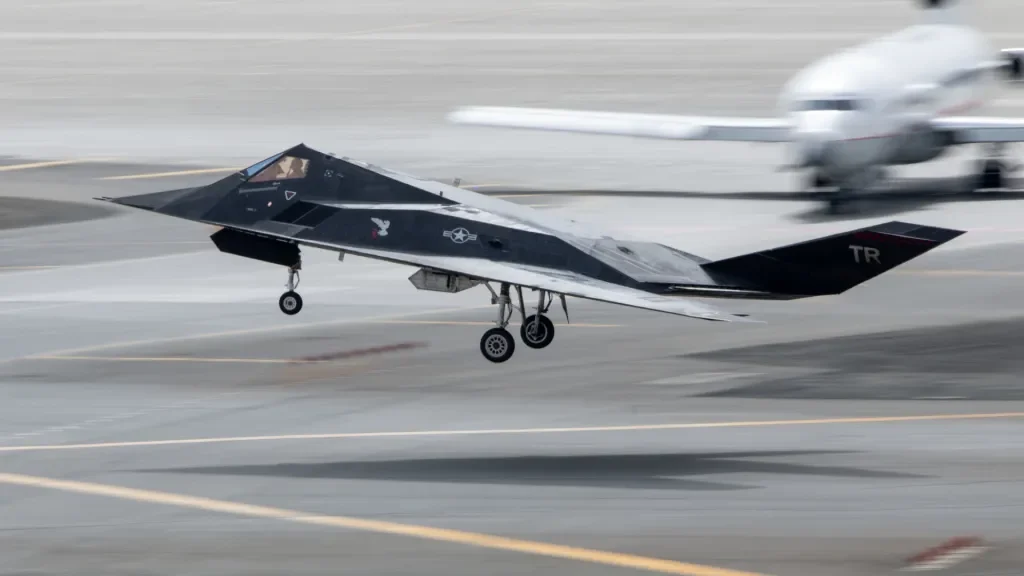
F-117s started appearing in the sky again.
And gradually it became clear that some of the supposedly retired Nighthawks had effectively remained at work.
The F-117 Simply Found a New Job
Today, the Air Force no longer makes much of a secret of the small flying Nighthawk fleet.
The aircraft have appeared during major exercises, operated alongside other U.S. combat aircraft, and participated in test programs.
Plans have called for continued use of F-117s for research, development, testing, evaluation, and training activities until at least 2034.
That creates a remarkable situation.
An aircraft officially retired in 2008 could continue flying for another 26 years after its supposed retirement.
Why?
Because as a frontline combat aircraft, the F-117 really is obsolete.
As an adversary, however, it remains extremely useful.
An Old Stealth Aircraft Makes an Excellent Target
Imagine that engineers are developing a new radar.
They need to determine how effectively it can detect a low-observable target.
Computer modeling can be used. Special target drones can be built. Engineers can attempt to reproduce a particular radar signature.
Or they can put a real stealth aircraft into the sky.
The F-117 has another major advantage: its characteristics have been studied in extraordinary detail by the United States itself.
Its radar, infrared, and other signatures are well understood. That means the Nighthawk can function as a kind of reference target during testing of new sensors.
If a new radar detects an F-117 at a particular range and aspect, engineers receive real-world data that can be compared with simulations and previous test results.
But testing is only part of the aircraft’s new job.
The F-117 has also proved useful as an adversary aircraft.
The Nighthawk Became an “Aggressor”
The U.S. military has long used dedicated aggressor units to simulate potential adversaries.
Conventional fighters can reproduce foreign tactics.
Low-observable threats create a more difficult problem.
If F-15, F-22, or F-35 pilots need to train against an unusual low-observable target, an ordinary F-16 is not particularly convincing.
An F-117 is much more useful.
Nighthawks have been used as red air, representing hostile aircraft during exercises, and have also served as surrogates for certain low-observable cruise-missile-type threats.
Their unusual signatures give pilots, radar operators, and air-defense personnel something substantially different from an ordinary fighter to detect and track.
It amounts to a remarkable career change.
The F-117 was originally designed to penetrate air defenses.
Today, it helps train the people whose job is to detect aircraft like it.
In This Role, the Aircraft’s Age Is Actually an Advantage
It sounds paradoxical, but the F-117’s age can be useful for a test platform.
It does not have to be protected as carefully as a latest-generation F-35.
The aircraft has been known to potential adversaries for decades. Its fundamental design principles are no longer protected at anything like the level they were during the 1980s.
Yet it remains a genuine low-observable aircraft.
More importantly, it is a stable platform with well-understood characteristics.
For researchers, that makes it extremely useful.
If a new radar is tested against a constantly changing experimental aircraft, determining exactly what affected the results can be difficult.
The F-117, by contrast, can act almost as a flying reference standard for a stealth signature.
That is one reason this old aircraft has unexpectedly outlived its own combat career.
But Keeping It Alive Comes at a Strange Price
Keeping several aircraft airworthy is far more complicated than simply putting them in a hangar.
They need engines.
Landing gear components.
Hydraulic systems.
Flight-control components.
Low-observable materials have to be maintained.
Technicians, documentation, ground equipment, and replacement parts are still required for an aircraft whose production ended decades ago. Only 59 production F-117s were built.
And even tiny components that almost nobody normally thinks about still matter.
Such as the pyrotechnic charge that blows away the cover over the emergency arresting hook.
That is what makes the latest procurement so interesting.
A relatively mundane document offers a glimpse into the small logistics ecosystem that still exists to keep a handful of old black aircraft flying over the Nevada desert.
But There Is Something Even Stranger Than the Pyrotechnics
The U.S. Air Force received its first operational KC-46A Pegasus tanker in 2019.
By that point, the F-117 had officially been retired for eleven years.
The two aircraft seem to belong to completely different eras. There should have been little reason for them ever to meet.
But they did.
The KC-46 gained the ability to refuel the F-117 in flight.
That fact alone demonstrates how conditional the word “retired” became when applied to the Nighthawk.
Normally, nobody worries about ensuring that an aircraft retired more than a decade earlier remains compatible with a new generation of aerial refueling tankers.
With the F-117, that is exactly what happened.
Because the Air Force still needs to send Nighthawks away from Tonopah for exercises and testing.
How Many F-117s Are Actually Left?
Here it is important to distinguish between aircraft built, aircraft preserved, and aircraft actually flying.
A total of 59 production F-117s were manufactured. After formal retirement, a substantial portion of the fleet remained stored at Tonopah. A gradual process of demilitarization, museum transfer, and disposal followed.
According to Air & Space Forces Magazine, 45 aircraft were still either flyable or recoverable in 2023, with roughly three aircraft per year expected to be removed from that pool.
That absolutely does not mean that four dozen Nighthawks were flying operationally at the same time.
The number actually used for flight activities is much smaller.
And that explains why the program has a finite lifespan.
The United States is not planning to return the F-117 to frontline combat squadrons.
The fleet is gradually shrinking.
But as long as enough usable aircraft remain, the Air Force continues to exploit them.
The F-117 Was Never Really a Fighter in the Conventional Sense
There is another interesting historical detail.
The letter F normally stands for Fighter.
But the Nighthawk was not designed for air combat.
Its primary mission was not to achieve air superiority. It was designed to penetrate air defenses and precisely strike ground targets.
In practical terms, it was a specialized low-observable strike aircraft.
The F-117 carried weapons in two internal bays and could employ precision-guided bombs. The design emphasized stealth rather than speed or maneuverability.
Its maximum speed remained subsonic.
It did not even carry a conventional search radar, whose regular emissions could compromise the aircraft’s position.
For the early 1980s, this was an extraordinary design philosophy.
And It Worked
The F-117 first saw combat over Panama in 1989, but it became famous during Operation Desert Storm in 1991.
That campaign demonstrated the practical value of stealth technology to a global audience.
The aircraft could operate against important targets in heavily defended environments, relying on low observability rather than the traditional combination of speed, altitude, and electronic warfare.
In a sense, the F-117 proved the entire concept.
After the Nighthawk, stealth was no longer merely an experimental technology.
The B-2, F-22, and F-35 represented later generations of low observability, combining more sophisticated aerodynamics, materials, sensors, and computing power.
That was precisely why the Nighthawk looked increasingly obsolete by the mid-2000s.
But this creates one final paradox.
The F-117 Is Useful Today Precisely Because It Is Obsolete
Returning the Nighthawk to frontline combat service would make little sense.
Modern stealth aircraft are vastly more versatile. The F-35 has an AESA radar, an advanced sensor suite, modern data links, and the ability to perform a much broader range of missions.
The F-117 has none of that.
But using a latest-generation F-35 merely as a flying target for a new radar can be expensive and inconvenient.
Some testing could also require exposing characteristics of a modern aircraft to a wider group of engineers and contractors than desirable.
The old Nighthawk avoids some of those problems.
It is stealthy enough to remain an interesting target.
Its characteristics are understood well enough to make it a useful reference.
And it is old enough that many of its secrets are no longer particularly sensitive.
This is a rare case in which technological obsolescence did not destroy the usefulness of a machine.
It simply changed its purpose.
That Is Why the Air Force Is Buying Explosives for a Retired Aircraft
Now we can return to the question from the beginning.
Why, in 2026, does the U.S. Air Force need new pyrotechnic charges for an F-117 that officially retired back in 2008?
Because the F-117 never actually stopped flying.
It stopped being a frontline combat aircraft.
Those are not the same thing.
A small fleet of Nighthawks continues to perform testing and training missions. And if the aircraft flies, every safety-critical system must remain functional regardless of how strange or archaic that system may now appear.
If an arresting-hook pyrotechnic device reaches the end of its certified life, it has to be replaced.
If the ejection system needs new CAD/PAD components, they have to be ordered.
If the aircraft needs aerial refueling, even the newer KC-46 has to be able to work with it.
And this will continue for as long as the Air Force considers the small F-117 fleet more useful than the cost of keeping it operational. Current plans extend that horizon to at least 2034.
The result is a remarkably elegant story about the lifecycle of military technology.
In the 1980s, the F-117 was one of the most secret aircraft on the planet. It was designed to make detection by hostile radar extraordinarily difficult. In the 1990s, it became a symbol of the American approach to stealth and precision strike. In 2008, it officially retired.
Today, it helps the United States solve almost the opposite problem:
learning how to detect low-observable threats.
So the latest purchase of explosives for the F-117 is not really a story about an old tailhook.
The tailhook is merely a small technical detail that accidentally reveals a much more interesting paradox.
The world’s first operational stealth combat aircraft became obsolete as a weapon — but proved too useful as an adversary to be sent permanently to a museum.






