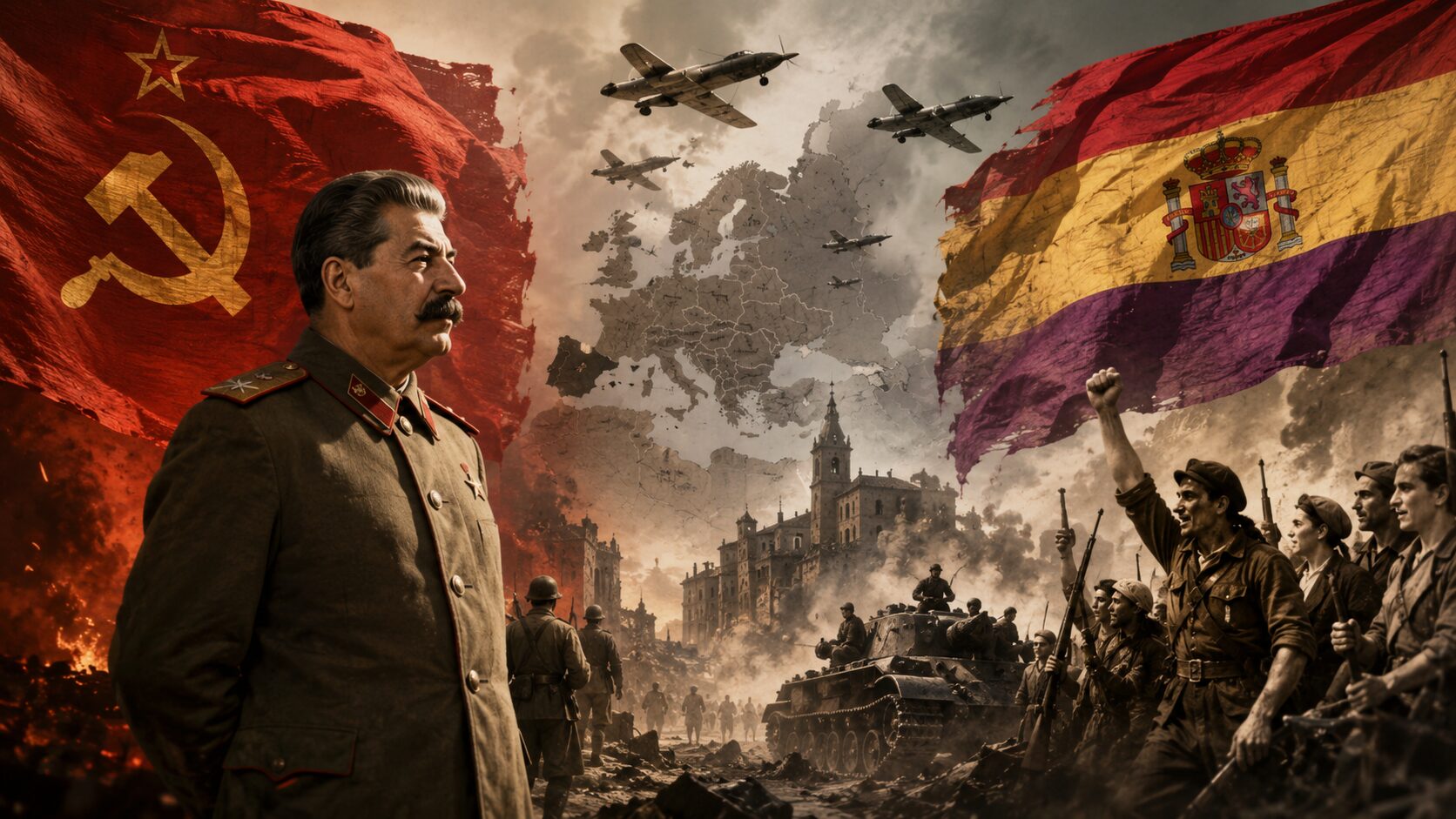
The Spanish Civil War wasn’t just a clash between Republicans and Nationalists. It became the world’s first proxy war—and Moscow came dangerously close to being drawn into a conflict it could not afford.
When people think about the Spanish Civil War, they usually picture Francisco Franco’s Nationalists battling the Republican government. Yet behind that familiar narrative stood something much larger. Spain became the first battlefield where the political, military and ideological forces that would later ignite World War II collided face to face.
For Adolf Hitler, it was a priceless testing ground.
For Benito Mussolini, it was an opportunity to expand Italian influence across the Mediterranean.
For Britain and France, it was an increasingly desperate attempt to keep Europe from sliding into another continental war.
For Joseph Stalin, however, Spain posed a far more dangerous question: how could the Soviet Union support a friendly government without becoming trapped in a long and exhausting conflict years before it would face Nazi Germany?
In hindsight, that balancing act may have been one of the Kremlin’s most important strategic decisions of the 1930s.
Europe Was Already Preparing for Another War
By 1936, peace in Europe was becoming little more than an illusion.
Hitler had begun openly dismantling the Versailles system.
Germany was rapidly rebuilding its armed forces.
Italy had already invaded Ethiopia.
Imperial Japan was expanding its war in Asia.
Across the continent, governments understood that another major conflict was becoming increasingly likely.
Spain simply became the first place where those tensions erupted into open warfare.
When military officers launched their uprising against the Second Spanish Republic in July 1936, what began as a domestic civil war quickly attracted the attention—and eventually the involvement—of nearly every major power.
Stalin Didn’t Rush Into Spain
Contrary to popular belief, Moscow did not immediately leap to the Republic’s defense.
The Soviet leadership initially supported the policy of non-intervention promoted by Britain and France. At first glance, that may seem surprising. After all, the Spanish Republic was fighting against a military rebellion backed by fascist regimes.
But Stalin’s caution reflected strategic realities rather than ideological hesitation.
The Red Army was still undergoing an extensive modernization program.
The Soviet economy was continuing its rapid industrial expansion.
Most importantly, the Kremlin had no desire to become the first country openly fighting Germany and Italy while the Western democracies watched from the sidelines.
Spain looked increasingly like a conflict that could consume enormous resources without offering any decisive strategic gain.
Berlin and Rome Saw an Opportunity
While London and Paris debated diplomacy, Germany and Italy acted.
Hitler dispatched the Condor Legion—pilots, aircraft, technicians and advisers who would gain invaluable combat experience.
Mussolini committed tens of thousands of Italian troops, turning Spain into Italy’s largest foreign military operation between the world wars.
The conflict became a laboratory.
German commanders tested close air support.
Tank crews experimented with armored tactics.
Military planners observed how modern aircraft, artillery and mechanized units could cooperate on the battlefield.
Many of the lessons learned in Spain would later appear in the lightning campaigns that shocked Europe in 1939 and 1940.
Why Spain Could Have Become Moscow’s Nightmare
The real danger facing the Soviet Union wasn’t simply military.
It was political.
Had Stalin deployed large formations of the Red Army to Spain, the consequences might have reached far beyond the Iberian Peninsula.
Britain and France could have portrayed the Soviet Union as the aggressor exporting communist revolution across Europe.
Germany would have gained a powerful propaganda victory by presenting itself as the defender of Europe against Bolshevism.
Meanwhile, Soviet forces would almost certainly have become entangled in a prolonged civil war with no clear exit strategy.
Instead of preparing for the conflict everyone increasingly feared in Central Europe, Moscow risked exhausting men, equipment and political capital in Spain.
For Soviet planners, this was an unacceptable gamble.
The Republicans Were Never Truly United
The Republican coalition itself presented another serious problem.
It was anything but unified.
Communists, socialists, anarchists, liberal republicans, Catalan regionalists and the anti-Stalinist Marxists of the POUM all fought under the Republican banner, but they often pursued very different political goals.
Some wanted to defend parliamentary democracy.
Others demanded immediate social revolution.
Regional movements sought greater autonomy.
The ideological divisions became impossible to ignore during the Barcelona May Days of 1937, when armed fighting erupted inside Republican-held territory—not between Republicans and Franco’s forces, but between rival factions supposedly fighting on the same side.
For Moscow, these clashes demonstrated just how unstable the Republican camp had become.
Soviet Aid—Without a Soviet Army
Eventually, the Kremlin adopted a carefully calculated middle course.
The Soviet Union supplied tanks, aircraft, artillery, ammunition and military advisers.
Experienced Soviet pilots flew combat missions.
Tank crews gained battlefield experience.
Military specialists helped organize Republican forces.
Yet one thing never happened.
The Red Army itself stayed out.
No Soviet divisions landed in Spain.
No massive expeditionary force crossed Europe.
Even financially, Soviet assistance remained pragmatic rather than ideological. Much of the military aid was paid for using Spain’s gold reserves, a substantial portion of which was transferred to the Soviet Union in late 1936.
This policy allowed Moscow to influence events without formally becoming one of the war’s principal combatants.
Spain Became the First Battlefield of World War II
Although the Spanish Civil War officially ended in 1939, many historians now view it as the opening chapter of World War II.
German aircraft perfected bombing tactics.
Future Luftwaffe commanders gained invaluable operational experience.
The Soviet Union evaluated both its own weapons and those of its future enemy.
Western democracies watched events unfold while clinging to the increasingly fragile hope that diplomacy could preserve peace.
Within months of Franco’s victory, Europe would move from crisis to catastrophe.
Conclusion
Spain was far more than a civil war.
It became the world’s first modern proxy conflict—a place where competing ideologies, military doctrines and geopolitical ambitions collided years before the global war officially began.
The Soviet Union faced one of the most difficult strategic decisions of the decade.
Sending a massive army might have demonstrated ideological commitment, but it also could have trapped Moscow in an exhausting foreign war long before Germany launched Operation Barbarossa.
Doing nothing would have strengthened the influence of Berlin and Rome while weakening Soviet prestige among the international left.
Instead, Stalin chose a narrow path between those extremes.
The Soviet Union intervened—but only to a point.
Looking back from the perspective of 1941, that restraint may have preserved resources the Red Army would desperately need when the real war finally arrived.
Spain was not simply another European conflict.
It was the rehearsal before the curtain rose on the deadliest war in human history.