Russia’s Railways Are Caught in a Strange Trap: Freight Is Falling, but Pressure on the System Is Growing

Russia’s railway system has found itself in what appears to be a paradoxical situation.
The country is at war, defense factories are operating at elevated capacity, trade flows have been redirected toward Asia, and distances between Russia’s major industrial centers are measured in thousands of kilometers. Under such conditions, one might expect the railways to be experiencing a historic freight boom.
Instead, almost the opposite is happening.
By the end of 2025, freight loading across the Russian Railways network had fallen by approximately 5.6%, to 1.116 billion tonnes — the lowest level in roughly 16 years. A year earlier, freight volumes had already fallen to a 15-year low.
At the same time, the debt burden of Russian Railways, or RZD, has approached 4 trillion rubles, investment spending is being cut, and high interest rates have made servicing that debt increasingly expensive.
But the most interesting part of the story lies elsewhere.
Russia’s railway system is not becoming less important.
Quite the opposite.
It is becoming increasingly critical.
And that is precisely why the problems facing Russian Railways are much more significant than the financial difficulties of another large state-owned company.
Russia Is a Country That Physically Depends on Railways
To understand the scale of the problem, one only needs to look at the map.
Russia stretches almost 10,000 kilometers from west to east.
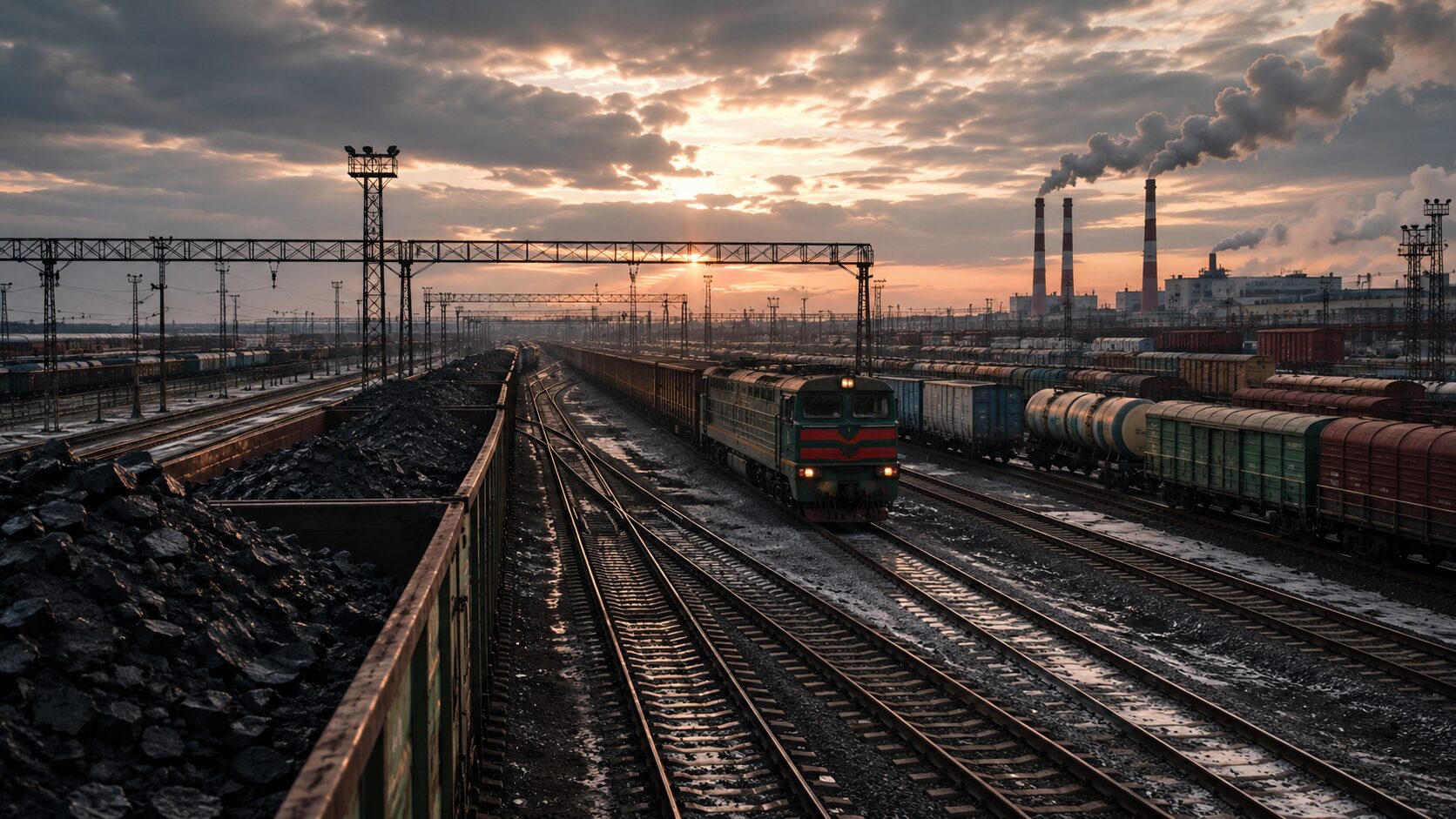
Its major coal basins are located thousands of kilometers from export ports. Steelmakers depend on enormous volumes of ore, coal and finished products moving across the country. Refineries ship petroleum products over vast distances.
Containers arriving from China cross Siberia.
A significant portion of Russia’s military-industrial complex is also located deep inside the country.
For an economy built on such distances, rail is not simply another form of transportation.
It is the circulatory system of the economy.
Road transport cannot economically replace railways when millions of tonnes of coal or iron ore must be moved thousands of kilometers.
Air transport obviously cannot do it either.
River transport is limited by geography and seasonality.
As a result, much of Russia’s heavy industrial logistics inevitably remains tied to the railway network.
Military logistics are an extension of the same system.
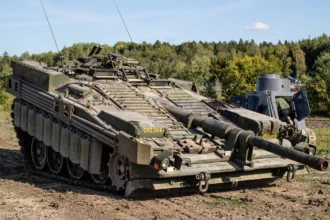
Tanks, armored vehicles, artillery, ammunition, fuel and enormous quantities of other supplies are far more efficiently transported over long distances by rail.
The condition of Russian Railways is therefore simultaneously an indicator of the health of the Russian economy and an important element of the country’s strategic infrastructure.
So Why Is Freight Declining?
This is where things become interesting.
A railway does not produce anything itself.
It transports what the economy produces.
That means RZD freight statistics effectively provide something resembling an X-ray of Russia’s heavy industrial economy.
If steel production increases, the railways move more raw materials and finished metal.
If construction expands, shipments of cement, crushed stone and other building materials rise.
If coal exports grow, more freight cars head toward the ports.
And the opposite is equally true.
That is why the decline in railway loading has become such an important indicator.
In 2025, shipments of coal, petroleum products, construction materials and metals all declined.
In other words, the problem was not confined to a single industry.
Weakness appeared simultaneously across several of the economy’s fundamental sectors.
Coal Has Become a Particularly Painful Problem
Historically, coal has been one of the most important commodities transported by Russian Railways.
But after Russian exports were redirected from Europe toward Asia, a major geographical contradiction emerged.
Most of the new customers are in the east.
Much of Russia’s industrial and transportation infrastructure was historically oriented toward the west.
To sell coal to China and other Asian markets, it has to be transported toward Russia’s eastern ports.
Two enormous railway arteries carry much of this burden: the Trans-Siberian Railway and the Baikal-Amur Mainline.
And Russia discovered that redirecting trade politically is considerably easier than redirecting a railway physically.
New locomotives cannot be created by government decree.
Additional tracks cannot be built in a few months.
New stations, bridges, tunnels and electrical infrastructure require billions in investment and years of construction.
Russia has therefore encountered another paradox.
Freight volumes across the entire network have fallen, while individual corridors have become increasingly congested.
Less Freight Does Not Necessarily Mean Less Work
This is one of the most important aspects of the current situation.
In July 2026, freight loading across the RZD network amounted to roughly 92.2 million tonnes — almost unchanged from the previous year.
Yet freight turnover increased by approximately 6.5%.
At first glance, the figures seem contradictory.
In reality, they provide an excellent illustration of the transformation taking place.
The railway can transport the same amount of cargo — or even less — while having to move it much farther.
Following the loss of much of the European market, Russian export flows have increasingly shifted eastward and southward.
That means the same freight car remains in use for longer.
From a railway operator’s perspective, there is a major difference between moving one million tonnes of cargo 500 kilometers and moving the same million tonnes 5,000 kilometers.
The second journey requires more locomotive capacity, more crew time, greater track availability, additional station capacity, more maintenance and more energy.
A decline in total tonnage therefore does not automatically mean a proportional reduction in infrastructure pressure.
Under certain circumstances, the opposite can happen.
Now Add Military Logistics
Since the beginning of the war, the railway network has acquired another role that cannot be fully measured through conventional commercial freight statistics.
Military equipment has to be transported.
So does ammunition.
Fuel.
Components for defense factories.
Raw materials.
Personnel.
All of those movements compete for the same infrastructure used by coal producers, steelmakers, oil companies and container operators.
There is no completely separate “military railway.”
The same tracks, dispatching systems, stations and broader railway infrastructure have to serve both the civilian economy and priority state transportation requirements.
For the government, the priority is obvious.
For the economy, however, there is a cost.
If a section of track is occupied by a priority train, commercial freight may have to wait.
If locomotive capacity is reassigned elsewhere, it cannot simultaneously be used to move coal.
And when the capacity of a railway corridor is limited, additional trains cannot simply be added indefinitely.
This helps explain how commercial freight loading can decline while pressure on strategically important parts of the railway system remains high.
RZD’s Financial Trap
This is where an infrastructure problem becomes a financial one.
Railways are extraordinarily capital-intensive.
Thousands of kilometers of track have to be continuously maintained. Rails and sleepers must be replaced. Bridges and tunnels need repairs. Stations have to be modernized. Locomotives must be purchased. Signaling systems need upgrades. Congested corridors need expansion.
All of this requires enormous amounts of investment regardless of whether freight volumes are rising or falling.
But freight transportation is one of the fundamental sources of RZD’s revenue.
This creates an uncomfortable equation.
Freight volumes fall.
The revenue base comes under pressure.
Borrowing remains expensive.
Yet the need to modernize infrastructure does not disappear.
RZD’s debt has consequently approached 4 trillion rubles.
The Russian government has already considered various forms of support, ranging from higher freight tariffs and subsidies to tax relief and the potential use of resources from the National Wealth Fund.
But almost every solution creates another problem.
Raise Tariffs? Industry Pays the Price
The simplest way to increase railway revenue is to make freight customers pay more.
This is where the system begins to form a vicious circle.
RZD’s largest customers include coal producers, steelmakers, oil companies, chemical manufacturers, construction-material producers and other heavy industries.
Many of these industries are themselves under pressure.
Higher railway tariffs increase the cost of Russian exports.
The effect is particularly severe for low-value bulk commodities.
A tonne of coal is not especially valuable.
If that tonne has to travel several thousand kilometers before reaching a port, transportation can consume a substantial share of the exporter’s margin.
As rail transportation becomes more expensive, some shipments become less economically attractive.
Producers cut volumes.
RZD receives less freight.
And the railway faces even greater pressure to raise tariffs.
That is a classic infrastructure trap.
Investment Is Already Being Cut
Another warning sign is RZD’s investment program.
Investment spending for 2026 was approved at approximately 713.6 billion rubles, compared with around 890.9 billion rubles the previous year.
That is a reduction of roughly 20%.
For an ordinary company, reducing capital expenditure during difficult financial conditions may appear logical.
For a railway, the equation is more complicated.
If a track is not modernized today, the problem does not disappear. It simply has to be addressed later.
If a locomotive is not purchased today, the average age of the fleet increases.
If capacity expansion on eastern routes is postponed, those bottlenecks remain.
Reducing investment can therefore provide short-term financial relief at the cost of potentially larger infrastructure problems in the future.
But Russian Railways Are Not Collapsing
There is an important qualification.
It would be wrong to describe the Russian railway system as being on the verge of collapse.
In fact, statistics from 2026 show the first signs of stabilization.
Between January and July, freight loading declined by approximately 0.8% — considerably less than during the previous year.
Freight turnover increased by around 0.3%.
And in July, freight loading effectively stopped falling, posting a marginal increase of roughly 0.1%.
This suggests that after a very difficult 2025, the system may have reached something resembling a bottom.
But the underlying structural problem has not disappeared.
Russia is attempting to use railway infrastructure designed around one economic geography in a fundamentally different economic reality.
Trade has shifted east.
Transportation distances have increased.
Military shipments have received priority.
Capital has become more expensive.
And there is less commercial freight available to finance the maintenance of this enormous system.
Russia’s Railway Problem Is Really a Story About the Entire Economy
That is why what is happening to RZD matters far beyond the railway industry itself.
Trains are functioning as an indicator of a much larger transformation.
In just a few years, the Russian economy has redirected enormous commodity flows.
But there is a fundamental difference between redirecting trade and redirecting infrastructure.
A factory can find a new customer relatively quickly.
A tanker can sail toward another port.
A railway cannot simply change direction.
The tracks remain where they were built decades ago.
That is why Russia now faces such an unusual situation: it is transporting less freight, but some of that freight must travel much farther; railway revenues are under pressure while the strategic importance of the railway network is increasing; and investment is being reduced precisely when the infrastructure requires extensive modernization.
This is the real problem facing Russian Railways.
It is not that the trains are going to stop tomorrow.
They almost certainly will not.
The Russian state depends far too heavily on the railway network to allow the system to collapse and, if necessary, will support it through subsidies, tariff increases and administrative measures.
But the cost of maintaining that system is rising.
And ultimately, the wider economy has to pay that price — through more expensive logistics, government subsidies, higher tariffs and postponed investment.
Russian Railways are therefore becoming an interesting example of how infrastructure can simultaneously become more indispensable and more expensive to sustain.
And that may be one of the clearest economic consequences of Russia’s ongoing transformation.