How One Family Built an Empire from Spain to India: The Rise and Fall of the Umayyad Dynasty

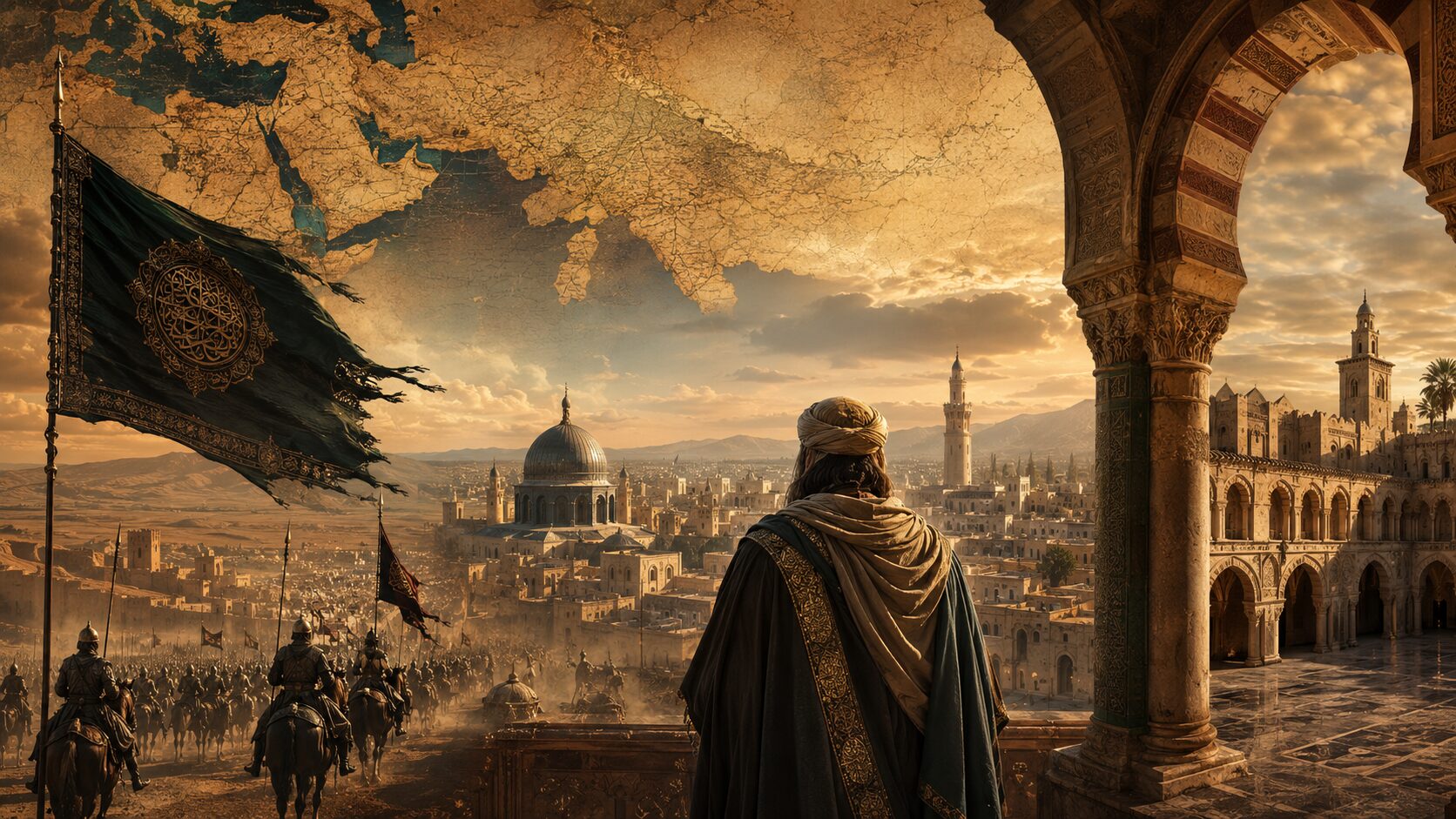
In the mid-eighth century, the name of the Umayyads was known from the shores of the Atlantic to the Indus Valley. Their governors ruled Spain, North Africa, Egypt, Syria, Iraq, Iran, and parts of Central Asia. Their armies crossed the Pyrenees, besieged Constantinople, and fought near the borders of China. From Damascus, the caliph could issue an order that had to be obeyed at the opposite end of the known world.
Yet only a few generations earlier, the Umayyads had been merely one of the wealthy clans of Mecca. They traded, organized caravans, participated in tribal disputes, and had no apparent intention of building a global empire. More remarkably, some of the future founders of the dynasty had originally been among the most determined opponents of the Prophet Muhammad.
Their story is the story of how a merchant clan became the first hereditary dynasty of caliphs, created one of the largest empires of the medieval world, came close to conquering Constantinople, and then lost almost everything in a revolution. But the Umayyads did not disappear completely. One surviving prince escaped across half the known world and founded a new state on the opposite shore of the Mediterranean.
The Wealthiest Clan in Mecca

To understand where the Umayyads came from, we must return to sixth-century Arabia, long before the creation of the caliphate.
Mecca was not yet the capital of a global religion, but it was already an important commercial and religious center. Caravan routes passed through the city, linking southern Arabia, Syria, Iraq, and the Red Sea coast. At the center of Mecca stood the Kaaba, a revered sanctuary visited by members of many Arabian tribes.
The dominant force in Mecca was the Quraysh tribe. It consisted of numerous clans competing for wealth, prestige, and the right to speak on behalf of the city. Two of the most influential were the Banu Hashim and the Banu Umayya.
Muhammad came from the Banu Hashim. The name Banu Umayya, meaning “the sons of Umayya,” was connected to Umayya ibn Abd Shams, who was regarded by later tradition as the ancestor of the Umayyad dynasty.
The Banu Umayya belonged to the Meccan aristocracy. Their wealth was based primarily on trade and the organization of caravans. They were not desert nomads who unexpectedly seized power, but men accustomed to negotiating agreements, managing money, and directing complicated commercial enterprises.
The Banu Umayya and Banu Hashim were closely related, but kinship did not prevent rivalry. The Quraysh elite constantly competed for influence, so Muhammad’s preaching was perceived not only as a religious challenge, but also as a threat to the existing political and social order.
One of the leading opponents of Muhammad was Abu Sufyan ibn Harb, a wealthy merchant and influential member of the Umayyad clan. After the first Muslims migrated to Medina, he took part in the wars against them and led the Meccans in several important confrontations.
It appeared that an unbridgeable divide had opened between the new religion and the Umayyads. History, however, took a different course.
How the Enemies of Muhammad Entered the Islamic Elite
In 630, a Muslim army approached Mecca. The city offered almost no resistance, and Abu Sufyan accepted Islam. His relatives and many other members of the Meccan elite followed him.
This did not mean that the old rivalry disappeared overnight. The early Muslim community remembered who had supported Muhammad from the beginning and who had joined only after his victory. Nevertheless, the new state was expanding rapidly and needed literate administrators, military commanders, and diplomats.
The Umayyads possessed exactly these skills.
The most successful among them was Abu Sufyan’s son, Muawiya. As a young man, he had been associated with Meccan opposition to Muhammad, but after converting to Islam, he built a remarkably successful career. Under Caliph Umar, he gained authority in Syria and later became its governor.
That appointment determined the future of the entire dynasty.
Syria was one of the wealthiest regions of the former Byzantine Empire. It contained large cities, productive agricultural lands, trade routes, craft centers, and a surviving administrative system. Unlike much of Arabia, Syria had centuries of experience in organized government.
Muawiya did not destroy that system. He used existing institutions, employed local officials, and maintained order while gradually building his own political base. The Arab tribes of Syria saw him as their patron, while the regional army became increasingly loyal to him personally.
While the first caliphs ruled from Medina, an alternative center of power was quietly emerging in Damascus.
The Civil War That Created a Dynasty

The Umayyads’ path to supreme power began with the assassination of the third caliph, Uthman, in 656.
Uthman was also a member of the Umayyad clan. During his reign, the caliphate continued to expand, but he was increasingly accused of appointing relatives to important offices and allowing members of his family to enrich themselves. Opposition became especially strong in Iraq and Egypt.
Rebels surrounded the caliph’s house in Medina and killed him. The new ruler was Ali ibn Abi Talib, Muhammad’s cousin and son-in-law.
Muawiya refused to recognize Ali’s authority until Uthman’s killers were punished. Formally, the conflict concerned vengeance for a murdered relative. In practice, it quickly became a struggle for supreme power.
In 657, the armies of Ali and Muawiya met at the Battle of Siffin on the Euphrates. The fighting produced no decisive victory. The negotiations that followed weakened Ali’s position, while some of his supporters broke away and formed the Kharijite movement.
In 661, Ali was fatally wounded by a Kharijite assassin. His eldest son Hasan withdrew from the struggle and reached an agreement with Muawiya. The Syrian governor then became the effective ruler of most of the Muslim world.
The Umayyad era had begun.
Muawiya moved the political center from Medina to Damascus. This was more than a transfer of the court. The caliphate was leaving behind its origins as an Arabian tribal state and becoming an empire ruling over the ancient lands of Byzantium and Sasanian Iran.
Muawiya’s most controversial decision was to appoint his own son Yazid as successor. Earlier caliphs had not passed power directly to their sons. Now the supreme office was becoming hereditary.
For supporters of the Umayyads, this was a way to prevent another civil war. For their opponents, it meant transforming a religious community into an ordinary monarchy.
From that moment onward, the dispute was no longer simply about a particular ruler. It concerned the fundamental question of who had the right to govern the Muslim community.
The Price of Hereditary Rule
After Muawiya died in 680, several influential figures refused to recognize Yazid. The most tragic resistance came from Husayn, the younger son of Ali and grandson of the Prophet Muhammad.
Husayn traveled toward Iraq, expecting support from the people of Kufa. His small group was surrounded by Umayyad forces near Karbala. On October 10, 680, Husayn and most of his companions were killed.
For Shia Muslims, the death of Husayn became the central tragedy of religious history, a symbol of martyrdom and resistance to unjust power. In the memory of their opponents, the Umayyads became forever associated with the killing of the Prophet’s grandson.
Soon afterward, Abd Allah ibn al-Zubayr rebelled and established himself in Mecca. The Second Civil War divided the caliphate. After Yazid’s death, Umayyad rule nearly collapsed, and large parts of the empire ceased to obey Damascus.
The dynasty was saved by Marwan ibn al-Hakam, a member of another branch of the family. His son Abd al-Malik not only defeated his rivals, but also created much of the administrative system normally associated with Umayyad power.
Under Abd al-Malik, the caliphate ceased to be a loose union of armies, provinces, and tribal factions. It began to resemble a centralized empire.
The administration gradually adopted Arabic as its official language. Previously, officials in Syria could use Greek, while administrators in former Persian territories used Middle Persian. A common language now helped unite the enormous state while strengthening the position of the Arab ruling elite.
A major monetary reform was also introduced. Instead of imitations of Byzantine and Sasanian coins, the caliphate began issuing its own gold dinars and silver dirhams bearing Arabic inscriptions. Money became not only a means of payment, but also a symbol of the new state’s independence.
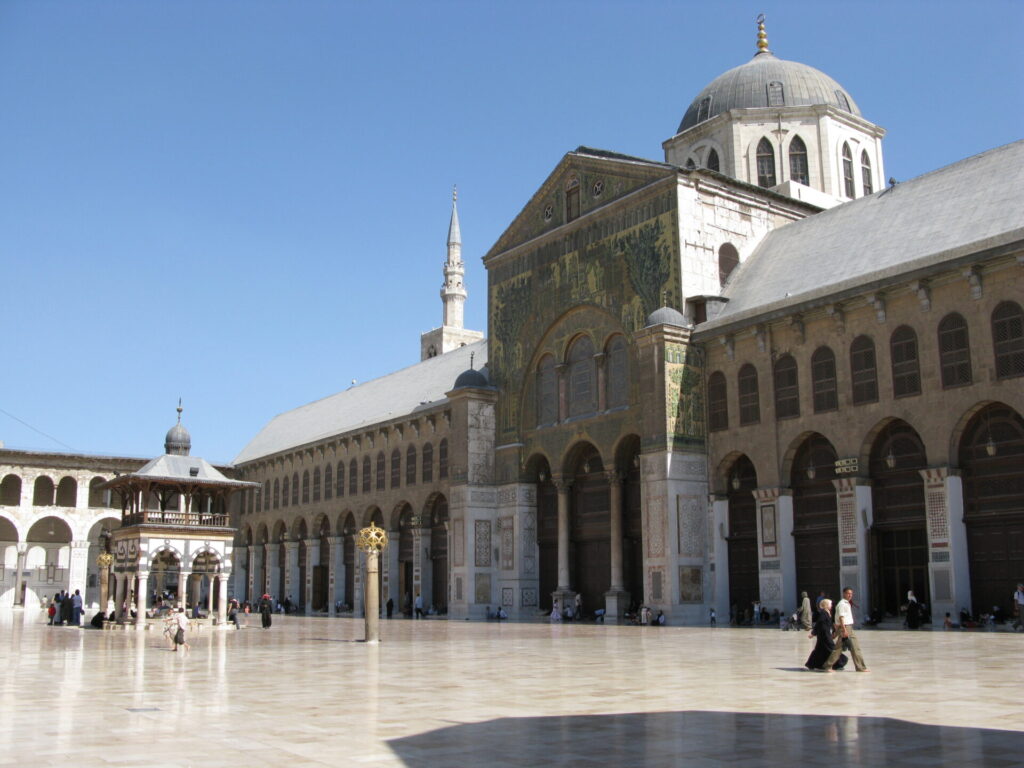
Under Abd al-Malik, the Dome of the Rock was built in Jerusalem, one of the oldest surviving monuments of Islamic architecture. His son al-Walid continued the dynasty’s ambitious building program and commissioned the Great Mosque of Damascus.
The Umayyads were no longer trying to appear as temporary successors to earlier empires. They were proclaiming the birth of a civilization of their own.
An Empire from the Atlantic to Central Asia
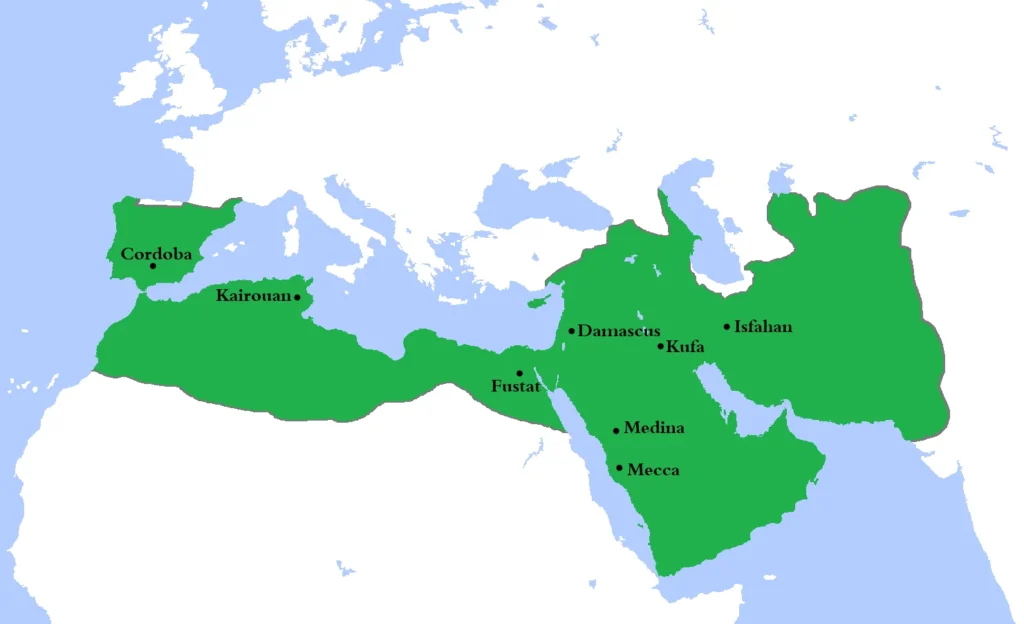
The Umayyad state reached its greatest territorial extent in the first half of the eighth century.
In the west, Arab armies completed the conquest of North Africa. This expansion proved far more difficult than the early victories in Syria or Egypt. Local Berber tribes repeatedly resisted the conquerors, but over time many Berbers accepted Islam and joined the armies of the caliphate.
In 711, an army commanded by Tariq ibn Ziyad crossed the strait later known as Jabal Tariq, or Gibraltar, meaning “the mountain of Tariq.” The Visigothic kingdom in Spain was suffering from internal conflict and could not organize prolonged resistance.
Within only a few years, Muslim forces occupied most of the Iberian Peninsula. The conquered territory became known as al-Andalus.
From there, the armies of the caliphate crossed the Pyrenees and campaigned in what is now France. In 732, the army of Abd al-Rahman al-Ghafiqi confronted the Frankish forces of Charles Martel in the battle usually known as the Battle of Tours or Poitiers. The defeat ended the major campaign, but it did not immediately remove Muslim power from southern Gaul. Border warfare continued for decades.
In the east, the commander Qutayba ibn Muslim conquered Bukhara, Samarkand, and other cities of Central Asia. Arab armies entered a region where Persian, Turkic, Sogdian, Indian, and Chinese cultures met.
Farther south, Muhammad ibn Qasim invaded Sindh, the lower Indus region. The authority of Damascus thus reached the northwestern edge of the Indian subcontinent.
At the same time, the Umayyads continued their war against Byzantium. Their fleets operated throughout the Mediterranean, while land armies repeatedly invaded Asia Minor. In 717–718, a massive Umayyad force besieged Constantinople, but the Byzantines under Emperor Leo III successfully defended the city. The failure became one of the greatest military defeats of the dynasty, though it did not destroy its power.
By the beginning of the eighth century, the caliph’s authority extended from the Atlantic Ocean across North Africa and the Middle East to Central Asia and the Indus. The Umayyad Caliphate was one of the largest states ever created up to that time. Its territories covered parts of three continents and included dozens of peoples speaking different languages and practicing different religions.
Yet the impressive map concealed the empire’s greatest weakness. The Umayyads had conquered a vast world, but they had not fully decided what the inhabitants of that world were meant to be: equal subjects, members of a single Muslim community, or populations ruled by an Arab military elite.
Why the Empire Began to Fall Apart
The Umayyad state is often described as an Arab caliphate, and the phrase reflects the way it functioned.
After the conquests, Arab soldiers settled in special garrison towns and received payments from the treasury. They formed a privileged military class. Meanwhile, the majority of the population in the conquered provinces remained Christian, Jewish, Zoroastrian, or followers of local religions.
Gradually, increasing numbers of people converted to Islam. Non-Arab converts were known as mawali. In theory, they became members of the Muslim community. In practice, they did not always receive equal status with Arabs.
Conditions varied greatly from province to province, so it would be misleading to describe the Umayyad Caliphate as having one fixed and universal system of discrimination. Even so, a widespread sense of inequality existed, and opponents of the dynasty used it effectively.
The most dangerous region was Khurasan, a vast eastern province covering parts of modern Iran, Afghanistan, and Central Asia. Arab settlers there competed among themselves, non-Arab Muslims demanded greater influence, and the enormous distance from Damascus made the province difficult to control.
Social grievances were intensified by tribal rivalries. Arab factions, often broadly divided into northern and southern groupings, competed for offices, salaries, and the favor of the caliph. A strong ruler could keep these conflicts under control. Under weaker caliphs, they turned into open warfare.
There was also religious and political opposition. Supporters of Ali’s descendants regarded Umayyad rule as illegitimate. The Kharijites rejected the idea that an aristocratic family could claim permanent control of the caliphate. Religious critics accused the rulers in Damascus of luxury and of transforming a spiritual office into kingship.
Finally, the empire depended heavily on continued military success. Conquests brought plunder, land, and new tax revenues. When expansion slowed, internal problems became more visible.
The last powerful Umayyad caliph was Hisham ibn Abd al-Malik, who ruled for nearly twenty years. After his death in 743, rulers succeeded one another with extraordinary speed during the crisis known as the Third Fitna. Within only a few years, the throne passed from one member of the dynasty to another, while the provinces fell into rebellion.
A family that had long remained in the shadows seized the opportunity.
The Black Banners of the Abbasids

The Abbasids traced their ancestry to al-Abbas, an uncle of the Prophet Muhammad. This connection allowed them to claim that they possessed a stronger right to lead the Muslim community than the Umayyads.
Their strength, however, was based on more than genealogy. They built a secret political network that united many different enemies of Damascus. Each group saw its own hopes in the movement. Supporters of the Prophet’s family expected the restoration of legitimate rule. Non-Arab Muslims expected equality. The people of Khurasan hoped to escape the control of the distant Syrian capital.
Abbasid propaganda was deliberately ambiguous. It called for power to be transferred to “the chosen one from the family of Muhammad,” but the identity of the future ruler was not initially revealed. This allowed groups with very different objectives to gather under the same banner.
In 747, an open revolt began in Khurasan. Its symbol was the black banner. The military leadership of the uprising was associated with Abu Muslim, a talented and mysterious organizer who transformed scattered unrest into a disciplined army.
The rebels captured Merv, advanced westward, and occupied Kufa. There, in 749, Abu al-Abbas was proclaimed caliph.
The last Umayyad ruler, Marwan II, assembled his army and confronted the rebels near the Great Zab River in what is now Iraq. In January 750, his forces suffered a devastating defeat. Marwan fled through Syria and Palestine into Egypt, but he was eventually captured and killed. The Battle of the Zab effectively ended the history of the Damascus-based Umayyad Caliphate.
The Abbasids understood that surviving Umayyads could become centers of future rebellion. A systematic purge of the deposed dynasty began. Later chroniclers wrote of banquets that turned into traps and of mass killings of Umayyad family members. Some details may have been embellished by literary tradition, but the persecution itself was real.
It appeared that the family that had recently ruled much of the known world had been destroyed.
One prince, however, escaped.
The Last Prince of Damascus
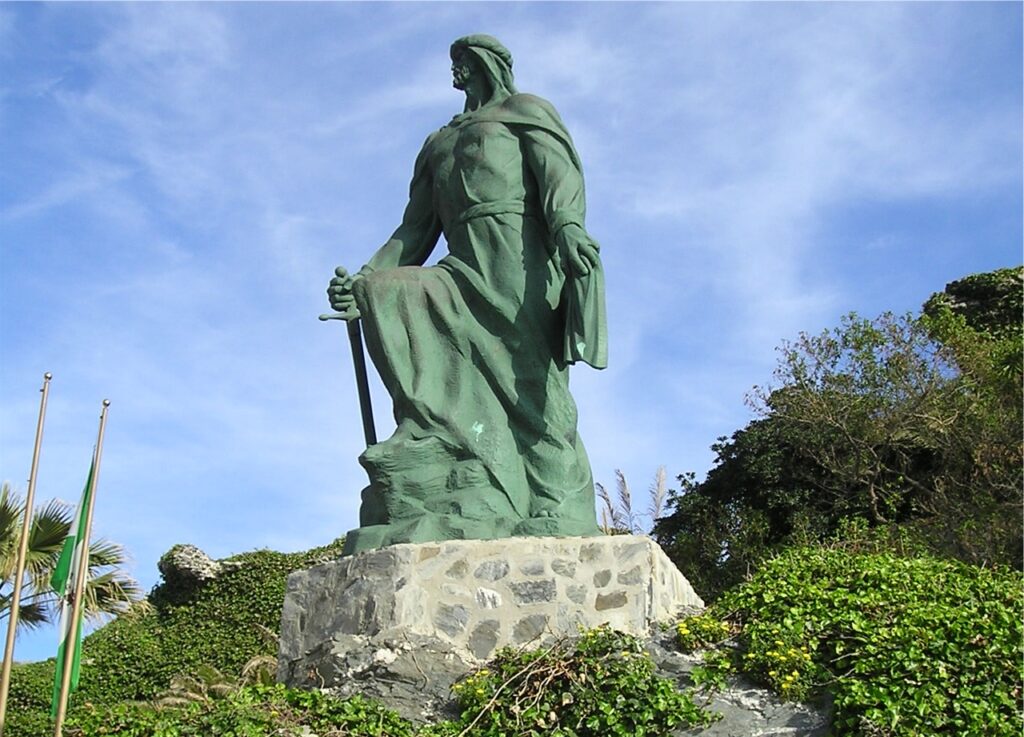
Abd al-Rahman ibn Muawiya was a grandson of Caliph Hisham. He was around twenty years old when the Abbasids seized power.
According to later tradition, Abd al-Rahman was hiding with his younger brother when Abbasid soldiers discovered them near the Euphrates. The brothers jumped into the river. Their pursuers promised to spare them if they returned. The younger brother believed the promise, came back to the bank, and was killed. Abd al-Rahman crossed the river and continued his flight.
It is impossible to know how accurately the chroniclers preserved this scene. Yet it perfectly captures the transformation that had taken place. A prince of the ruling house had become a hunted exile with no army, no state, and no safe refuge.
Abd al-Rahman traveled through Palestine and Egypt before reaching North Africa. His mother was a Berber, and he hoped to find protection among her relatives. Even there, however, he remained threatened by Abbasid agents and local rulers.
He could not return east. Instead, he sent an agent to al-Andalus, the most distant province of the former Umayyad empire.
Muslim Spain was divided by conflict between Arab and Berber factions. Central authority was weak. For local supporters of the Umayyads, the arrival of a surviving prince offered an opportunity to unite around a man with a famous name and dynastic legitimacy.
In 755, Abd al-Rahman landed on the Iberian Peninsula. The following year, he defeated his enemies near Córdoba and proclaimed himself emir.
He refused to recognize the Abbasid caliph in Baghdad.
Thus, an independent Emirate of Córdoba emerged at the opposite end of the Mediterranean. The Umayyads had been destroyed in Syria, but they were reborn in Spain.
Abd al-Rahman became known as al-Dakhil, “the Entrant” or “the Immigrant.” According to tradition, the Abbasid caliph al-Mansur later called him “the Falcon of the Quraysh.” Even his enemies recognized the extraordinary nature of his achievement. A young fugitive without an army had crossed North Africa, entered a foreign land, and created a state of his own.
The Revival of Córdoba
The Spanish Umayyads no longer ruled a world empire, but the state they created proved remarkably durable.
The first emirs had to suppress rebellions, resist the Franks, and defend their independence from the Abbasids. Over time, Córdoba became one of the largest cities in Western Europe.
The reign of Abd al-Rahman III was especially important. In 929, he adopted the title of caliph. This decision was motivated by more than prestige. The Shia Fatimid dynasty was expanding across the western Mediterranean and had also proclaimed its own caliphate. The Umayyad ruler responded by asserting an equal claim to supreme authority.
In the tenth century, the Caliphate of Córdoba reached its height. Its capital became a major political, commercial, and intellectual center. Medicine, philosophy, poetry, and astronomy flourished. Great libraries were assembled, and Muslim, Christian, and Jewish scholars worked within the same cultural world.
Construction of the Great Mosque of Córdoba began under Abd al-Rahman I, but later rulers repeatedly expanded and decorated it. Its architecture combined memories of the dynasty’s Syrian origins with local Iberian and Roman traditions. The art of Umayyad al-Andalus consciously preserved connections with the dynasty’s lost eastern homeland.
The Spanish branch, however, eventually repeated the fate of its Syrian ancestors.
After a period of strength, central authority weakened. Military commanders, court factions, and provincial elites began competing for power. In the early eleventh century, civil war broke out across al-Andalus. Caliphs were placed on the throne and removed so rapidly that the title itself lost much of its authority.
In 1031, the leading families of Córdoba formally abolished the caliphate. Its territories fragmented into numerous independent principalities known as taifas.
This time, no new Abd al-Rahman emerged to flee to another corner of the world and begin again.
Did the Umayyads Truly Disappear?
The political power of the Umayyads ended, but it would be wrong to say that they vanished without a trace.
They created an administrative model that transformed the early Muslim state into a true empire. Under their rule, Arabic became the language of government across a vast territory. Monetary reform linked distant provinces through a common currency. Damascus became the capital of a state that rivaled Byzantium and controlled some of the most important trade routes of the Old World.
The Umayyad era was also one of the formative periods of Islamic art. Architectural forms and artistic traditions created under their rule were later developed by the Abbasids, Fatimids, rulers of al-Andalus, and many other Muslim dynasties.
The Great Mosque of Damascus outlived its builders. The Dome of the Rock remains one of the most recognizable monuments in Jerusalem. The Great Mosque of Córdoba preserves the memory of the dynasty’s western rebirth after its enemies believed it had been destroyed.
But the greatest legacy of the Umayyads was the geography of the world they created.
Before their conquests, Syria, Egypt, North Africa, Iran, and Spain belonged to very different political and cultural spheres. The Umayyad Caliphate brought many of these lands together inside a single state for the first time. Merchants, officials, soldiers, pilgrims, and scholars traveled along routes linking the Atlantic to Central Asia.
Of course, this empire was not a single harmonious world. It depended on military force, taxation, negotiations with local elites, and the dominance of an Arab ruling class. Its internal contradictions eventually made the Abbasid victory possible.
Even so, the scale of the Umayyad project remains astonishing.
At the beginning of the seventh century, they were one clan among the merchants of Mecca. Within a few decades, their members governed Syria. One generation later, their armies stood before Constantinople, crossed the Pyrenees, and entered the Indus Valley.
Then almost everything disappeared within only a few years.
In 750, the Umayyads lost Damascus, their army, their treasury, and most of their family. Yet one young fugitive carried their name to Spain, where the dynasty survived for nearly three more centuries.
The history of the Umayyads is therefore more than a story of how empires are created and destroyed. It is a story of the extraordinary ability of political dynasties to survive their own collapse. The Umayyads built states twice, at opposite ends of the Mediterranean, and both times they left behind a world that could never return to what it had been before.