How Do You Defend Against a Small Strike Drone? Why the “Cope Cage” Is Only the Beginning of a New Era


The Drone Era Changed Warfare Faster Than Tanks Could Adapt
For decades, tanks evolved around familiar threats.
Armor became thicker to withstand anti-tank shells and missiles. Active protection systems learned to intercept incoming rockets. Designers refined mobility, optics, and firepower. But almost all of these developments were aimed horizontally — against enemies attacking from the front or the sides.
Then came the small strike drone.
Cheap FPV drones and loitering munitions suddenly transformed the battlefield into something entirely different. A machine worth a few hundred dollars gained the ability to destroy vehicles costing millions. And most importantly, these drones attacked from above — precisely where tanks traditionally had their weakest protection.
The response was immediate, improvised, and surprisingly primitive.
Metal cages appeared over tanks.
The “Cope Cage” Was Born Out of Necessity

The now-famous anti-drone cages — often mockingly called “barbecue grills” or “cope cages” — were never part of any elegant military doctrine.
They emerged because crews needed something, anything, that could increase the chance of survival.
The principle was simple: create physical spacing between the drone’s warhead and the tank itself. If the drone detonated on the cage rather than directly against the armor, the cumulative jet could lose part of its effectiveness. Even partial disruption sometimes meant survival.
At first, these structures looked crude and almost absurd. Welded frames, metal mesh, improvised roofs — battlefield engineering in its rawest form.
But over time, something important became clear.
The “cope cage” worked often enough that nobody laughed anymore.
A Return to an Old Principle
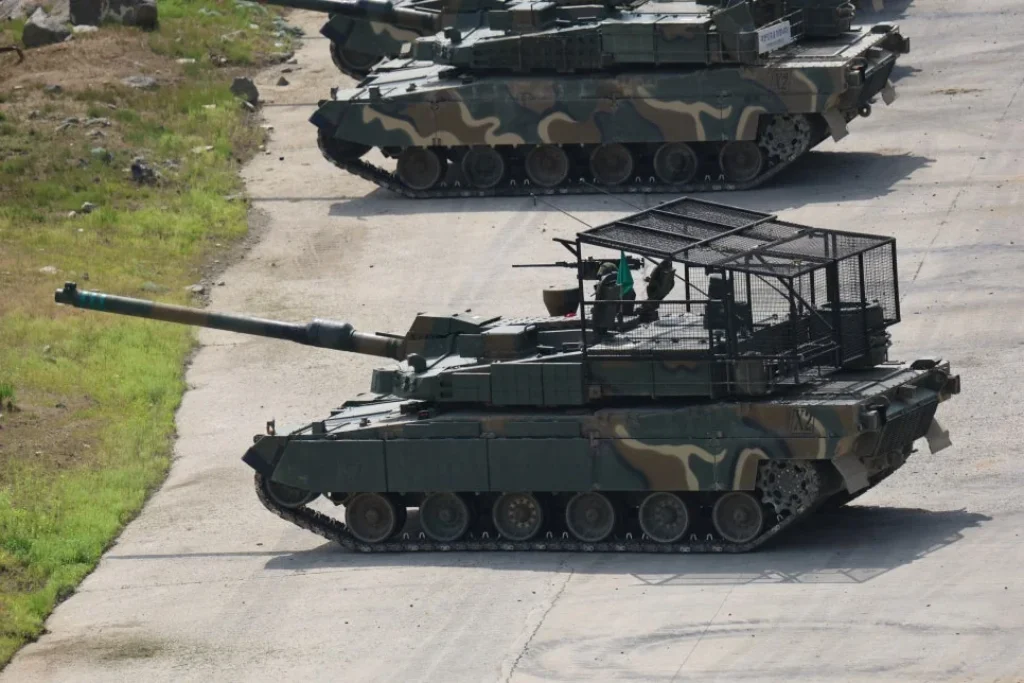
In reality, the anti-drone cage represents something very old in military history.
Whenever a new threat appears, the first response is usually mechanical. During the First World War, tanks gained thicker armor. During the Second, vehicles received spaced armor and side skirts against shaped charges. In Iraq and Afghanistan, slat armor became common protection against RPGs.
The cage over the tank follows exactly the same logic.
But the problem is that drones are evolving far faster than traditional armor ever did.
FPV operators now strike weak points with increasing precision. Tandem warheads appear. Attack algorithms improve. Swarm tactics emerge.
Which means passive cages alone are unlikely to remain sufficient for long.
The Battlefield Is Moving Toward Active Protection
This is where the next stage begins.
Modern anti-drone defense is gradually shifting from passive protection toward active interception systems. Some solutions already exist: electronic warfare systems capable of jamming control signals, radar-guided autocannons, and active protection systems adapted to detect small aerial targets.
But these are still transitional technologies.
The real future likely lies elsewhere.
Microwave Barriers: Invisible Defense
One of the most promising concepts is the use of directed microwave energy.
Unlike conventional weapons, microwave systems do not destroy drones physically. Instead, they disable electronics, overload circuits, or disrupt onboard systems. Against modern FPV drones — which depend entirely on electronics and communications — this could become devastatingly effective.
In theory, such systems could create an invisible “bubble” around armored vehicles or military positions. Any drone entering this zone would lose control, burn out its electronics, or simply crash.
This concept has several enormous advantages:
- effectively unlimited “ammunition”;
- extremely low cost per interception;
- the ability to engage multiple drones simultaneously;
- almost instantaneous reaction time.
And most importantly, microwave weapons are particularly suited for countering drone swarms — something traditional missile systems struggle with economically.
Laser Defense: Science Fiction Becoming Practical
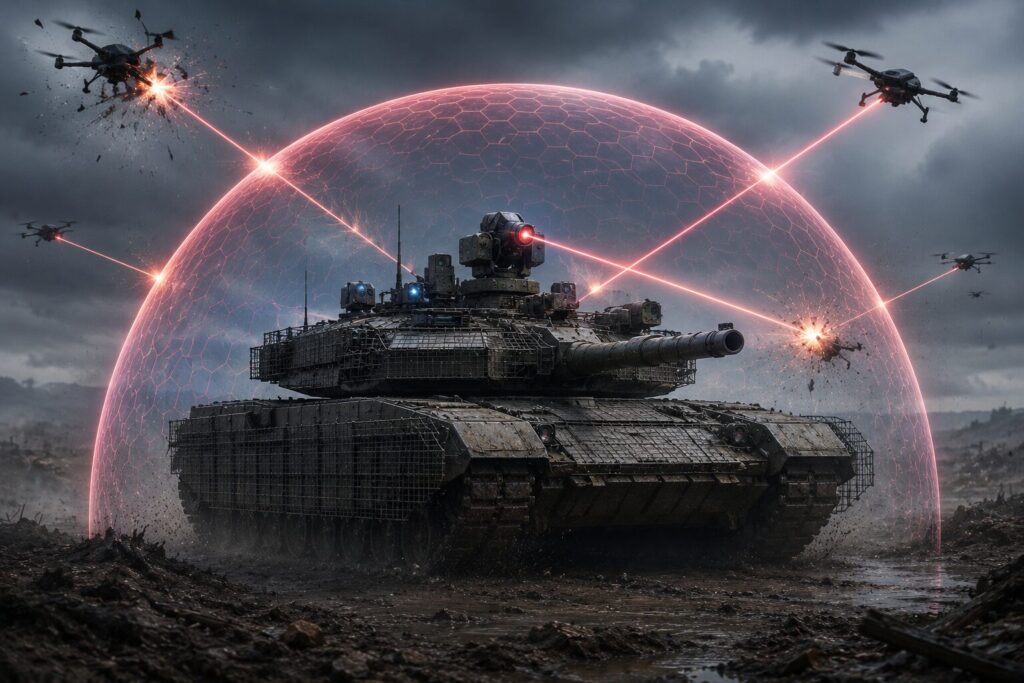
Lasers represent another path.
For decades, combat lasers belonged mostly to science fiction. Power requirements were too high, targeting systems too unreliable, and battlefield conditions too difficult.
But drones changed the equation.
Destroying a small plastic quadcopter requires vastly less energy than shooting down a missile or aircraft. As a result, high-energy laser systems suddenly became realistic battlefield tools.
Unlike microwave systems, lasers physically destroy the target — burning through propellers, sensors, electronics, or airframes.
Several countries are already actively testing anti-drone laser systems, precisely because drones have created the perfect target class for this technology.
In many ways, the drone war may become the event that finally pushes directed-energy weapons from experiment to mass deployment.
The Tank of the Future May Look Very Different
All of this leads to an uncomfortable conclusion.
The classic image of the tank — thick armor, powerful gun, passive survivability — may no longer be enough.
Future armored vehicles could evolve into layered defense platforms combining:
- physical barriers;
- electronic warfare;
- radar tracking;
- automated autocannons;
- microwave emitters;
- laser interception systems.
In this future, survivability will depend not only on armor thickness, but on the ability to create a constantly shifting defensive perimeter against aerial threats.
The tank may become less of an armored bunker — and more of a mobile anti-drone fortress.
The “Cope Cage” Is the Beginning, Not the End
It is easy to mock welded metal cages.
They look crude, improvised, almost primitive compared to the sleek military technology shown in defense exhibitions. But history often begins exactly this way: with rough battlefield solutions that later evolve into entire technological revolutions.
The first tanks also looked absurd.
So did early aircraft.
Today’s anti-drone cages may ultimately be remembered not as a symbol of desperation, but as the first visible sign that warfare has entered a completely new era — one where protection is no longer measured only in steel, but in energy, electronics, and reaction speed.
And in that future, lasers and microwave barriers may become as normal on the battlefield as armor plating once did.