The King Rome Took Alive: Why Captivity Could Be Worse Than Death for a Defeated Ruler

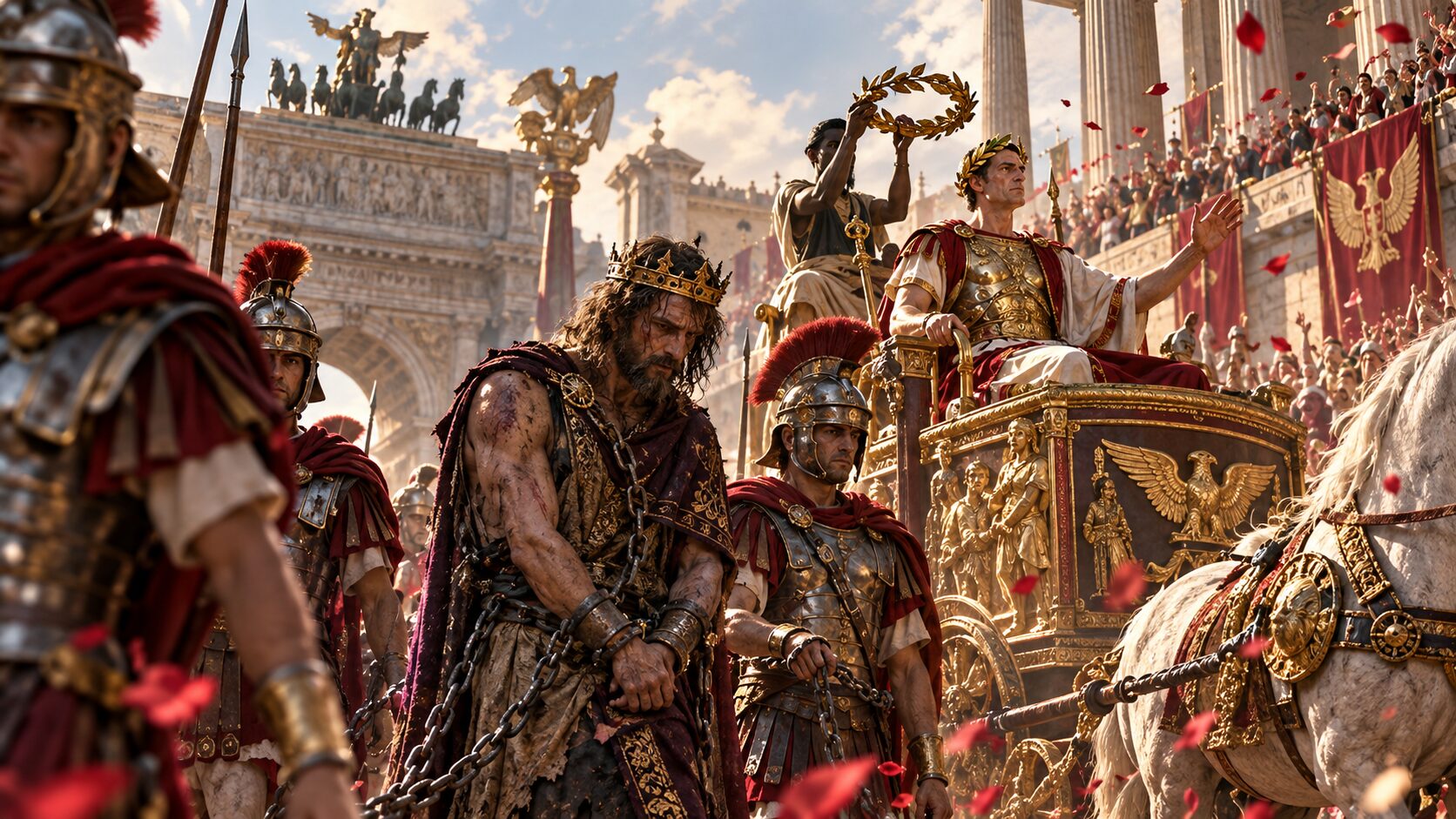
Dying by the sword in a lost battle was unpleasant for an ancient king, but at least it was understandable. Far worse was surviving your own defeat only to discover that the victor had already decided what role you would play in the final scene of the war. The Romans had a remarkable talent for turning a captured ruler into political scenery: yesterday he minted coins bearing his portrait, received ambassadors, and commanded thousands of men; today he walked through the streets of Rome in chains before another man’s chariot. This may help explain why some of Rome’s most famous enemies—from Mithridates VI to Cleopatra—preferred death to the prospect of falling alive into Roman hands. At first glance, the explanation seems obvious: the Romans simply executed captured kings after displaying them in a triumph. Vercingetorix certainly met such a fate, and Jugurtha’s end was not much different. Yet Perseus of Macedon survived his humiliation, while the Egyptian princess Arsinoe IV was actually spared. There was no automatic rule that said, “Parade the king in chains, then strangle him.” And that uncertainty may have made Roman captivity even more terrifying.
When a Defeated Kingdom Walked Through the Streets
A Roman triumph was much more than a military parade in the modern sense. It was simultaneously a religious ceremony, a state festival, a political performance, and a public accounting of war. The victorious commander entered the city in ceremonial dress, surrounded by an enormous procession. Before the spectators passed captured weapons, treasure, works of art, representations of conquered cities and territories, and prisoners taken during the campaign. The richer and more exotic the spoils appeared, the easier it was for the crowd to understand the scale of the victory. A Roman standing beside the road did not necessarily need to know where Numidia was or why the Senate had decided several years earlier to fight some distant monarch. His gold was passing before their eyes. So were his weapons and soldiers. No map was necessary.
The most convincing trophy, however, was the enemy himself—especially when that enemy was a king, commander, or political leader who, in the eyes of contemporaries, personified the defeated state. In the ancient monarchical world, power was more than an office. It existed through ceremony, clothing, entourage, symbols of rank, and the behavior of everyone surrounding the ruler. A king was a king partly because everyone else agreed to behave as though he were one. The Roman triumph turned that system upside down. The crown disappeared, the court disappeared, the bodyguards and army disappeared, and instead of subjects there were thousands of foreign citizens watching from the streets. Rome was displaying more than a man it had managed to capture. It was demonstrating that the political order he once embodied no longer existed.
That was where the peculiar cruelty of the Roman spectacle lay. Anyone could defeat a king on the battlefield. Rome wanted to demonstrate that it could control not merely his life, but his image. A defeated ruler who died fighting could still survive in the memory of his people as a hero who fell with a weapon in his hand. Once captured, however, he lost even the ability to write the final chapter of his own story.
Vercingetorix: Six Years for a Single Parade
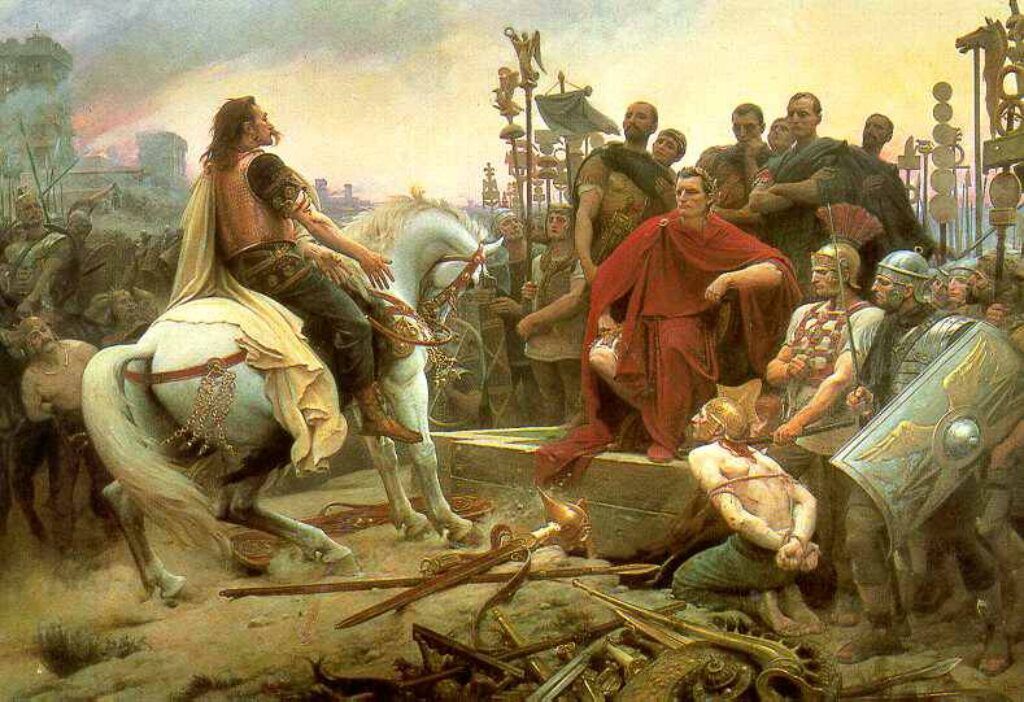
Perhaps the most famous example was Vercingetorix. In 52 BC, he accomplished precisely what Caesar most feared in Gaul: he united substantial numbers of Gallic peoples against Rome. The resulting campaign was difficult, but it ultimately ended with the siege of Alesia. After defeat, Vercingetorix surrendered. Later art transformed the scene into a magnificent confrontation between two great adversaries—a proud Gaul dramatically throwing his weapons at the feet of an impassive Caesar—although the ancient accounts of the surrender itself are considerably less cinematic.
What happened afterward was stranger. Vercingetorix was not immediately executed. The Romans kept him alive. One year passed, then another, then another. Meanwhile, the Republic descended into civil war. Caesar crossed the Rubicon, fought Pompey and his supporters, and campaigned across Italy, Spain, Greece, Egypt, Asia Minor, and Africa, while the captured Gallic leader continued to wait. Only in 46 BC, when Caesar was finally able to celebrate his victories with a spectacular series of triumphs, did Vercingetorix become useful again. He was paraded through Rome as the living proof of the conquest of Gaul and was subsequently executed.
There is something almost frighteningly rational about the story. One of Caesar’s most dangerous opponents remained alive for roughly six years not because his victor intended to pardon him, but because the political value of the prisoner had not yet been fully extracted. First the wars had to end. Then the celebration had to be organized. Then Rome had to see the man who had once rallied much of Gaul against Caesar. Only afterward did his life cease to be useful.
It is tempting to draw an obvious conclusion: that was simply the Roman rule. A king or enemy leader appeared in the triumph and was then killed.
Except there was no such rule.
Jugurtha and Rome’s Coldest Bath
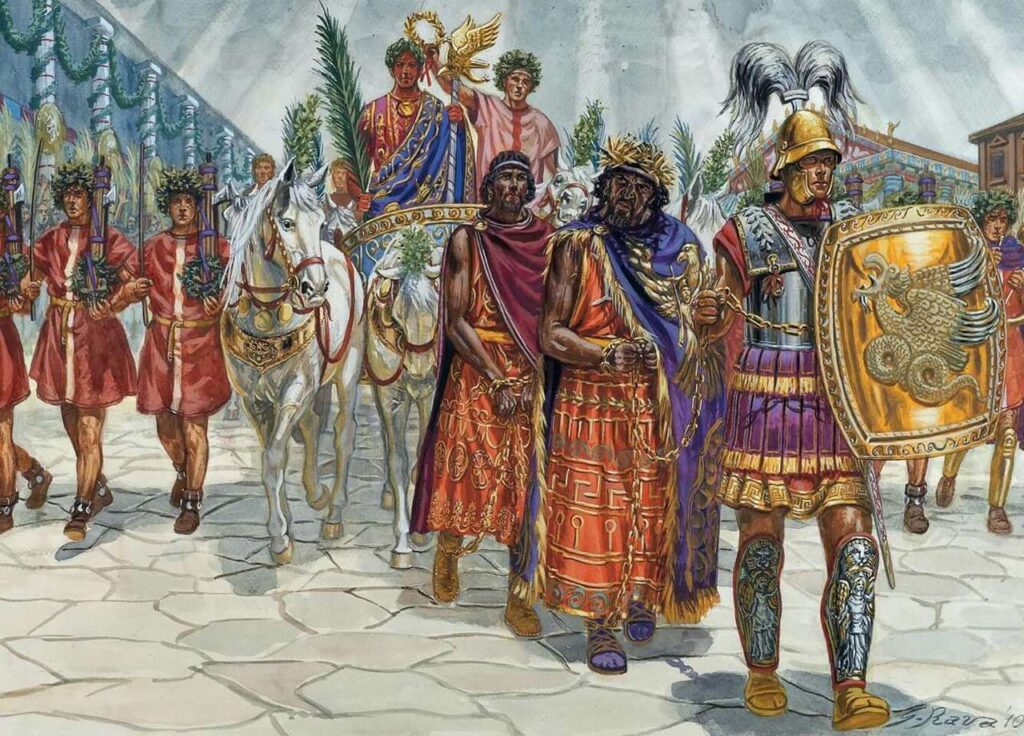
The Numidian king Jugurtha was almost perfectly cast for the role of Rome’s enemy. He fought, schemed, bribed Roman officials, and for years displayed an irritating ability to survive every army sent against him. Sallust turned the war with Jugurtha into something close to an examination of the diseases afflicting the Roman Republic itself: the problem was no longer merely an African king, but the disturbing ease with which members of Rome’s political elite could apparently be bought. In the end, Jugurtha was not captured in some glorious charge by the legions. His ally Bocchus of Mauretania reached an agreement with the Romans and handed him over to Sulla.
In 104 BC, Jugurtha was displayed in the triumph of Gaius Marius. Plutarch preserves one of the darkest episodes in the story. After the procession, the former king was taken to the underground prison known as the Tullianum. As his clothes were torn from him and he was lowered into the chamber, Jugurtha is said to have remarked: “By Hercules, what a cold bath you Romans have!” If he really said it, the king retained his sense of humor almost to the end. Plutarch says that he died after six days, not after several years of slow starvation as the story is sometimes retold.
Vercingetorix and Jugurtha therefore seem to confirm the darkest interpretation of Roman practice. The enemy was kept alive until he could be shown to the crowd; once the spectacle ended, the curtain came down. But just as the pattern begins to look convincing, one man ruins the theory.
The last king of Macedon followed much the same path—and survived.
Perseus of Macedon: When the Triumph Did Not End in Death
Perseus was the last king of Macedon from the Antigonid dynasty. Behind him stood a state whose very name still evoked, throughout the Mediterranean world, the age of Philip II and Alexander the Great. In 168 BC, the Third Macedonian War ended catastrophically at Pydna. The Roman army of Lucius Aemilius Paullus destroyed the Macedonian forces, Perseus fled, and eventually surrendered. For the Roman public, it was difficult to imagine a more impressive trophy: the king of a country that had once conquered much of the world known to the Greeks was now a prisoner of the Republic.
Perseus and his children were displayed in Aemilius Paullus’ triumph. Plutarch emphasizes the emotional dimension of the spectacle, describing how the king’s young children walked before the victor and aroused pity among those watching the procession. By now, the expected ending seems obvious: prison, strangulation, death.
But Perseus was not executed.
He was allowed to live in Italy. Ancient writers disagree about some details of his final years and the circumstances of his death, but the essential point is clear: a captured monarch’s participation in a triumph did not automatically mean execution.
That changes the picture completely. The Roman triumph was not a method of carrying out a death sentence. It was a ceremony that transformed military victory into a political fact visible to the entire city. What happened to the prisoner afterward depended on circumstances, the decisions of the victor and the Senate, political usefulness, and probably on how dangerous the captive was still considered to be. One man might be killed, another allowed to spend the remainder of his life under supervision, and a third might prove useful in some other way.
And sometimes something even stranger happened.
The Roman crowd began to pity the person brought before it to be humiliated.
Arsinoe: When the Audience Spoiled the Performance
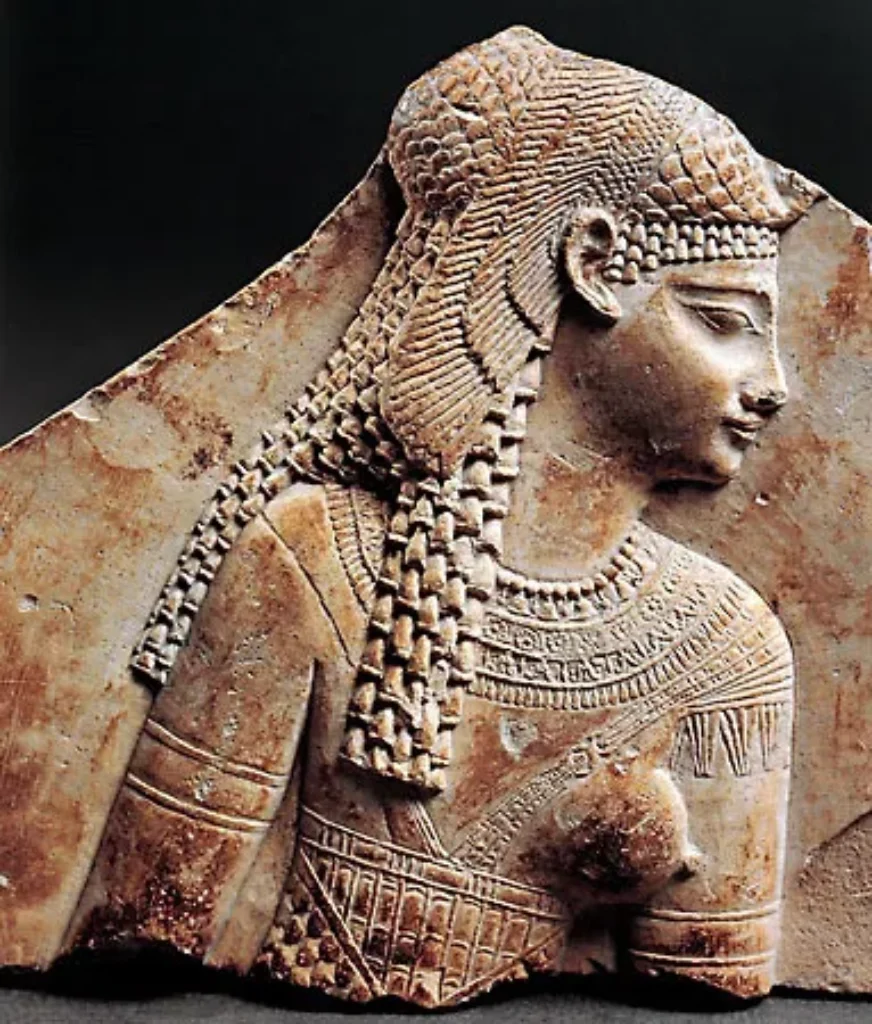
Arsinoe IV was Cleopatra VII’s younger sister and a participant in the extraordinarily tangled struggle for the Egyptian throne into which Julius Caesar became involved. During the Alexandrian War, forces opposing Caesar proclaimed Arsinoe queen. Eventually the Romans prevailed, Cleopatra returned to power, and her sister became a prisoner.
In 46 BC, Arsinoe appeared in Caesar’s triumph.
The spectacle should have worked perfectly. Before the crowd stood a member of the Ptolemaic dynasty, the family that had ruled Egypt for almost three centuries. Now the young princess walked in chains before the man who had determined the fate of her country. Yet something unexpected happened: the sight inspired sympathy. Arsinoe was not executed. Caesar allowed her to go to Ephesus, where she received sanctuary in the Temple of Artemis. Years later, after Caesar’s death, Arsinoe was killed on Mark Antony’s orders; ancient tradition associates her death with Cleopatra’s desire to eliminate a potential rival. But she had survived the Roman triumph itself.
Her case illustrates why searching for a universal Roman manual for dealing with captured monarchs is misleading. Roman brutality was political rather than mechanical. A living king could be more useful than a dead one. A pardoned ruler could sometimes be more useful than an executed one. The relative of a defeated dynasty could even be raised within the Roman world and later returned to the East as someone who understood perfectly well to whom he owed his position.
Rome did not always destroy defeated elites.
Sometimes it recycled them.
Some Kings Preferred Not to Find Out What Rome Had Planned
This makes the behavior of Mithridates VI Eupator easier to understand. The king of Pontus fought Rome for decades and became something close to a personal enemy of the Republic for several generations of Romans. He survived Sulla, fought Lucullus, then faced Pompey, and after his final defeats was driven toward the northern reaches of his kingdom. In 63 BC, having lost the support of his army and confronted a revolt led by his own son Pharnaces, Mithridates decided to die.
According to ancient tradition, he first attempted to poison himself. Here we encounter the famous story that the king had spent so many years taking small quantities of poison as protection against assassination that the poison failed him when he finally needed it. How literally this detail should be taken is another question, but the sources make the conclusion clear enough: Mithridates ultimately had to ask a loyal soldier to help him die.
He knew what the alternative might be. Had Pompey captured one of Rome’s most notorious enemies alive, it is difficult to imagine a more desirable centerpiece for a future triumph.
Pompey never got a living Mithridates.
Three decades later, another monarch faced much the same problem.
And she understood Roman triumphs better than most.
Cleopatra Already Knew What Rome Did to Defeated Princesses
After the defeat of Mark Antony and Cleopatra at Actium in 31 BC, the fate of Egypt was effectively sealed. Octavian entered Alexandria, Antony killed himself, and Cleopatra fell into the victor’s power. Unlike many of Rome’s enemies, the Egyptian queen needed no explanation of Roman politics. She had dealt with Rome’s ruling elite for decades, had been Caesar’s ally and lover, had lived in Rome, and later tied her fortunes to Mark Antony. She understood the language of symbols through which Roman power expressed itself.
More importantly, there was one person whose fate Cleopatra had every reason to remember.
Her own sister Arsinoe.
Arsinoe had already walked in chains in Caesar’s triumph. Now Cleopatra herself could become the captive Egyptian queen displayed before Rome. Plutarch directly connects her fears with the prospect of being led in Octavian’s triumph. When Cleopatra concluded that she was to be taken to Rome, she killed herself. The precise method of her death remains disputed—the famous asp is only one ancient version—but the political result was unmistakable.
Octavian got Egypt.
He got the Ptolemies’ treasure.
He got Alexandria.
He got Cleopatra’s children.
But he did not get the queen alive for his triumph.
Instead, an image of Cleopatra had to be displayed. For someone who had lost virtually everything else, it was a small but symbolically important final victory.
And What About Boudica?
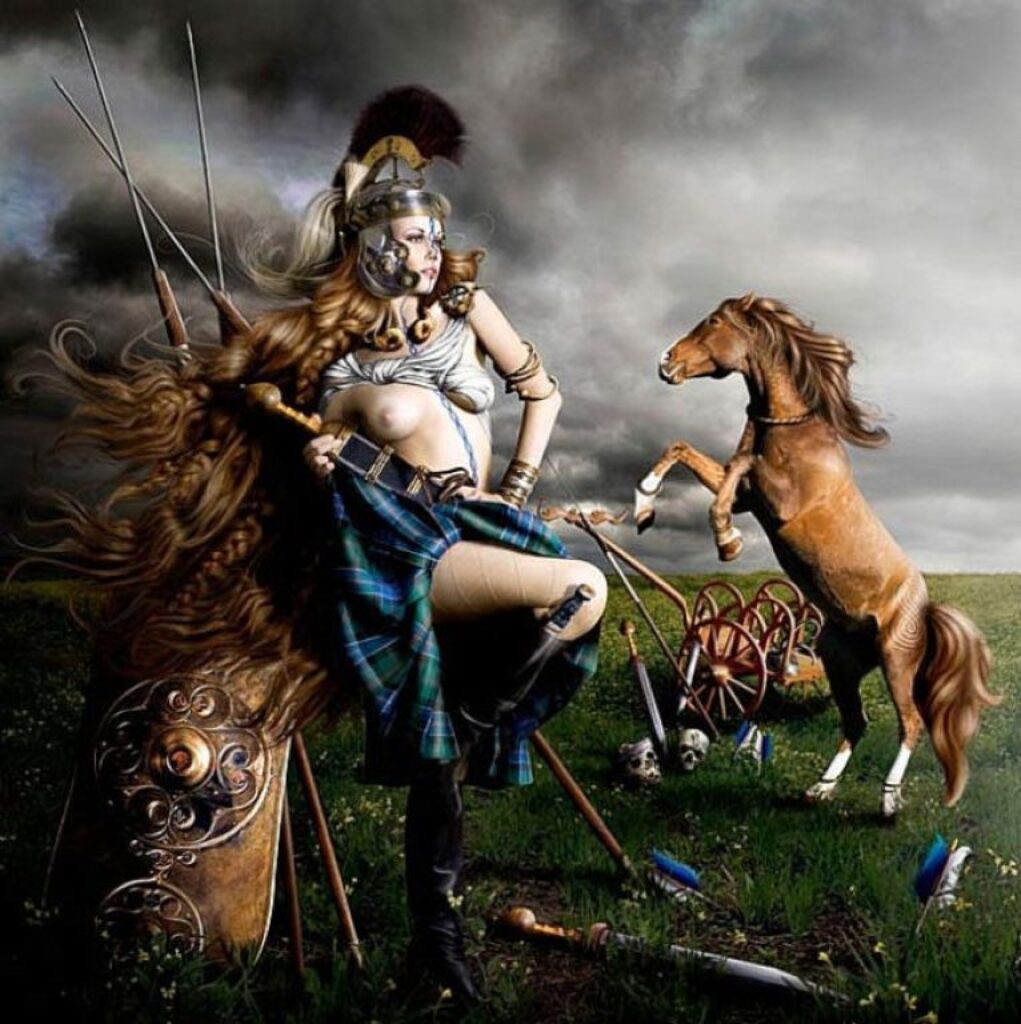
At this point it is worth addressing a story that frequently appears in accounts of Roman treatment of defeated rulers. Boudica really was subjected to terrible humiliation by the Romans—but it did not happen after her rebellion was defeated. It was one of the causes of the rebellion itself.
After the death of her husband Prasutagus, king of the Iceni, relations with Rome deteriorated dramatically. Tacitus reports that local aristocratic property was seized, Boudica herself was flogged, and her daughters were raped. The result was exactly the opposite of whatever Roman officials may have intended. In AD 60 or 61, the Iceni rebelled, other discontented peoples joined them, and the uprising became one of the greatest disasters suffered by Roman rule in Britain. Camulodunum, Londinium, and Verulamium were devastated before Gaius Suetonius Paulinus managed to assemble his forces and crush the rebellion.
The Romans never captured Boudica alive after her defeat. According to Tacitus, she took poison. The popular claim that the Romans abused her family after the rebellion in order to legally invalidate the dynasty therefore reverses the chronology. Nor is there reliable evidence that the rape of her daughters constituted some formal Roman procedure for “annulling” royal legitimacy. Reality is grim enough without the invention: abuses by the Roman administration helped provoke a revolt that nearly destroyed Roman authority across a substantial part of Britain.
And Boudica, like Mithridates and Cleopatra, died before the victors could decide what to do with her.
Antiochus III Lost to Rome—and Remained a King
There is another useful way to test the myth of inevitable Roman vengeance: look not only at kings who were captured, but also at those who knew when to negotiate.
Antiochus III the Great was one of the most powerful monarchs of his age. The Seleucid Empire stretched across enormous territories from the eastern Mediterranean deep into Asia. Then Antiochus intervened in Greek affairs and collided with Rome. The war ended disastrously for him at Magnesia in 190 BC. Under the subsequent Treaty of Apamea, Antiochus lost territories in Asia Minor, accepted an enormous indemnity, faced restrictions on his military power, and was required to provide hostages, among them his son—the future Antiochus IV.
But Antiochus himself was never paraded through Rome in chains.
He made peace and continued ruling what remained of his empire.
That may seem obvious, but the example helps clarify the Roman system. Rome’s objective was not to collect as many kings as possible and strangle them in underground cells. Its objective was to achieve a political result. If a defeated monarch accepted Roman terms and remained useful as a weakened or dependent ruler, destroying him was unnecessary.
The real danger began when a king ceased to be someone with whom Rome negotiated and became something Rome possessed.
Why a Chain Could Be Worse Than a Sword
For a modern reader, the distinction can be difficult to feel completely. We are accustomed to separating the person from the office: a president, prime minister, or king loses power but physically remains the same individual. In the ancient world, authority was far more closely connected to the ruler’s person and to the public recognition of his status. A king appeared before his subjects in a particular way, wore particular clothing, occupied a particular place in ceremonies, and was surrounded by people whose behavior constantly confirmed his position.
The Roman triumph systematically stripped away every one of those signs.
Instead of a throne, there was a road. Instead of a royal entourage, guards. Instead of subjects, a foreign crowd. Most importantly, alongside the captive came material proof that everything he had once controlled now belonged to his conqueror: his gold, his weapons, representations of his cities, and sometimes members of his own family.
And at the center of the procession rode the real protagonist of the performance.
Not the king.
The Roman commander.
In this sense, a captive monarch underwent a kind of political execution before anyone decided what would happen to his body. He might remain alive, but publicly he had already ceased to be the man he once was.
Death could therefore appear to be a perfectly rational choice.
Rome Wanted More Than Victory—It Wanted Victory to Be Seen
Even the famous detail about a slave supposedly standing behind the triumphant commander and whispering, “Remember that you are mortal,” is less certain than it is usually presented. Ancient sources do know of a figure holding a crown over the victor’s head, and later tradition connects the ceremony with reminders of the triumphant general’s human nature. But the familiar phrase itself is not securely attested by the early sources in precisely the form endlessly repeated today.
In a way, that is fitting. The Roman triumph was such a powerful spectacle that later generations continued rewriting its script long after Rome itself had disappeared. From this grew the convenient image of the captured king dragged through the streets in chains while the crowd threw refuse at him, inevitably strangled once the procession ended, as a specially trained slave whispered philosophy into the victor’s ear.
Reality was more complicated—and therefore more interesting.
There was no single answer to the question of what Rome would do with a captured king. Vercingetorix spent years in captivity, waited for Caesar’s triumph, and was executed. Jugurtha appeared in Marius’ triumph and died in the Tullianum. Perseus of Macedon survived his public humiliation and continued living in Italy. Arsinoe IV aroused the crowd’s sympathy and was spared. Antiochus III made peace in time and retained his throne. Mithridates, Boudica, and Cleopatra chose not to discover what fate the victors might have prepared for them.
That is why saying that “kings preferred death to Roman captivity” is both true in some famous cases and much too simple. What they feared was not necessarily guaranteed torture or even certain execution. More frightening was the complete loss of control over their own fate. From the moment of capture, Rome had the final word: the victor decided whether the defeated ruler would live, where he would live, whether he would see his family again, whether he would become a political hostage or a participant in a triumph, and whether his final appearance before the public would end in execution or in the beginning of a long life as a former king.
On the battlefield, a defeated ruler could still choose how to die. In Roman captivity, he could choose almost nothing.
And perhaps that is why Cleopatra, Mithridates, and some of Rome’s other enemies fought so desperately to preserve at least one final decision for themselves.
For Rome, winning the war was not enough. The Romans wanted the defeated ruler to be personally present when they explained to the world exactly who had won it.