Saab Put a Second Person Back in the Fighter: Why the Gripen F Needs an Extra Seat in the Age of AI and Drones

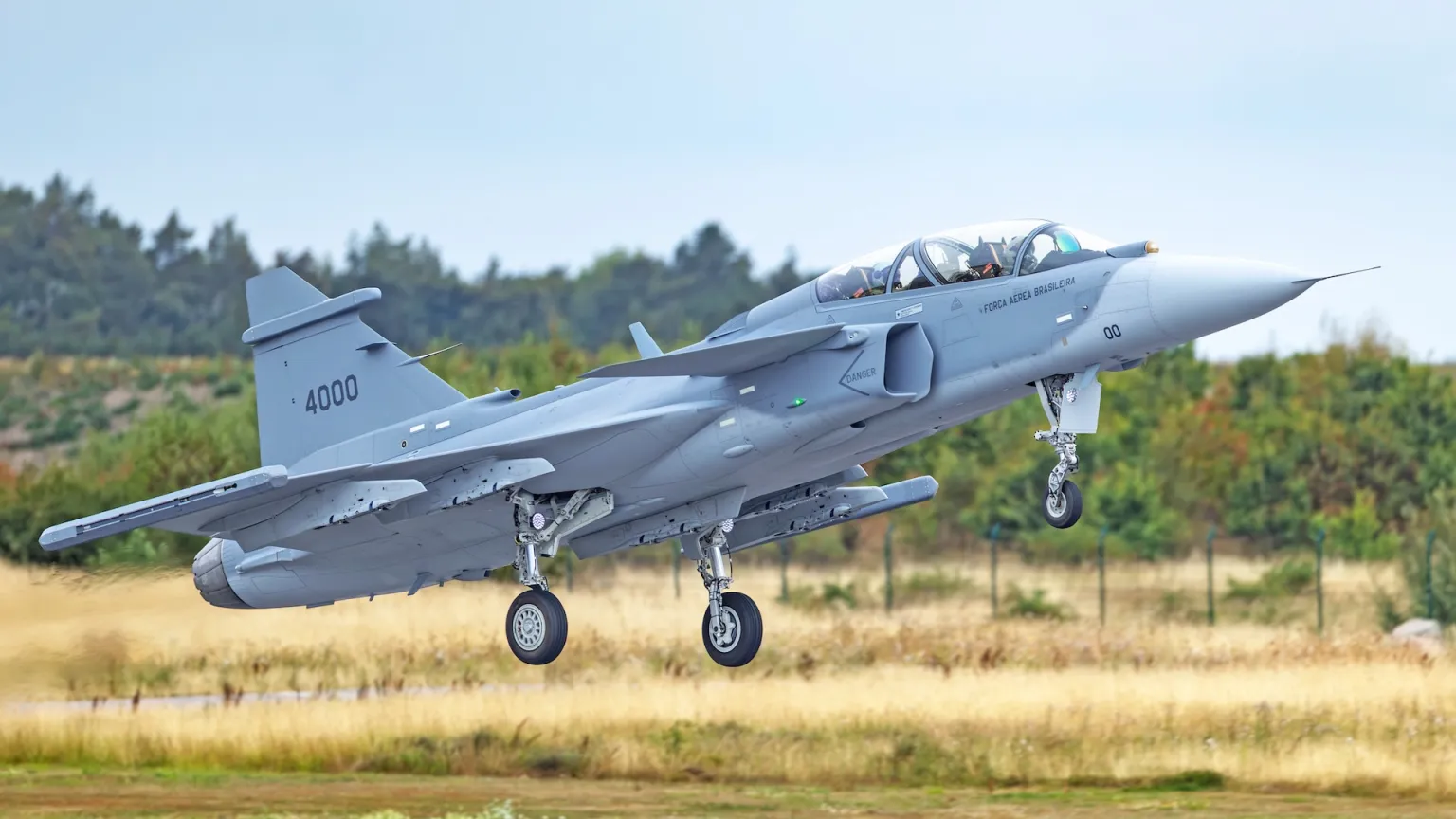
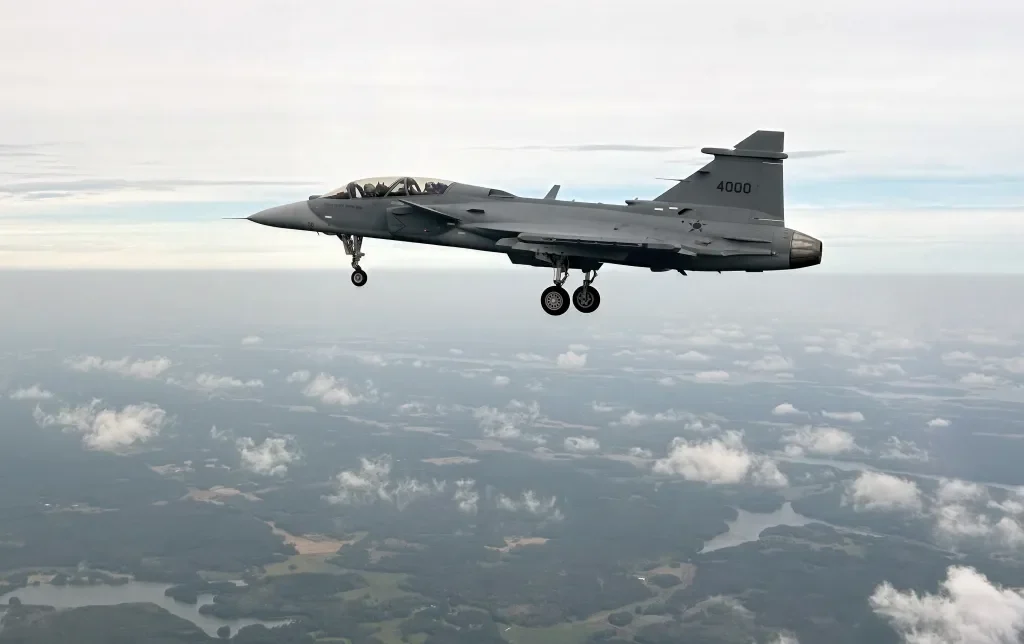
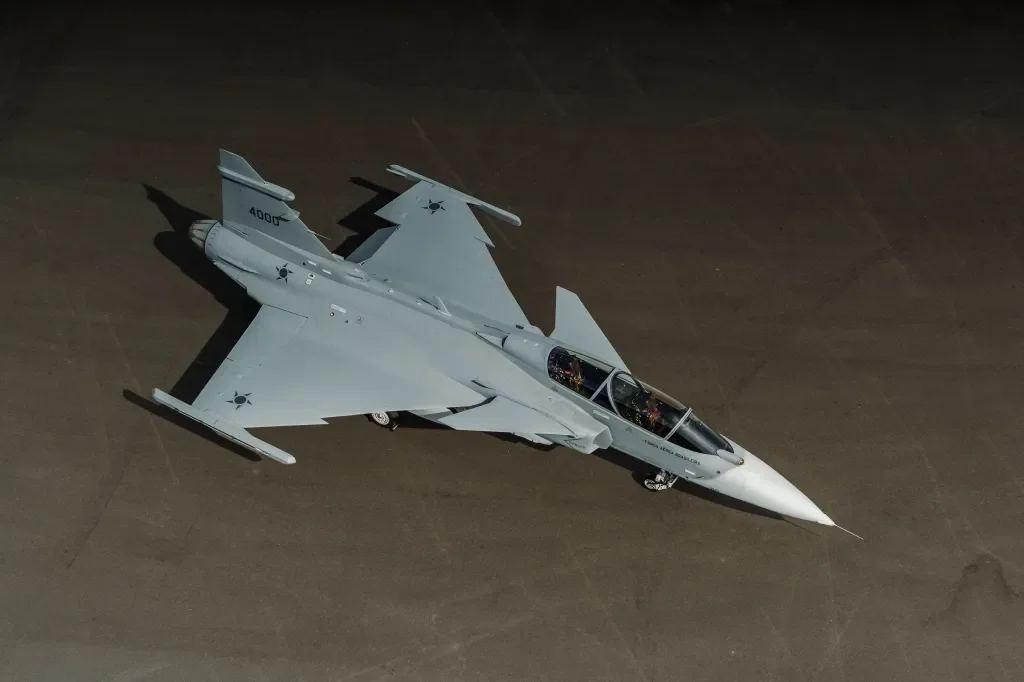
On August 28, 2026, a new fighter took off from Saab’s airfield in Linköping. The flight lasted only 40 minutes. The aircraft did not demonstrate a new missile, record-breaking speed, or any revolutionary performance. In fact, from the outside it looked much like the familiar new-generation Gripen — except that the fuselage was slightly longer and there was now a second seat behind the pilot. This was the maiden flight of the Saab Gripen F, the two-seat version of the Gripen E, developed through cooperation between Saab and Brazilian industry. The first sortie began at 9:40 a.m. local time and marked the start of a full flight-test campaign for the new variant.
At first glance, there is nothing unusual about this. Two-seat versions of combat aircraft have existed for decades and are primarily associated with training. The previous generation of the Swedish fighter consisted of the single-seat Gripen C and two-seat Gripen D, so the appearance of the Gripen E/F pair seems like a natural continuation of the same concept. But the Gripen F becomes much more interesting when Saab’s plans for the aircraft are examined more closely. The company increasingly presents it as more than simply a trainer. Saab explicitly talks about full combat capability and the possibility of using the rear-seat operator to coordinate multiple unmanned systems in real time. And almost simultaneously with the Gripen F’s first flight, Saab unveiled a full-scale concept of its future A3-001 unmanned combat aircraft, intended to operate as part of a network of crewed and uncrewed platforms.
This creates an almost perfect aviation paradox. For the past half-century, electronics have steadily pushed the second crew member out of the fighter cockpit. Computers learned to perform the work of navigators, radar operators, and a significant portion of the weapons systems officer’s duties. A modern Gripen E can be operated perfectly well by a single pilot. But now the number of drones, sensors, and information sources surrounding the aircraft is growing so rapidly that a second person may once again become useful — only this time for an entirely different job.
First, Electronics Made the Second Crew Member Unnecessary
Two-seat combat aircraft did not appear because designers wanted to make fighters more complicated. For a long time, the second crew member was effectively a technical necessity. As combat aircraft became more sophisticated, the workload inside the cockpit increased. In the F-4 Phantom II, the second crew member helped operate the radar and weapons systems. The F-14 Tomcat had a dedicated Radar Intercept Officer. Strike aircraft such as the F-111, Tornado, and later the F-15E were built around dividing the workload between two people. While one flew the aircraft, the other could focus on navigation, target acquisition, radar operation, the electronic environment, and weapons.
Computing technology gradually began eliminating the need for this division of labor. Multifunction displays replaced dozens of separate instruments, digital navigation simplified the navigator’s job, automation took over many routine operations, and sensor fusion allowed the pilot to see a processed tactical picture rather than manually combine information from numerous systems. This is why most modern fighters are designed primarily as single-seat aircraft. The F-16 demonstrated the viability of this approach decades ago, the F-22 has only one pilot despite its sophisticated avionics, and the F-35 made the fusion of radar, electro-optical, electronic warfare, and external sensor data one of the central elements of its entire concept.
The Gripen E follows the same logic. It is a single-seat multirole fighter capable of conducting interception, air combat, strike, and reconnaissance missions on its own. Its pilot does not need a dedicated radar operator or navigator to exploit the aircraft’s capabilities. Moreover, the single-seat Gripen E is the backbone of the new family: Sweden, for example, has ordered 60 aircraft, with the first officially entering Swedish Air Force service in October 2025.
So the second crew member did not appear in the Gripen F because the Gripen E proved too complicated for one pilot.
The original reason was much more straightforward.
The Gripen F Exists Because of Brazil
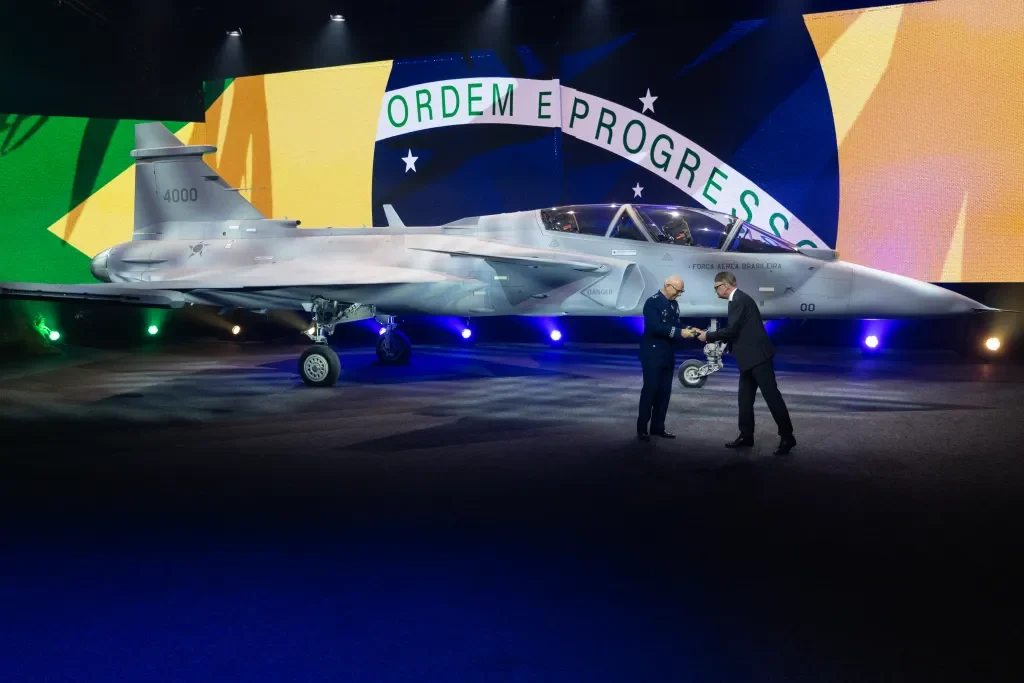
Brazil became the launch foreign customer for the new-generation Gripen and played a crucial role in the development of the two-seat variant. Under the original program, Brazil acquired 36 Gripen E/F fighters, and the requirement for a two-seat version came specifically from the Brazilian Air Force. The program developed into much deeper industrial cooperation than a conventional purchase of finished aircraft. Brazil participated in the development of the Gripen F, received extensive technology transfer, and part of the Gripen fleet is now being manufactured directly at Embraer’s facility in Gavião Peixoto. In March 2026, the first Gripen E manufactured in Brazil was presented.
The original logic behind the Gripen F is easy to understand. Transitioning to a new combat aircraft requires pilot training, and having an instructor in the second cockpit greatly simplifies the process of mastering the aircraft. Saab also sees the F as more than a platform for the final few training sorties before a pilot moves to a single-seat fighter. It can potentially shorten intermediate stages of conversion training by allowing pilots to move directly onto a fully capable combat platform equipped with essentially the same systems and performance as the Gripen E.
If that were the entire story, however, the Gripen F would be a fairly conventional aircraft.
What makes it interesting is Saab’s decision to retain almost all of the Gripen E’s combat capabilities.
This Is Not a Trainer With Reduced Combat Capability
Accommodating the second cockpit required the fuselage to be lengthened. The Gripen E is 15.2 meters long, while the Gripen F stretches to 15.9 meters. Yet the maximum takeoff weight of both versions is listed at 16.5 tons, the engine provides up to 98 kN of thrust, both aircraft have ten external hardpoints, and both retain aerial refueling capability. One notable difference is that the two-seat F does not carry the internal 27mm Mauser BK27 cannon.
Otherwise, Saab presents the E and F as two versions of the same combat system. The Gripen F inherits the Gripen E’s avionics, can employ the same sensors and weapons, and is intended not only for training but also for operational missions. The second station therefore becomes an independent asset: the rear crew member can handle tasks that would otherwise have to be performed by the pilot in a single-seat aircraft.
And this brings us to the reason why the Gripen F may become considerably more interesting ten years from now than it seemed when Brazil originally ordered it.
Because the job of a fighter pilot itself is changing.
The Modern Fighter Pilot Is Becoming the Operator of a Huge Network
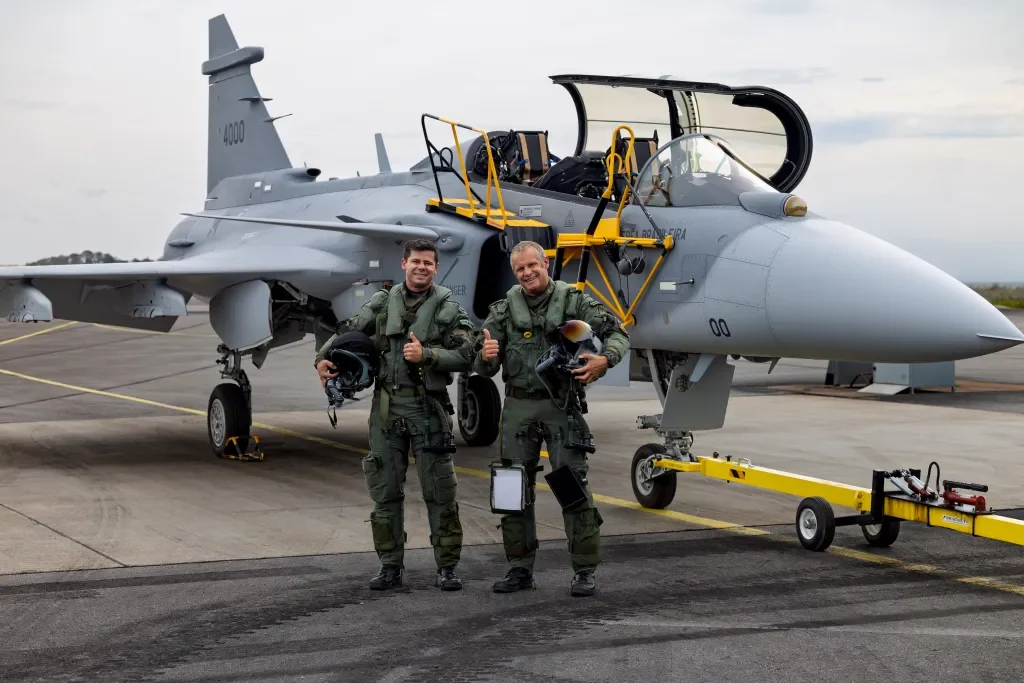
A World War II fighter pilot largely experienced the battle through his own eyes. He searched for the enemy, maneuvered against him, and fired his weapons. A modern fighter exists within an information environment far larger than the aircraft itself. Its own radar is only one source of information. Data can arrive from airborne early warning aircraft, other fighters, ground-based radars, electronic intelligence systems, and other nodes across the battlespace. The Gripen itself can simultaneously act as a shooter, sensor, and information relay.
Automation is essential precisely because a human being cannot process dozens of independent streams of raw data. Computers have to combine them into a coherent picture and show the pilot not a collection of signals, but an understandable tactical situation: the enemy is here, a friendly aircraft is there, an air-defense radar is operating in this sector, and another platform is already tracking this target.
Now another element is entering that network.
Combat drones.
And the problem begins to grow exponentially.
If a single unmanned aircraft is operating alongside the Gripen, the pilot may still be able to supervise it while performing the primary mission. But what happens when there are four? Or six? One carries air-to-air missiles, another acts as an electronic warfare platform, a third performs passive electronic reconnaissance, while a fourth moves ahead to locate enemy air-defense systems.
Of course, the pilot should not fly them manually like remote-controlled aircraft.
But somebody still has to command the system.
And Suddenly the Second Crew Member Makes Sense Again
Saab now openly discusses precisely this kind of role for the Gripen F. The company describes future air combat as an interaction between crewed, uncrewed, and AI-controlled platforms, and specifically notes that the operator in the Gripen F’s rear cockpit could command, control, and coordinate multiple unmanned systems in real time.
This is fundamentally different from the traditional role of a second crew member.
The rear-seat operator would not manually fly every drone. Doing so would largely defeat the purpose of autonomy. Instead, the task would be to manage the mission at a higher level. An unmanned group could be assigned a search area, targets could be distributed, priorities changed, one aircraft ordered to move forward, another to activate electronic warfare systems, and a third to prepare its weapons, while the information collected by all of them is assembled into a common tactical picture.
The front-seat pilot continues doing what remains essential: flying the fighter, monitoring immediate threats, and making decisions necessary to keep the aircraft alive.
The person in the back manages the battle around the aircraft.
At that point, the Gripen F begins to evolve from a conventional two-seat fighter into something much more interesting — a small airborne command post.
Especially If the A3 Joins the Formation
The timing is almost symbolic. Only days before the Gripen F’s maiden flight, Saab publicly unveiled the full-scale A3-001 concept, a prospective unmanned combat aircraft. The company describes it as a potential component of a future system in which crewed and uncrewed platforms operate together, and intends to fly uncrewed demonstrators with fighter-like characteristics before 2030. The A3 itself is being considered as a potential next-stage system that, if Sweden decides to proceed, could emerge in the mid-2030s.
And this is not a small, inexpensive drone. Saab’s concept depicts a stealthy jet-powered aircraft of a relatively high performance class, potentially capable of conducting electronic warfare, suppression of enemy air defenses, reconnaissance, and strike missions. It is effectively being explored as a sophisticated uncrewed partner for the Gripen family.
This does not mean that the Gripen F was originally designed specifically for the A3. Chronologically, that would be incorrect. The two-seat fighter emerged primarily from Brazilian requirements and was already in development long before the current unmanned concept appeared.
But the technologies have unexpectedly converged.
Saab now has a two-seat fighter with a fully capable second workstation.
At the same time, Saab is developing a system in which fighters are expected to cooperate with uncrewed combat aircraft.
Connecting the two ideas seems almost natural.
Drones May Change the Meaning of “Wingman”
The term “loyal wingman” can create a misleading image of future air combat: a crewed fighter flies ahead while a single unmanned aircraft obediently stays beside it. The actual architecture may be much more complex. Several drones could operate far ahead of the crewed aircraft precisely because they can be sent into the most dangerous areas.
Imagine a Gripen F remaining at a safer distance from a powerful enemy air-defense network. Several A3s or other unmanned aircraft operate ahead of it. One passively searches for radar emissions. Another attempts to provoke enemy radars into activating. A third carries electronic warfare equipment. A fourth has weapons ready to attack whatever target is discovered.
The Gripen receives information from the entire group.
The rear-seat operator assembles the common picture and distributes tasks.
The pilot positions the fighter and monitors aerial threats.
If necessary, the missile may not even be launched by the Gripen itself, but by one of the unmanned aircraft.
In such an architecture, the fighter is no longer merely a platform that has to approach the target, detect it, and fire its own weapon.
It becomes a command node for distributed weapons.
And in that case, an additional human being may become more valuable than an additional missile.
This Matters Especially for the Gripen
For decades, Saab has built the Gripen around a somewhat unusual philosophy. Sweden cannot compete with the United States in aircraft numbers and does not possess an aerospace industry on the scale of the United States or France. The Gripen therefore has to gain its advantage through system efficiency: dispersed operations, high availability, relatively simple maintenance, powerful data links, and the ability to adapt quickly to new threats.
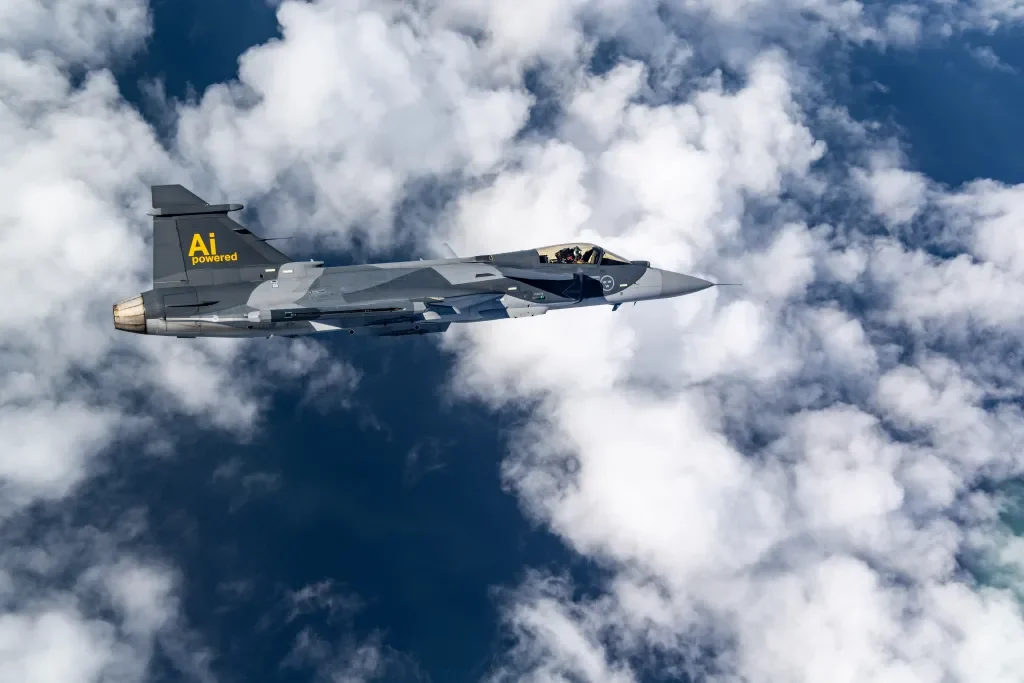
The Gripen E/F takes this philosophy a step further with an open and modular avionics architecture. Saab particularly emphasizes the ability to integrate new software, artificial-intelligence algorithms, and equipment relatively quickly without fundamentally rebuilding the aircraft’s entire avionics suite.
For a conventional fighter, this means new capabilities can be introduced faster.
For a future command aircraft controlling an unmanned formation, it could be even more important.
Unmanned aircraft are likely to evolve much faster than crewed fighters. New drones, autonomy algorithms, communications systems, and methods of target distribution will appear. An aircraft expected to control them cannot afford to wait ten years for another major modernization block.
The Gripen F’s potential advantage therefore lies not simply in having another display and another person.
What matters is that this person sits inside a platform Saab has deliberately tried to make software-adaptable.
There Is Another Reason the Gripen F Matters to Saab
The Brazilian order transformed the aircraft from a national Swedish project into an international industrial program. More importantly, the Gripen F is gradually ceasing to be an exclusively Brazilian requirement.
In 2025, Thailand ordered four new-generation Gripens — three Gripen Es and one Gripen F. Colombia later signed a contract for 17 Gripen E/F aircraft, including 15 single-seat Es and two two-seat Fs.
A clear pattern is emerging. Customers do not buy the F in the same numbers as the E — nor do they need to. The single-seat fighters form the backbone of the squadron, while a handful of two-seat aircraft provide training while remaining fully capable combat platforms.
But that same ratio could be almost ideal for a future command role.
Imagine a squadron with twelve or sixteen Gripens. There is no need to turn every fighter into a two-seat command aircraft. Most Gripen Es continue performing conventional missions. One or two Gripen Fs, when required, fly with two-person crews and become coordinators for more complex operations involving unmanned aircraft.
Saab therefore does not have to choose between the single-seat and two-seat fighter.
They can complement each other.
The F-15E Was Right — But for an Entirely Different Reason
The continued existence of two crew members in a modern combat aircraft is not itself unusual. The F-15E Strike Eagle has demonstrated for decades that complex strike missions can provide more than enough work for both a pilot and a weapons systems officer. Two-seat versions of the Rafale also exist, while several other modern combat aircraft retain fully capable twin-seat variants.
But drones could fundamentally change the purpose of that second seat.
In the past, the second crew member was necessary because one aircraft was too complicated for one person.
In the future, the second crew member may be necessary because one person has to control too many aircraft.
That is a fundamental difference.
And it is what makes the Gripen F story much more interesting than a routine report about the maiden flight of another fighter variant.
Saab May Have Accidentally Built the Right Aircraft for the Next Stage of Air Warfare
It would be wrong to claim that the Gripen F was designed specifically as a command aircraft for unmanned systems. That would rewrite the history of the program after the fact. The aircraft emerged from Brazil’s requirement for a fully capable two-seat training and combat version of the Gripen E. That is the role it needs to perform today, the reason it was built, and the mission with which its service life will begin.
But military aircraft routinely acquire roles that did not exist when they were originally designed. In the Gripen F’s case, several factors have converged: a fully functional second workstation, Gripen E combat avionics, an open software architecture, advanced data links, and Saab’s own emerging program for future uncrewed combat aircraft.
Ten years from now, therefore, the most valuable difference between the Gripen F and Gripen E may not be the ability to put an instructor in the back.
The most valuable feature may simply be that there is room for a second human being at all.
Combat aviation spent almost half a century moving in the opposite direction. Automation allowed one pilot to perform jobs that once required two people. Sensor fusion removed the need to manually assemble information from dozens of instruments. Artificial intelligence promises to reduce the workload even further. The logical endpoint seemed to be the complete removal of humans from combat aircraft.
But something unexpected happened at the same time.
The number of machines that humans may have to command began to increase.
One Gripen becomes a Gripen plus several drones. Then come external sensors, airborne early warning aircraft, ground-based systems, satellites, and other nodes in the wider network. Computers can process enormous amounts of information, but in many scenarios the final decisions about weapons employment and task allocation may still remain with humans.
And so the second crew member returns.
Not as a navigator.
Not as a radio operator.
Not as someone helping the pilot operate the radar.
But as the operator of a small air war taking place around the fighter.
That is why the Gripen F’s first 40-minute flight may ultimately prove more significant than it initially appears. For now, Saab has simply begun testing the two-seat version of its latest fighter. At the same time, however, the company is already showing the uncrewed aircraft that such a fighter could potentially command.
The result is a remarkable technological paradox: computers first allowed the second person to be removed from the fighter cockpit. Now artificial intelligence and drones may create such a complex aerial system that the second person has to be brought back.
And if this is what air warfare in the 2030s begins to look like, the Gripen F may turn out not to be a belated return to the two-seat fighters of the past, but an early indication of why two-seat fighters could once again become valuable in the future.