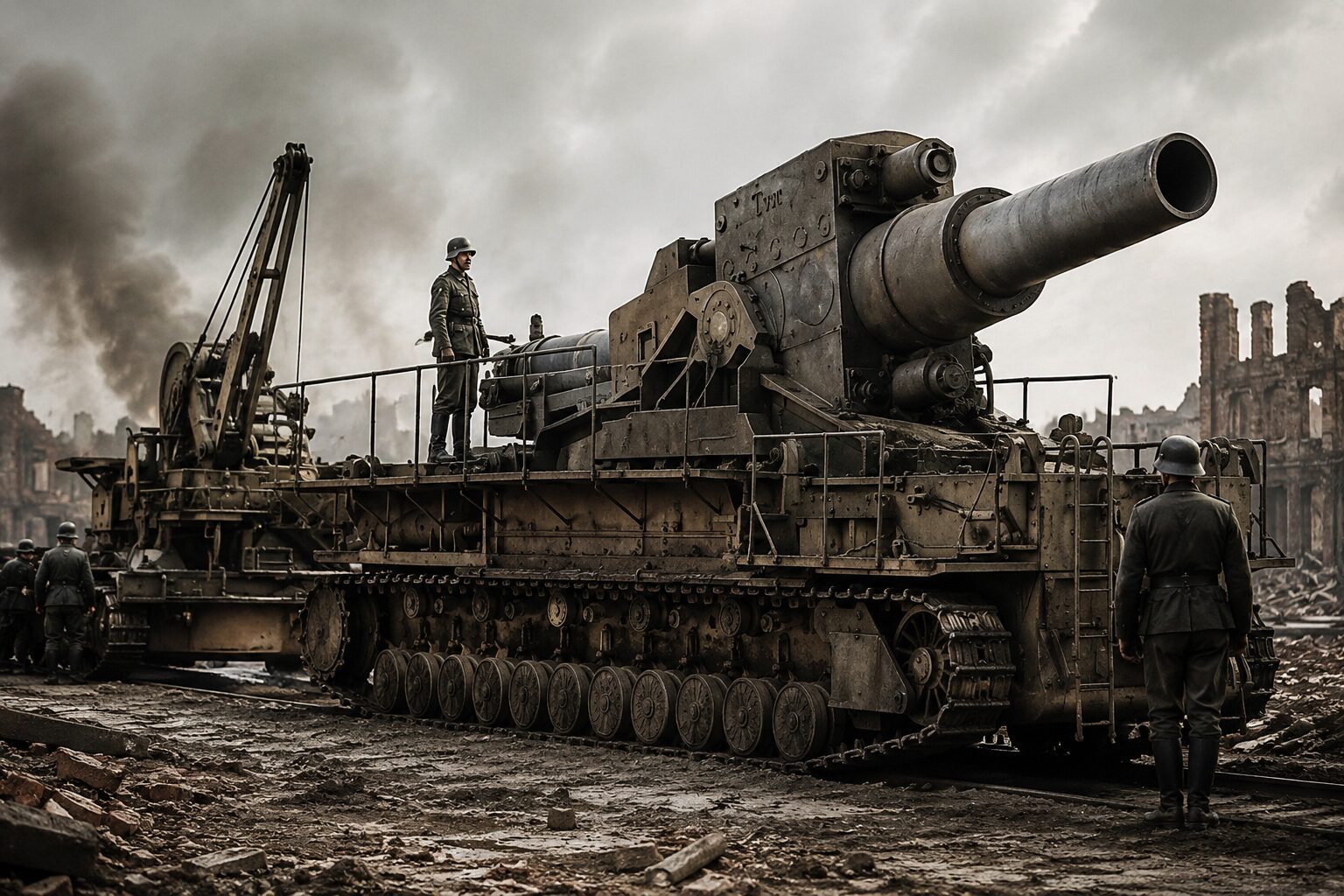
The history of German weapons development during World War II is full of machines that today look like products of almost pathological gigantomania. The 188-ton Maus, the 800mm Dora railway gun, plans for land cruisers — against this background, the Karl-Gerät self-propelled mortar seems almost inevitable. It weighed more than 120 tons, moved on tracks at walking speed, and fired shells that could not even be handled without a crane. Only seven machines were built, while the original Gerät 040 fired a 600mm concrete-piercing shell weighing as much as 2,170 kilograms. The later Gerät 041 reduced the caliber to “only” 540mm and used a projectile weighing around 1,250 kilograms.
It is easy to stop here and conclude that this was simply another German wonder weapon into which enormous resources were poured for questionable results. But the Karl-Gerät story is more complicated. In the late 1930s, the problem it was designed to solve was very real: Germany expected to face some of the most formidable reinforced-concrete fortifications in Europe, and reliably destroying several meters of concrete with ordinary field artillery was extremely difficult. Rheinmetall was therefore effectively asked to develop a mobile system capable of delivering a two-ton concrete-piercing projectile. And the word “mobile” is crucial.
The Karl was not a conventional self-propelled artillery system. Its tracks were never intended to let it march alongside Panzer divisions. It was fundamentally a traditional siege mortar equipped with its own engine so that, after being transported close to a fortress, it could cover the final few kilometers under its own power, occupy a prepared firing position and open fire.
Then came the irony that would define the entire history of the Karl-Gerät.
The weapon developed primarily to smash the Maginot Line was barely needed against the Maginot Line at all.
Germany Was Preparing to Break French Concrete
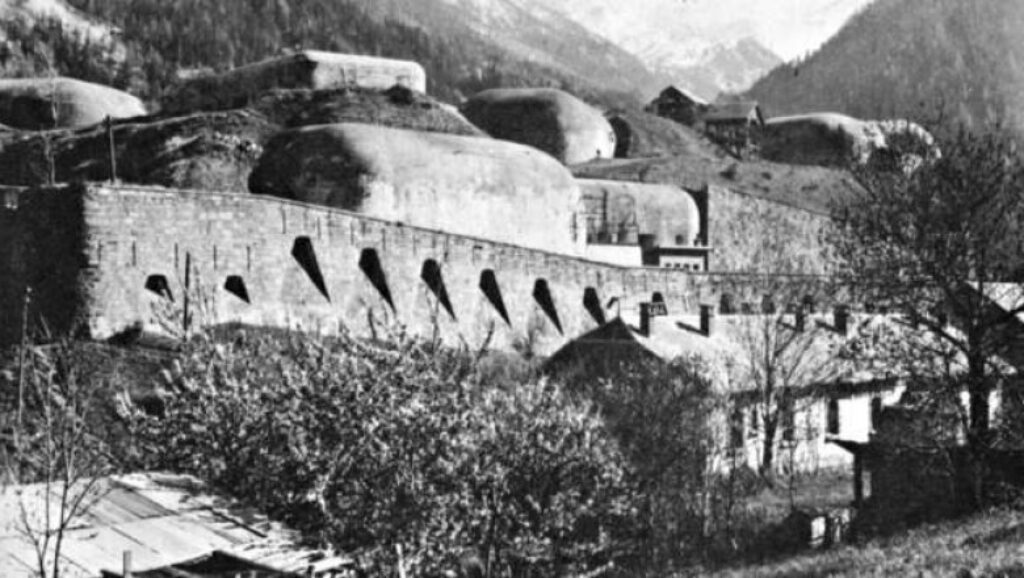
After World War I, European armies remembered very well how serious an obstacle permanent fortifications could become. France drew particularly ambitious conclusions from that experience. The Maginot Line was not simply a continuous concrete wall, but a sophisticated network of large ouvrages, smaller fortifications, artillery positions, armored turrets, anti-tank obstacles and extensive underground complexes. For Germany, this created a practical question: what would happen if a future offensive actually had to grind its way through such defenses?
One answer was super-heavy artillery. Rheinmetall began work on what would become the Karl-Gerät before the war, and the original version received the designation Gerät 040 and a short-barreled 600mm mortar. Seven machines were ultimately manufactured between 1940 and 1942, including the prototype. The six production vehicles received the famous individual names Adam, Eva, Odin, Thor, Loki and Ziu.
But while engineers were turning the project into a functioning weapon, the German Army solved the Maginot Line problem in a completely different way. In May 1940, the main German offensive came through the Ardennes, allowing German forces to penetrate into the operational rear of the principal Allied armies. The fortifications did not simply disappear, and some sectors still had to be attacked directly, but the strategic problem was solved through maneuver rather than systematic siege warfare.
The Karl-Gerät had arrived too late for the war it had originally been designed to fight.
Germany, however, now possessed an extraordinary weapon capable of performing tasks that almost no other land-based system could accomplish.
2,170 Kilograms Flying Into a Single Concrete Casemate
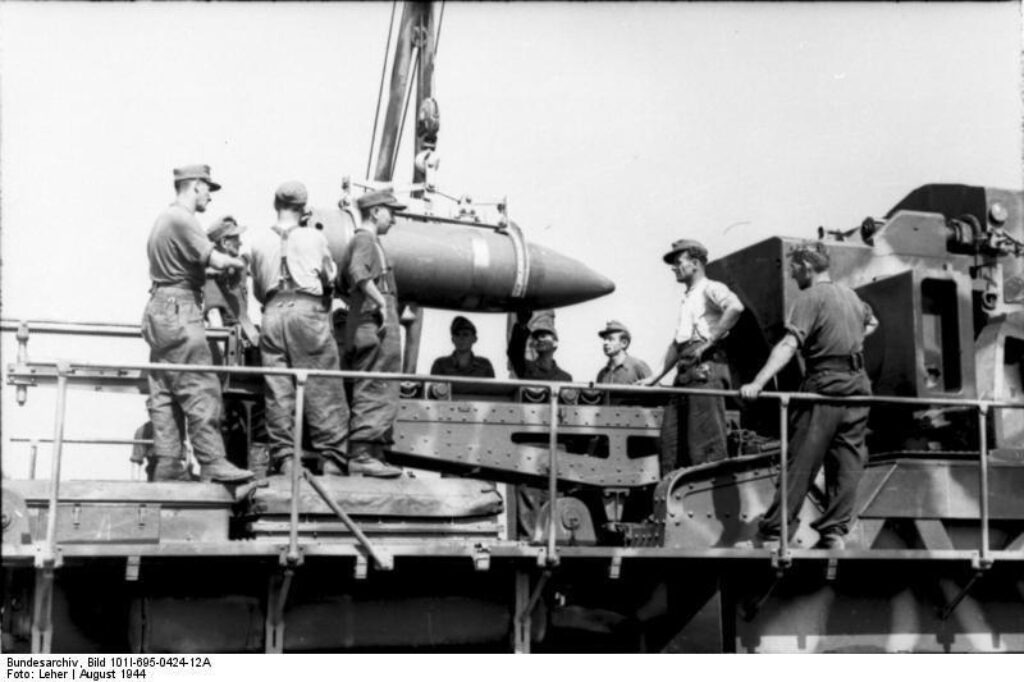
The main argument of the Gerät 040 was its heavy 600mm concrete-piercing projectile. It weighed approximately 2,170 kilograms, including roughly 289 kilograms of explosive. Muzzle velocity was only around 220 meters per second, while maximum range was approximately 4.3 kilometers. A later, lighter 1,700-kilogram concrete-piercing projectile could be fired at around 283 meters per second to approximately 6.4 kilometers. The heavy projectile was credited with the ability to penetrate more than two meters of reinforced concrete.
By modern standards, the range seems almost absurd. Ordinary field artillery could shoot farther. But range was never the primary purpose of the Karl.
Its mission was to deliver a projectile weighing almost as much as a small automobile against a relatively close, previously identified and stationary target.
The physics involved were very different from those of an ordinary high-explosive artillery shell. A concrete-piercing projectile had to survive impact with a massive obstacle, penetrate into it or break apart its structure, and only then detonate. The enormous caliber made it possible to combine an exceptionally strong shell body with hundreds of kilograms of explosive. Even when complete penetration did not occur, the impact imposed enormous mechanical loads on concrete, structural elements and equipment inside the fortification.
This is why comparing the Karl with an ordinary howitzer is misleading.
In terms of purpose, its projectile was much closer to an air-dropped bunker-busting bomb delivered by a gun instead of an aircraft.
And this leads to the central question: if the weapon was designed to fire only a few kilometers, why put it on tracks at all?
A Self-Propelled Gun That Could Barely Go Anywhere
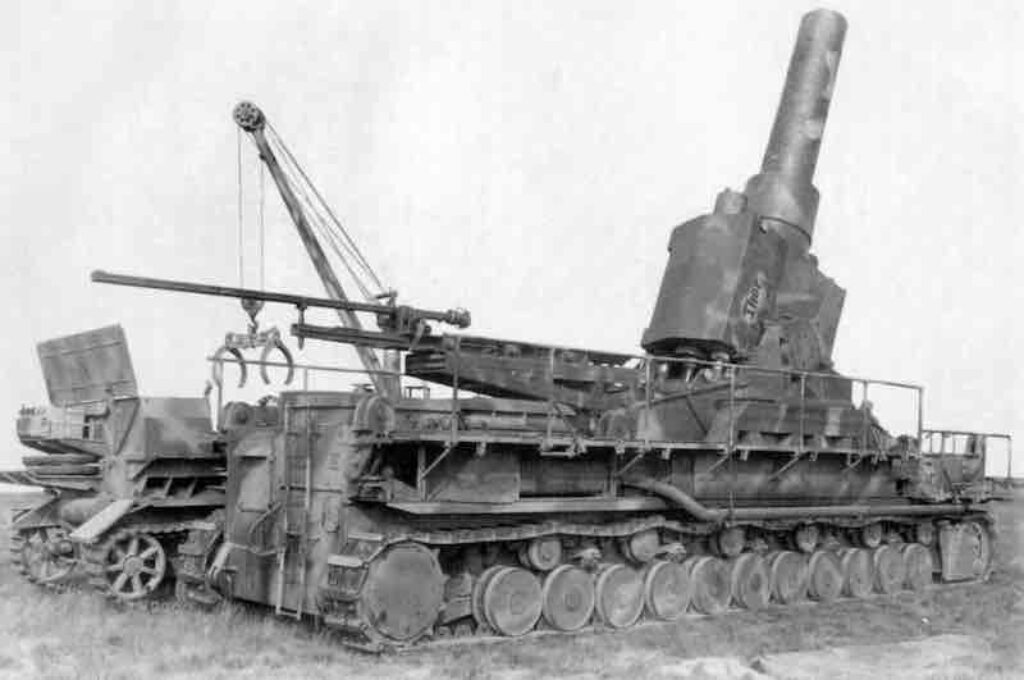
The Gerät 040 weighed around 124 tons, while the Gerät 041 was approximately 126 tons. Depending on the individual vehicle, power came from either a Daimler-Benz MB 503A gasoline engine or an MB 507C diesel producing roughly 580 horsepower. With that kind of power-to-weight ratio, tank-like mobility was impossible. Maximum speed was only around 6–10 km/h, while operational range under its own power was measured in mere tens of kilometers.
Driving a Karl from Germany to Sevastopol was therefore not simply impractical. It was absurd.
For long-distance transport, the Germans developed a dedicated railway system. The enormous mortar was suspended between two specially designed railway bogies, effectively turning the vehicle itself into cargo carried inside its own transporter. Special road-transport arrangements were also developed, involving partial disassembly of the machine. Independent movement generally began only after the Karl had reached the vicinity of its firing position.
This is where the logic behind the design becomes clear.
If the Germans had built an ordinary 600mm siege mortar, it would still have needed to travel toward the front by rail. Its enormous components would then have to be unloaded, transported to the firing position, assembled, mounted on a prepared foundation and only then made ready to fire. Moving to another position would require much of the process to be repeated.
The Karl solved precisely this problem.
It arrived in the operational area by rail and then became an independent vehicle. It could leave its transporter, slowly crawl toward a prepared position, orient itself toward the target and later move away under its own power.
The Karl-Gerät is therefore better understood not as an enormous self-propelled gun.
It was a siege mortar given tracks so that it did not have to be assembled again before every battle.
But a Two-Ton Shell Created Its Own Problem
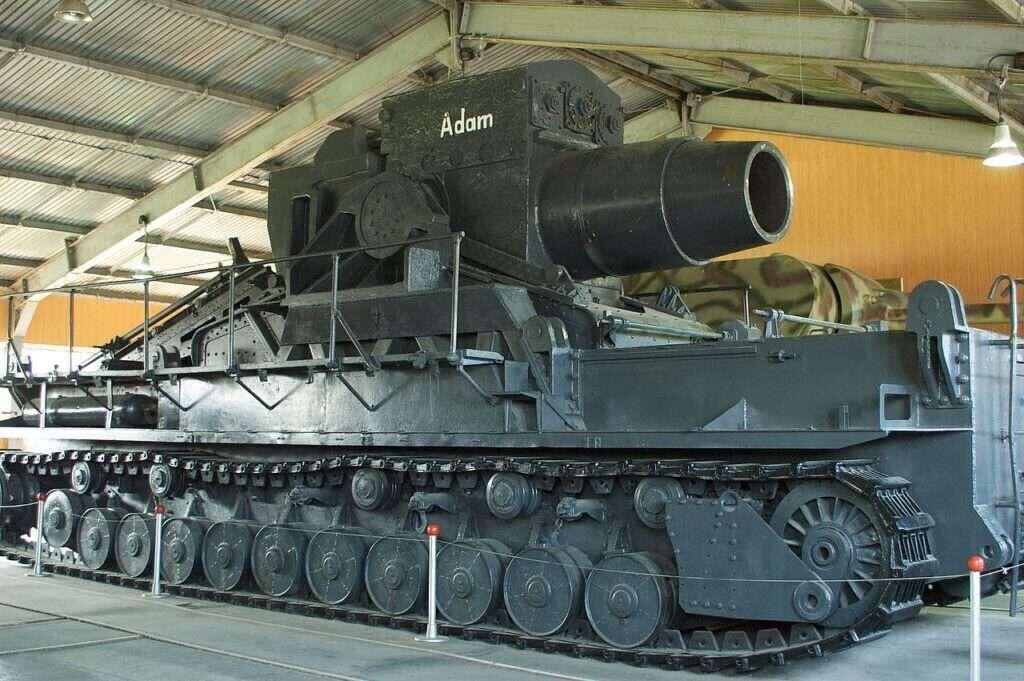
Even after engineers had made a 120-ton gun self-propelled, one rather obvious question remained: how do you load it?
A human being cannot even move a two-ton projectile.
The Germans therefore had to create a small logistical ecosystem around every Karl. Special Munitionsschlepper für Karl-Gerät ammunition carriers were built on Panzer IV chassis. Their turrets were removed and replaced with a cargo platform for several enormous shells and a crane capable of transferring a projectile onto the mortar’s loading tray. More than twenty Panzer IV chassis were converted for this role, with several ammunition carriers normally assigned to each Karl.
And ammunition was only part of the problem.
The system required railway transporters, maintenance units, gun crews, engineering personnel, communications, target reconnaissance and prepared firing positions.
The Karl-Gerät itself was therefore only the most visible component of a much larger complex.
This produces another apparent paradox. The rate of fire was approximately one round every ten minutes. At first glance, it seems absurd to drag what amounted to a small mobile artillery factory across Europe merely to fire six rounds per hour.
But counting shots without considering their mass is misleading.
Six heavy Gerät 040 projectiles represented almost 13 tons of shells delivered against fortifications in a single hour. And each one was intended not to suppress infantry over a broad area but to destroy a specific structure.
If that structure was a fortress capable of delaying an entire corps, the expense of moving several railway loads of specialized equipment suddenly looked less irrational.
There was, however, another problem.
The Karl had to get within four to six kilometers of its target.
So the Germans Reduced the Caliber
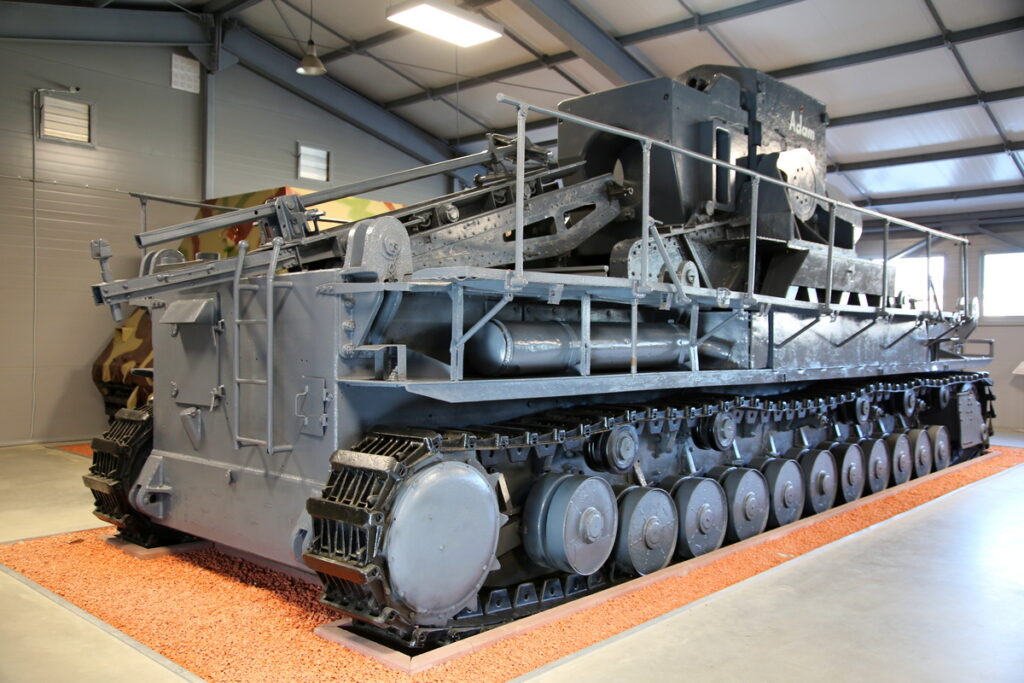
At first glance, the next stage in the Karl’s development seems completely illogical. Germany had built a monstrous 600mm mortar — and then decided to make it smaller.
The result was the Gerät 041.
The caliber was reduced from 600 to 540mm, while the barrel was considerably lengthened to approximately L/11.5. The concrete-piercing projectile became lighter at around 1,250 kilograms, muzzle velocity increased to roughly 378 m/s, and maximum range rose to approximately 10 kilometers.
This is what makes the Gerät 041 particularly interesting.
The 600mm Karl had been built around maximizing destructive effect against fortifications. The Gerät 041 represented an attempt to make the same basic concept somewhat more practical.
The Germans effectively exchanged almost a ton of projectile weight for several additional kilometers of range.
It was a perfectly rational compromise. An artillery system with a maximum range of four kilometers was forced to operate dangerously close to enemy defenses. Ten kilometers still did not make the Karl a long-range artillery weapon, but it dramatically expanded the number of possible firing positions.
At the same time, the destructive power of the 540mm projectile remained enormous. Reference data commonly credits the Gerät 041 concrete-piercing projectile with the ability to penetrate roughly 3–3.5 meters of reinforced concrete.
Reducing the caliber therefore did not necessarily mean reducing practical effectiveness.
On the contrary, the Gerät 041 demonstrated one of artillery’s oldest lessons: the heaviest projectile in the world is useless if the gun cannot safely get close enough to its target.
The modernization came very late, however. Development dragged on, and the 540mm version reached maturity only during the final years of the war. Only three 540mm barrels appear to have been manufactured for conversion of existing machines.
The Karl’s battlefield reputation was therefore earned primarily with its original 600mm mortars.
At Brest, Germany Discovered That Even a Two-Ton Shell Could Not Solve Every Problem
The Karl-Gerät received its first major combat test during the German invasion of the Soviet Union in the summer of 1941. Two machines were deployed against the Brest Fortress.
On paper, it was difficult to imagine a more appropriate target. Massive brick and concrete structures, casemates and fortifications — almost exactly the kind of problem for which super-heavy artillery had been developed.
But actual combat quickly exposed a fundamental limitation of such systems.
An enormous projectile could indeed destroy a structure.
But a fortified area is not a single structure.
Destroying one casemate or building does not automatically eliminate every defending unit. A garrison can move between positions, use basements, ruins and communications passages. Some shells may fail to detonate. Accuracy is also far from absolute.
This is essential to understanding the entire history of super-heavy artillery.
The destructive power of a single hit and the operational effectiveness of a weapon are two very different things.
The Karl could create an enormous crater.
It could not provide a button marked “delete fortress.”
Sevastopol Was the Kind of War the Karl Had Actually Been Built For
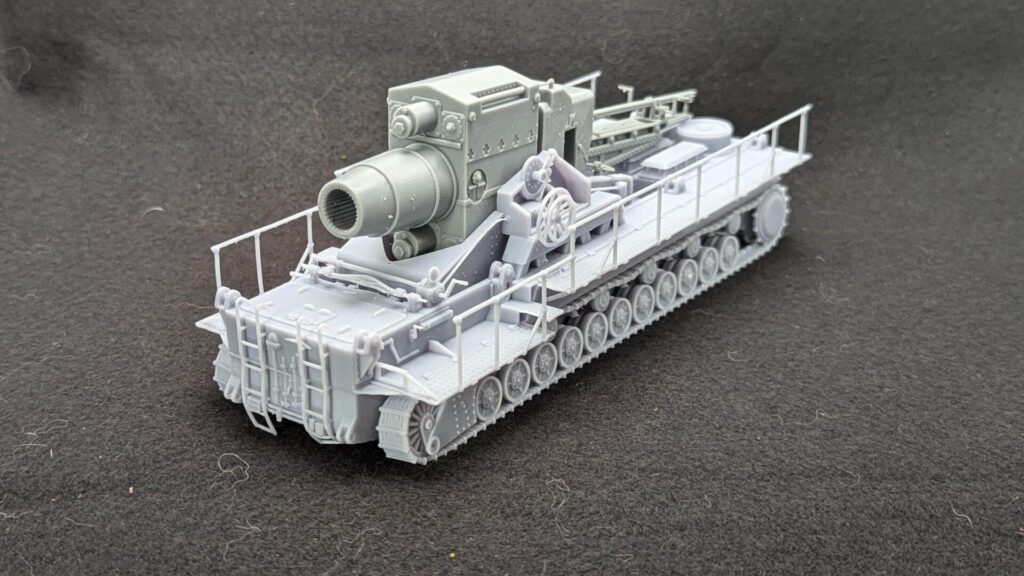
The situation during the siege of Sevastopol in 1942 was very different. Here, the German 11th Army under Erich von Manstein had the opportunity to prepare an enormous artillery concentration in advance to break Soviet defenses.
The Karl became part of this system.
Firing positions were selected and prepared beforehand. The preparations could be extensive: large excavated positions were constructed to shelter the huge machines and place them correctly in relation to their targets. Descriptions of the positions mention pits roughly 10 meters wide, 15 meters long and around 3 meters deep.
This no longer resembles conventional self-propelled artillery at all.
Nobody expected the Karl to suddenly drive onto a battlefield, fire several rounds and disappear.
Reconnaissance first identified the target.
Engineers prepared the positions.
The guns and ammunition arrived by rail.
Ammunition carriers moved forward.
Firing data was calculated.
Only then did the mortar begin its work.
The Karl operated alongside conventional heavy artillery and other super-heavy weapons, including the famous 800mm Dora railway gun. But that combination itself explains the Karl’s real purpose. Germany never expected one giant gun to win the siege on its own.
The Karl was a specialized tool within an enormous system designed to dismantle a fortified area.
When there was enough preparation time, railway access and a stationary target valuable enough to justify the expenditure, the concept could work.
The problem was that modern warfare was producing fewer and fewer situations like this.
In Warsaw, the Siege Mortar Found a Different Kind of Fortress
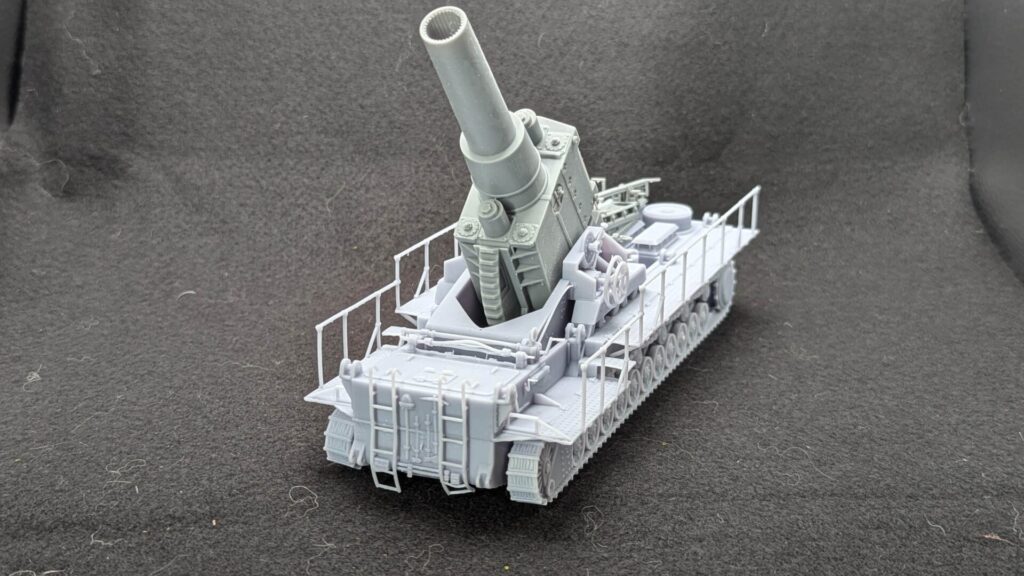
In August 1944, the Karl-Gerät appeared in Warsaw during the suppression of the Warsaw Uprising. Some of the best-known photographs show Ziu, a giant 600mm Karl, operating in the urban environment.
The mission had changed. There were no Maginot Line ouvrages or massive coastal fortifications like those around Sevastopol.
Instead, the city itself had become a fortified area.
Stone buildings, basements, barricades and dense urban construction created positions against which the enormous destructive power of a 600mm shell could again be used. One of the most famous episodes involved a dud Karl-Gerät projectile that struck Warsaw’s Prudential building. Other unexploded shells recovered in the city later became direct physical evidence of the super-heavy mortar’s use there.
But Warsaw simultaneously demonstrated how strange the Karl’s existence had become.
The weapon had been developed to destroy French fortifications.
Its first major combat use came against a Soviet fortress.
It later participated in the enormous siege of Sevastopol.
And a few years later it was firing into the buildings of a European capital.
The Karl kept searching for the kind of war it had been designed to fight.
And that kind of war was gradually disappearing.
The Karl’s Greatest Enemy Was Not Concrete
From an engineering standpoint, Rheinmetall solved the problems it had been given.
Need a weapon capable of launching a two-ton projectile? Build one.
Need to make it self-propelled? Give it tracks.
Need to transport it? Develop special railway carriers.
Humans cannot lift the ammunition? Convert Panzer IV chassis into crane-equipped ammunition carriers.
The 600mm mortar does not have enough range? Develop the 540mm Gerät 041 capable of reaching approximately ten kilometers.
Every individual engineering problem had a solution.
But the combined system became heavier and heavier.
The Gerät 041 itself weighed around 126 tons. Each projectile weighed 1.25 tons. Ammunition carriers were required. Railways were required. Prepared firing positions were required. Large numbers of personnel were required. The rate of fire remained only a few rounds per hour. And the target had to be both important enough and stationary enough to justify all of this.
That final problem could not be solved by engineering.
Because warfare itself was changing.
An Aircraft Could Do the Same Job — From Hundreds of Kilometers Away
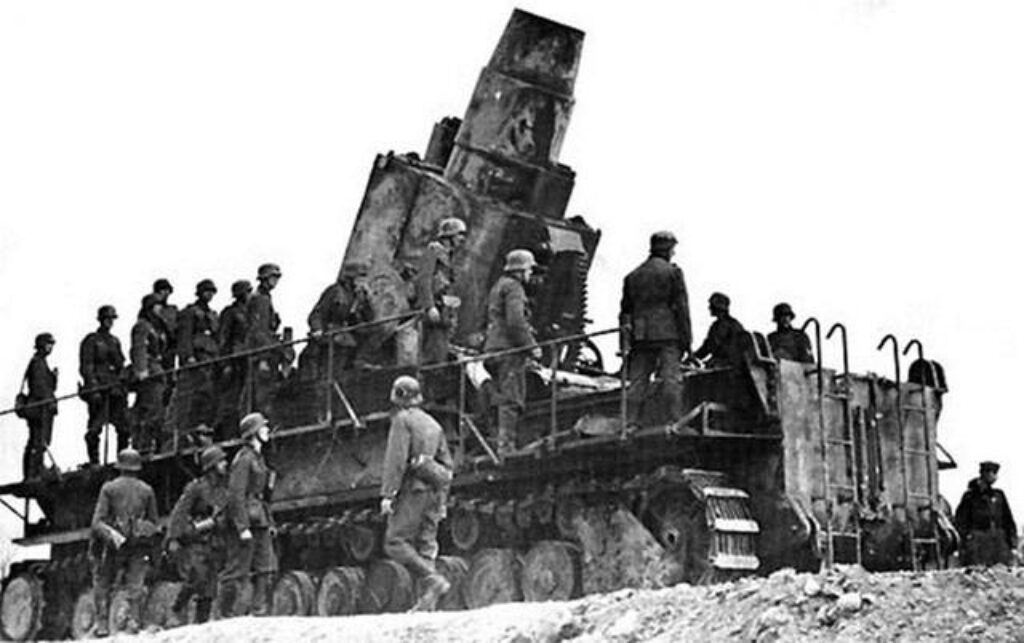
Super-heavy artillery had existed long before the Karl. As long as heavily fortified positions could only be reliably destroyed by enormous projectiles, armies were willing to tolerate the logistical nightmare associated with giant siege guns.
But aircraft gradually changed the equation.
If a two-ton projectile could instead be carried beneath an aircraft and delivered from hundreds of kilometers away, the logic of building a 120-ton tracked artillery system to launch it became much less convincing. During World War II, the British effectively pushed this concept to its logical extreme with the five-ton Tallboy and ten-ton Grand Slam earthquake bombs designed for exceptionally hardened targets.
After the war came guided bombs, ballistic missiles and increasingly accurate precision weapons.
At that point, the Karl-Gerät was effectively doomed.
Not because its shell lacked destructive power.
But because increasingly convenient ways existed to deliver the same — or greater — destructive effect to the target.
An aircraft did not require a railway leading toward the front.
A missile did not require an excavation the size of a house.
And most importantly, their effective reach was no longer measured in four or even ten kilometers.
Gerät 041 Was Both the Best Karl and the Last Karl
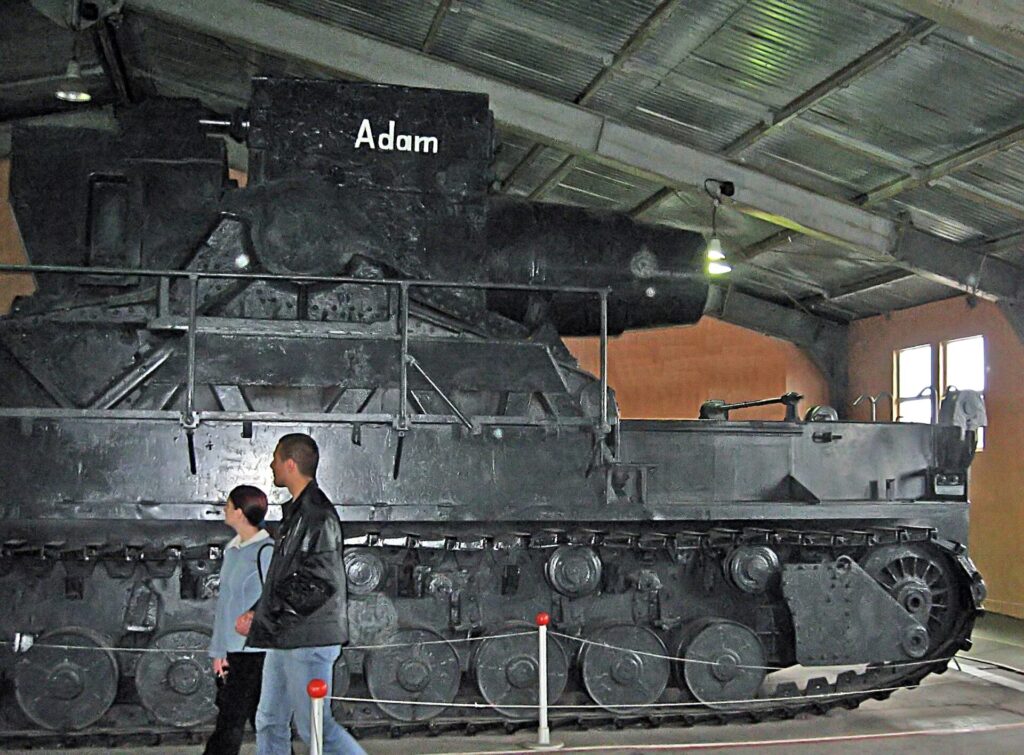
In this respect, the 540mm Gerät 041 is particularly revealing.
It corrected one of the original machine’s greatest weaknesses. The lighter 1,250-kilogram shell could reach approximately 10 kilometers, compared with around 4.3 kilometers for the heavy 2,170-kilogram Gerät 040 projectile.
The obvious next step might appear to be reducing the caliber further, lengthening the barrel, increasing muzzle velocity and gaining still more range.
But continue that process far enough and eventually you simply create a conventional heavy artillery system.
The entire reason for the Karl’s existence disappears.
Its value came precisely from its ability to do something almost no other land-based gun could do: launch an extraordinarily heavy concrete-piercing projectile.
Reduce the projectile weight in pursuit of range, and the system gradually loses its defining advantage.
Increase the projectile weight, and range falls back to only a few kilometers.
This was a technological dead end created not by poor engineering, but by a fundamental contradiction in the concept itself.
The Karl-Gerät Was Not Pointless — But It Only Made Sense Under Very Specific Conditions
Today, it is easy to compare the development effort, seven completed machines, enormous logistical requirements and relatively limited combat use, and then dismiss the Karl-Gerät as another expensive mistake of Nazi Germany.
That conclusion is too simple.
When development began, the problem was entirely real. Europe was covered with fortifications, France had invested enormous resources in the Maginot Line, and Germany could not know in advance that the campaign of 1940 would be decided by operational maneuver. Had the Wehrmacht actually been forced to systematically smash its way through major ouvrages, a weapon capable of dropping two-ton shells onto their concrete roofs would have looked considerably less absurd.
The Karl-Gerät ultimately was used against fortresses and fortified urban areas. It could destroy structures that posed serious problems for ordinary artillery. And the Gerät 041 demonstrates that German engineers were not simply chasing maximum caliber: they attempted to correct the system’s practical weaknesses by deliberately reducing projectile size in exchange for almost twice the range.
Only seven Karl-Gerät machines were built, and only a handful of 540mm Gerät 041 barrels were produced.
But the most important lesson of the Karl lies precisely in how quickly a rational specialized weapon can become an anachronism.
The Karl was designed for a world in which a concrete fortress could stop an army and destroying it required artillery positioned only a few kilometers away.
World War II began in something close to that world.
It ended in another.
By the age of long-range bombers, enormous aerial bombs, rockets and the first generations of guided weapons, the need to transport a 126-ton gun to the vicinity of a fortress was becoming increasingly difficult to justify.
And that is why the most interesting question about the Gerät 041 is not why Germany built such an enormous mortar. There was, in fact, a perfectly rational answer to that question.
The more interesting question is this:
How quickly did warfare change if a weapon conceived as a logical answer to one of Europe’s greatest military problems managed to become obsolete almost within the span of its own development?