
Equalizer: What Ukraine’s New Glide Bomb Actually Is and How Close It Is to Russia’s UMPK

At first glance, this is one of the simplest types of modern air-launched weapon. An aircraft releases a bomb, its wings deploy, the guidance system corrects its trajectory, and the weapon glides toward a pre-programmed target. There is no turbojet engine, no sophisticated propulsion system, and no terrain-following flight at low altitude. Yet weapons of this type have become one of the most important categories of air-delivered munitions in recent years. The reason is straightforward: they can provide substantial stand-off range at a cost far below that of a full-fledged cruise missile.
Ukraine has now developed a weapon of this class of its own. The system developed by DG Industry is called Vyrovniuvach, commonly translated in English-language reporting as Equalizer or Leveller. The first relatively detailed information about the weapon emerged in spring 2026, it was displayed at Eurosatory in June, and on August 18, TWZ published additional technical details obtained directly from Ukraine’s Brave1 technology cluster.
One of the most important clarifications concerns propulsion: the current Equalizer has no engine. It is a pure glide weapon whose range depends on aerodynamic efficiency as well as the altitude, speed, and release profile of the launch aircraft.
For that reason, it makes more sense to compare Equalizer with the American JDAM-ER, unpowered glide-bomb configurations, and Russian aerial bombs equipped with UMPK kits than with cruise missiles. Despite the broad conceptual similarities, however, there are significant differences in how these systems are being developed and produced.
Is It a Bomb or a Kit That Turns an Existing Bomb Into a Guided Weapon?
The first interesting question arises when trying to understand the weapon’s architecture. Russia’s UMPK and the American JDAM family are fundamentally based on the idea of upgrading an existing munition. A conventional free-fall bomb is fitted with a guidance section, aerodynamic control surfaces and, in extended-range versions, deployable wings.
The economic advantage is obvious. The expensive guidance and flight-control system does not have to be manufactured together with an entirely new warhead and bomb body because the basic bomb already exists.
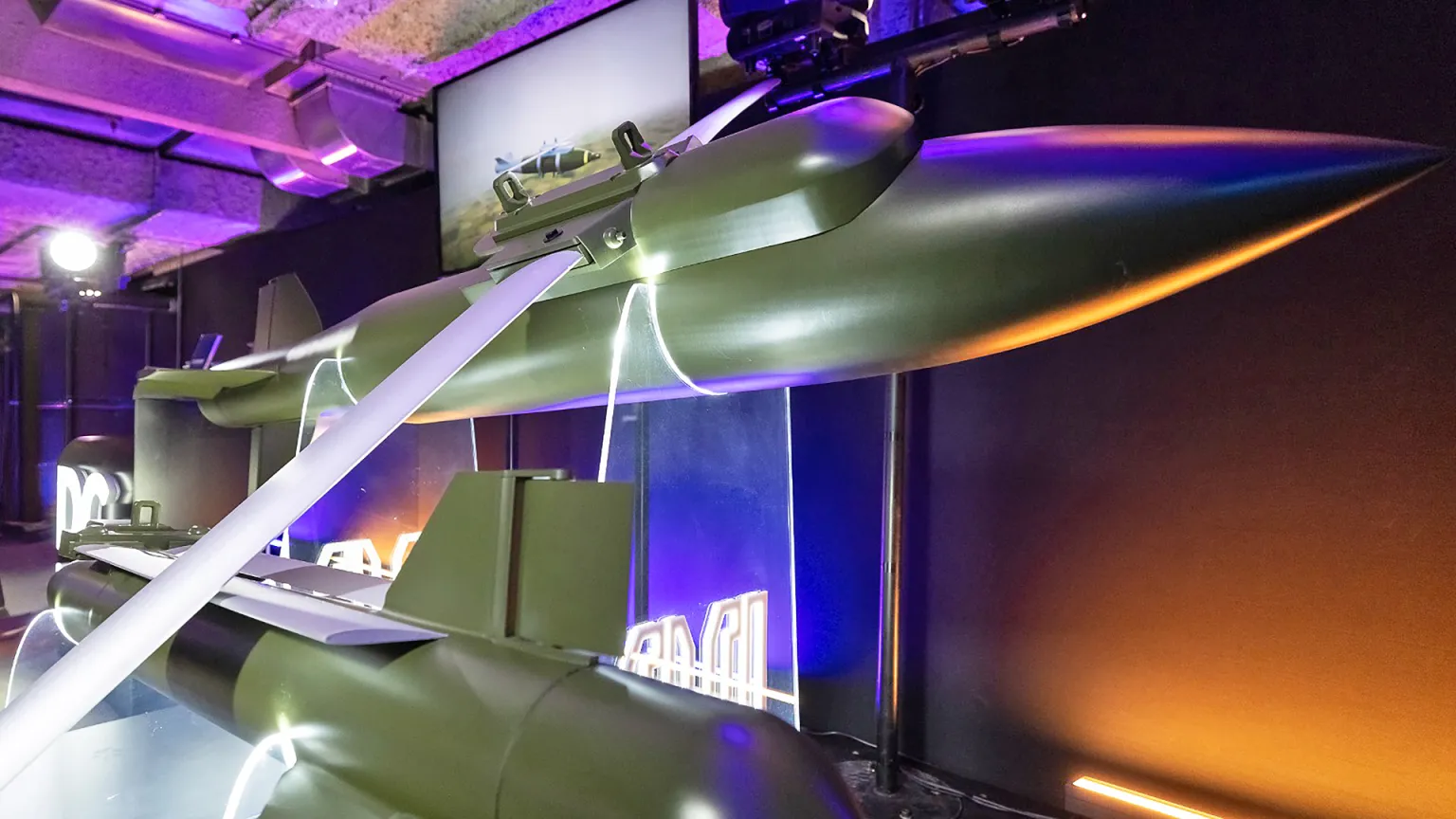
The situation with Equalizer appears somewhat more complicated. Ukraine’s Ministry of Defense has said the weapon was developed “from scratch” rather than being a direct copy of Western or Soviet systems. Photographs from Eurosatory nevertheless show a conventional arrangement for this class of weapon, including a large wing assembly and a rear control section. The underlying aerodynamic principles are therefore familiar.
Brave1 also says that virtually the entire system — from the wing to the controller software — was developed in Ukraine, although imported microchips and other electronic components are still used. According to the developers, approximately 90 percent of the components are of Ukrainian, European, or American origin.
There is another important complication. Some reports describe Equalizer as a guidance kit fitted to a 250-kilogram bomb, while Ukraine’s Ministry of Defense specifically refers to a 250-kilogram warhead. Those are not the same thing. Consequently, the frequently repeated direct comparison with Russia’s FAB-250 based purely on the number “250” should be treated cautiously. The exact total launch weight of the production weapon has not been publicly disclosed.
Where Does the 130-Kilometer Range Come From?
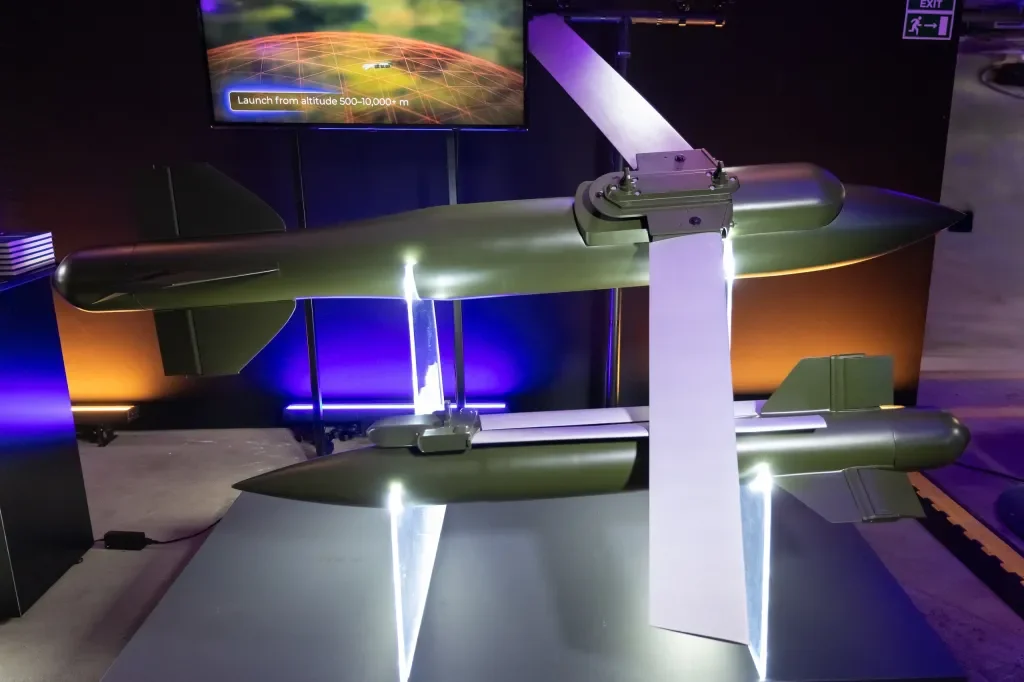
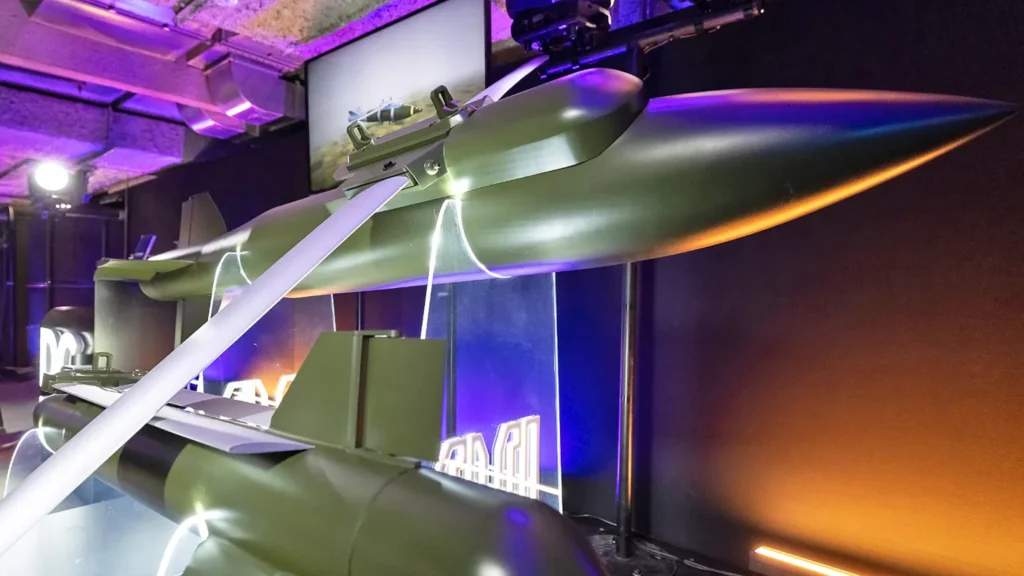
This is where the technical details become particularly interesting. Ukraine’s initial official announcement used a fairly vague description, saying that the weapon could engage targets at “tens of kilometers.” After Eurosatory, much more specific figures began appearing: a range of 10 to more than 130 kilometers, with employment altitudes reportedly ranging from approximately 500 meters to more than 10,000 meters.
But 130 kilometers should not be understood as a fixed range comparable to the published maximum range of a powered missile.
A glide bomb produces essentially no thrust of its own. Once separated from the aircraft, its available energy comes from two sources: the altitude and speed imparted by the carrier. The higher and faster the aircraft is flying at release, the greater the potential gliding range. Release exactly the same weapon from low altitude and the result will be very different.
This makes the stated 10–130+ kilometer envelope considerably more informative than the headline maximum figure alone. The lower end presumably reflects less favorable release conditions, while achieving the claimed 130 kilometers would require an advantageous altitude-and-speed profile.
For comparison, the commonly quoted range for JDAM-ER is around 45 miles, or roughly 72 kilometers. Russian UMPK-equipped bombs also exist in several configurations, and their actual range depends heavily on bomb type, carrier aircraft, altitude, speed, and release profile.
It would therefore be misleading to argue that “the Ukrainian bomb flies 130 kilometers, so it has twice the range of JDAM-ER.” Without identical release conditions, those figures cannot be compared directly.
The Wing Is Effectively the Engine
Because Equalizer has no propulsion system, almost all of its range comes down to aerodynamics. After separation, a large wing deploys and transforms what would otherwise be a falling bomb into a gliding aircraft. Publicly available images show a relatively high-aspect-ratio wing compared with the size of the body. Published figures indicate an overall weapon length of around 2.7 meters and a deployed wingspan of approximately 2.4 meters.
This forces designers to balance competing requirements. A larger wing can improve aerodynamic efficiency and range, but it also increases structural loads, complicates carriage under the aircraft, and makes the deployment mechanism more demanding. After release, the weapon must transition rapidly into stable flight without striking the carrier while remaining controllable across a wide speed envelope.
Brave1 representative Yurii Voronkov told TWZ that this was indeed one of the more difficult aspects of the program. Without an engine, navigation and control are completely dependent on the kinetic and potential energy available at release, making aerodynamic calculations, structural strength, and balance critical. Developers have also highlighted the combination of high speeds, aerodynamic loads, and aircraft integration requirements, where tolerances can sometimes come down to millimeters.
For something that superficially looks like little more than “a bomb with wings,” the engineering problem is considerably more complicated than it appears.
Why the Su-24 Is Particularly Interesting
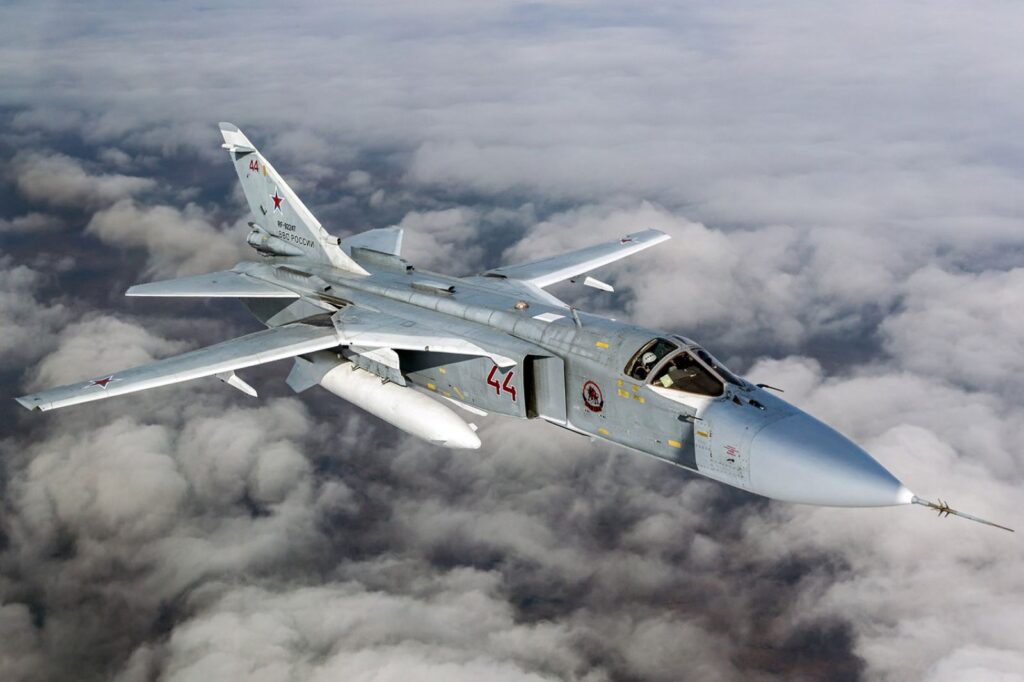
Published test footage shows Equalizer being released from a Su-24 strike aircraft. The choice makes sense. The Su-24 was designed from the outset as a dedicated strike platform capable of carrying a wide range of heavy air-launched weapons, making its pylons and weapon systems better suited to such loads than those of a fighter that has to be adapted for a new weapon.
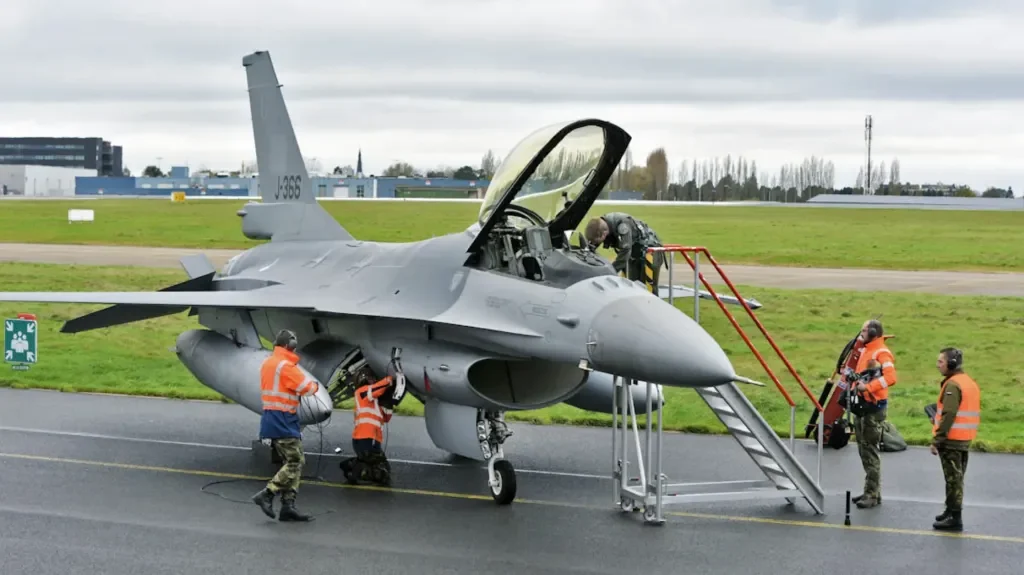
The developers, however, claim much broader compatibility. According to Brave1, Equalizer has been designed for use with the Su-24, Su-27, and MiG-29. Integration with the F-16 and Mirage 2000 is also considered technically possible, but would require separate certification and integration work.
That distinction is important. “Can be integrated” and “can be operationally employed right now” are not the same thing.
Physically attaching a bomb to an aircraft is only the beginning. Engineers have to verify pylon loads, safe separation throughout the permitted speed and maneuvering envelope, electrical interfaces, data transfer, target-coordinate input, and compatibility with the aircraft’s weapon-management system.
This is why introducing a new air-launched weapon usually requires far more work than photographs of a bomb hanging beneath a wing might suggest.
Why Does 130 Kilometers Matter If the Aircraft Has to Climb?
This reveals the fundamental limitation of all unpowered glide weapons.
Maximum range is achieved with a high-altitude, high-speed release. But an aircraft operating at high altitude is generally easier for radar systems to detect. This creates an uncomfortable trade-off: to give the glide bomb maximum energy and therefore maximum range, the carrier has to climb higher and/or accelerate.
Other release profiles are possible. An aircraft can approach at low altitude, climb briefly before release in a so-called pop-up maneuver, launch the weapon onto a climbing or gliding trajectory, and then descend again. Similar concepts are used with various Western stand-off weapons.
But the range obtained from such a profile will not necessarily match the ideal high-altitude release figure.
This is also where weapons equipped with a rocket booster or other propulsion system gain an important advantage. Propulsion can add energy after separation from the aircraft, reducing dependence on the carrier’s release conditions.
Equalizer, at least in its current form, has no such capability.
There Is No Engine — But a Powered Version Is Already Being Considered
This may be the most interesting direction for future development. Ukrainian developers are reportedly working on a version of the guided weapon equipped with a small turbojet engine. A prospective range of approximately 200 kilometers has been mentioned.
Once an engine is added, the distinction between a glide bomb and a compact cruise missile begins to blur. The wing produces lift, the navigation system guides the weapon toward the target, and propulsion allows it to maintain energy and substantially increase range.
But the price is greater complexity and cost. An engine introduces fuel, an intake, additional structural requirements, different center-of-gravity considerations, and more demanding flight-control requirements.
Russia has also been developing powered derivatives of its extended-range aerial bombs, reflecting the same underlying logic: one branch of development favors the cheapest possible unpowered glide weapon, while another sacrifices some simplicity in exchange for substantially greater stand-off range.
The Guidance System Remains the Biggest Unknown
Reliable public technical information becomes much thinner here. Brave1 refers to “modern guidance algorithms,” but the detailed architecture of the guidance system has not been disclosed.
For a weapon in this class, the obvious solution would be a combination of inertial navigation and satellite correction, similar in principle to that used by JDAM and many comparable weapons. However, there is currently insufficient public evidence to state confidently that the production Equalizer uses a specific GNSS/INS architecture.
That matters because of electronic warfare.
Satellite navigation can give a relatively inexpensive weapon high accuracy against fixed targets, but jamming or spoofing navigation signals can significantly degrade performance. An inertial navigation system allows the weapon to continue flying without satellite updates, but its positional error gradually accumulates.
The real value of Equalizer will therefore depend not only on its headline maximum range, but on how much accuracy it can retain in a heavy electronic-warfare environment.
There is currently no public answer to that question.
How Large Is the Warhead?
Ukraine’s Ministry of Defense officially gives a figure of 250 kilograms for the warhead itself. That would be substantial for a precision-guided glide weapon.
For comparison, an entire American GBU-39/B Small Diameter Bomb weighs roughly 130 kilograms, although the comparison is not direct. The SDB was deliberately designed as a compact precision weapon that allows aircraft to carry several bombs on a single station.
Comparisons with the Russian FAB-250 create a different problem. The “250” in the Soviet bomb’s designation refers to its overall weight class, not the mass of explosive contained inside it. Therefore, saying that Equalizer has a 250-kilogram warhead and is equivalent to a FAB-250 would be technically misleading.
If the official Ukrainian description of a 250-kilogram warhead is accurate, the complete Equalizer weapon must weigh substantially more.
Its exact total mass, explosive filling, warhead construction, and possible alternative warhead types have not been publicly disclosed.
This is another reason to treat some of the specification tables circulating online with caution.
What Is Actually Known
As of August 19, 2026, the available technical picture looks approximately like this:
| Developer | DG Industry |
| Development began | 2024 |
| Time to working prototype | 17 months |
| Type | Guided glide bomb |
| Engine | None |
| Length | Approx. 2.7 m |
| Wingspan | Approx. 2.4 m |
| Warhead | Claimed 250 kg |
| Claimed range | 10–130+ km, depending on release profile |
| Employment altitude | Approx. 500–10,000+ m |
| Wing | Deployable |
| Guidance | Exact architecture not publicly disclosed |
| Main stated carriers | Su-24, Su-27, MiG-29 |
| F-16 / Mirage 2000 | Additional integration/certification required |
| Ukrainian/European/American component share | Claimed at around 90% |
| Status | Tested and officially being procured |
| Future version | Powered variant, target range around 200 km |
One point is particularly important: this table should not be treated as a fully verified technical data sheet. Many of these figures originate from the developer or Ukrainian government agencies and have not been independently demonstrated.
This is especially true of maximum range and accuracy.
How Similar Is It to Russia’s UMPK?
Conceptually, very similar.
Russia’s UMPK, Ukraine’s Equalizer, and the American JDAM-ER all address the same fundamental problem: how to allow a relatively inexpensive air-launched munition to travel tens of kilometers after release and guide itself toward a predetermined target.
The industrial philosophy behind them, however, may be quite different.
Russia’s major advantage is the enormous legacy of the Soviet aviation industry. Large stocks of conventional aerial bombs of various weight classes already exist. The fundamental logic of UMPK is therefore to transform an existing mass-produced bomb into a stand-off glide weapon. The entire bomb does not need to be manufactured again; the more technologically sophisticated part is the planning and correction module attached to it.
Ukraine faces a different industrial situation. It does not possess a directly comparable stockpile of Soviet aerial bombs and therefore also has to address production of the basic munitions themselves.
This is a crucial distinction.
Even an excellent guidance kit is of limited value if there are not enough bombs available to attach it to.
Which Means the Most Important Number Is Not 130 Kilometers
A glide bomb can be designed to travel 130 kilometers.
It can be made accurate.
It can be integrated onto several aircraft types.
But for a weapon in this category, one of the decisive characteristics eventually becomes production volume.
Mass employment is what makes inexpensive stand-off weapons strategically significant. A single precision glide bomb is simply another guided munition. Hundreds of standardized weapons produced and employed on a sustained basis become an entirely different military-industrial capability.
This is currently the biggest unanswered question surrounding Equalizer.
DG Industry has moved beyond the prototype stage, the weapon is officially being procured, and Brave1 says that at least eight Ukrainian manufacturers are working on their own glide-bomb projects. Actual production rates, however, have not been publicly disclosed.
And those numbers may ultimately matter considerably more than the advertised 130-kilometer maximum range.
Has Ukraine Produced an Equivalent to UMPK?
In technical terms, Ukraine has developed a weapon belonging to the same general class and intended to solve the same basic problem. Calling it a direct copy of Russia’s UMPK would nevertheless be inaccurate. The design was developed separately, its configuration differs, and the two countries operate under very different conditions when it comes to existing bomb stocks and industrial capacity.
Equalizer itself does not appear to represent some extraordinary technological breakthrough.
And that may actually be the most interesting thing about it.
The basic engineering concept is relatively straightforward: a warhead, a large deployable wing, flight-control electronics, and aerodynamic control surfaces. The current version has no engine. Most of the underlying technologies required to build such a weapon have been understood for decades.
But modern weapons do not always become important because they are technologically revolutionary.
Sometimes the more important achievement is to make a weapon good enough, inexpensive enough, simple enough, and manufacturable in sufficient numbers.
That is how Equalizer should ultimately be judged — not by an exhibition mock-up and not even by the headline figure of 130 kilometers. Its real test is only beginning: production rates, aircraft integration, accuracy under electronic countermeasures, reliability of the wing-deployment mechanism, and the ability of industry to manufacture large batches of consistent weapons.
So the answer to how significant Equalizer will become remains open.
Ukraine has demonstrated that it can develop its own long-range glide bomb. The considerably harder challenge now is turning that weapon from an individual product into a mass-produced weapons system.






