At the end of the 1930s, General Motors faced a problem that is difficult to imagine today. The company possessed technologies capable of transforming the lives of millions of people. It could demonstrate television, new methods of transmitting sound, advances in chemistry, aviation, agriculture, and automobile manufacturing — but much of America would never see any of it. There was no internet, television remained an experimental novelty, and major exhibitions were concentrated in large cities.
The solution was distinctly American: if people could not come to see the future, then the future would be brought to them.
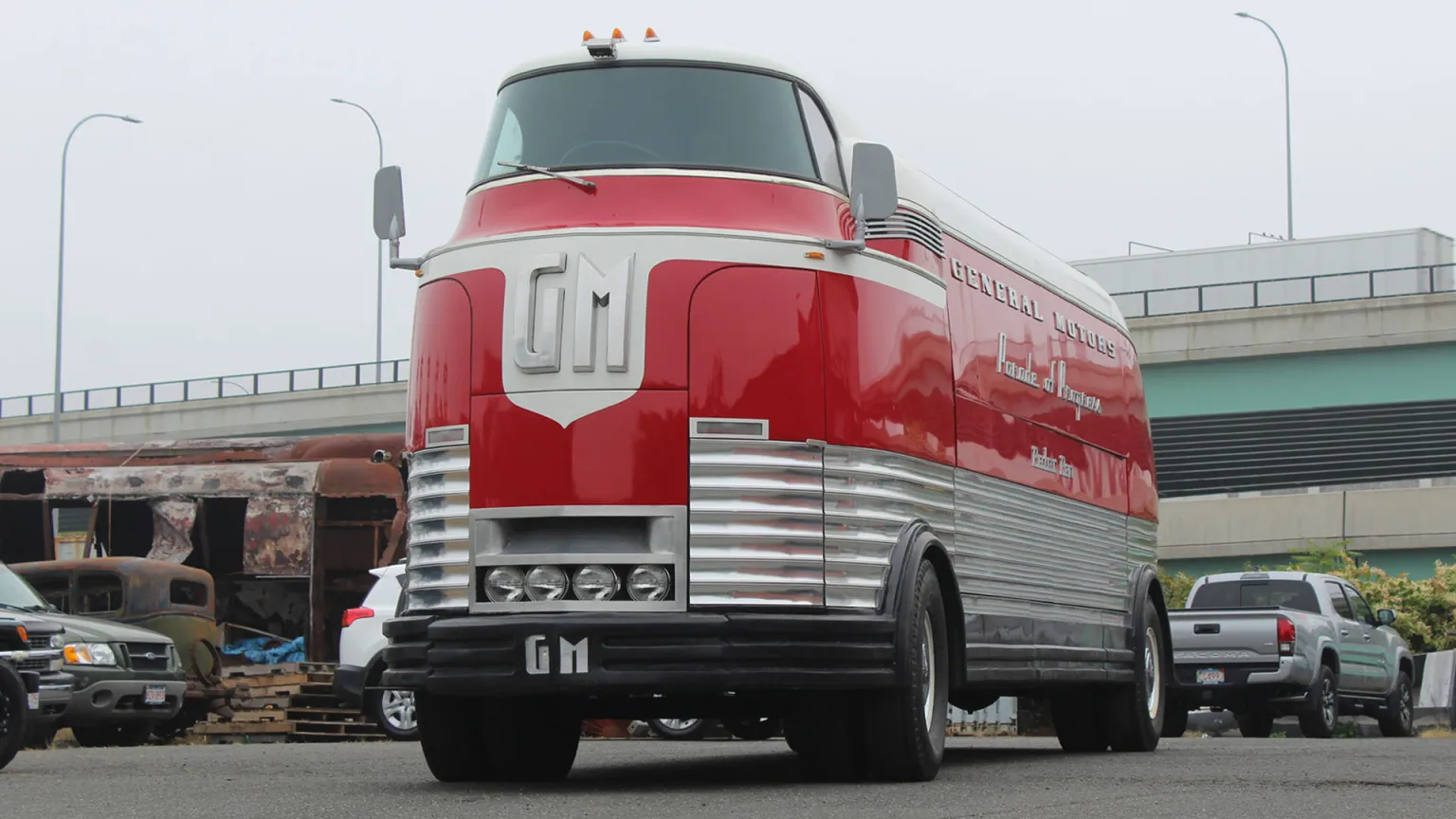
That idea produced the GM Futurliner — a gigantic red-and-white machine nearly as tall as a small house, with its driver sitting high above the road and enormous side panels that transformed the vehicle into a mobile exhibition pavilion. General Motors built only 12 of them, and they became the centerpiece of one of the most unusual educational and promotional projects of the 20th century: the Parade of Progress.
The most interesting thing about the Futurliner is that it was not really designed to advertise a particular General Motors automobile. It was selling something much bigger — faith in technological progress itself.
When the Future Had to Be Shown in Person
The origins of the Futurliner can be traced to Chicago’s 1933–1934 Century of Progress exposition. One of the General Motors executives fascinated by the enormous potential of such exhibitions was the company’s famous engineer and inventor Charles Kettering. He helped convince GM management that technological exhibitions should not remain confined to major exhibition halls. They could be taken directly to the public.
The first Parade of Progress went on the road in 1936. A convoy of cars and specially designed GM vehicles traveled from city to city, setting up free exhibitions demonstrating the latest achievements in science and industry.
Initially, eight special Streamliners were used for the program. It soon became clear, however, that General Motors needed something considerably more spectacular.
A completely new vehicle was therefore developed toward the end of the 1930s. Historical sources differ slightly on the exact date: some GMC historical material points to 1939, while modern General Motors accounts associate the machines with the second Parade of Progress, which took to the road in 1941. The Futurliner’s appearance is therefore generally placed around 1939–1940.
Only 12 were built.
And calling them buses does not really do them justice.
Thirty-Three Feet of American Optimism
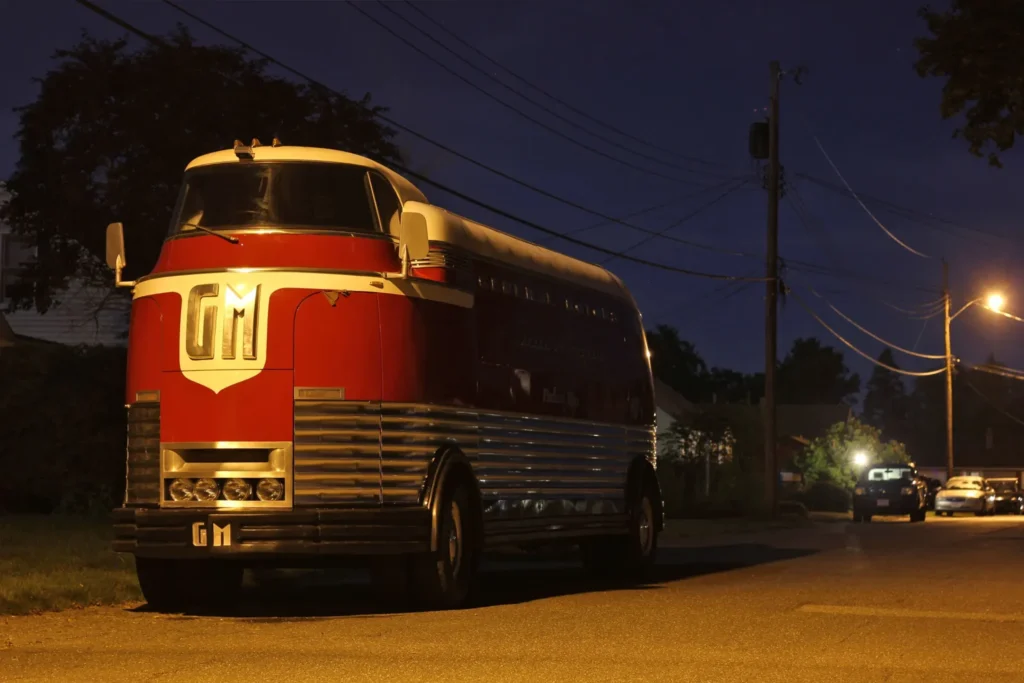
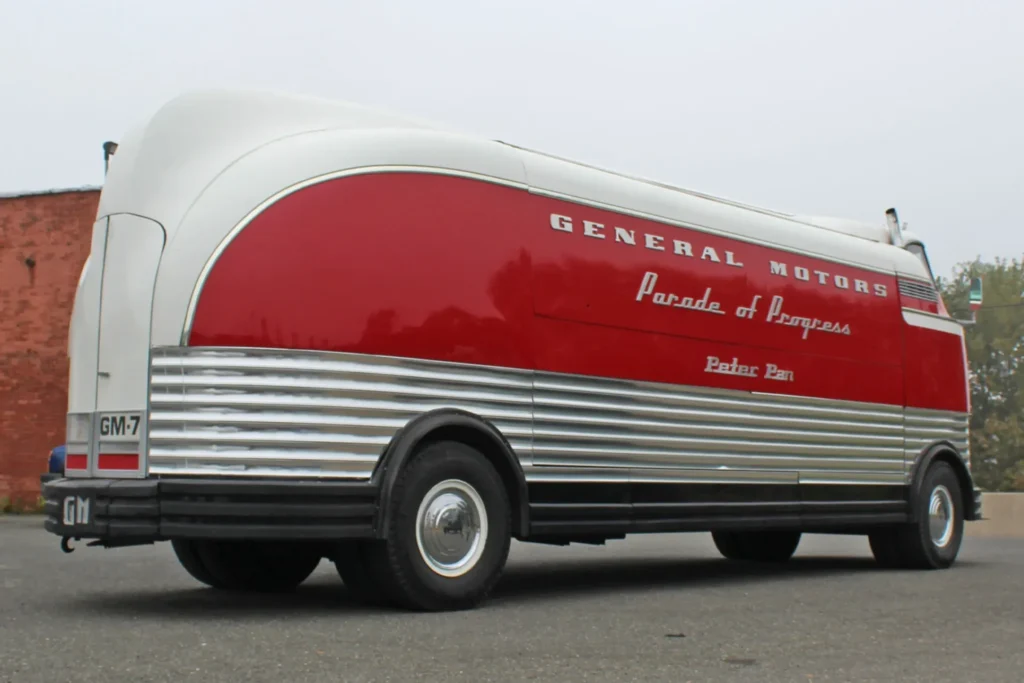
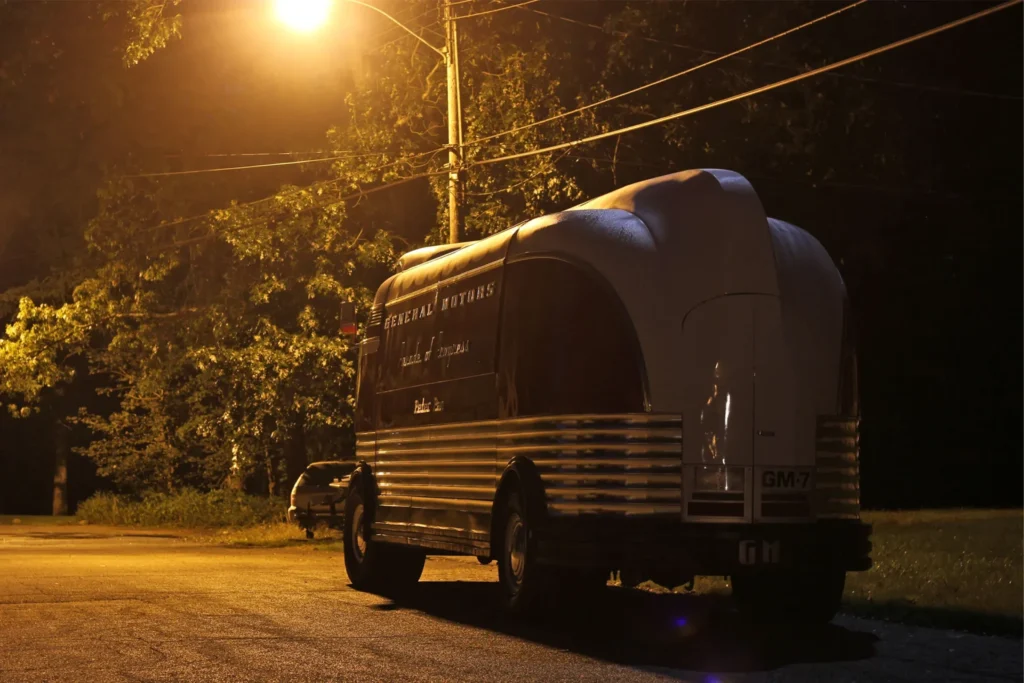
The Futurliner measured approximately 33 feet (10.1 meters) long, almost 9 feet (2.7 meters) wide, and more than 11.5 feet (3.5 meters) tall. Depending on configuration, its weight approached 15 tons.
Yet its dimensions were not its most extraordinary feature.
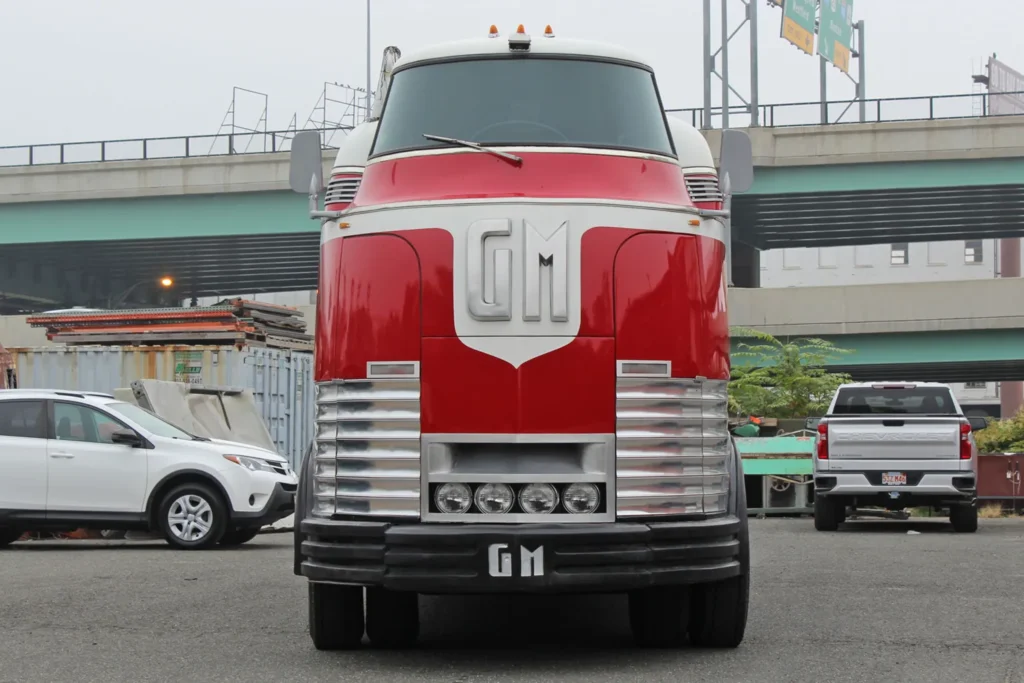
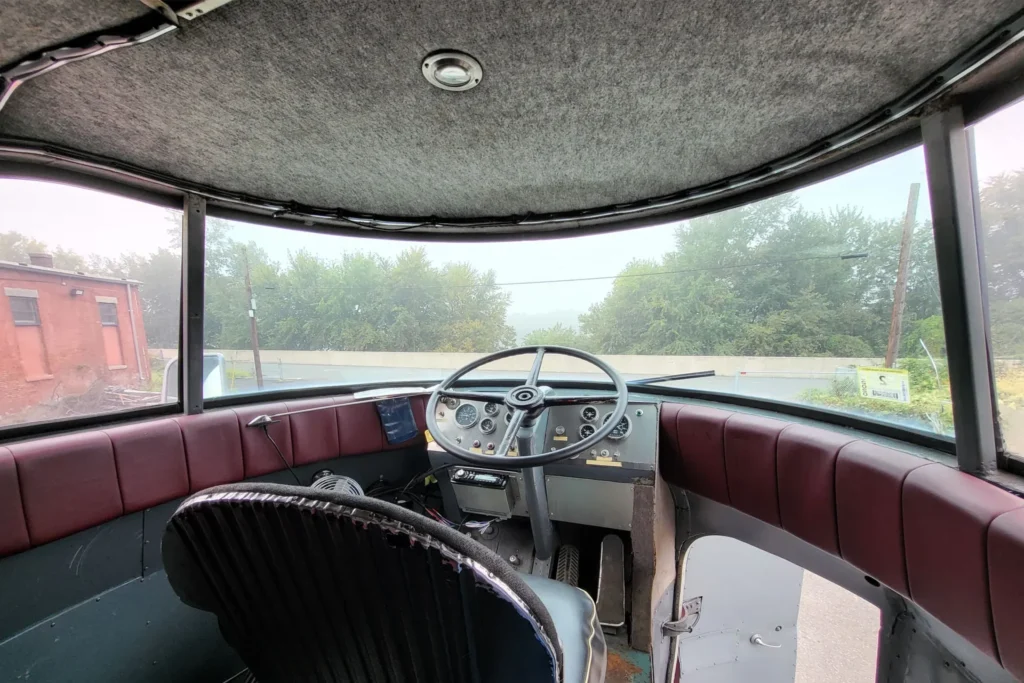
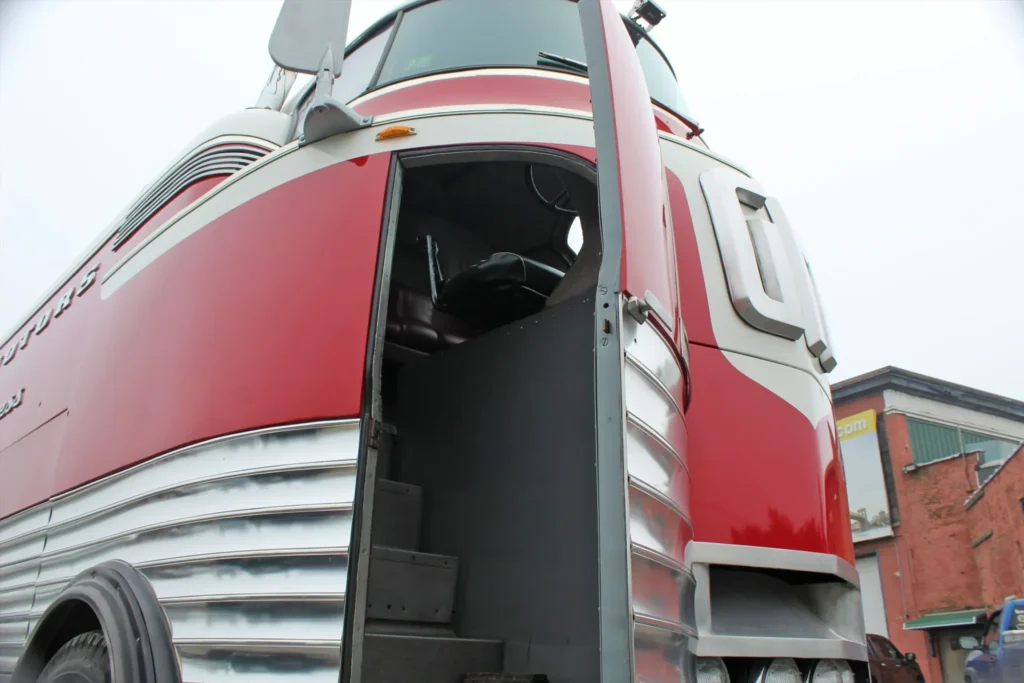
The driver sat high above the road in a centrally positioned cab surrounded by enormous windows. Reaching the driver’s seat required climbing an internal staircase. At the front was a distinctive streamlined nose with an illuminated GM emblem, while the overall body blended Streamline Moderne, Art Deco, and the 1930s vision of what transportation in the 21st century might look like.
Its running gear was equally unusual. At the front were four wheels arranged as two closely spaced pairs, with individual braking arrangements. Altogether, the Futurliner rolled on eight wheels.
But all of this was merely the shell.
The real purpose of the machine became apparent only after it stopped.
Huge side panels roughly 16 feet (4.9 meters) long could be raised to form canopies, revealing an exhibition stage inside. A lighting tower extended from the roof, while an integrated public-address system allowed presenters to address large crowds.
Within a matter of hours, a Futurliner arriving in a small American town could transform from an enormous road vehicle into a technological theater.
What Was Inside?
Each of the 12 Futurliners was assigned its own exhibition theme.
At various points, visitors were introduced to developments in jet propulsion, television, stereophonic sound, agriculture, refrigeration, road construction, new materials, and industrial manufacturing.
Some demonstrations seem particularly remarkable today. Audiences could watch the possibilities of microwave heating, for example, with demonstrations showing an egg being cooked without igniting nearby newspaper. Other exhibits demonstrated sound transmitted by a beam of light, stereophonic audio systems, and models explaining the principles of jet aircraft.
The postwar Parade of Progress eventually featured around two dozen major exhibits.
And the Futurliners represented only part of the traveling operation. By 1953, the entire convoy consisted of 44 vehicles, including the 12 Futurliners, trucks, and passenger cars.
At the center of the temporary exhibition complex stood the enormous Aer-O-Dome, a specially designed tent without conventional interior support poles that could accommodate approximately 1,500 spectators.
In effect, General Motors was transporting an entire science and technology museum from city to city.
The Futurliner Looked Much Faster Than It Really Was
Here lay one of the great contradictions of the design.
The Futurliner looked like transportation from a distant future, but its mechanical components were relatively conservative.
The original vehicles were equipped with four-cylinder diesel engines and manual transmissions. For an enormous vehicle weighing roughly 15 tons, power was limited. Despite its streamlined appearance, the Futurliner was anything but fast.
After World War II, General Motors extensively rebuilt the entire fleet.
When the Parade of Progress was revived, the vehicles received GMC 302 inline-six gasoline engines displacing 302 cubic inches, or approximately 4.9 liters. The engine belonged to a family of rugged GMC powerplants associated with heavy-duty trucks and military applications.
It was paired with a four-speed Hydra-Matic automatic transmission and a two-speed reduction gearbox. In practical terms, the driver had access to eight principal gear combinations, while the complete drivetrain arrangement was even more complicated because of auxiliary systems and equipment.
Yet the Futurliner still wasn’t fast.
General Motors listed a maximum speed of as much as 55 mph (88 km/h), but people who actually drove the machines later recalled that around 40 mph — approximately 64 km/h — was already a fairly serious cruising speed.
With its extraordinary driving position, enormous weight, and unusual front axle arrangement, operating a Futurliner was a specialized skill in itself.
GM Futurliner Specifications
| Manufacturer | General Motors |
| Number Built | 12 |
| Introduced | 1939–1940 |
| Purpose | Mobile exhibition pavilion |
| Length | Approx. 33 ft / 10.1 m |
| Width | Approx. 9 ft / 2.7 m |
| Height | More than 11.5 ft / 3.5 m |
| Wheelbase | Approx. 20.7 ft / 6.3 m |
| Weight | Approx. 13.7–15 tons depending on configuration |
| Number of Wheels | 8 |
| Original Engine | Four-cylinder diesel |
| Postwar Engine | GMC 302 inline-six gasoline engine |
| Displacement | 302 cu in / 4.9 liters |
| Postwar Transmission | 4-speed Hydra-Matic + 2-speed reduction gearbox |
| Claimed Top Speed | Up to 55 mph / 88 km/h |
| Typical Practical Speed | Around 40 mph / 64 km/h |
| Exhibition Panel Length | Approx. 16 ft / 4.9 m |
War Stopped the Future
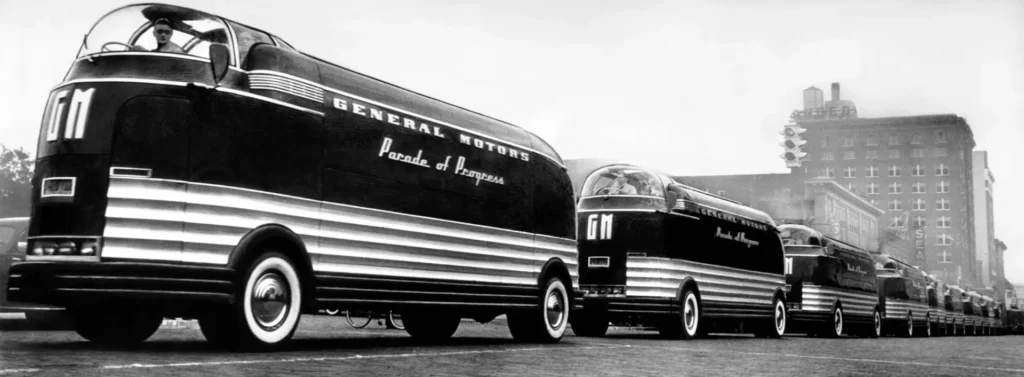
The second Parade of Progress took to the road in 1941. The response was enormous: according to General Motors, more than three million people in 43 cities saw the exhibition in less than a year.
But it did not last long.
On December 7, 1941, Japan attacked Pearl Harbor. The United States entered World War II, and a traveling exhibition celebrating civilian technological progress suddenly became irrelevant.
Approximately two weeks after Pearl Harbor, the Parade of Progress was suspended.
The Futurliners went into storage, while many of the people who had worked on the exhibition soon exchanged their General Motors uniforms for military ones.
It appeared that the story of these extraordinary machines had come to an end.
Twelve years later, however, GM decided to try again.
The Futurliner Returns
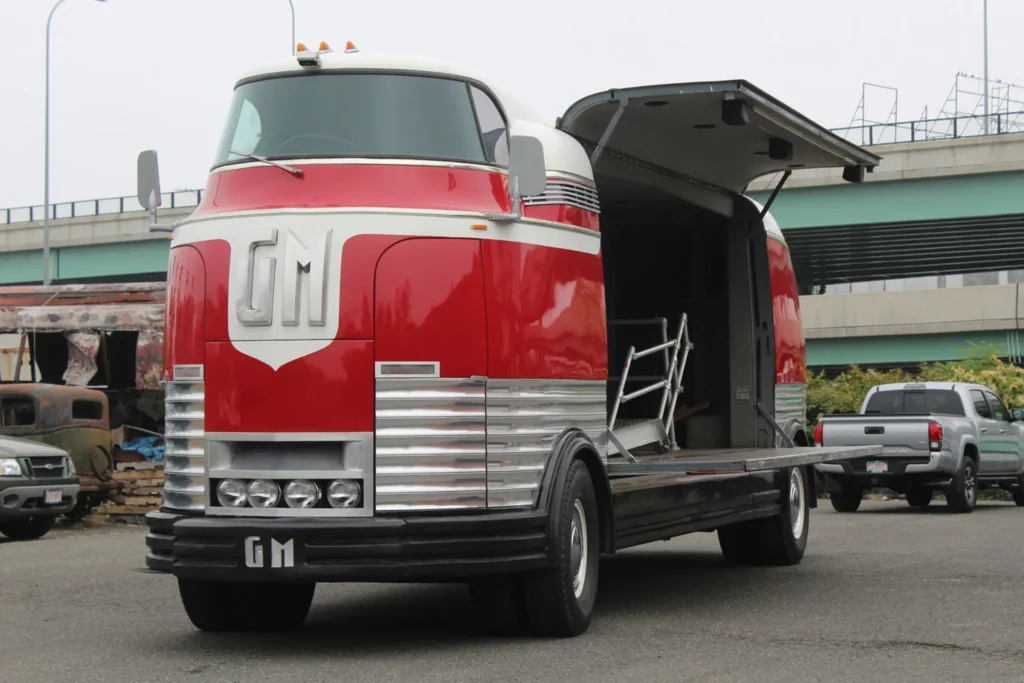
In 1953, the Parade of Progress was revived.
All 12 Futurliners underwent substantial modernization. The GMC 302 gasoline engines and Hydra-Matic transmissions were installed during this period. The cabs were modified, and a metal roof was added over what had previously been an almost entirely glass-enclosed driver’s compartment. A Frigidaire air-conditioning system was also installed — a sensible improvement considering how hot the glass-heavy cab could become under the summer sun.
The exhibition program changed as well.
Now Americans were shown jet aviation, atomic energy, new manufacturing techniques, electronics, and other technologies defining the postwar world. The convoy also carried some of GM’s newest automobiles, including the early Chevrolet Corvette.
At first, the formula seemed to work once again.
But something had happened that would have been almost impossible to predict when the Futurliner was conceived.
The future that these vehicles had spent years carrying across America ultimately made them obsolete.
It Was Killed by the Technology It Promoted
By the middle of the 1950s, Americans no longer needed to travel to the town square to see the wonders of modern science.
They had television.
During the 1930s, the Parade of Progress had offered people living in smaller towns one of their few opportunities to see advanced technologies with their own eyes. Now similar spectacles could enter their homes every evening.
Attendance began to decline.
In 1956, General Motors finally discontinued the Parade of Progress. The Futurliners were no longer needed and were sold or donated to various organizations.
There is a beautiful irony in their fate.
These machines had been created to popularize technological progress — and technological progress ultimately destroyed the reason for their existence.
From Advertising Truck to Multi-Million-Dollar Collectible
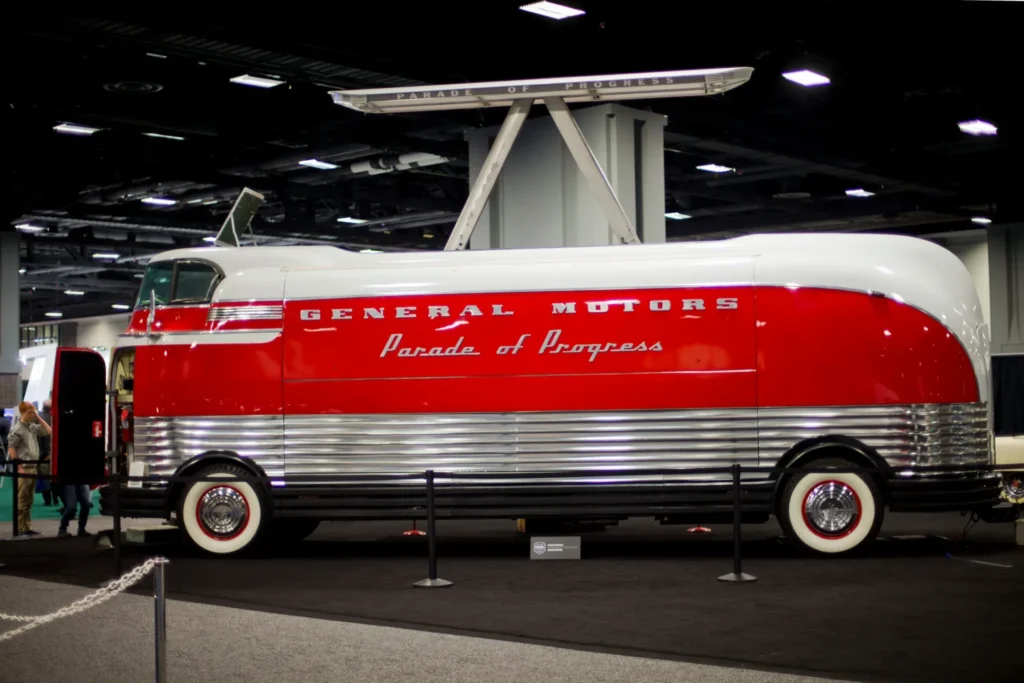
After the Parade of Progress ended, the 12 Futurliners followed very different paths. Some became promotional vehicles, mobile stages, or enormous rolling billboards. Others gradually deteriorated.
Decades later, however, attitudes toward them changed completely.
Collectors and historians began to realize that the surviving Futurliners were not merely rare trucks. They were unique monuments to American industrial design and to an era when major corporations attempted to shape the public’s vision of the future.
One of the best-known survivors, Futurliner No. 10, eventually went to the National Auto & Truck Museum in Auburn, Indiana. Its restoration began in 1999 and required roughly seven years of work by a large team of volunteers.
Another restored Futurliner sold at auction in 2006 for an astonishing $4 million.
For a machine that had originally served as little more than a mobile exhibition stand, that was an extraordinary transformation.
Yet rarity alone does not explain why the Futurliner has become so valuable.
General Motors Wasn’t Selling Cars. It Was Selling the Future
The Futurliner reveals just how differently the great automotive corporations of the mid-20th century viewed their place in society.
General Motors was not simply trying to persuade Americans to buy a Chevrolet, Buick, or Cadillac. The corporation wanted to present an entire vision of the future: new highways, new materials, jet aircraft, television, automated factories, electrical appliances, and a world in which technological progress would inevitably make everyday life better.
The Futurliner was the physical embodiment of that optimism.
It was enormous, impractical, complicated, and spectacular. It would arrive in a small town, raise its giant side panels, switch on its lights — and literally show people tomorrow.
Today, we can watch the presentation of a new technology on a smartphone seconds after it is unveiled on the other side of the planet. In 1940, achieving something similar required a 15-ton red-and-white machine, dozens of employees, a convoy of trucks, and a tent capable of seating 1,500 people.
And perhaps that is why the GM Futurliner remains so fascinating.
It looks like a vehicle from a future that never quite arrived.
Yet for millions of Americans, machines like this were how the future first came to town.