
Eight Stingers on a Golf Course: Why the U.S. President Now Needs His Own Air Defense

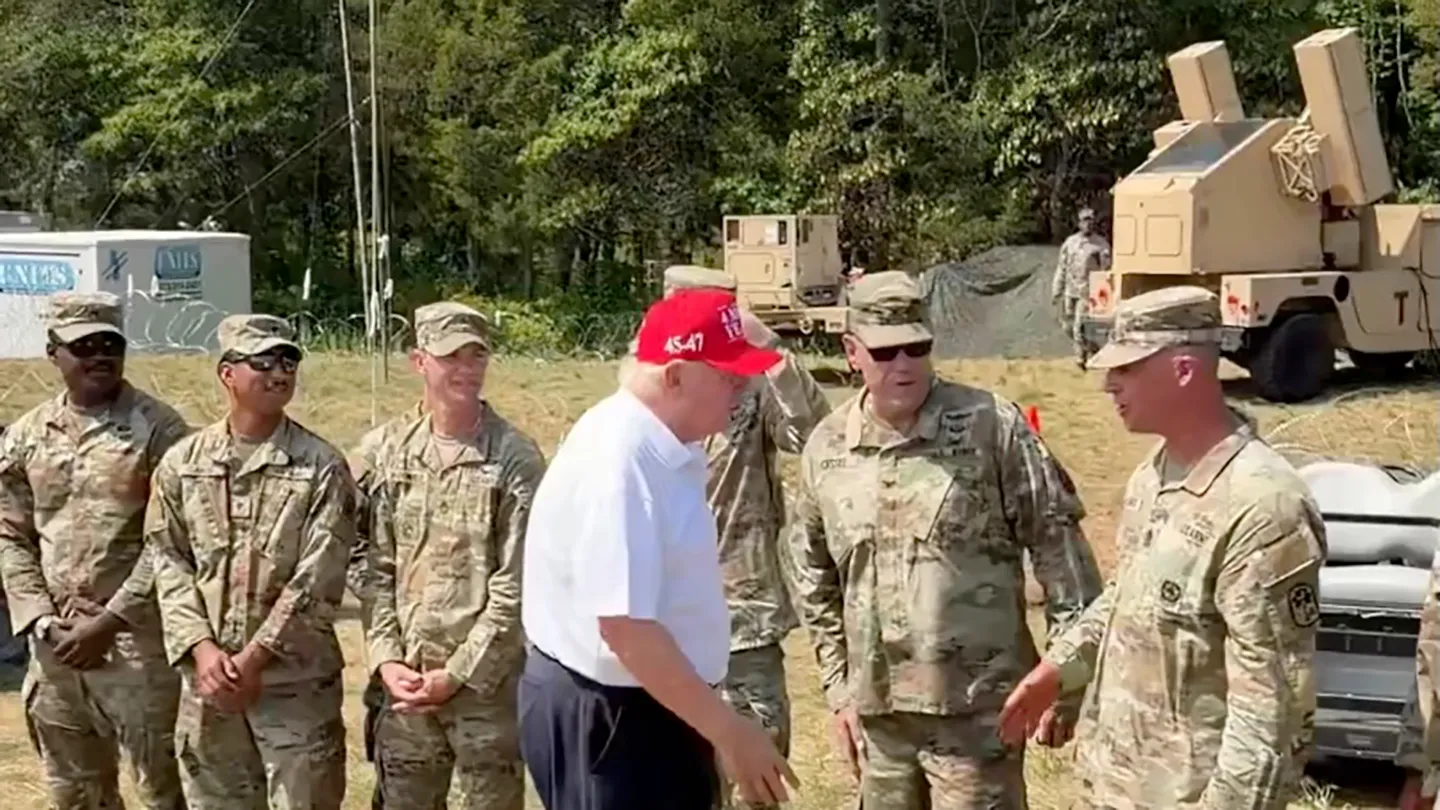
When the President of the United States goes golfing, it is normal to expect Secret Service agents, armored vehicles, police cordons, and counter-sniper teams. But in August 2026, the security package around Donald Trump looked considerably more elaborate. At Bedminster, New Jersey, an Army AN/TWQ-1 Avenger was spotted nearby — a Humvee armed with eight Stinger missiles and a heavy machine gun. An AN/MPQ-64 Sentinel radar was also seen in the area. We may have reached the point where you can barely go to the bathroom without taking a SAM system with you. Jokes aside, however, the episode reflects a much more serious change: drones are gradually turning the protection of national leaders into a genuine air-defense mission.
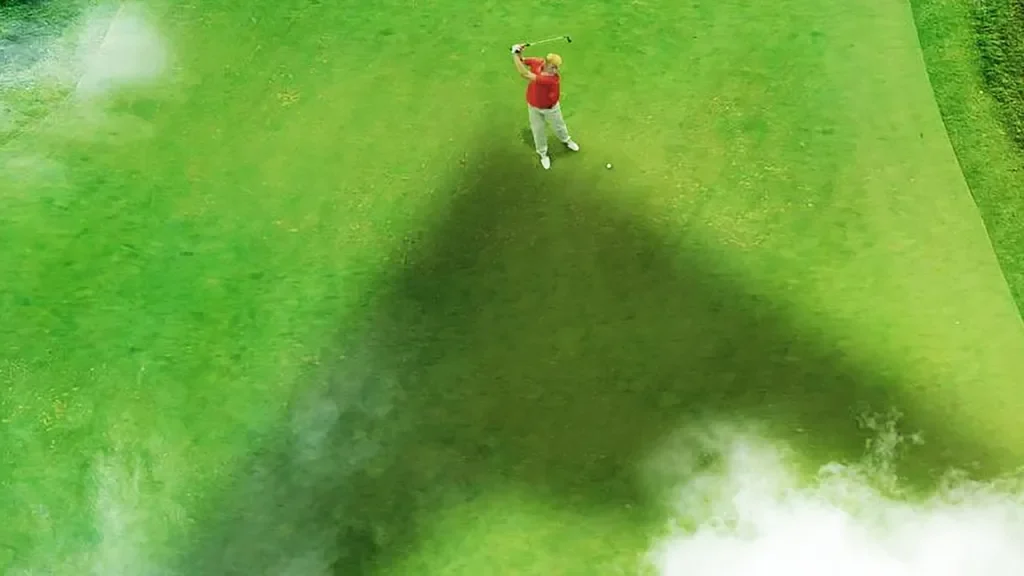
The photos were taken on August 9 during the final round of LIV Golf Bedminster in New Jersey. In one image, Trump can be seen on the course while an Avenger sits behind the perimeter. Other footage revealed what appeared to be a Sentinel radar nearby. The White House confirmed the authenticity of the imagery to TWZ, although the full composition of the security deployment was, unsurprisingly, not disclosed.
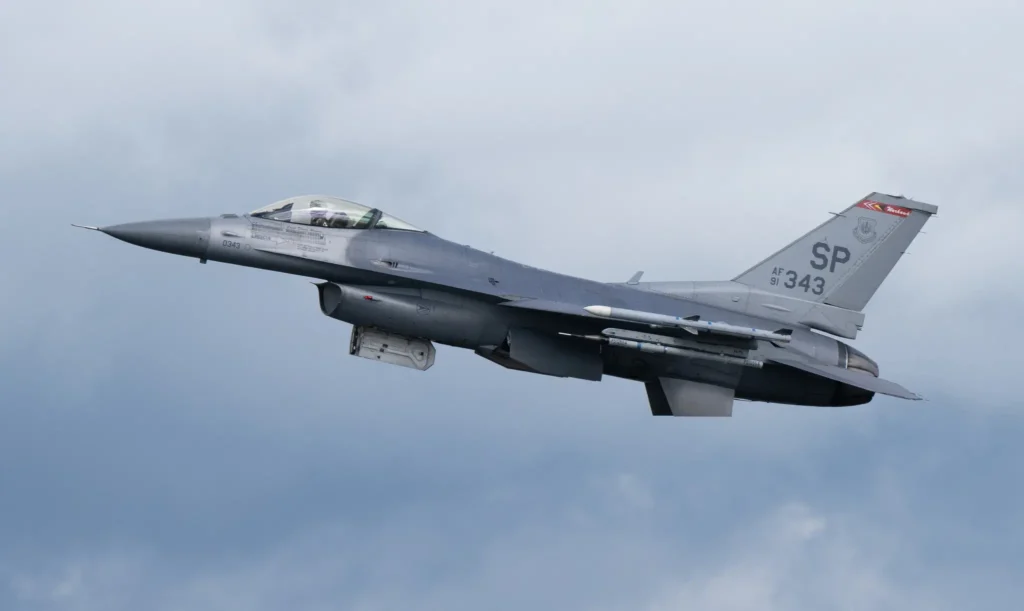
The timing made the scene even more striking. On the same day, NORAD scrambled F-16s after two civilian aircraft entered temporarily restricted airspace around Bedminster. They were not considered threats and were escorted out of the area, but the incident illustrates just how layered modern presidential protection has become: Secret Service on the ground, Army air defense nearby, controlled airspace overhead, and fighter aircraft available if someone ignores the restrictions.
The obvious question is: why does a president need an actual surface-to-air missile system?
A Cold War Veteran Finds a New Job
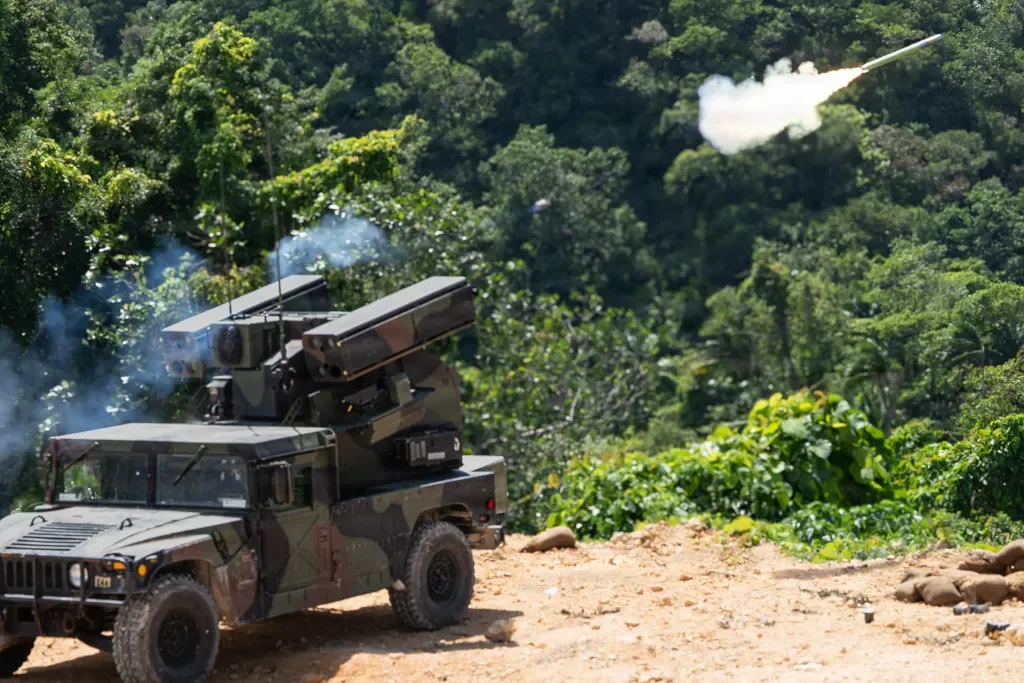
The AN/TWQ-1 Avenger almost looks too simple to be part of the American defense industry. Take an Army HMMWV, mount a rotating turret on top, place two four-round Stinger missile pods on the sides, add a 12.7mm M3P machine gun, optical and infrared sensors, and a fire-control system — and you have a mobile short-range air-defense system.
Avenger was originally developed in the 1980s for a very different world. The U.S. Army needed a mobile SHORAD system capable of moving with ground forces and protecting them against low-flying aircraft and helicopters. The system is operated by a two-man crew and carries eight ready-to-fire FIM-92 Stinger missiles, with the M3P providing an additional option against close aerial or ground targets.
The concept is deliberately practical. Avenger is not designed to replace Patriot or engage targets dozens of kilometers away. It is a last-line, short-range defensive weapon — compact, highly mobile, and easy to redeploy with the force it is protecting. Once the event is over, the crew can simply start the engine and drive away.
After the Cold War, it seemed that systems like Avenger would become less important. For roughly two decades, the U.S. military fought mainly against opponents with little or no conventional air power, and short-range battlefield air defense declined in priority.
Then a new threat appeared.
The drone.
The U.S. Army has already acknowledged that the spread of cheap unmanned aircraft has created renewed demand for systems like Avenger. A platform originally intended to fight helicopters and low-flying aircraft has found a new role against UAVs.
And now it can be found protecting a presidential golf course.
Avenger Is Useful, but Sentinel Makes the Picture Much More Interesting
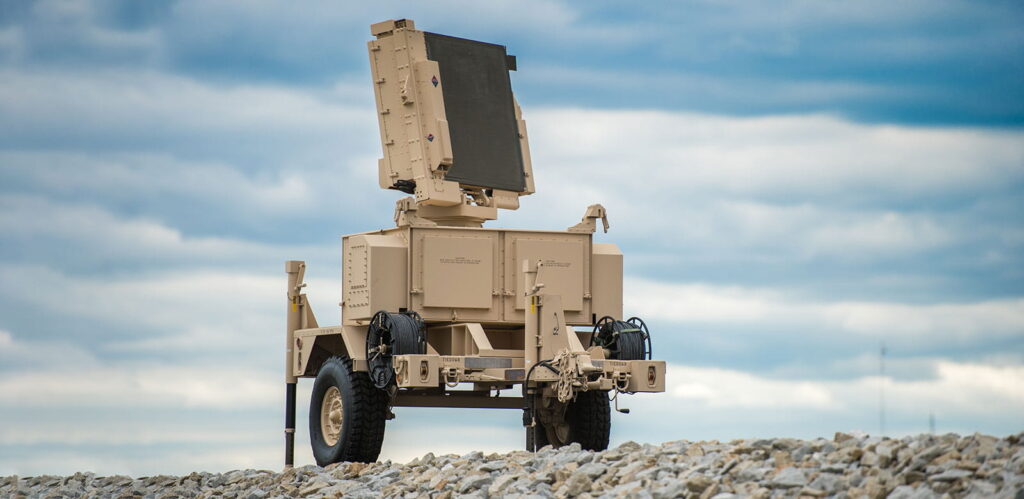
The most intriguing part of the Bedminster deployment may not have been the eight Stingers at all. Footage from the area also appeared to show an AN/MPQ-64 Sentinel radar, which makes the overall picture much more significant.
Avenger has its own optical and targeting equipment, but its effectiveness improves dramatically when it receives external radar cueing. That is exactly what Sentinel is designed to provide.
In Army air-defense doctrine, the relationship is straightforward: Sentinel detects and tracks aerial targets, passes their coordinates to firing units, and allows systems such as Avenger to orient toward the threat. The turret can then rapidly slew toward the assigned target rather than relying solely on the crew to search the sky visually.
That turns the deployment into something much more sophisticated than a Humvee carrying missiles.
It becomes a small air-defense network.
Sentinel watches the airspace, target information is distributed, Avenger prepares to engage, and additional security elements operate around that layer. TWZ also noted that the photos almost certainly do not show every component of the protective system. Electronic warfare and counter-drone equipment may also have been present, although their exact composition is unknown.
And this is where the story becomes much bigger than Trump himself.
Drones Have Changed the Job of the Bodyguard
Traditional VIP protection has always focused primarily on threats approaching from the ground. Keep armed individuals away, clear buildings, control rooftops and windows, establish multiple security perimeters, maintain armored vehicles nearby, and ensure the protected person can be evacuated immediately.
Aircraft were a separate category. Airspace restrictions, radar surveillance, NORAD, and fighter aircraft already existed for that purpose, so protecting presidential movements from conventional aviation is nothing new.
But drones created an entirely new layer between a sniper and a manned aircraft.
A small UAV does not need a road. It does not care about a police cordon. It can approach at low altitude, use terrain and buildings for concealment, and potentially be launched from well outside the immediate security perimeter.
And a drone does not even have to be armed to cause problems. It can conduct surveillance, transmit live video, map security positions, or simply violate protected airspace.
As a result, the protection of important people and facilities increasingly resembles classical layered air defense. First detect the object. Then classify it. Determine whether it is a threat. Finally choose the appropriate countermeasure — electronic warfare, a dedicated interceptor, gunfire, or, at the highest end, a missile.
That is where Avenger suddenly becomes extremely useful.
It can be quickly deployed with the rest of the security force, positioned near the protected site, connected to external detection assets, and used as a mobile missile layer.
Essentially, a personal short-range air-defense umbrella.
Firing a Stinger at a Cheap Drone Sounds Insane — Until You Consider What Is Being Protected
Economically, it does sound absurd.
A modern Stinger missile is obviously far more expensive than most commercial drones. That is why contemporary counter-UAS systems increasingly rely on multiple layers: electronic warfare, machine guns, automatic cannons, cheap interceptors, and only then traditional surface-to-air missiles.
But there is one situation where the price of the interceptor stops being the primary concern.
When the value of the protected target is effectively beyond normal pricing.
If a cheap drone threatens a truck worth tens of thousands of dollars, firing a costly missile may make little sense. If the same drone is assessed as a direct threat to the President of the United States, the equation changes instantly.
Eight Stingers become insurance.
And the presence of Avenger does not mean every quadcopter entering the area would automatically receive a missile. The entire purpose of a layered defense system is to offer multiple response options while reserving the most powerful weapon for a threat that must be stopped with maximum certainty.
There is another useful detail. Stinger missiles carried by Avenger can also be removed and used as conventional man-portable air-defense weapons if necessary. In other words, one vehicle serves both as a mobile launch platform and as a stock of eight missiles that can support dismounted teams.
For temporary site protection, that makes Avenger a surprisingly flexible asset.
From Secret Service to a Small Army
The image itself remains remarkable.
The president is playing golf. Secret Service agents are moving nearby. Behind the perimeter sits an Army Humvee carrying eight surface-to-air missiles. A radar operates in the area. The airspace is restricted. And when two civilian aircraft enter that restricted zone, NORAD sends F-16s.
A few decades ago, that scene would have looked more appropriate around a forward command post than a golf resort in New Jersey.
What makes Avenger particularly interesting is how unremarkable the system itself is. The U.S. did not deploy some futuristic laser weapon for one of the strangest security missions of 2026. It used a system whose roots go back to the final years of the Cold War.
Avenger changed less than the world around it did.
Once, the main barriers between an attacker and a protected person were bodyguards, walls, and armored vehicles. Today, a threat can simply fly over all three.
So pistols, body armor, and armored limousines are gradually being joined by radars, electronic warfare systems, and surface-to-air missiles.
It is easy to joke that soon nobody important will be able to go to the bathroom without a SAM battery.
But behind that joke is a very real technological shift.
Protecting national leaders is no longer solely the job of bodyguards. In the age of cheap drones, it is increasingly becoming a genuine air-defense mission.
And an Avenger parked beside a golf course may be one of the clearest images of that new reality.






