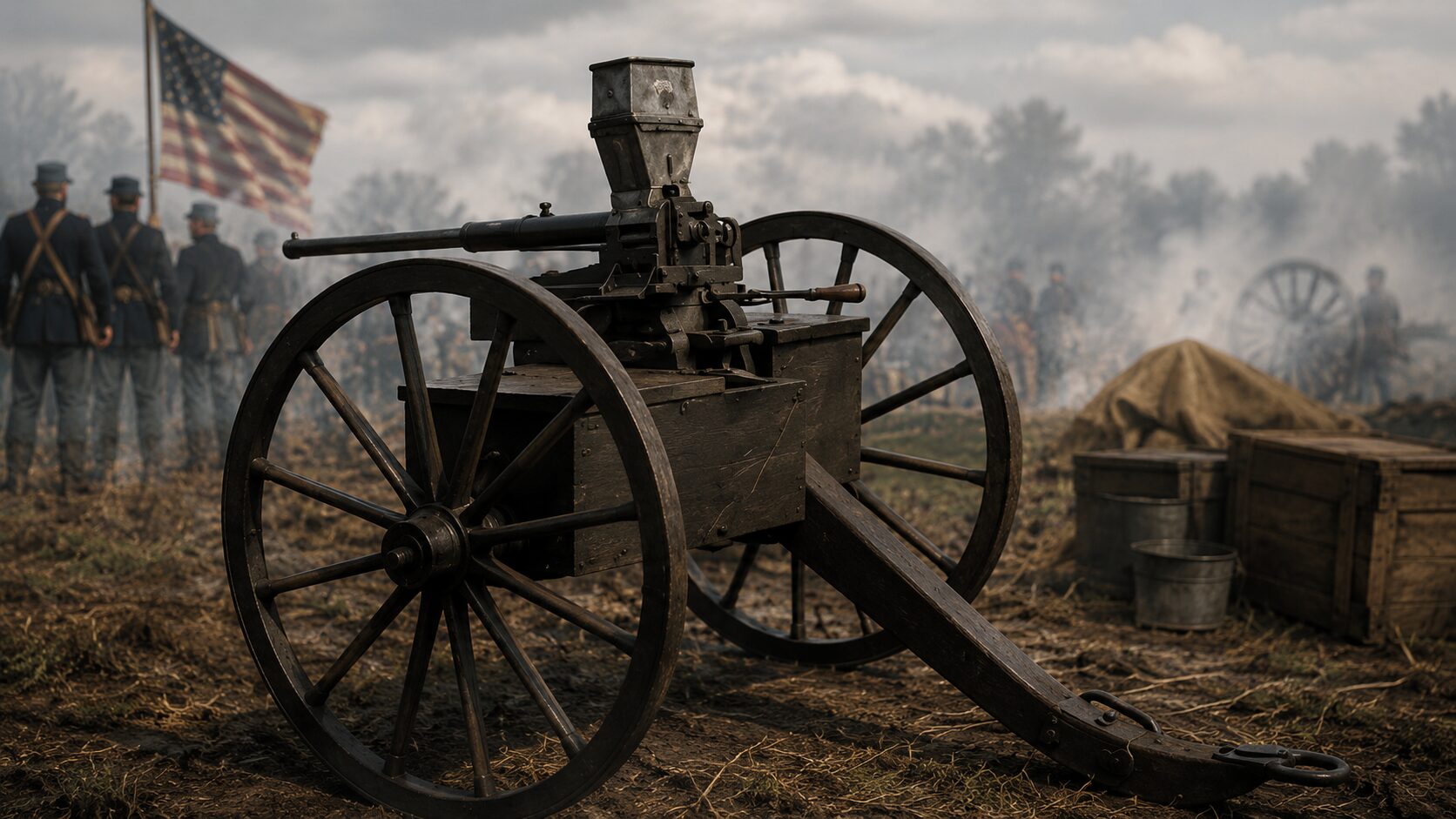
In 1861, when the standard American infantry weapon was still a muzzle-loading rifle, a mechanical gun appeared that could fire around 120 rounds per minute. It had a top-mounted ammunition feed, a hand crank, and a mechanism that produced near-continuous fire as long as the operator kept turning. Abraham Lincoln personally attended a demonstration and believed the weapon deserved government attention. One year later, Richard Gatling patented his famous multi-barrel gun. Yet today almost everyone knows the Gatling name, while Wilson Agar’s “coffee mill” has been largely forgotten. Why?
In the history of weapons, the first design is not always the one that wins. Sometimes one invention appears slightly earlier, demonstrates genuinely revolutionary potential, and even reaches the battlefield, only to become a technological dead end. Another follows almost immediately, fixes a few fundamental problems, and creates an entire new branch of weapons development.
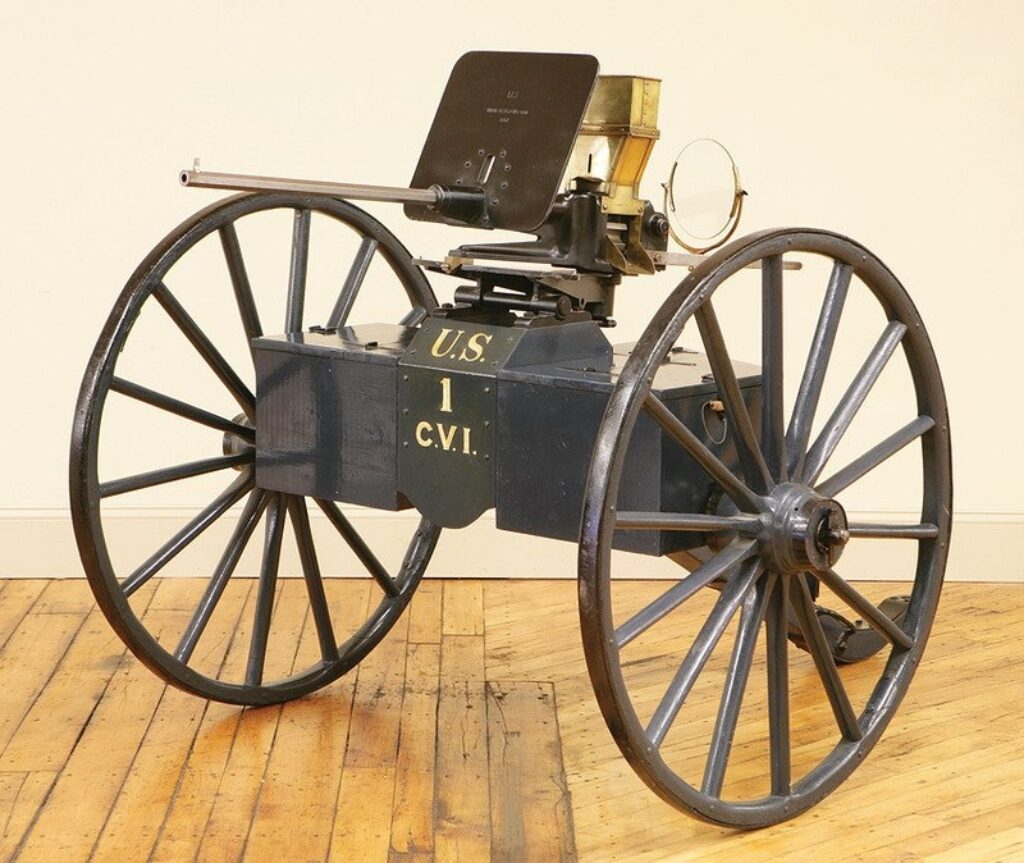
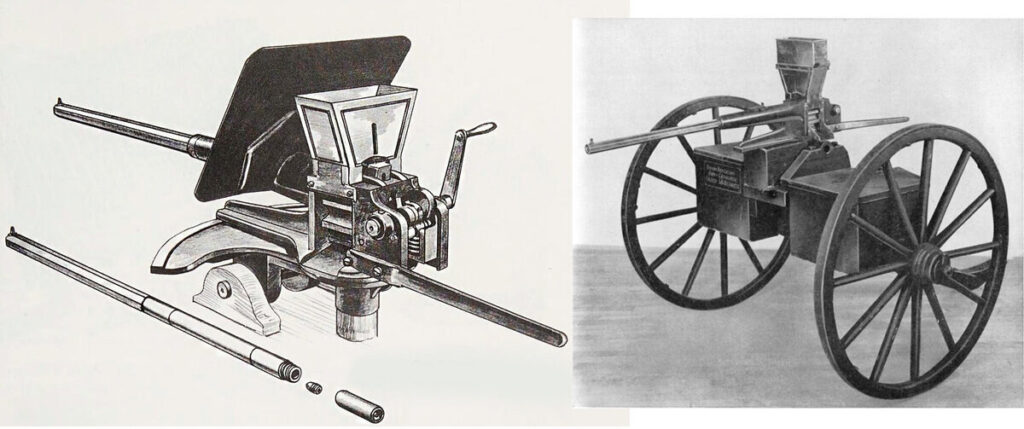
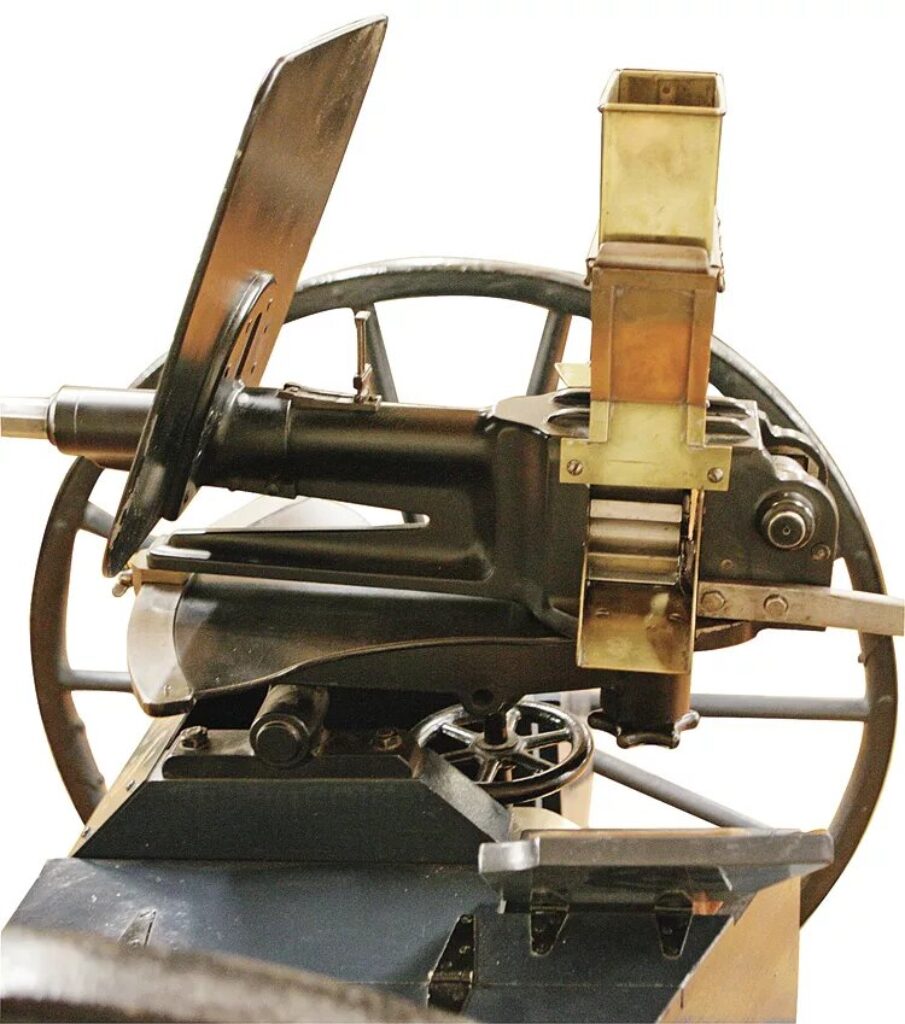
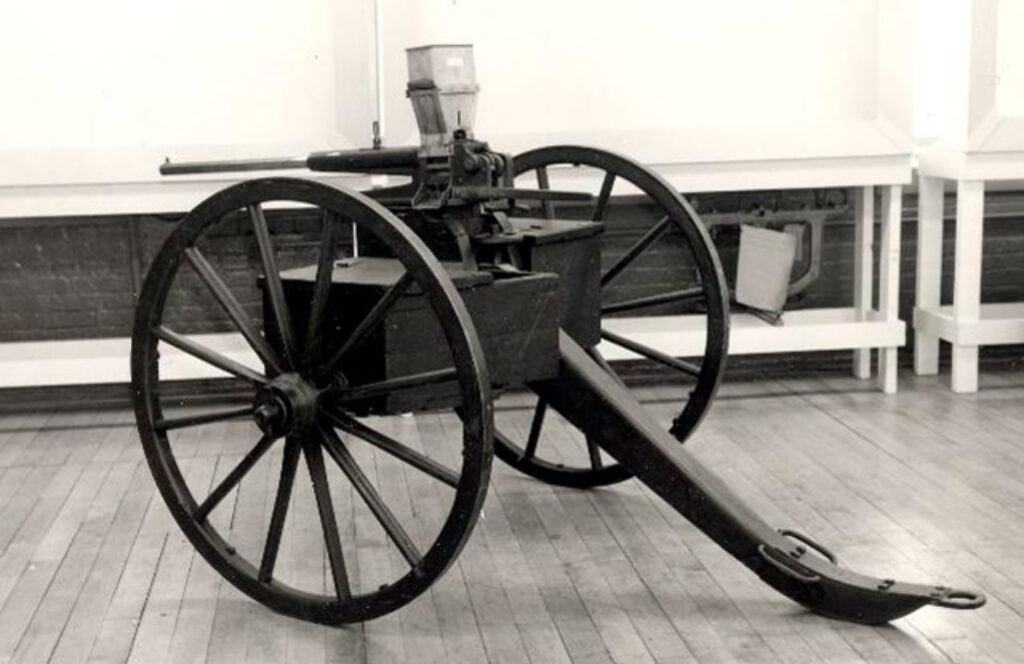
That is exactly what happened with the Agar Gun, also known as the Union Repeating Gun, the Ager Gun, and most memorably, the Coffee Mill Gun. The nickname made sense: the weapon had a tall ammunition hopper mounted on top and a crank on the side that the crew had to keep turning, giving it a strong resemblance to a large hand-operated coffee grinder.
Behind that almost comic appearance, however, was a very serious idea for 1861: make one weapon do the work of many riflemen.
1861: When 120 Rounds per Minute Looked Like Science Fiction
To understand how unusual the Agar Gun was, it has to be placed in the context of the American Civil War.
The conflict began during a transitional era in small arms development. Rifled muzzle-loading muskets had greatly improved infantry range and accuracy, but the basic loading process was still old-fashioned. A soldier had to take out a cartridge, tear open the paper, pour in the powder, place the bullet in the muzzle, ram it down the barrel, fit a percussion cap, and only then fire again.
A well-trained infantryman could manage only a few aimed shots per minute.
Then a machine appeared that could achieve a practical rate of fire of roughly 120 rounds per minute.
Even if battlefield conditions reduced that figure, the difference was enormous. A single Agar Gun could theoretically produce a volume of fire that would otherwise require dozens of riflemen.
Agar promoted his invention with a suitably ambitious claim: it was essentially an army compressed into a few square feet.
For 1861, that was an extraordinary glimpse of the future.
But It Was Not Yet a Machine Gun in the Modern Sense
There is an important distinction to make.
The Agar Gun did not use recoil or propellant gases to cycle itself. It was not fully automatic, and it could not continue firing simply by holding down a trigger.
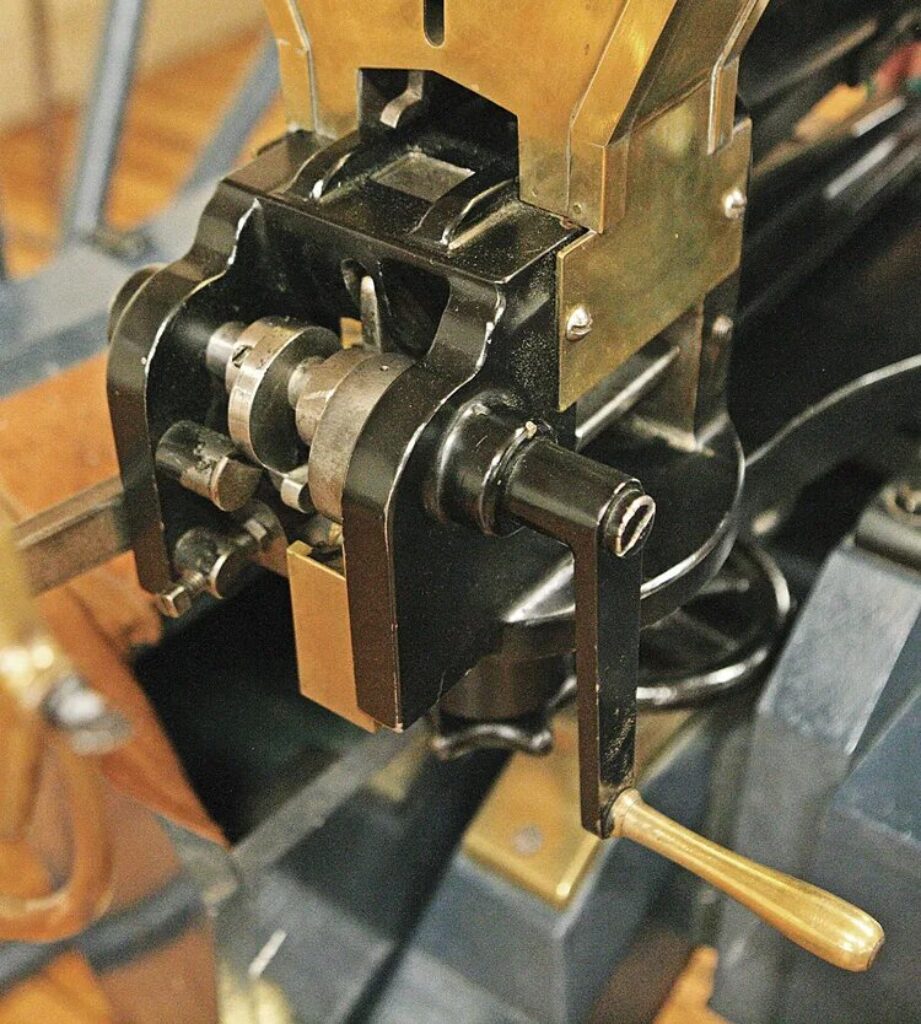
The operator supplied the energy manually by turning a crank. The mechanism then carried out the sequence of loading, locking, firing, and preparing the next round.
Technically, it is more accurate to describe it as a mechanically operated rapid-fire weapon — a direct predecessor of the modern machine gun.
But the crucial idea had already arrived.
The soldier no longer had to reload the weapon manually after every shot. Instead, he supplied mechanical energy while the machine performed the repetitive firing cycle.
That principle would soon lead to more sophisticated manually operated rapid-fire guns, and eventually to truly automatic weapons.
The Strangest Part Was Inside the Gun
Agar’s biggest problem was that his weapon appeared too early.
A reliable, powerful, mass-produced metallic rifle cartridge suitable for such a system did not yet exist in the form the gun really needed. So Agar had to create a transitional solution.
The approximately .58-caliber ammunition was loaded into reusable metal cylinders. Each cylinder acted both as a chamber and, in effect, as a primitive cartridge case. It contained the powder charge and projectile, with a percussion cap fitted at the rear.
The prepared cylinders were loaded into the hopper above the weapon.
As the operator turned the crank, the mechanism fed one cylinder into firing position, locked it, fired the round, and then extracted the spent cylinder. It could later be collected, cleaned, reloaded, and reused.
From an engineering perspective, this was ingenious.
From a military logistics perspective, it was a nightmare.
The crew needed not only powder, bullets, and percussion caps, but also a large supply of reusable metal chambers that had to be recovered, serviced, and reloaded.
The Agar Gun was therefore a strange hybrid: mechanically, it was already reaching toward the industrial age, while its ammunition system still had one foot in the era of the percussion musket.
Then the Barrel Started to Overheat
This was the second fundamental problem.
The Agar Gun had one barrel.
A rate of around 120 rounds per minute was spectacular by the standards of the mid-19th century, but physics did not care about military enthusiasm. During sustained fire, a large amount of energy from the propellant gases turned into heat, and all of it accumulated in the same barrel.
Prolonged firing therefore caused rapid overheating.
Contemporary accounts of demonstrations describe the barrel becoming dangerously hot after sustained use. This was one reason the practical rate of fire was generally kept around 120 rounds per minute instead of pushing the mechanism even faster.
And this brings us to another inventor who was solving the same problem at almost exactly the same time.
His name was Richard Jordan Gatling.
Agar vs. Gatling
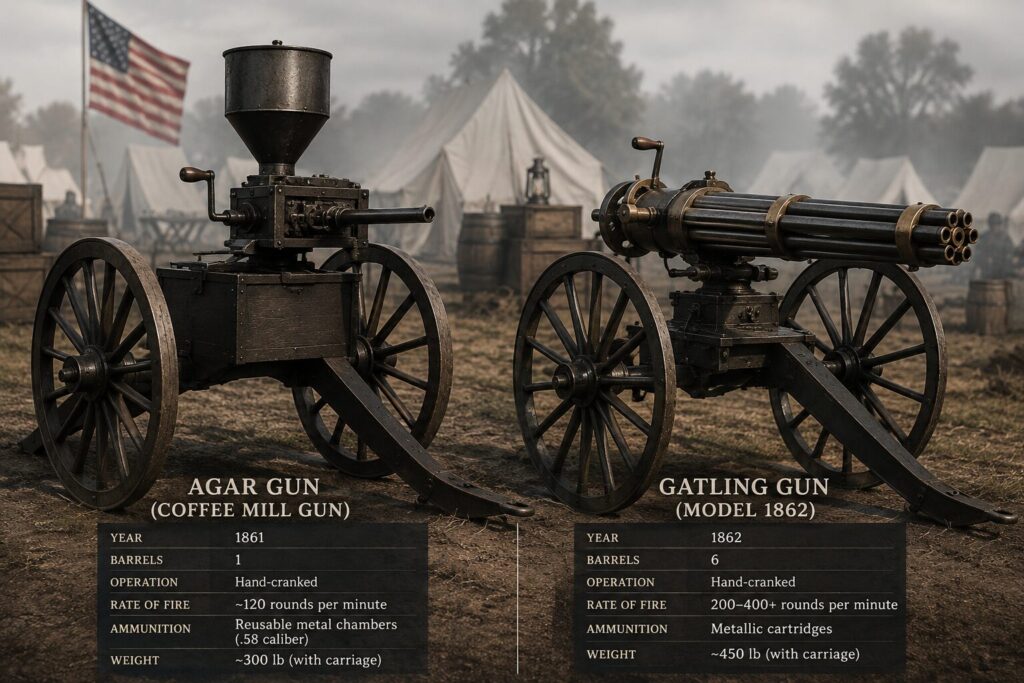
Gatling developed his weapon at roughly the same time as Agar. His famous design was patented in the United States in 1862. Like the Coffee Mill Gun, it used a hand crank and mechanically performed a repeating firing cycle.
At first glance, the two systems were remarkably similar.
But there was one fundamental difference.
Agar used one barrel. Gatling used several rotating barrels.
That difference changed almost everything.
| Appearance | 1861 | 1861–1862 |
| Power source | Hand crank | Hand crank |
| Barrels | 1 | Multiple, early designs often 6 |
| Feed system | Reusable metal chambers | Mechanized ammunition feed |
| Early caliber | About .58 | Varied by model |
| Early rate of fire | About 120 rpm | Several hundred rpm in later models |
| Main weakness | Overheating and complex chambers | Weight, cost, mechanical complexity |
| Development potential | Limited | Extremely high |
The most important difference was not simply rate of fire.
Gatling had found a far more elegant answer to the problem of heat.
Why Multiple Barrels Changed Everything
Imagine a weapon firing 300 rounds per minute.
If there is one barrel, all 300 rounds pass through it.
If there are six barrels rotating in sequence, each barrel handles only around 50 rounds per minute on average.
While one barrel fires, the others rotate through the cycle and have time to cool.
That makes sustained rapid fire far more manageable.
There was another advantage as well.
In the Gatling system, each barrel passed through a separate stage of the operating cycle as the assembly rotated: feeding, chambering, locking, firing, extraction, and resetting.
Instead of forcing one barrel to do everything faster, Gatling distributed the work across multiple barrels.
For the 19th century, it was an extraordinarily effective engineering solution.
And that gave the Gatling architecture far more room to evolve.
Lincoln Was Impressed by Agar First
There is another curious twist in the story.
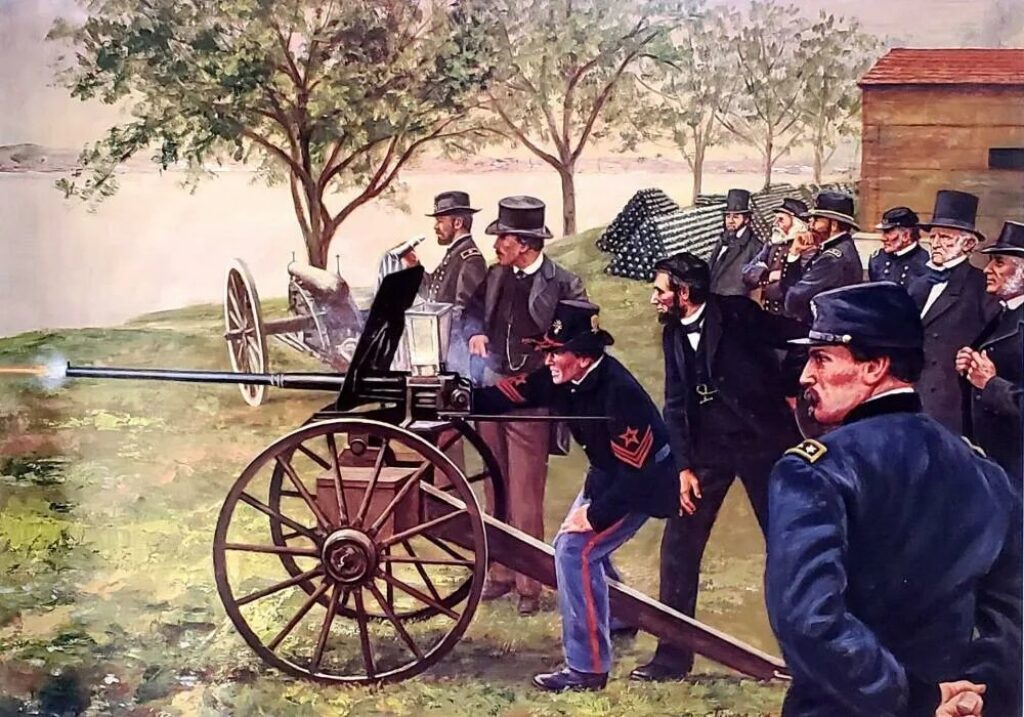
In 1861, the Agar Gun was demonstrated to President Abraham Lincoln. Lincoln had an unusually strong personal interest in military technology and regularly reviewed inventions proposed for wartime use.
The Coffee Mill Gun impressed him.
He reportedly believed the weapon deserved government attention, and the federal authorities soon purchased several examples. Sources commonly refer to an initial purchase of 10 guns, followed by an additional order for 54.
So this was not merely a laboratory curiosity.
The Agar Gun genuinely entered U.S. military service.
And it even reached the battlefield.
The Coffee Mill Gun Goes to War
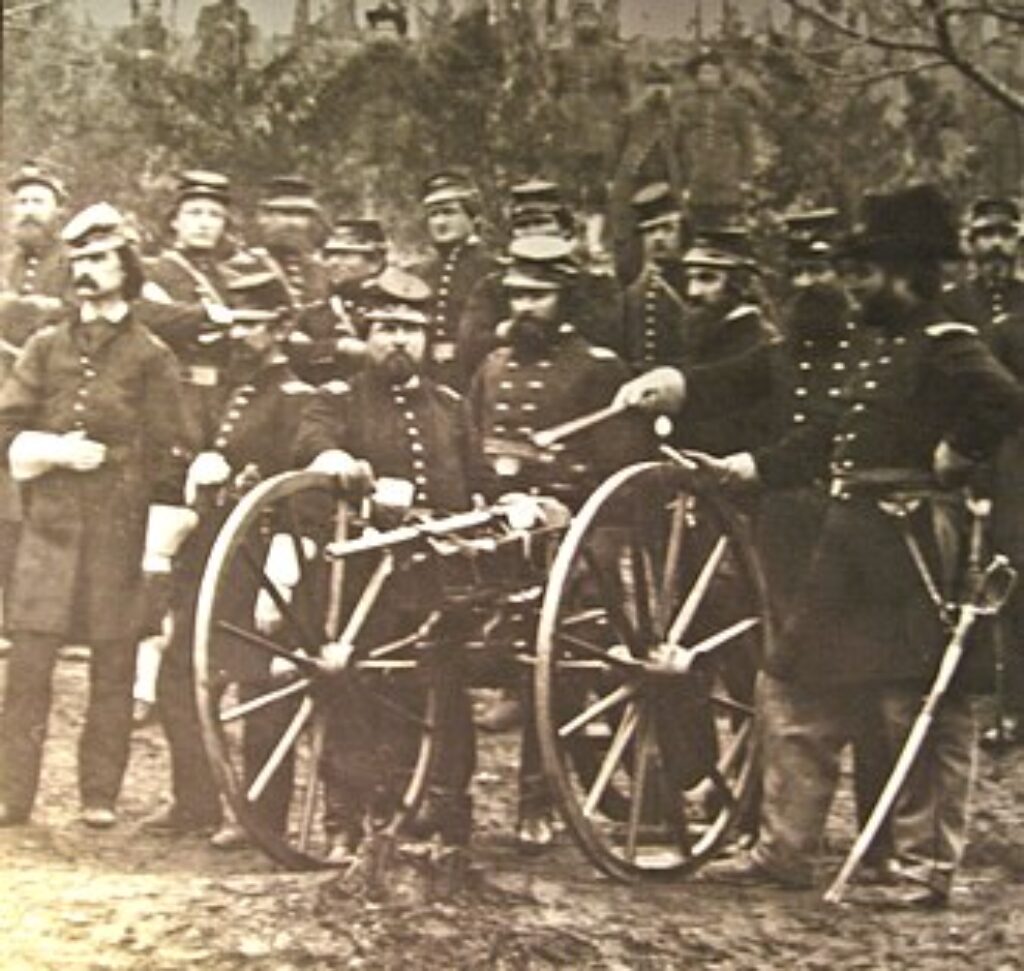
Agar Guns were used by several Union formations during the Civil War. One of the best-known early combat appearances came during the Siege of Yorktown in 1862, while sources also associate the weapon with the 56th New York Volunteer Infantry.
Other reports mention its use against cavalry and in additional engagements.
But there was no battlefield revolution.
Real combat exposed the system’s weaknesses very quickly. The weapon was heavy and required a wheeled mounting. Its reusable chamber system complicated ammunition supply. Black powder generated huge clouds of smoke. The single barrel overheated. The mechanism was far more demanding than an ordinary rifle.
There was also a tactical problem.
Mid-19th-century armies thought primarily in terms of infantry and artillery. A rapid-fire mechanical weapon sat awkwardly between the two. It was too heavy to be treated like an ordinary infantry arm, but too small in caliber to be regarded as conventional artillery.
The army did not yet have a proper place for the new class of weapon.
Gatling Faced Many of the Same Problems
It would be wrong to suggest that Gatling immediately defeated his rival.
He did not.
During the Civil War, the Gatling Gun also saw only limited use. The U.S. Army did not formally adopt the weapon until 1866, after the conflict was over. From there, however, it gradually spread through American service and into foreign armies.
Both systems had appeared slightly before military doctrine was ready for them.
The difference became clear later.
Agar’s architecture had little room left to grow.
Gatling’s had plenty.
The arrival of reliable metallic cartridges made feeding much simpler. Better machining improved mechanical reliability. New magazines, calibers, and mountings followed. The multi-barrel arrangement allowed the rate of fire to increase without immediately running into the same thermal limits.
Eventually, the inventor’s surname became almost a generic term for an entire class of weapon.
Why Agar Lost
It would be a mistake to call the Coffee Mill Gun a bad weapon.
For 1861, it was remarkably ambitious.
Its real problem was that Agar tried to build a rapid-fire weapon before several supporting technologies were mature enough.
He lacked a fully suitable mass-produced metallic cartridge.
He lacked an effective way to manage heat in a single barrel.
Industrial metallurgy and precision manufacturing were still developing.
And military doctrine had not yet figured out how to use such weapons properly.
Gatling faced many of the same limitations, but his multi-barrel architecture had far greater development potential.
One gun became an impressive experiment of its era.
The other became a technological platform.
The Most Interesting Part Came a Century Later
With the appearance of the Maxim gun, it seemed that manually rotated multi-barrel weapons had become obsolete.
Recoil and gas operation allowed a single barrel to reload automatically after every shot. Machine guns became lighter, more compact, and no longer required a soldier to turn a crank.
By the early 20th century, the classic hand-cranked Gatling Gun had largely disappeared.
But the underlying engineering idea unexpectedly returned.
When military aircraft began demanding rates of fire not in the hundreds but in the thousands of rounds per minute, engineers encountered the same old problem: a single barrel has hard physical limits in terms of heating and operating speed.
The answer had already been discovered in the 1860s.
Multiple rotating barrels.
The modern American M61 Vulcan uses six barrels and can fire thousands of rounds per minute. The GAU-8/A Avenger carried by the A-10 uses seven. The difference is that an electric or hydraulic motor now rotates the mechanism instead of a soldier turning a hand crank.
It creates a remarkable historical loop.
Agar and Gatling were both trying to solve the same problem: make a firearm shoot far faster than a human could manually reload it.
Agar tried to make one barrel work faster.
Gatling distributed the work among several barrels.
Within a few years, the advantage of the second approach became clear.
A century later, it turned out that the limits of Gatling’s architecture lay far beyond anything its inventor could have imagined.
A Weapon That Arrived Just a Little Too Early
Today, the Agar Gun can easily look like a technological curiosity — a strange carriage-mounted weapon with a hopper and crank that really does resemble an oversized coffee grinder.
But beneath that appearance was an important step in the evolution of firearms.
As early as 1861, engineers had reached the idea of a mechanized firing cycle. The shooter no longer loaded the weapon after every shot. He simply turned the crank while the mechanism fed the chamber, locked it, fired, extracted it, and prepared for the next cycle.
The true automatic machine gun was still decades away.
Agar did not become its direct ancestor. His design was too complicated, too dependent on awkward ammunition, and too vulnerable to overheating.
But that is exactly why the comparison with Gatling is so revealing.
The two systems appeared almost simultaneously and tried to solve the same problem. Agar proved that a mechanical rapid-fire weapon was possible. Gatling found the architecture that allowed the idea to keep evolving.
History remembered the second man.
But the Coffee Mill Gun had already started firing before the famous Gatling Gun truly entered the stage.