
The Last Days of the Warthog: Why the A-10 Will Keep Flying Even Though Its Era Is Already Over

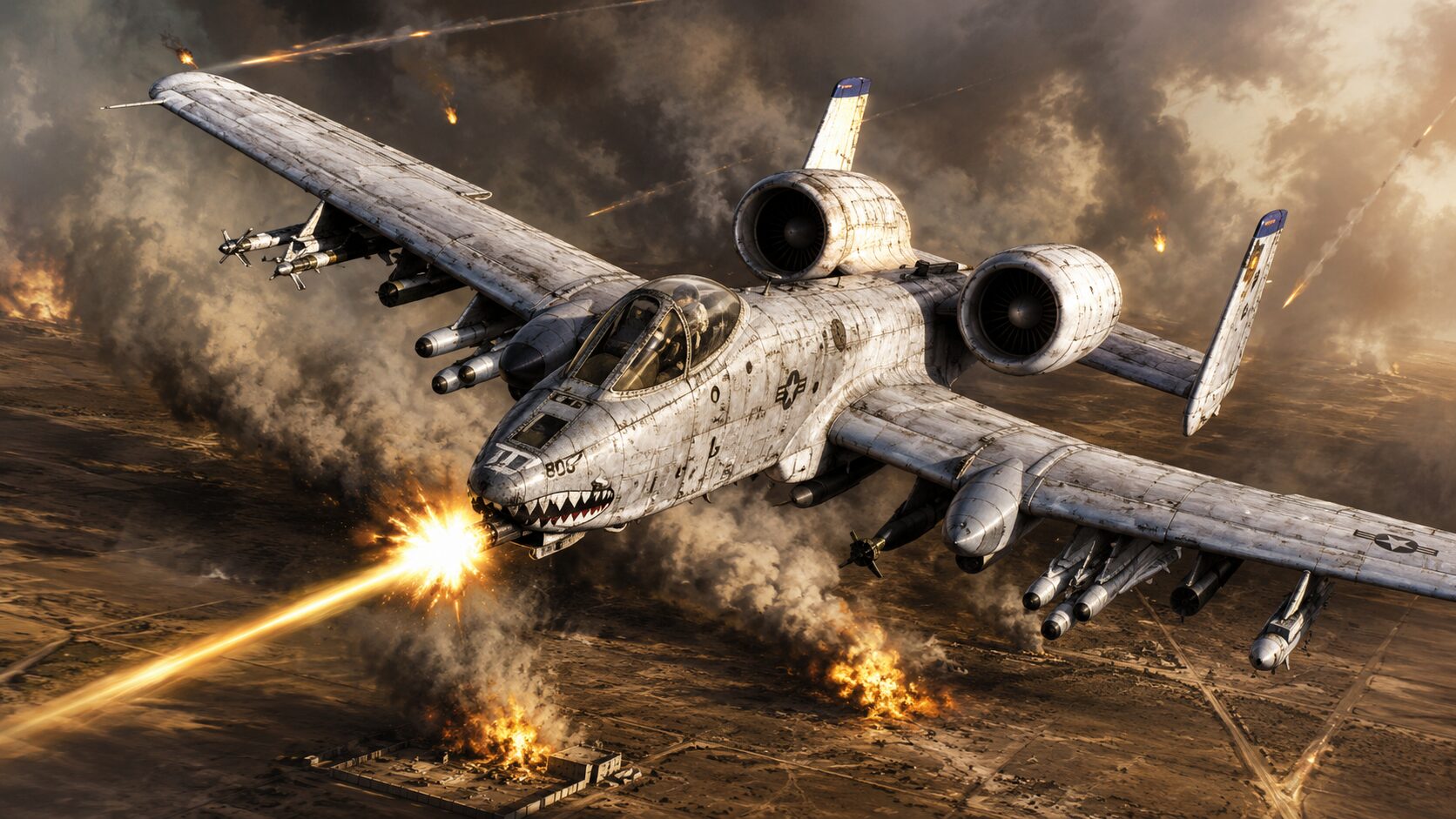
It was designed around a massive seven-barrel cannon and built to hunt Soviet tank armies in Europe. Instead, the A-10 Thunderbolt II spent nearly half a century fighting in the Middle East, the Balkans, and Afghanistan, surviving repeated attempts to send it into retirement. Now something truly symbolic is happening: the U.S. Air Force has kept part of the A-10 fleet in service until 2030, but the training pipeline for new pilots is already shutting down, while the famous Weapons School prepares to say goodbye to the Warthog. The aircraft is still flying, but the era of the specialized armored attack aircraft appears to be ending.
Military aviation history is full of aircraft remembered for speed records, victories, or unusual appearances. The A-10 combines several of these qualities, but for the general public its trademark has become the sound of the 30mm GAU-8/A Avenger cannon — the famous “BRRRRT” that long ago became an aviation meme. Behind that spectacular image, however, lies a much more interesting story. The A-10 became one of those rare aircraft repeatedly declared obsolete, marked for retirement, and theoretically replaced by more advanced machines, only to be called back into service again and again.
Now that story really is approaching its final chapter. At Davis-Monthan Air Force Base, the last class of new A-10 pilots has completed training, while the section of the famous USAF Weapons School that spent decades preparing top-level instructors for the type is reaching the end of its mission. The paradox is that the aircraft themselves are not disappearing just yet: in the spring of 2026, the U.S. Air Force decided to retain part of the fleet through 2030. This has created an unusual situation — the aircraft has been given a few more years of life, while the institutional infrastructure that sustained its community and reproduced its expertise is already beginning to disappear.
An Aircraft Literally Built Around a Gun

An A-10 Thunderbolt II, assigned to the 74th Fighter Squadron, Moody Air Force Base, GA, returns to mission after receiving fuel from a KC-135 Stratotanker, 340th Expeditionary Air Refueling Squadron, over the skies of Afghanistan in support of Operation Enduring Freedom, May 8, 2011. (U.S. Air Force photo/Master Sgt. William Greer)
The phrase “the aircraft was built around the gun” has become a cliché when discussing the A-10, but in this case it is almost literally true. The centerpiece of the future attack aircraft was the seven-barrel 30mm GAU-8/A Avenger, developed specifically to engage armored vehicles. The complete gun system is almost six meters long, while the weapon, ammunition feed system, and fully loaded drum together approach two tons in weight. In later A-10 configurations, the ammunition capacity is up to 1,174 rounds, while the GAU-8 can fire at approximately 3,900 rounds per minute.
The cannon was so large that engineers had to design the entire forward section of the aircraft around it. The ammunition drum sits directly behind the weapon, the nose landing gear is offset from the aircraft’s centerline, and the gun itself is positioned so that the firing barrel is as close as possible to the aircraft’s longitudinal axis. Even today, the GAU-8 looks enormous for an aircraft weapon. In the early 1970s, however, there was a perfectly rational reason for such excess: the A-10 was intended primarily as a specialized tank killer.
And there were expected to be a lot of tanks. In the event of a major NATO–Warsaw Pact war, American planners anticipated facing huge formations of Soviet tanks and armored vehicles in Central Europe. They needed a relatively inexpensive close-air-support aircraft capable of operating from forward airfields, remaining over the battlefield for extended periods, and destroying armored vehicles even under serious enemy fire. The A-X program began in the late 1960s, the YA-10 prototype first flew in 1972, and the first operational units reached initial combat capability in 1977.
A Slow Aircraft Built for a Very Big War
By the standards of its era, the A-10 looked almost defiantly old-fashioned. At a time when the aviation industry was competing in speed, altitude, and increasingly sophisticated electronics, the Americans created a subsonic attack aircraft with straight wings and a maximum speed of roughly 700 km/h, or 435 mph. For comparison, the F-4 Phantom II, already in service at the time, could exceed 2,300 km/h. But the A-10 did not need extreme speed. It was supposed to work relatively slowly over the battlefield, giving its pilot time to identify small ground targets and make repeated attack runs.
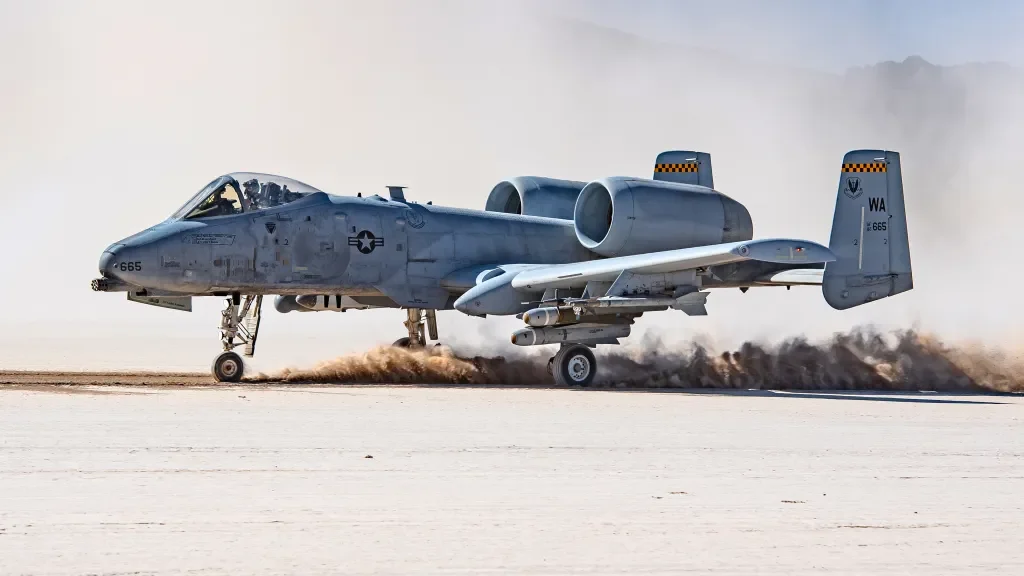
Far more attention was paid to survivability. The pilot sat inside the famous “titanium bathtub,” an armored enclosure weighing approximately 540 kilograms, designed to protect the cockpit from ground fire. The TF34 engines were mounted far apart on the rear fuselage so that a single hit would be less likely to disable both. Flight controls and hydraulic systems were redundant, and even after complete hydraulic failure, the pilot retained a degree of mechanical control. The fuel system received extensive protection, while the airframe itself was designed with severe battle damage in mind.
Even the landing gear was unusual. The main wheels remain partially exposed when retracted, allowing them to absorb some of the impact during an emergency gear-up landing. The result was something resembling an aerial descendant of the armored ground-attack aircraft of World War II, but designed with the technology and lessons of the jet age. The A-10 was not intended to escape the battlefield through speed. It was intended to survive being there.
The War the A-10 Was Built For Never Happened
The great irony is that the A-10 never had to perform the mission for which it had originally been designed. Soviet tank armies never rolled into West Germany, the Warsaw Pact collapsed, and the Soviet Union itself ceased to exist in 1991. Logically, the specialized anti-tank attack aircraft should have been among the first platforms to face deep post-Cold War cuts. Instead, the most famous period of the Warthog’s career was only beginning.
Its first major test came during Operation Desert Storm in 1991. A-10s flew more than 8,000 combat sorties, employing not only their famous cannon but also AGM-65 Maverick missiles, bombs, and other weapons. Iraq was followed by the Balkans, Afghanistan, another war in Iraq, and operations against militant groups in the Middle East. An aircraft designed to fight Warsaw Pact armored columns ultimately spent most of its combat career in wars where American air power enjoyed a significant degree of superiority.
It was in these conflicts that one of the A-10’s most important qualities became apparent — something difficult to express in a conventional specifications table. The aircraft could remain near ground forces for extended periods, operate at relatively low speeds, search for targets, and maintain close coordination with forward air controllers. For troops on the ground, the Warthog’s value was not simply the number of bombs it carried or the power of the GAU-8. It was also the presence of an experienced pilot directly above the battlefield.
The GAU-8 Gradually Stopped Being the A-10’s Most Important Weapon
Popular culture permanently linked the Warthog with its cannon, but the aircraft’s real evolution followed a somewhat different path. As precision-guided weapons improved, the GAU-8 remained an important tool, but it was no longer the only — or necessarily the primary — way to destroy targets. The A-10 gained the ability to employ AGM-65 Maverick missiles, JDAM guided bombs, and other modern weapons that allowed targets to be engaged from much greater distances.
The transformation became especially significant with the upgrade to the A-10C standard. The aircraft received a digital cockpit, new multifunction displays, modern communications and data-sharing equipment, targeting pods, and compatibility with a much broader range of guided weapons. In terms of target acquisition and weapon employment, the A-10C of the 2020s was far removed from the original A-10A of the late 1970s, even though externally it remained unmistakably the same Warthog.
That ability to evolve helps explain the aircraft’s extraordinary longevity. An airframe designed more than half a century ago proved flexible enough to absorb entirely new generations of weapons and electronics. Calling the modern Warthog simply a “1970s aircraft” is therefore somewhat misleading. Its basic structure was certainly old, but its combat capabilities were repeatedly rebuilt for wars its original designers could hardly have imagined.
Weapons School: Where Pilots Learned More Than How to Fly the A-10
This is why what is now happening at Nellis Air Force Base is more significant than the headline might suggest. The USAF Weapons School is not an ordinary flight-training institution. Its students are already experienced personnel who are trained to become instructors and experts in the combat employment of their particular weapons systems. After graduation, they return to operational units and spread that knowledge throughout the force.
The A-10 community was part of this system for decades. Training went far beyond firing the GAU-8 or launching Mavericks. Pilots refined far more complicated skills: coordinating with ground forces, working with Joint Terminal Attack Controllers, conducting armed reconnaissance, providing close air support, integrating with other aircraft, and employing weapons close to friendly troops. Over time, an entire professional culture developed around the Warthog, accumulating an enormous body of tactical experience.
Now that system is coming to an end. The final class of new A-10 pilots completed training in the spring of 2026, while the Weapons School is preparing its final specialists for the platform. The aircraft remain operational and experienced pilots continue to fly them, but the mechanism that created new generations of A-10 experts is shutting down. More than any retirement ceremony, that shows that the aircraft’s ultimate fate has already been decided.
Why the A-10 Was Still Given Until 2030
Only a few years ago, it appeared that the Warthog’s fate had been settled and that the remaining aircraft would rapidly head into storage. The U.S. Air Force had long advocated accelerated retirement, hoping to free funding, maintainers, and pilots for newer platforms, particularly the F-35. Yet in the spring of 2026, those plans were unexpectedly revised: the service decided to retain three combat A-10 squadrons through 2030, amounting to roughly five dozen aircraft.
The reason is largely pragmatic. Despite its age, the A-10 remains capable of performing useful missions, while the changing international security environment has made the U.S. military more cautious about rapidly eliminating existing combat capacity. Keeping the aircraft for several additional years preserves trained crews and operational platforms while newer systems gradually absorb their missions. But this is a postponement, not a cancellation of retirement.
That explains the apparently strange logic. The Air Force is keeping several squadrons but is not rebuilding the full pilot-training pipeline or reversing the dismantling of institutional infrastructure. The remaining A-10s will be operated by the personnel already trained to fly and maintain them. In aviation terms, it is essentially a retirement arrangement: the aircraft is still useful, but nobody is investing in the next generation of people who would operate it.
Why Retire Such a Successful Attack Aircraft at All?
The A-10’s central problem is not that it suddenly became a bad aircraft. It still offers a substantial weapons load, excellent endurance, and exceptional suitability for supporting troops on the ground. What has changed is the environment in which it would have to operate during a major modern war.
The contemporary battlefield is saturated with mobile surface-to-air missile systems, man-portable air defenses, radars, drones, and electronic intelligence systems. Long-range air-defense weapons can engage targets from tens or even hundreds of kilometers away, while modern fighters can launch air-to-air missiles without ever approaching a slow-moving attack aircraft. Under such conditions, one of the A-10’s greatest strengths — the ability to remain relatively low and close to the battlefield for extended periods — simultaneously becomes one of its greatest vulnerabilities.
The titanium cockpit can protect a pilot from fragments and small-caliber ground fire, but no amount of armor can make the Warthog invulnerable to a modern surface-to-air missile. In a conflict against a technologically advanced opponent, the A-10 would therefore have to employ weapons from greater distances and avoid heavily defended areas. But once it is forced to fight that way, some of the advantages of a specialized armored attack aircraft begin to lose their relevance.
What Will Replace the Warthog? Nobody — and Everyone
Perhaps the most interesting aspect of the A-10’s retirement is that the U.S. Air Force has no direct successor. There is no new A-11 with an armored cockpit, straight wings, and an even larger cannon. Judging by current plans, there never will be. Instead of replacing one specialized aircraft with another, the A-10’s missions are being distributed across an entire ecosystem of weapons and platforms.
Some close-air-support missions can be performed by F-35s and F-16s, using precision weapons and far more advanced sensors. Other tasks are increasingly shifting toward unmanned aircraft, Army aviation, long-range artillery, and missile systems. In the future, inexpensive unmanned platforms and Collaborative Combat Aircraft could take on an even greater role, operating in dangerous airspace without putting a pilot at risk. Close air support itself is not disappearing. What is disappearing is the assumption that it necessarily requires a dedicated, heavily armored manned attack aircraft.
That question fueled one of the longest-running debates in modern U.S. military aviation. Supporters of the A-10 correctly argued that a modern multirole fighter cannot perfectly reproduce the Warthog’s ability to remain near ground troops for long periods and provide support almost on demand. Its critics were equally correct in pointing out that those advantages matter only as long as the aircraft can survive over the battlefield. Ultimately, the argument was settled not by the cannon, the armor, or even the cost per flight hour, but by the changing nature of warfare itself.
The Aircraft Can Be Retired. Its School of Warfare Cannot
That is why the disappearance of the A-10 is more interesting than the ordinary retirement of another aging aircraft. Along with it, the U.S. Air Force risks losing a professional culture of close air support accumulated over decades. Warthog pilots specialized in working with ground units, understood the capabilities and limitations of forward air controllers, learned to assess rapidly changing situations directly over the battlefield, and practiced employing weapons in environments where an error of a few dozen meters could put friendly troops at risk.
The A-10 itself will inevitably disappear, but those skills must migrate to other platforms. The true legacy of the Weapons School will therefore be less about teaching pilots how to handle one particular aircraft and more about preserving an enormous library of tactical knowledge. In the long run, that experience may prove far more valuable than the Warthogs eventually preserved in museums.
And this is perhaps the greatest paradox of the A-10 story. The aircraft was designed as an extremely specialized tool for one very specific war, yet it survived for so long precisely because its pilots learned to use it far beyond the scenario for which it had originally been created.
Conclusion
The A-10 is ending its career almost as unusually as it began it. It was designed to destroy thousands of Soviet tanks in Europe, but that war never came. After the Cold War, the aircraft should have quickly become irrelevant, yet instead it fought for another three decades. It was repeatedly marked for retirement, only for the military to find another job for it. Now even the final goodbye has been stretched out for several more years: part of the fleet will remain until 2030, while the last new pilots have already been trained and the Weapons School is closing its A-10 program.
What is ending, therefore, is not merely the story of another combat aircraft approaching half a century of service. It is the decline of an entire concept: the specialized armored attack aircraft designed to descend close to the battlefield, remain beside the infantry, absorb enemy fire, and keep hunting for the next target.
A-10s will continue to take to the skies for a few more years. The GAU-8 will undoubtedly produce its unmistakable BRRRRT again. Several dozen Warthogs may survive in active service until 2030.
But the closure of the school says far more about the aircraft’s future than its official retirement date ever could.
The A-10 is still alive. Its era is already over.
based on https://www.twz.com/air/the-last-days-of-the-a-10-warthog-weapons-school






