How China Spent More Than a Decade Preparing for an Oil War — and Why It Helped Stabilize the Global Market

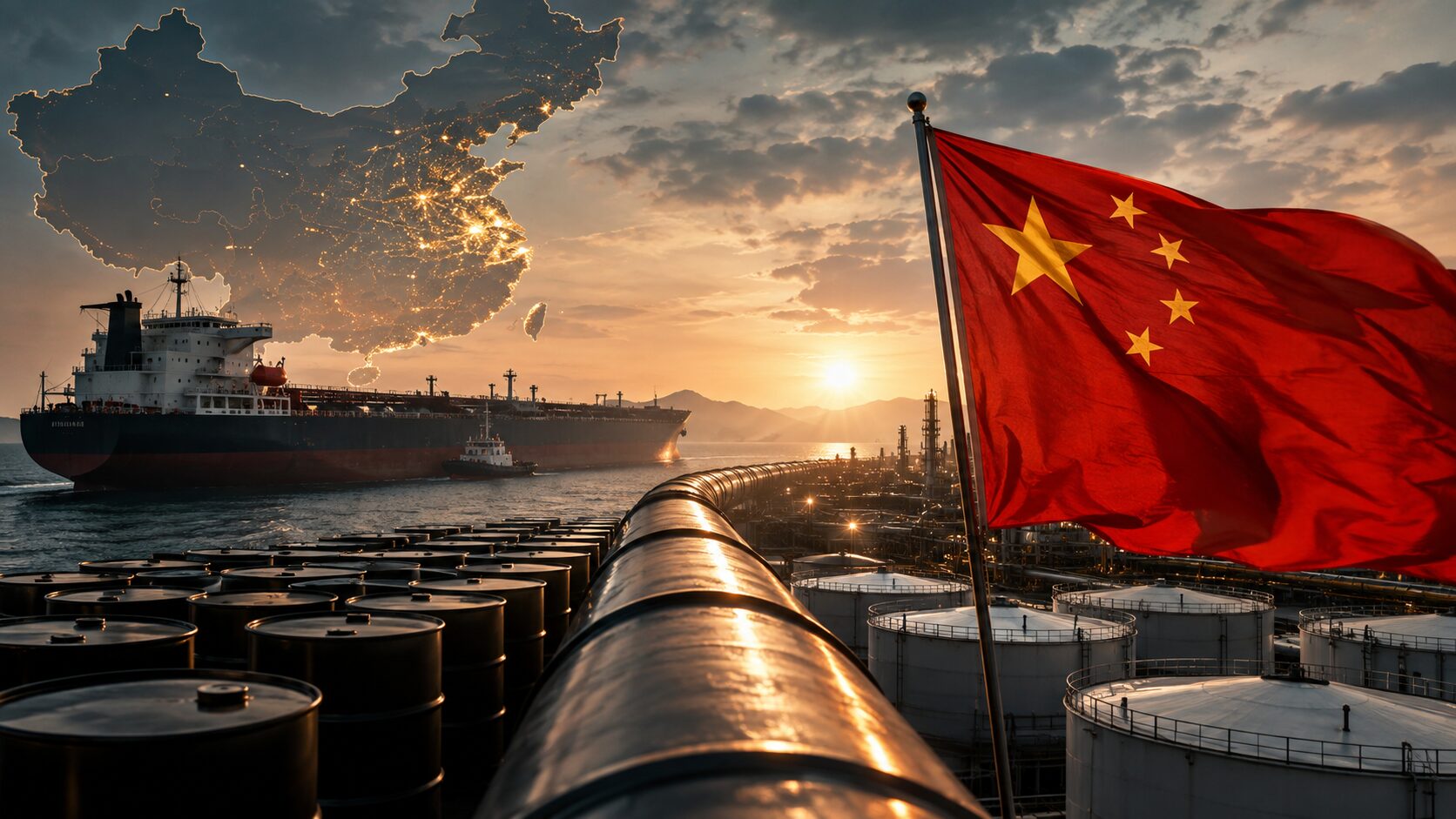
When the Strait of Hormuz was effectively blocked, many analysts began warning of what could become the largest energy crisis of the 21st century.
Roughly 20 million barrels of oil per day normally pass through this narrow maritime corridor — equivalent to nearly one-fifth of global petroleum consumption. If those flows were severely disrupted, the consequences seemed obvious: oil prices would soar, airlines would cut flights, fuel shortages would spread, and industries around the world would face sharply higher costs.
Yet the catastrophe many had feared did not materialize.
Oil prices rose. The market came under enormous pressure. But the global energy shock proved less devastating than some of the most pessimistic forecasts had suggested.
And one of the reasons was China.
For decades, China had been seen as the great engine of global oil demand. During the crisis, however, the world’s largest crude importer suddenly became one of the biggest sources of demand reduction.
The most important part of the story is that this did not happen by accident.
China had been preparing for precisely this kind of vulnerability for years.
Beijing Saw the Problem Long Before the Crisis
For much of the past fifteen years, China has been the world’s largest importer of crude oil.
More than 70% of the oil it consumes has come from abroad, while a substantial share of those supplies has historically traveled through the Strait of Hormuz and other vulnerable maritime chokepoints.
For Beijing, this represented an obvious strategic weakness.
China could build factories, power plants, railways and the world’s largest manufacturing economy, but much of the energy needed to keep that machine running still had to arrive aboard tankers traveling through narrow waterways far beyond Chinese control.
A serious disruption in the Persian Gulf could therefore become an economic crisis thousands of kilometers away.
Beijing understood this problem.
And it began addressing it long before the current crisis.
There was no single grand announcement.
No dramatic declaration of energy independence.
Instead, China adopted dozens of policies that individually looked like ordinary industrial planning: strategic oil reserves, electric vehicles, high-speed rail, coal-fired power generation, alternative petrochemical feedstocks, diversified energy suppliers and enormous investments in domestic infrastructure.
Taken together, however, they created something much more significant.
They gave China a massive energy-security buffer.
Step One: Buy the Oil Before You Need It
Unlike many countries, China did not rely exclusively on a traditional government-controlled strategic petroleum reserve.
Over the years, it simultaneously expanded state storage facilities, increased commercial inventories held by major energy companies and aggressively purchased crude whenever favorable market conditions appeared.
Sanctions on Russia and Iran created another opportunity.
As many Western buyers reduced or abandoned purchases from these countries, Chinese refiners became increasingly important customers. Discounted Russian and Iranian crude flowed toward Asia, sometimes through complicated trading structures, intermediary companies and fleets of aging tankers.
For Beijing, the geopolitical circumstances created an opportunity to acquire enormous quantities of energy at attractive prices.
By the time the Hormuz crisis arrived, estimates of China’s combined government and commercial crude inventories had climbed to around 1.4–1.5 billion barrels, although the precise figure remains difficult to establish because Beijing does not publish comprehensive real-time data on its strategic stocks.
Whatever the exact number, the scale of the reserves was enormous.
And when imports suddenly became more difficult, those inventories gave China something most oil-importing economies desperately lack:
time.
China did not have to compete for every available tanker cargo on the international market.
It could draw down stocks instead.
Step Two: Make Transportation Less Dependent on Oil
China’s electric-vehicle revolution is usually discussed as an automotive story.
Western governments worry about Chinese EV exports. European manufacturers worry about competition. Investors follow companies, battery prices and market share.
From an energy-security perspective, however, there is another way to look at China’s enormous EV industry.
Every electric vehicle replacing an internal-combustion car is one less vehicle dependent on gasoline.
And Beijing has spent years subsidizing that transition.
China built not only the world’s largest electric-car market, but also huge fleets of electric buses, increasingly competitive electric commercial vehicles and an enormous charging infrastructure.
At the same time, it constructed the world’s largest high-speed railway network.
Aircraft require aviation fuel.
Cars require gasoline.
Diesel trains require diesel.
Electric trains can instead be powered from a national electricity grid supplied by coal, nuclear, hydroelectric, solar and wind generation.
This distinction becomes extremely important during an oil shock.
A passenger traveling between two Chinese cities aboard a high-speed electric train represents transportation demand that does not necessarily require another barrel of imported crude.
None of these measures eliminated China’s dependence on oil.
But collectively they reduced the amount of oil required to keep people and goods moving.
And when the crisis arrived, that flexibility suddenly became extremely valuable.
Step Three: Keep Other Energy Options Alive
There is an apparent contradiction at the heart of China’s energy policy.
China is simultaneously the world’s largest builder of renewable-energy capacity and the world’s largest consumer of coal.
From a climate perspective, that combination is controversial.
From the perspective of energy security, however, the logic is much easier to understand.
China possesses enormous domestic coal resources.
Unlike oil arriving aboard tankers from the Persian Gulf, Chinese coal does not need to pass through the Strait of Hormuz.
Beijing therefore continued maintaining and expanding a huge coal-fired generating fleet even while installing extraordinary amounts of solar and wind capacity.
China also invested heavily in coal chemistry — technologies capable of producing chemicals, synthetic fuels and industrial feedstocks from coal rather than relying exclusively on petroleum and natural gas.
Again, none of this makes China independent of crude oil.
Modern aviation, shipping, road transport, petrochemicals and numerous industrial processes still require enormous quantities of petroleum.
But it does create redundancy.
And redundancy is exactly what matters during an energy crisis.
Step Four: The Domestic Market Comes First
Another important response was the reduction of petroleum-product exports.
When crude supplies became uncertain, keeping gasoline, diesel and aviation fuel inside China became more valuable than selling those products abroad.
The logic was straightforward.
Every barrel of fuel retained for domestic consumption reduced the pressure to acquire replacement crude on an increasingly disrupted international market.
At the same time, Chinese refiners could reduce operating rates rather than continue processing oil primarily for export.
This mattered beyond China’s borders.
For years, Chinese refiners had become significant participants in Asian petroleum-product markets. When Beijing changes export quotas or refiners alter production, the effects can be felt across the region.
During an oil shock, therefore, China’s decisions affect not only its own energy security but the balance of fuel supply across Asia.
Then the Market Saw What China Could Actually Do
This was the moment when years of preparation became visible.
During the height of the crisis, Chinese crude imports fell dramatically.
From normal levels of roughly 11.5–12 million barrels per day, imports temporarily dropped toward approximately 7 million barrels per day, reaching levels not seen for almost a decade.
That was an extraordinary change.
A reduction of several million barrels per day is not simply a Chinese economic statistic.
It is large enough to affect the global oil balance.
And this is where China’s enormous reserves, transportation electrification and diversified energy system became strategically important.
Instead of desperately competing with India, Europe, Japan, South Korea and other importers for every available cargo, China could temporarily reduce its presence on the spot market.
In effect, millions of barrels of potential Chinese demand disappeared.
Those barrels could then be purchased by somebody else.
The result did not eliminate the global supply shock.
But it helped prevent an already severe disruption from becoming even worse.
China Has Not Become Independent of Oil
This point is crucial.
China has not “gotten off the oil needle.”
Nor can it simply disconnect itself from the global petroleum market indefinitely.
It remains the world’s largest crude importer and one of the largest petroleum consumers on Earth. Its aviation industry needs jet fuel, its petrochemical sector requires enormous volumes of feedstock, and millions of conventional cars and trucks still burn gasoline and diesel every day.
If foreign oil supplies were severely disrupted for months or years, the economic consequences for China would be profound.
Strategic reserves are finite.
Coal cannot replace every petroleum product.
Electric vehicles cannot substitute for every truck, aircraft or ship.
But Beijing does not need complete energy independence to achieve something strategically important.
It only needs enough flexibility to survive the initial shock.
And that is precisely what China appears to have built.
The Most Important Lesson Is Not Really About Oil
For decades, China’s dependence on imported energy was considered one of its greatest strategic vulnerabilities.
The basic assumption was simple.
China might become the world’s factory, build the world’s largest navy and accumulate enormous financial reserves — but its economy would still depend on tankers traveling through a handful of vulnerable maritime chokepoints.
That assumption has not disappeared.
But it now looks considerably less absolute.
China has spent years constructing strategic petroleum reserves, diversifying suppliers, electrifying transportation, expanding railways, preserving domestic coal capacity and building the world’s largest renewable-energy system.
Individually, these policies served different purposes.
Together, they created resilience.
And the Hormuz crisis demonstrated what that resilience can mean.
China did not leave the global oil market.
It did not become immune to an energy blockade.
And it certainly did not replace OPEC as the dominant force determining world oil prices.
But Beijing demonstrated something potentially just as important: the world’s largest crude buyer can temporarily remove several million barrels per day of demand from the international market without bringing its own economy to an immediate halt.
That changes the equation.
For most of modern oil history, market power has primarily been associated with producers — countries capable of adding or withholding supply.
China is demonstrating the growing importance of another form of power:
the ability of a giant consumer to rapidly change demand.
And when the country making that decision normally buys more oil than almost anyone else on Earth, even a temporary adjustment can ripple through tanker routes, refinery margins, fuel prices and ultimately the cost of goods on store shelves around the world.
China did not escape its dependence on oil overnight.
It spent more than a decade making sure that, when the oil stopped flowing, it would have more options than everyone expected.