The Armored Car That Barely Fought—but Still Changed the British Army: The Forgotten Story of the Guy Armoured Car

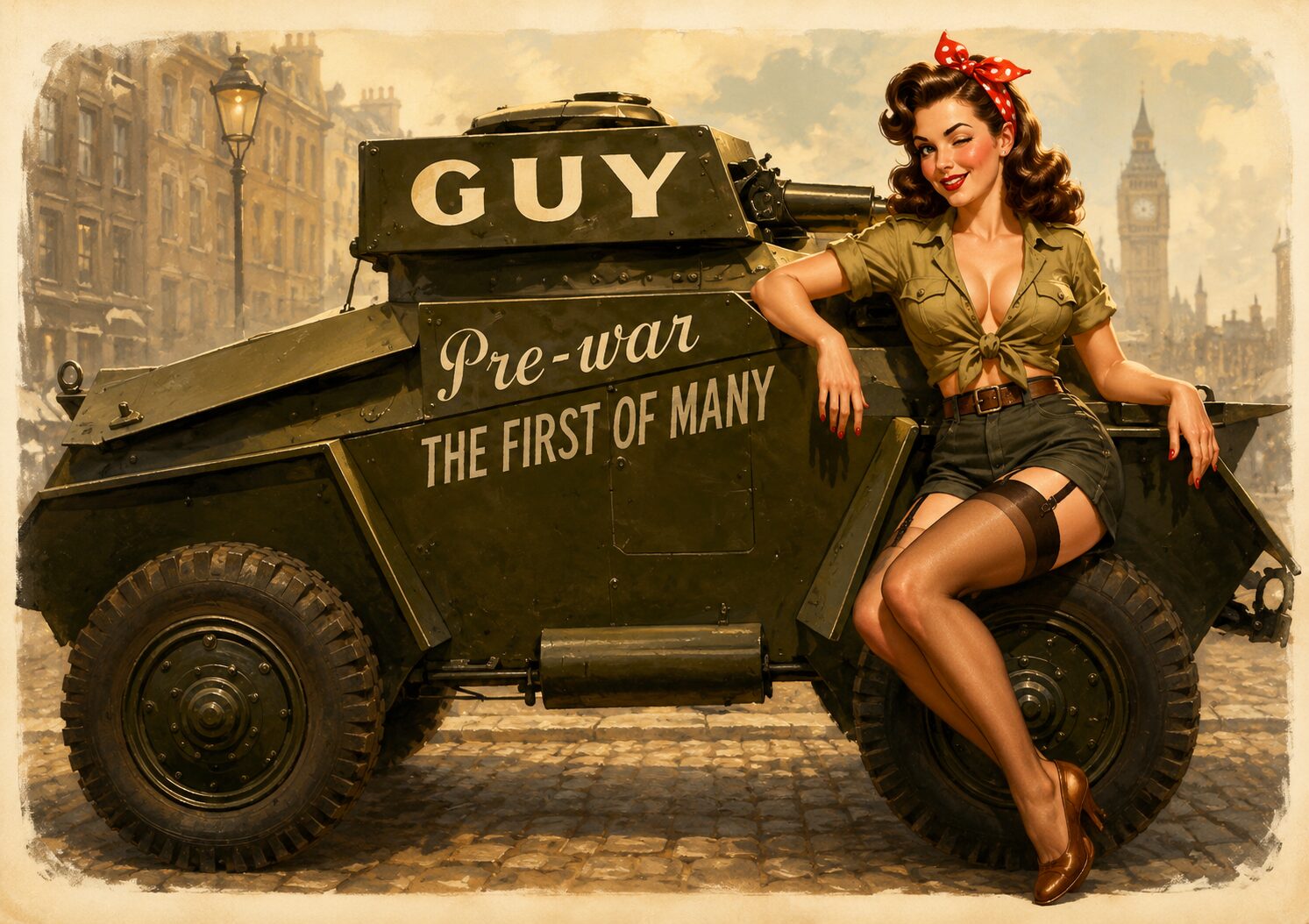
In the history of armored warfare, the most influential vehicles were not always those produced in the thousands or used throughout an entire conflict. Sometimes a machine could be built in little more than a hundred examples, lose nearly all of those sent into combat within a matter of weeks, and still leave behind an important legacy.
That was the fate of the British Guy Armoured Car.
Developed on the eve of the Second World War, the vehicle saw very little front-line service. Only a handful were sent to France, while most of the remainder served in training and home-defense units. Yet the Guy became the first serially produced British armored car with a fully welded hull and, in practical terms, the technological predecessor of the much more numerous Humber Armoured Car.
It was a distinctly British wartime story: the design appeared at the right moment, was reasonably successful, but the company behind it lacked the capacity to manufacture it in the quantities the army required.
Britain Prepares for Another Major War
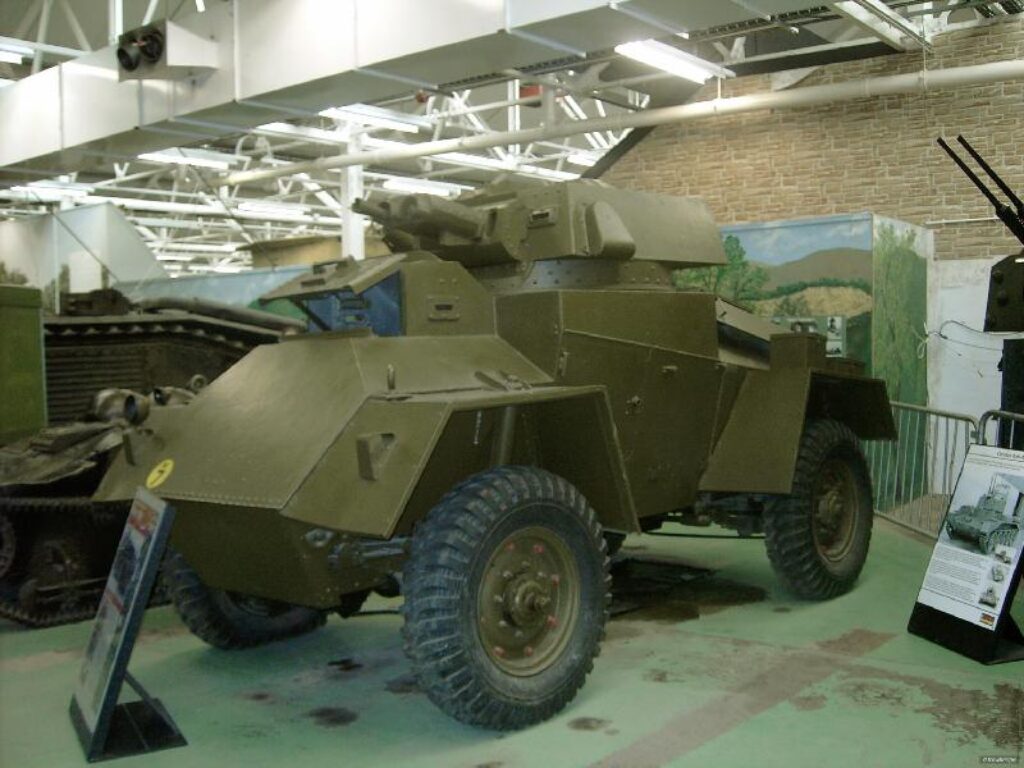
By the late 1930s, the British Army operated a highly varied collection of armored cars. Some had been designed primarily for colonial policing, while others were little more than armored bodies mounted on commercial truck chassis. They were adequate for road patrols and internal-security duties, but far less suitable for a modern European war.
The War Office wanted a new vehicle with four-wheel drive, a fully enclosed armored hull, a rotating turret, and sufficiently powerful machine-gun armament. It was intended for reconnaissance, convoy protection, liaison work, and combat against enemy armored cars.
One of the companies that entered the program was Guy Motors of Wolverhampton. The firm was best known for trucks, buses, and artillery tractors, but by the mid-1930s it had become increasingly involved in military vehicle production.
The new armored car was based largely on components from the company’s own Guy Quad Ant 4×4 artillery tractor. This reduced development time and allowed engineers to rely on already proven automotive units.
The first prototypes, built from mild steel, appeared in 1938. Trials showed that the design was fundamentally sound, even if it was not the most technically sophisticated contender. Its main advantage was readiness for production: the chassis was familiar to the factory, the major systems had already been tested, and the army needed new armored vehicles as quickly as possible.
Not Quite a Car, Not Yet a Tank
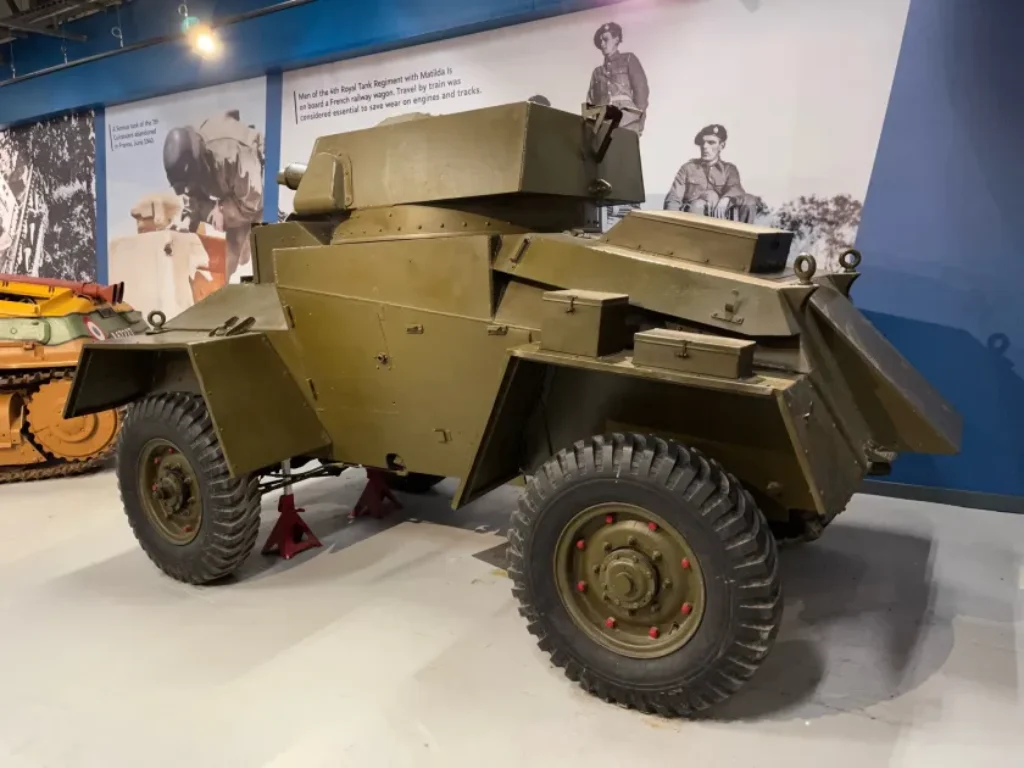
The vehicle initially received the rather curious designation Tank, Light, Wheeled Mark I.
From a modern perspective, the name seems unusual, but it reflected the uncertainty of British armored doctrine at the time. The distinction between a heavy reconnaissance car and a light tank was still not entirely clear. A wheeled vehicle with a closed turret, armor, and a heavy machine gun could plausibly be regarded as a kind of wheeled light tank.
With a combat weight of just over five tonnes, four-wheel drive, a three-man crew, and turret armament comparable to that of early Light Tank Mk VI variants, the Guy certainly occupied a space between categories.
Structurally, however, it remained an armored car. Its wheels gave it good road speed and range, but its cross-country performance and obstacle-climbing ability were inferior to those of tracked vehicles.
The Guy was not designed to break through fortified positions or engage enemy tanks head-on. Its intended role was reconnaissance, fire support for forward units, and combat against lightly armored vehicles.
Britain’s First Fully Welded Armored Car
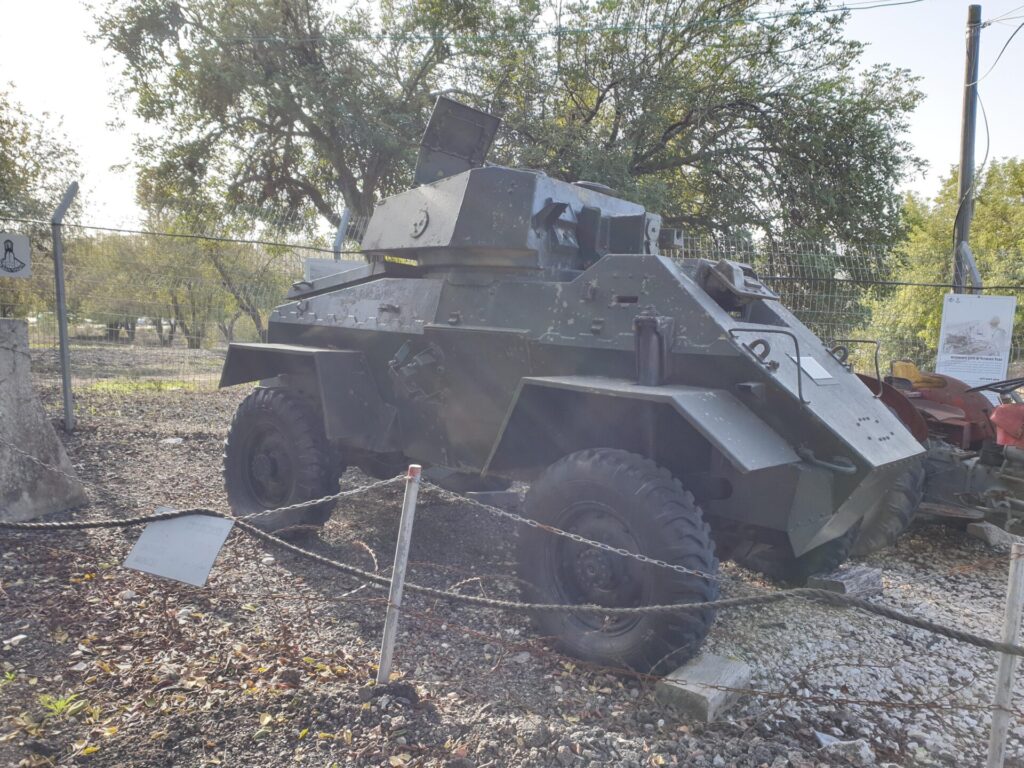
The Guy’s most important feature was not its armament or even its 4×4 chassis, but the way its hull was constructed.
British armored vehicle production in the 1930s still relied heavily on riveted construction. Armor plates were attached to an internal frame using rivets and bolts. The method was familiar and industrially convenient, but it had serious disadvantages.
Riveted vehicles tended to be heavier, and when struck by shells or heavy bullets, rivet heads could break loose inside the fighting compartment and become dangerous secondary projectiles.
Guy Motors proposed welding the armor plates instead.
The War Office initially treated the idea with caution. The company had to prove that a welded armored hull could be produced quickly, economically, and to a consistent standard. To facilitate assembly, Guy developed rotating fixtures that gave welders easier access to different sections of the hull and turret.
The result was successful. The Guy became the first British production armored car with both a fully welded hull and turret.
Its body was assembled from rolled armor plate up to approximately 14–15 mm thick. Many of the plates were sloped, improving the chance of deflection and increasing effective protection.
For the late 1930s, this was considered adequate. The armor could stop ordinary rifle bullets and shell fragments, but it offered little protection against anti-tank rifles, automatic cannon, or field artillery.
Armament: From Vickers to the 15 mm BESA
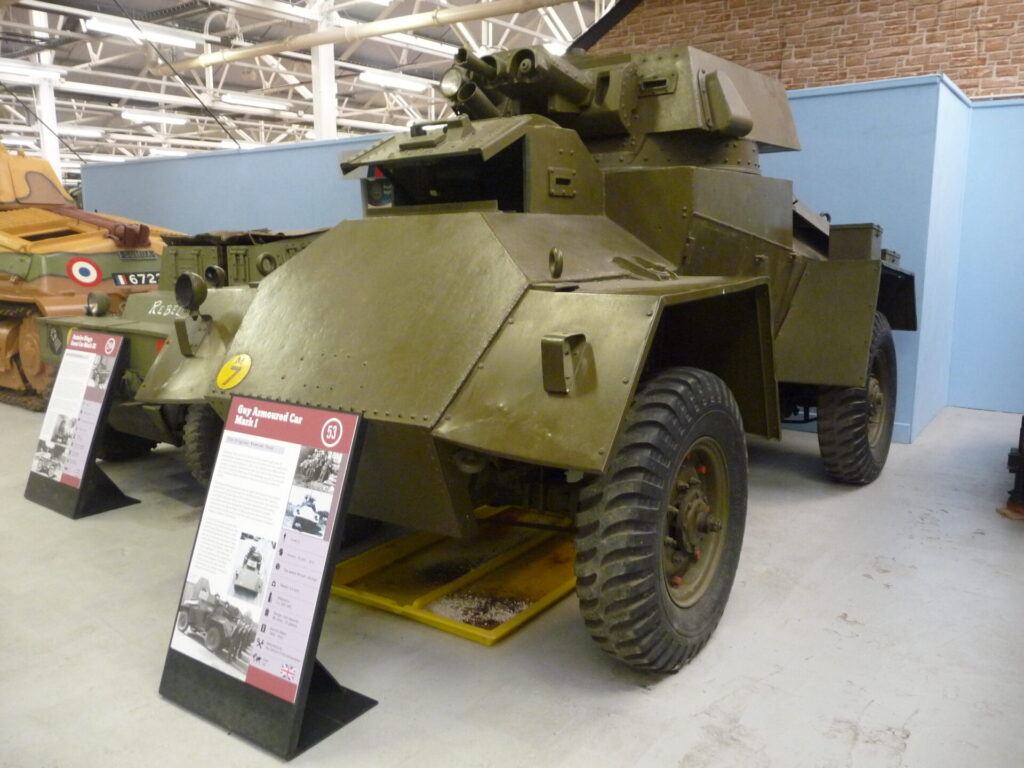
The Guy’s armament is sometimes described incorrectly because there were two distinct production versions.
The first 50 vehicles, designated Guy Mk I, carried two Vickers machine guns:
- a 12.7 mm Vickers heavy machine gun;
- a coaxial 7.7 mm Vickers machine gun.
The remaining 51 vehicles were built as Guy Mk IA and received a more modern pair:
- a 15 mm BESA heavy machine gun;
- a coaxial 7.92 mm BESA machine gun.
This means it is not entirely accurate to say that all Guy armored cars first carried the 12.7 mm Vickers and were later rearmed. In reality, the two armament combinations corresponded to separate production variants: 50 Mk I vehicles with Vickers weapons and 51 Mk IA vehicles with BESA machine guns.
The 15 mm BESA was particularly interesting. Based on the Czechoslovak ZB-60, it was a powerful weapon for its era and could engage unarmored vehicles, machine-gun positions, light armored cars, and some early tanks protected only by thin armor.
Even so, it could not turn the Guy into a true tank destroyer. While 15 mm ammunition posed a threat to the sides or rear of some lightly protected vehicles, it was inadequate against most German medium tanks.
The crew consisted of three men: driver, commander, and gunner. This was a more sensible arrangement than that found in many early light tanks, where the commander was also expected to aim, load, fire, and observe the battlefield.
A Reliable Chassis, but a Modest Engine
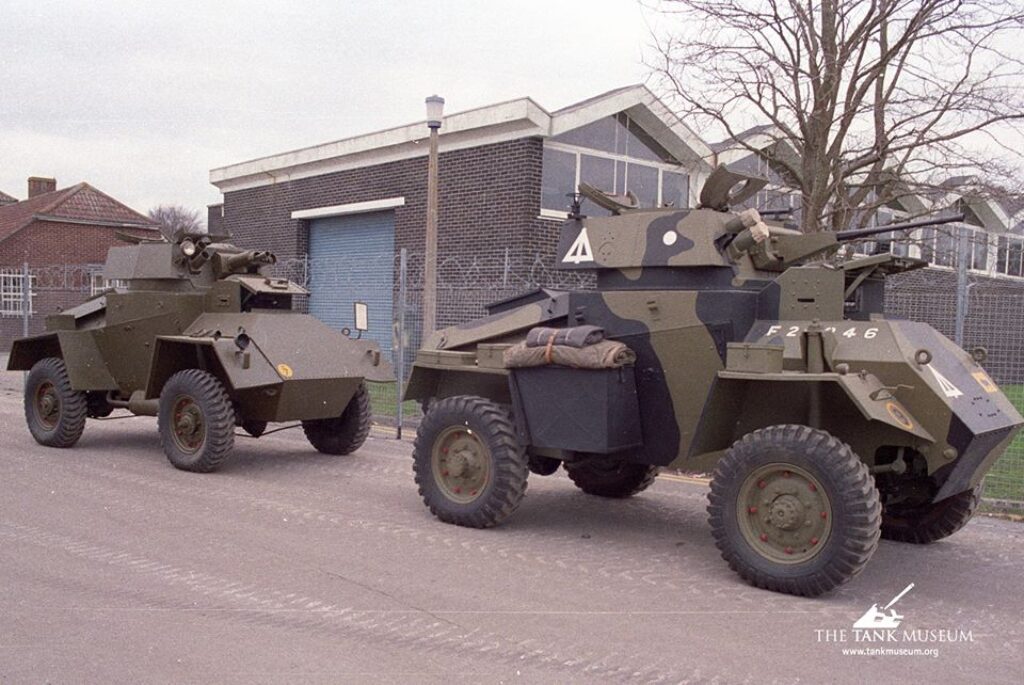
The vehicle was powered by a four-cylinder Meadows 4ELA gasoline engine producing around 55 horsepower.
For a machine weighing approximately 5.2–5.3 tonnes, that was not especially powerful. The power-to-weight ratio was only a little over 10 hp per tonne, so the Guy was hardly a lively performer.
Nevertheless, on a good road it could reach about 64 km/h, while its operational range was approximately 340 km. For a reconnaissance vehicle of the late 1930s, these were respectable figures.
The transmission and much of the running gear came from the artillery tractor. Four-wheel drive provided reasonable off-road mobility, although the vehicle’s performance on difficult terrain should not be exaggerated.
Its suspension used semi-elliptic leaf springs. This was simple and reliable, but did not provide a particularly comfortable ride. Over rough ground, the crew was subjected to severe shaking, and speed had to be reduced substantially.
On the other hand, the army received a vehicle built around comparatively simple and familiar mechanical components. It was easier to maintain than more specialized armored machinery.
Why Were Only 101 Built?
The Guy Armoured Car became a victim of its manufacturer’s limited production capacity.
Guy Motors had already received major contracts for artillery tractors and other military vehicles. It could not simultaneously mass-produce armored cars on the scale required by the War Office.
As a result, the design was transferred to the Rootes Group, which adapted it to the Karrier KT4 artillery tractor chassis. This led to the development of the Humber Armoured Car, a vehicle that looked and functioned very much like the Guy but was better suited to large-scale production.
Only 101 Guy armored cars were completed, while approximately 5,400 Humbers of various marks were later built. The Humber served in North Africa, Europe, and Asia and became one of the most common British armored cars of the Second World War.
The Guy should therefore not be regarded simply as a failed dead end. It was an intermediate design whose major features paved the way for a much more successful family of vehicles.
Six Armored Cars Against the Wehrmacht
The Guy’s combat career was extremely short.
Only six vehicles were sent to France with the British Expeditionary Force. They were used by reconnaissance units during the German offensive in the spring of 1940.
All six were lost during the British retreat. Some may have been destroyed in combat, while others were likely abandoned because of mechanical failure, fuel shortages, or the inability to evacuate them. The exact fate of each vehicle remains unclear, but none of the six returned to Britain.
That effectively ended the Guy’s front-line career in British service.
The remaining vehicles were used for crew training, protection of important sites, and anti-invasion defense in the United Kingdom. By 1943, most had been replaced by more modern armored cars.
There are also reports that a small number were issued to Belgian, Danish, and Dutch units formed in Britain, but the vehicle never entered large-scale service outside the British Army.
Armored Cars for the Royal Family
The most unusual chapter in the Guy’s history had nothing to do with combat.
After the evacuation from Dunkirk in the summer of 1940, the British government seriously considered the possibility of a German invasion. Emergency plans were drawn up for the evacuation of King George VI, Queen Elizabeth, and their daughters, Princesses Elizabeth and Margaret.
As part of the so-called Coats Mission, four Guy Armoured Cars were prepared for the evacuation of the princesses. Their turret weapons were removed, and additional seating was installed inside the former fighting compartment.
The vehicles were intended to move members of the Royal Family to a safe area or to a further evacuation point if Britain were invaded. In the end, the plan was never needed. Germany did not land on the British Isles, and the converted Guys remained unusual armored royal transport vehicles prepared for an extreme emergency.
Some accounts claim that individual vehicles were assigned to specific members of the Royal Family, but it is safer to say only that four armored cars were included in the evacuation plan, since details vary between sources.
Guy Mk I: Main Specifications
- Crew: 3
- Combat weight: approximately 5.2–5.3 tonnes
- Length: about 4.1 m
- Width: about 2.1 m
- Height: about 2.3 m
- Armor: up to 14–15 mm
- Engine: Meadows 4ELA, four-cylinder gasoline engine
- Power: 55 hp
- Drive: 4×4
- Maximum road speed: about 64 km/h
- Range: approximately 340 km
- Mk I armament: 12.7 mm and 7.7 mm Vickers machine guns
- Mk IA armament: 15 mm and 7.92 mm BESA machine guns
- Production: 101 vehicles — 50 Mk I and 51 Mk IA
A Vehicle More Important Than Its Combat Record
The Guy Armoured Car was not an outstanding fighting vehicle. Its engine was underpowered, its suspension was harsh, its armor protected only against small-arms fire, and its entire confirmed front-line career amounted to six vehicles lost in France.
But judging it only by battlefield success would miss its real importance.
The Guy marked one of the first steps in Britain’s transition from prewar riveted armored cars to more advanced welded construction. It demonstrated that a fully welded armored hull could be produced reliably and in series. Its overall layout and engineering approach also helped shape the Humber Armoured Car, which would go on to serve throughout the Second World War in much greater numbers.
That creates an interesting paradox: the Guy itself barely fought, but its design effectively continued the war under another name.
In the history of British armored vehicles, it remains a rare example of a predecessor that was imperfect, short-lived, and built in small numbers, yet still opened the way for a far more successful successor.